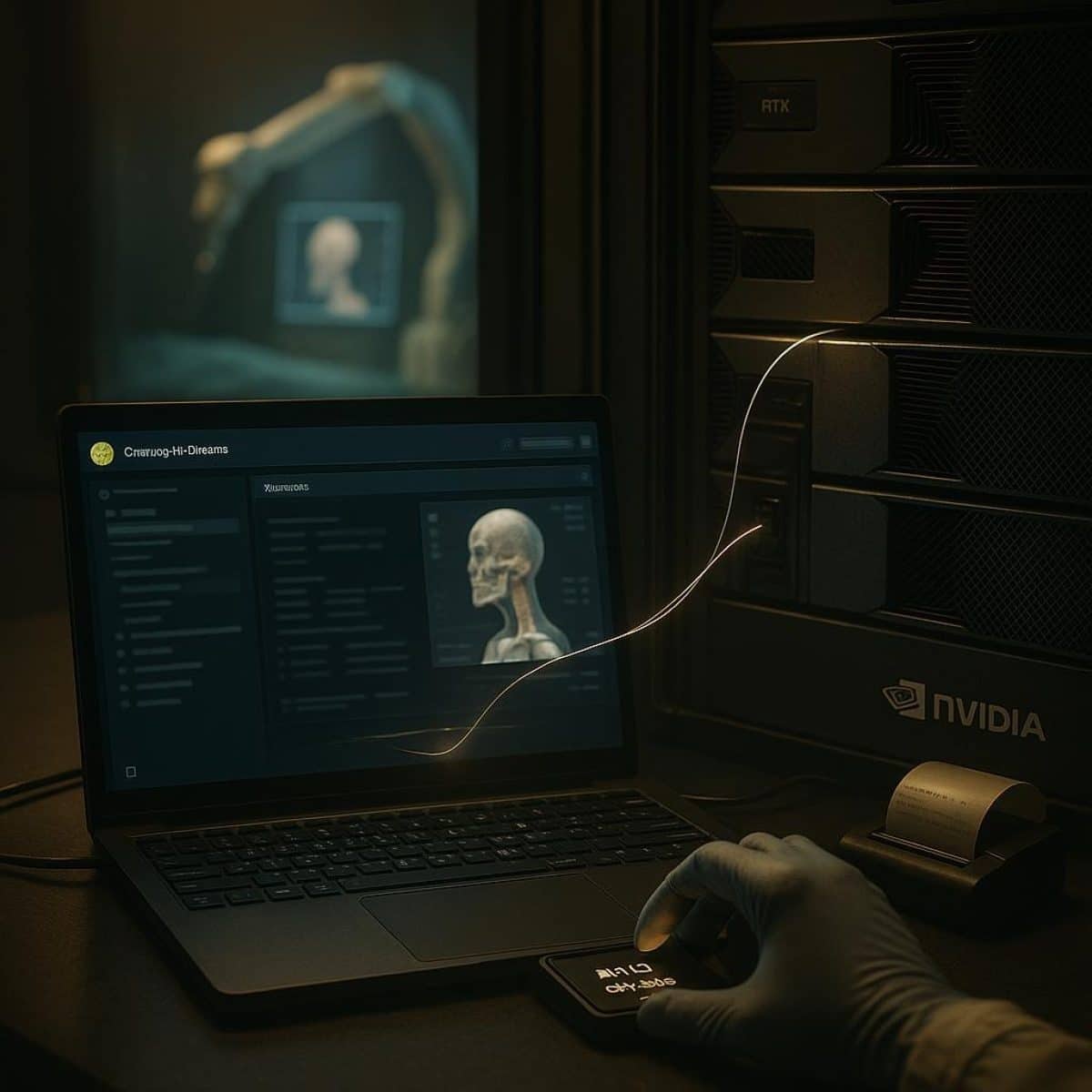
NVIDIA and Hugging Face today announced Cosmos-H-Dreams, a stack that stitches generative models, high-performance GPU rendering and robotics simulation into a platform able to run real-time generative simulations for surgical robots, according to a Hugging Face blog post. The signal is practical: simulation that used to be slow and offline is getting close to the latency and richness needed for closed-loop, interactive robotics testing.
The real issue
The dominant interpretation isn’t novelty; it’s commercial proof. If simulation becomes fast, varied and cheap enough to run in closed-loop, teams can iterate surgical-robot behavior far more quickly and at lower cost. That increases the chance AI-driven workflows move from lab pilots to paid validation and deployment work.
But faster sim does not equal validated safety. The core investor question is whether cheaper, higher-fidelity simulation actually leads to measurable business outcomes – shorter validation cycles, fewer physical trials, or lower product development costs. If teams can’t map sim metrics to clinical or regulatory endpoints, the technical improvement remains a demo rather than revenue.
This shift also reframes where value sits: platform providers that deliver low-latency stacks and hospital partners that accept simulation-based evidence capture much of the upside. Smaller labs or vendors without access to large GPU fleets could fall behind unless they rely on cloud partners or third-party evaluation services.
For readers tracking technical lineage, this move depends on GPU rendering and runtime improvements across the stack – not just model quality. That is a platform story as much as a modeling story, tying into broader debates about cloud and hardware choices in AI Infrastructure.
Why this matters now
Three forces have converged: faster GPUs and runtimes, generative models that can produce diverse patient anatomies and scenes, and commercial pressure in healthcare to cut validation time. Cosmos-H-Dreams stitches those pieces into an accessible developer surface, which shortens the time between a simulation idea and a repeatable test.
Two practical implications follow. First, product and validation teams must start treating simulation outputs as measurable inputs to business decisions – for example, showing how simulated trial runs reduce bench and cadaver testing hours. Second, capital and hiring will follow teams that can connect simulation work to demonstrable cost or time savings, not teams that only showcase impressive visuals.
Contextual work on physical AI also matters; engineers and decision makers should review prior platform experiments in Robotics to see how rendering and latency changes affect test fidelity.
What to watch next
Watch those signals closely: if simulation starts shortening certification timelines, capital will move from general AI narratives into companies that can show real revenue per test.