Introduction: Why AI Video Became the Dominant Content Format
Video has become the primary language of the internet.
Across YouTube, TikTok, Instagram, LinkedIn, streaming platforms, ecommerce stores, and search results, video consistently outperforms text and static images when it comes to capturing attention, explaining complex ideas, and driving engagement. For businesses, creators, educators, and marketers, video is no longer a supplementary content format—it has become the default way people consume information online.
The challenge has traditionally been production.
Creating professional video content required cameras, lighting equipment, editing software, specialized skills, and significant amounts of time. Even short-form content often demanded hours of scripting, recording, editing, and revision. For many organizations, the cost and complexity of production limited how much video content could realistically be created and distributed.
Artificial intelligence is changing that equation.
Modern AI video creation tools can generate video from simple text prompts, animate static images, simulate realistic camera movements, edit footage through natural language instructions, and produce professional visual assets without traditional production workflows. Tasks that once took days or weeks can now be completed in minutes.
The significance of this shift extends far beyond efficiency.
AI video generation is transforming how organizations approach content production itself. Instead of treating video as a resource-intensive project, businesses increasingly integrate AI-generated video directly into marketing campaigns, product launches, educational programs, internal training systems, social media operations, and customer communication strategies.
As generation quality continues to improve, competitive advantage is moving away from production capability and toward creativity, storytelling, distribution, and speed of execution.
Yet despite the rapid growth of AI video platforms, much of the online advice remains focused on feature lists, product announcements, or endless tool roundups. Professionals rarely ask which platform has the longest list of capabilities. They want to know which tools consistently produce usable results in real-world workflows.
That is the purpose of this guide.
Rather than chasing hype, this article examines how AI video creation actually works, which platforms are worth using in 2026, how modern video generation workflows are structured, where the technology still struggles, and how businesses can integrate AI video into scalable content operations.
Whether you are a creator looking to accelerate production, a marketer building high-volume content pipelines, or a business evaluating the future of digital communication, understanding AI video creation is rapidly becoming a competitive necessity rather than an optional skill.
If you are new to the broader AI ecosystem, start with our AI Tools Hub for an overview of modern AI software categories. For a deeper understanding of how text, images, audio, and video are increasingly combined into unified systems, explore our guide to Multimodal AI. You can also learn how different categories fit together inside modern workflows in our AI Workflow Guide.
AI video creation is no longer about replacing cameras or editors. It is about removing friction from the production process and making high-quality video creation accessible, scalable, and dramatically faster than traditional workflows.
In the sections that follow, we will break down how AI video models work, compare the leading platforms available today, examine real-world use cases, and show how organizations are using AI video generation to transform content production in 2026.
What Are AI Video Creation Tools?
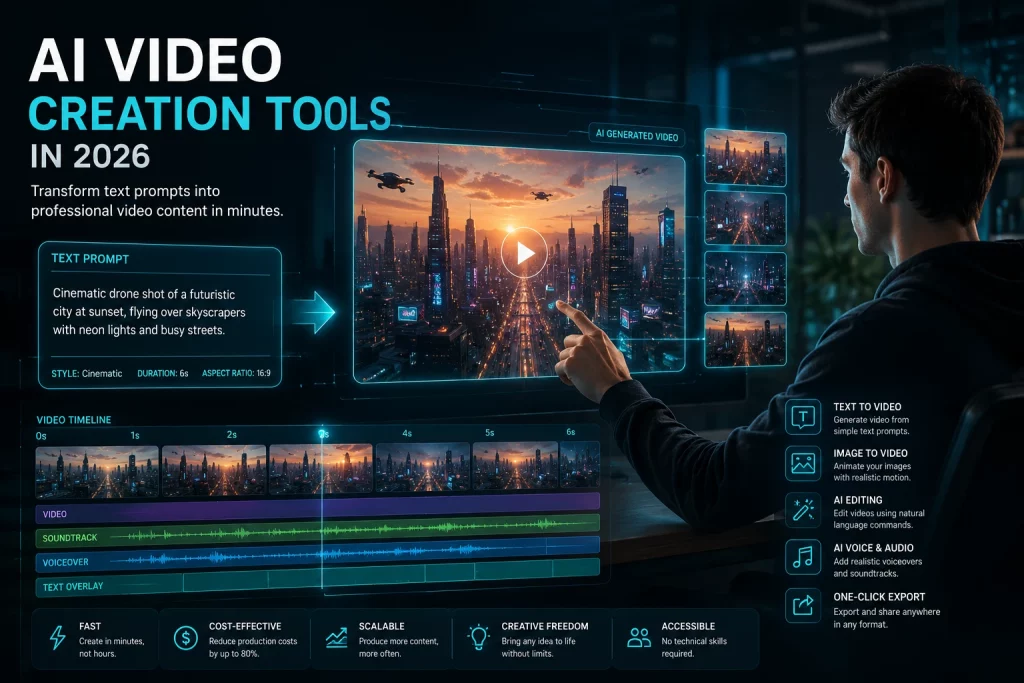
AI video creation tools are software systems that use artificial intelligence to generate, edit, enhance, or transform video content. Instead of relying entirely on cameras, actors, editing timelines, and traditional production workflows, users can create videos through natural language prompts, images, reference footage, or a combination of multiple media inputs.
In practical terms, AI video tools reduce the amount of manual work required to produce professional-quality video. A creator can describe a scene in plain language, upload a product image, provide a script, or specify a desired visual style, and the AI generates video content that would previously require hours—or even days—of production effort.
This shift is transforming content creation across industries. Marketing teams use AI video to scale campaigns, educators create visual learning materials faster, ecommerce brands generate product demonstrations automatically, and creators produce social content without traditional production equipment.
At its core, AI video creation is about turning ideas into motion using software rather than traditional production resources.
If you are new to the broader AI ecosystem, our AI Tools Hub explains how video generation fits alongside image generation, AI writing tools, AI voice platforms, and workflow automation systems.
Text-to-Video Generation Explained
Text-to-video systems allow users to generate video content directly from written prompts.
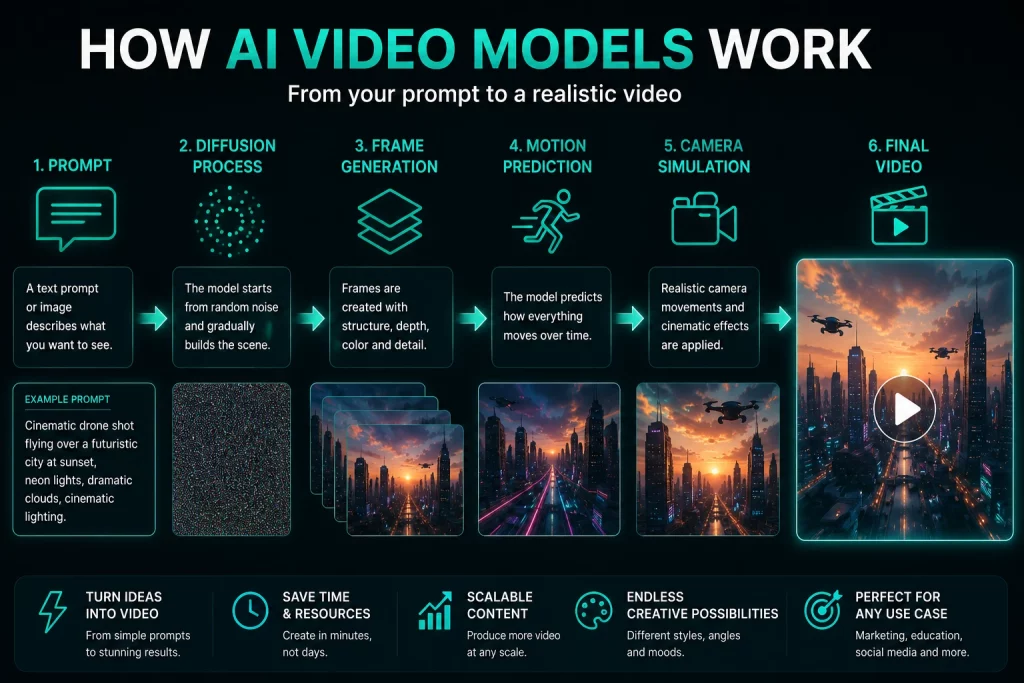
Instead of filming a scene, you simply describe what you want to see. The AI interprets the prompt, understands the requested environment, subjects, motion, lighting, camera behavior, and visual style, then generates a sequence of frames that become a video clip.
For example, a prompt such as:
“A cinematic drone shot flying over a futuristic city at sunset, neon reflections, dramatic lighting, slow camera movement.”
can be transformed into a realistic animated video without a camera ever being used.
Leading platforms such as OpenAI Sora, Runway, and Pika use advanced generative models to convert language into visual motion, making text-to-video one of the fastest-growing categories within generative AI.
To better understand the technology behind these systems, see our guide on What Is Generative AI?.
Image-to-Video Generation Explained
Image-to-video systems begin with an existing visual rather than a text prompt.
Users can upload:
- product photos
- illustrations
- logos
- concept art
- character designs
- marketing visuals
The AI then predicts realistic motion, camera movement, depth, and scene evolution to transform the static image into an animated sequence.
This capability has become particularly valuable for ecommerce businesses, designers, and marketing teams that want to create engaging video content without arranging new photoshoots or video productions.
Many organizations combine image generation and video generation workflows. Learn more in our guide to AI Image Tools.
Multimodal Video Systems: The Next Evolution
Modern AI video creation tools increasingly rely on multimodal AI systems.
Rather than processing only text or only images, multimodal models can understand and combine multiple forms of information simultaneously, including:
- text prompts
- images
- audio
- motion patterns
- camera instructions
- scene composition
- visual references
This allows creators to control video generation at a much deeper level. A single workflow might begin with a written script, use AI-generated images as visual references, add AI voice narration, and finish with AI-generated video sequences that combine all of those inputs.
Multimodal systems are rapidly becoming the foundation of next-generation content creation. For a deeper explanation, read our comprehensive guide to Multimodal AI.
Why AI Video Creation Matters
The importance of AI video generation extends beyond content creation efficiency.
Historically, video production was constrained by time, cost, and specialized expertise. AI dramatically reduces those barriers, allowing individuals and organizations to create more content, experiment faster, and scale distribution across multiple channels.
As video becomes the dominant format for communication, marketing, education, and digital engagement, organizations that successfully integrate AI video into their workflows gain a significant advantage in production speed and content scalability.
Increasingly, the question is no longer whether AI video tools can produce usable content. The more important question is how businesses can incorporate these systems into repeatable workflows that support long-term growth.
AI video tools are not replacing creativity. They are reducing production friction, allowing creators and organizations to spend more time on storytelling, strategy, and distribution.
Next, we will examine how AI video models actually work under the hood, including diffusion models, motion prediction, camera simulation, and the technologies responsible for transforming simple prompts into realistic video.
Benefits of AI Video Creation
AI video creation is often presented as a creative breakthrough, but its most significant impact is operational. The real value does not come from the ability to generate video itself. It comes from the ability to produce more content, more consistently, and at a scale that traditional production methods struggle to match.
As video becomes the dominant format across marketing, education, ecommerce, customer support, and internal communication, organizations are increasingly discovering that production capacity can become a competitive constraint. AI changes that equation by reducing the time, cost, and complexity required to move from an idea to a finished video asset.
The most important benefit of AI video generation is not automation. It is scalability.
Organizations that successfully integrate AI video into their workflows can significantly increase output without proportionally increasing budgets, staffing requirements, or production timelines. This shift is transforming how content teams think about growth, experimentation, and distribution.
Faster Production Cycles and Shorter Feedback Loops
Traditional video production is often a multi-stage process involving planning, scripting, filming, editing, review cycles, and distribution. Even relatively simple projects can require days or weeks before they are ready for publication.
AI dramatically compresses that timeline. Marketing teams can create product demonstrations within hours rather than days. Educators can transform written lessons into visual explainers without arranging filming sessions. Content creators can generate social videos on demand, test multiple concepts, and publish at a pace that would be difficult to sustain through traditional production methods.
The result is not simply faster content creation. It is faster learning. Teams receive feedback sooner, identify what resonates with audiences more quickly, and refine campaigns through shorter optimization cycles. In competitive markets, this speed advantage often becomes more valuable than production quality improvements alone.
For a broader look at how AI fits into modern production systems, see our AI Workflow Guide.
Lower Barriers to Professional Video Production
Historically, producing professional video content required access to equipment, editing software, studio environments, voice talent, and specialized production expertise. These requirements often placed video creation beyond the reach of smaller organizations or limited the amount of content larger organizations could realistically produce.
AI does not eliminate the value of professional production teams, but it reduces dependence on many traditional resources. Businesses can increasingly create product demonstrations, educational content, promotional assets, and social media videos internally without investing in the same level of infrastructure.
This is particularly valuable for startups, ecommerce brands, content creators, and marketing teams that need to maintain a consistent publishing cadence while managing limited resources. As generation quality improves, the economic advantage of AI-assisted production continues to grow.
Scaling Content Across Multiple Channels
One of the most powerful aspects of AI video generation is its ability to transform a single piece of source content into multiple formats. A blog article can become a YouTube explainer, a short-form social clip, a LinkedIn video, an internal training asset, and a product demonstration without requiring separate production workflows for each format.
This ability to repurpose content at scale fundamentally changes how organizations approach content operations. Rather than producing individual assets for individual channels, teams can build systems that continuously adapt and distribute content across multiple platforms.
The organizations seeing the greatest success with AI video are rarely focused on creating a single exceptional video. Instead, they are building repeatable systems capable of generating large volumes of relevant, useful content that reaches audiences wherever they consume information.
This is one of the reasons AI video is increasingly becoming part of broader AI Content Creation workflows.
Creative Experimentation Without Traditional Production Risk
Traditional video production often discourages experimentation because every revision increases cost, consumes time, and requires additional resources. AI changes that dynamic by making iteration inexpensive and accessible.
Teams can explore different visual styles, test multiple story concepts, experiment with alternative messaging, and create numerous creative variations without restarting an entire production process. This encourages a culture of experimentation that is difficult to achieve in conventional production environments.
For marketers, this often translates directly into stronger campaign performance. More experimentation leads to more learning opportunities, which ultimately improves creative effectiveness and audience engagement.
Global Reach Through Localization
Modern AI video systems increasingly integrate with translation models, voice synthesis platforms, and automated captioning tools. As a result, organizations can adapt a single piece of content for multiple languages and regional audiences without rebuilding entire productions from scratch.
This capability is particularly important for international businesses, training organizations, SaaS companies, and educational platforms. Content that once required multiple production teams can now be localized through largely automated workflows.
Combined with modern AI Voice Tools, localization is becoming one of the most compelling business applications of AI video technology.
A Competitive Advantage in the Attention Economy
Ultimately, AI video is not merely a production technology. It is an attention technology.
Organizations compete for visibility across search engines, social platforms, advertising networks, and content ecosystems. Video consistently outperforms most other formats when it comes to engagement, retention, and audience reach.
As AI-generated video quality continues to improve, competitive advantage will increasingly depend on strategy, storytelling, and distribution rather than production resources alone. The organizations that move fastest will not necessarily be those with the largest production budgets, but those capable of consistently creating and distributing valuable content at scale.
AI video creation does not replace creativity. It amplifies the reach of creative ideas by removing production bottlenecks and enabling content to scale far beyond traditional limits.
Of course, AI video generation is not without limitations. Understanding where the technology still struggles is just as important as understanding its benefits. In the next section, we examine the practical challenges, risks, and trade-offs organizations should consider before building AI video workflows at scale.
Limitations and Risks of AI Video Generation
AI video generation has evolved from an experimental technology into a practical production tool. Modern platforms can create impressive visual content in minutes, generate realistic camera movement, and automate tasks that once required entire creative teams. Yet despite the rapid progress, the technology remains far from perfect.
Organizations evaluating AI video tools should understand that the current generation of systems excels at accelerating production, but still struggles with several challenges that affect quality, consistency, governance, and long-term scalability. The most successful teams are not replacing human creativity with AI. Instead, they are combining AI-generated content with editorial oversight, creative direction, and traditional production workflows.
AI video generation is most effective when treated as a creative accelerator rather than a fully autonomous production system.
Character Consistency Still Limits Long-Form Content
One of the most impressive capabilities of modern AI video models is their ability to generate realistic people, environments, and motion from simple prompts. However, maintaining consistency across longer scenes remains one of the industry’s biggest technical challenges.
Short clips often appear remarkably convincing because the model only needs to maintain coherence for a few seconds. As scenes become longer and more complex, subtle inconsistencies begin to emerge. Facial features may shift, clothing details can change between frames, and environmental elements occasionally drift over time.
While platforms such as Sora, Runway, and Luma have made significant progress in this area, long-form storytelling still requires careful review. For brands that rely on recognizable characters, products, or visual identities, maintaining consistency remains one of the primary reasons human editors continue to play a critical role in the production process.
AI Understands Patterns Better Than Reality
Another common misconception is that AI understands the physical world in the same way humans do. In reality, AI video models are highly sophisticated pattern-recognition systems. They learn from enormous amounts of visual data and predict what should happen next, but they do not possess a true understanding of physics, causality, or real-world behavior.
This explains why even advanced systems occasionally generate unrealistic movement, unusual object interactions, or subtle visual artifacts that immediately feel unnatural to human viewers. A hand may move incorrectly, an object may behave in a physically impossible way, or environmental details may shift unexpectedly between frames.
These issues are becoming less frequent as models improve, but they remain an important reminder that AI-generated video should still be reviewed before publication—particularly in professional, educational, or enterprise environments where accuracy matters.
The Quality of the Output Depends on the Quality of the Prompt
AI video tools have lowered the technical barriers to production, but they have not removed the need for creative direction. In many cases, the quality of the final video is directly influenced by the quality of the instructions provided to the model.
Vague prompts often produce generic results. Poorly defined creative direction can lead to inconsistent visuals, weak storytelling, or scenes that fail to communicate the intended message. Conversely, well-structured prompts provide the model with clear guidance regarding subject matter, motion, lighting, composition, style, and emotional tone.
As a result, prompt engineering is becoming an increasingly valuable skill within content creation workflows. The organizations achieving the strongest results are rarely relying on AI alone—they are combining AI capabilities with structured creative processes and strong editorial standards. Our AI Prompt Writing Guide explores these techniques in greater detail.
Brand Control Remains a Strategic Concern
For individual creators, slight variations in style may not be a problem. For organizations, however, brand consistency is often a critical requirement. Companies invest heavily in visual identity systems, design standards, and customer recognition. Maintaining those standards across AI-generated content is not always straightforward.
While AI models can replicate visual styles remarkably well, they may still struggle with exact brand colors, product representation, logo placement, or highly specific creative guidelines. This is one reason many organizations continue to combine AI-generated assets with traditional editing platforms such as Adobe Premiere Pro and After Effects.
In practice, the highest-performing workflows tend to be hybrid workflows, where AI accelerates production and human teams ensure brand alignment before content is published.
Copyright, Licensing, and Governance Continue to Evolve
As AI-generated content becomes more common, questions surrounding ownership, licensing, and intellectual property continue to attract significant attention from regulators, legal experts, and enterprise buyers.
Different AI video providers apply different policies regarding training data, commercial rights, and content ownership. For organizations producing customer-facing content at scale, understanding these policies is often just as important as evaluating generation quality.
The regulatory landscape is also evolving rapidly. New guidance related to AI transparency, disclosure requirements, and copyright protection continues to emerge across multiple jurisdictions. Businesses adopting AI video tools should view governance as an ongoing process rather than a one-time compliance exercise.
For a broader discussion of these developments, see our guides on AI Regulation, AI Ethics, and AI Safety.
The Future Is Human-AI Collaboration
Perhaps the most important takeaway is that AI video generation is not replacing human creativity—it is changing how creative work is performed. The strongest results typically emerge when AI handles repetitive production tasks while humans focus on storytelling, strategy, creative direction, quality control, and distribution.
Organizations that understand this distinction are often the ones extracting the greatest value from AI video systems. Rather than viewing AI as a replacement for existing teams, they use it to remove production bottlenecks, increase content output, and accelerate experimentation.
The future of video production is not AI versus humans. It is AI-assisted creators producing more content, with greater speed, consistency, and creative reach than traditional workflows allow.
Understanding these limitations creates realistic expectations and helps organizations build workflows that maximize the strengths of AI while mitigating its weaknesses. The next step is understanding how leading creators, marketers, and businesses are integrating AI video into repeatable production systems that deliver consistent results at scale.
The AI Video Production Workflow in 2026
The biggest misconception surrounding AI video creation is that users simply enter a prompt and instantly receive a finished production. While modern video generators have become remarkably capable, the highest-quality results rarely come from a single tool or a single prompt.
Instead, successful creators, marketers, and organizations increasingly rely on structured AI-powered workflows that combine multiple tools into a repeatable production process. AI is not replacing the workflow itself—it is accelerating each stage within it.
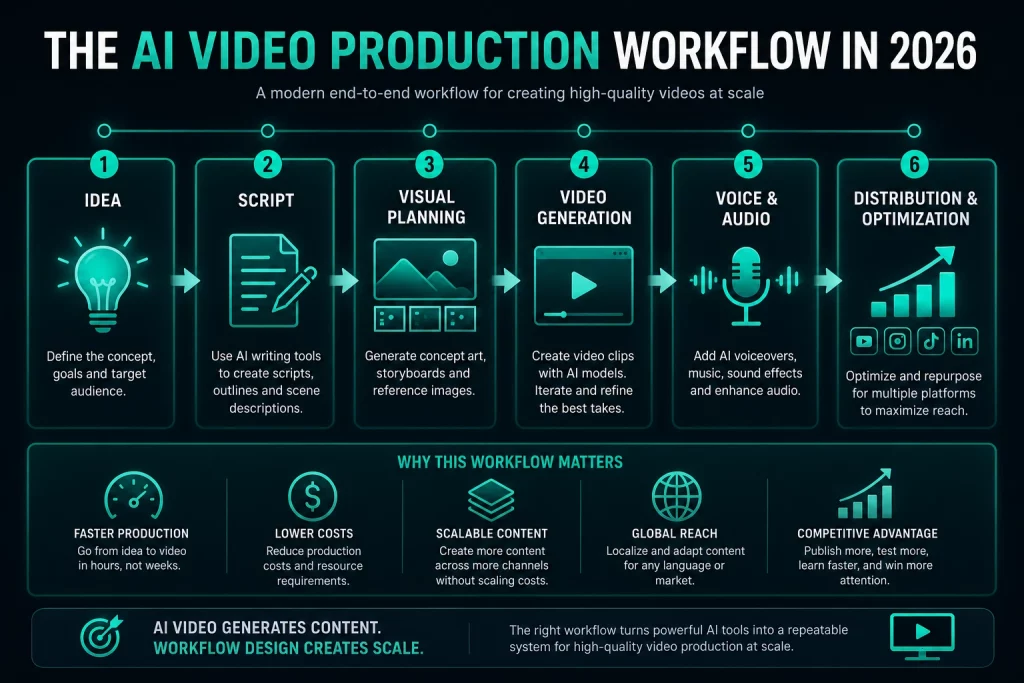
In 2026, the most effective AI video workflows typically move through six stages: ideation, scripting, visual development, video generation, enhancement, and distribution. Understanding how these stages fit together is often more important than choosing a specific video platform.
The best AI video creators are not necessarily using the best tool. They are using the best workflow.
Step 1: From Idea to Script
Every successful video begins with a clear concept. Whether the goal is education, marketing, storytelling, or product promotion, the first stage is defining the message that the audience should take away.
Many creators now use AI writing systems to accelerate this process. Platforms such as ChatGPT and Claude help generate outlines, scripts, video hooks, scene descriptions, and narrative structures. Rather than starting with a blank page, creators can quickly move from an idea to a production-ready script.
This stage is particularly important because AI video models perform best when they receive clear direction. Strong scripts generally produce stronger videos.
For practical prompting techniques, see our AI Prompt Writing Guide.
Step 2: Storyboarding and Visual Planning
Before generating video, many teams create visual references that establish the look and feel of the project. This process helps maintain consistency across scenes and reduces the amount of iteration required later.
AI image generators are increasingly used for storyboarding, concept art, character development, and scene planning. Rather than describing every visual element directly inside a video model, creators can provide reference images that guide the generation process.
This step is particularly valuable for brands that need visual consistency across multiple videos and campaigns.
Learn more in our guide to AI Image Tools.
Step 3: Video Generation
Once the creative direction is established, the workflow moves into video generation. This is the stage most people associate with AI video creation.
Platforms such as Sora, Runway, Pika, and Luma Dream Machine generate motion, camera movement, environments, and visual storytelling from prompts, reference images, or a combination of both.
The goal is rarely to create the final production immediately. Instead, creators generate multiple variations, evaluate the strongest outputs, and refine the results through iteration. This approach consistently produces higher-quality content than relying on a single generation attempt.
As generation quality improves, the distinction between production and post-production is becoming increasingly blurred.
Step 4: Voice, Audio, and Narration
Video alone rarely creates a complete viewing experience. Narration, music, sound effects, and voiceovers play a major role in audience engagement and information retention.
Modern AI voice platforms can generate realistic narration in multiple languages, adapt tone and pacing, and create localized versions of the same content without requiring traditional voice recording sessions.
This dramatically reduces production complexity for educational content, product explainers, training videos, and international marketing campaigns.
See our guide to AI Voice Tools for a deeper look at this rapidly evolving category.
Step 5: Editing and Refinement
Despite major advances in generation quality, human review remains a critical part of the workflow. Teams still evaluate pacing, narrative flow, visual consistency, branding, and overall quality before publishing.
Many organizations combine AI-generated assets with traditional editing platforms such as Adobe Premiere Pro, After Effects, and other professional production tools. This hybrid approach provides the speed advantages of AI while maintaining the quality control expected from professional content.
In practice, some of the most successful AI-generated videos still involve a meaningful amount of human editing and refinement.
Step 6: Distribution and Optimization
The final stage is distribution. Once a video is complete, it can be adapted and optimized for different platforms, audiences, and business objectives.
A single video may generate a YouTube version, multiple short-form clips for TikTok and Instagram Reels, LinkedIn content, embedded website assets, customer education materials, and paid advertising creatives. AI makes this repurposing process dramatically more efficient than traditional workflows.
The organizations achieving the highest return on investment are often those that focus not only on creation, but also on systematic distribution and content reuse.
AI video generation creates content. Workflow design creates scale.
Understanding this workflow helps explain why AI video is becoming a core component of modern content operations. The next step is evaluating the platforms themselves and understanding which AI video tools currently deliver the strongest results in real-world production environments.
Leading AI Video Creation Tools in 2026
The AI video market has matured rapidly. While dozens of platforms now offer some form of text-to-video or image-to-video generation, only a small group consistently delivers results suitable for professional workflows.
The difference between platforms is no longer simply image quality. Most leading systems can generate visually impressive scenes. The real differentiators are motion realism, character consistency, editing flexibility, workflow integration, and the ability to produce content reliably at scale.
Rather than asking which AI video tool is objectively the best, a more useful question is which platform is best suited to a specific workflow, audience, or production goal.
The strongest AI video platform is usually the one that fits your workflow, not necessarily the one with the most advanced model.
OpenAI Sora: Setting the Benchmark for Realism
Sora has become one of the most influential developments in AI video generation because it demonstrated that long-form, coherent video generation is possible at a quality level previously considered unrealistic.
What differentiates Sora is not simply visual quality, but its ability to maintain scene coherence, realistic motion, and cinematic camera behavior over longer sequences. Many earlier systems could create impressive clips lasting a few seconds. Sora pushed the industry toward more sophisticated storytelling and more realistic environmental simulation.
For creators focused on cinematic content, concept development, narrative storytelling, and high-end visual production, Sora represents one of the most capable systems currently available. Its influence extends beyond its own platform, as many competing vendors are now pursuing similar levels of realism and consistency.
Runway: The Professional Creator Platform
Runway occupies a unique position within the market because it combines video generation with practical production workflows. While some platforms focus primarily on generation quality, Runway has invested heavily in editing capabilities, workflow management, and creator-focused tooling.
This makes it particularly attractive for agencies, content creators, production teams, and marketing departments that need more than a simple text-to-video generator. The platform increasingly functions as a complete AI-assisted production environment rather than a standalone generation tool.
For many professional users, workflow efficiency is ultimately more important than marginal improvements in visual quality. This is where Runway continues to maintain a strong competitive position.
Pika: Built for Social-First Content
Pika has gained significant traction by focusing on speed, accessibility, and content formats that align with modern social media platforms.
Rather than competing directly for long-form cinematic production, Pika excels in short-form content, animated social assets, creative experiments, and visually engaging clips designed for platforms such as TikTok, Instagram Reels, and YouTube Shorts.
This positioning makes Pika particularly attractive for creators who prioritize publishing velocity and audience engagement over complex narrative production.
As short-form video continues to dominate digital attention, platforms optimized for rapid content creation are likely to remain highly relevant.
Luma Dream Machine: Motion and Visual Fluidity
Luma has established itself as one of the strongest platforms for generating visually fluid motion and natural-looking camera movement.
Many creators choose Luma because its outputs often feel less synthetic than traditional AI-generated footage. Smooth transitions, realistic environmental movement, and strong visual depth contribute to a cinematic quality that performs particularly well in product showcases, lifestyle content, and atmospheric storytelling.
For creators prioritizing aesthetics and motion quality, Luma continues to be one of the most compelling options available.
Adobe Firefly Video: Enterprise Integration Matters
Adobe approaches AI video generation from a different perspective than many newer entrants. Rather than building a standalone creative platform, Adobe focuses on integrating generative AI directly into established creative workflows.
For enterprise teams already using Premiere Pro, After Effects, Creative Cloud, and Adobe’s broader ecosystem, Firefly offers a natural path toward AI-assisted production without requiring an entirely new workflow.
This integration-focused strategy is particularly appealing for larger organizations that value governance, licensing clarity, and workflow continuity alongside generation capabilities.
Stability Video Diffusion: Flexibility and Open Innovation
While most commercial platforms focus on ease of use, Stability Video Diffusion appeals to developers, researchers, and organizations seeking greater control over the generation process.
The open-source nature of the project allows users to experiment, customize workflows, and integrate video generation into broader systems. Although it may require more technical expertise than commercial platforms, it offers a level of flexibility that proprietary systems cannot always match.
For organizations focused on research, experimentation, privacy, or custom implementations, open-source video models continue to play an important role within the broader AI ecosystem.
A Market Defined by Workflows Rather Than Features
As the technology matures, the conversation is shifting away from feature comparisons and toward workflow integration. Most leading platforms can generate impressive video. The more important question is how effectively they fit into existing production systems.
Some organizations prioritize realism. Others prioritize speed, workflow efficiency, editing capabilities, enterprise governance, or customization. There is no universally correct choice because different tools solve different production challenges.
The next step is understanding how to choose the right AI video platform based on specific use cases, budgets, and content objectives rather than marketing claims or headline features.
How to Choose the Right AI Video Tool
The rapid growth of AI video platforms has created a new challenge for creators and organizations: choosing the right tool.
Most leading platforms are now capable of generating impressive visual content. As a result, selecting an AI video tool is no longer simply a question of output quality. The more important consideration is how well a platform aligns with your workflow, content goals, team structure, and production requirements.
Many users make the mistake of searching for the single “best” AI video generator. In practice, there is no universal winner. A platform optimized for cinematic storytelling may be poorly suited for high-volume social content, while a tool designed for enterprise workflows may be unnecessarily complex for independent creators.
The best AI video tool is the one that removes the biggest bottleneck in your workflow.
Rather than focusing on marketing claims or feature checklists, it is often more useful to start with the type of content you need to produce.
| Primary Goal | Recommended Platform | Why It Fits |
|---|---|---|
| Cinematic storytelling | Sora | Strong realism, scene coherence, and narrative potential |
| Professional creator workflows | Runway | Combines generation, editing, and production tools |
| Short-form social content | Pika | Optimized for speed, experimentation, and publishing frequency |
| Visual product showcases | Luma | Excellent motion quality and natural camera movement |
| Enterprise production | Adobe Firefly | Strong integration with existing creative workflows |
| Research and customization | Stability Video Diffusion | Open-source flexibility and developer control |
Choose Based on Workflow, Not Features
Feature comparisons can be misleading because most platforms are rapidly adding similar capabilities. Text-to-video generation, image-to-video generation, editing tools, and AI-assisted effects are becoming standard across the industry.
The more meaningful question is how a platform fits into your existing production process. A marketing team producing hundreds of social assets per month has very different requirements than a filmmaker creating concept scenes or an enterprise team managing global content operations.
Organizations that focus on workflow compatibility typically achieve better results than those chasing the newest model release.
Consider Your Content Volume
Content volume is often overlooked when evaluating AI video platforms.
If your goal is to create occasional high-quality videos, realism and visual quality may be the primary selection criteria. However, if your organization plans to produce content at scale, factors such as workflow efficiency, generation speed, editing flexibility, and team collaboration become increasingly important.
In many cases, the platform that produces the absolute best video is not necessarily the platform that delivers the highest overall return on investment.
Think Beyond Video Generation
Video generation is only one stage of the production process. Scripting, visual planning, voice generation, editing, localization, and distribution all influence the final outcome.
Many organizations achieve the strongest results by combining multiple specialized tools rather than relying on a single platform. For example, a workflow might begin with AI-assisted script creation, continue through image generation and video production, and finish with AI voiceovers and traditional editing software.
This integrated approach often produces more professional results than attempting to handle every stage inside a single application.
To understand how these systems work together, explore our guides on AI Content Creation Tools, AI Image Tools, and AI Voice Tools.
The Market Is Still Evolving Rapidly
The AI video landscape is evolving faster than almost any other category within artificial intelligence. New models are released regularly, capabilities improve rapidly, and the gap between platforms continues to narrow.
For this reason, organizations should avoid treating platform selection as a permanent decision. The most successful teams continuously evaluate new tools, test emerging capabilities, and adapt their workflows as the market evolves.
The winners in AI video will not be the organizations using a single perfect tool. They will be the organizations that adapt their workflows fastest as the technology improves.
Choosing the right platform is only part of the equation. The next question is whether the investment makes financial sense. Understanding pricing structures, subscription models, and production economics is essential before scaling AI video across an organization.
How Much Do AI Video Tools Cost?
One of the most common questions surrounding AI video generation is whether the technology actually saves money. The answer depends less on subscription pricing and more on how organizations use these tools within their production workflows.
Most AI video platforms operate on subscription-based pricing models that provide access to generation credits, premium features, and higher-quality outputs. At first glance, monthly costs may appear significant, particularly for teams producing large volumes of content. However, comparing software subscriptions directly to traditional production costs often overlooks the broader economic impact of AI-assisted workflows.
The more relevant question is not how much an AI video tool costs, but how much production capacity it creates.
AI video tools should be evaluated as productivity multipliers rather than software subscriptions.
The Shift From Production Costs to Software Costs
Traditional video production typically involves a combination of equipment, editing software, production personnel, voice talent, filming locations, and post-production resources. Even relatively simple projects can require significant investments of both time and money.
AI changes this cost structure. Instead of paying primarily for production resources, organizations increasingly pay for software access, generation credits, and workflow automation. This transition fundamentally alters the economics of content creation.
For many businesses, the result is a lower cost per video asset, particularly when content is produced at scale or distributed across multiple channels.
Pricing Models Across the Industry
Most leading AI video platforms follow a similar pricing philosophy. Entry-level plans are designed for experimentation and individual creators, while professional and enterprise tiers focus on higher generation limits, collaboration features, advanced editing capabilities, and workflow integration.
Although exact pricing changes frequently, the market generally follows three broad categories. Individual creator plans are aimed at occasional content production. Professional plans support agencies, marketers, and content teams that publish regularly. Enterprise plans prioritize governance, security, collaboration, and large-scale deployment.
As competition increases, pricing pressure is likely to continue, making advanced video generation accessible to a broader range of organizations.
Calculating Return on Investment
Return on investment is often where AI video tools deliver their greatest value.
A marketing team that previously produced four videos per month may suddenly be capable of producing twenty. An educator who spent days creating visual learning materials may now generate similar assets within hours. A startup that previously outsourced video production can increasingly bring parts of that process in-house.
In these situations, the financial value comes less from replacing a single production task and more from increasing overall content output. The ability to publish more frequently, test more concepts, and reach more audiences often generates returns that significantly exceed software costs.
This is particularly true for organizations that depend on content marketing, educational resources, social media visibility, or product communication.
The Hidden Cost of AI Video
While AI video tools reduce many traditional production expenses, they are not entirely cost-free from an operational perspective.
Teams still need to invest time in scripting, prompt development, creative direction, quality control, and content distribution. In many cases, the bottleneck shifts from production itself to strategy and workflow management.
This is why organizations that achieve the strongest results typically combine AI tools with clearly defined processes. Software alone rarely creates competitive advantage. Workflow design and execution remain equally important.
When AI Video Delivers the Greatest Value
AI video tends to generate the highest return on investment when content creation is already a core business activity. Organizations that regularly publish marketing content, educational materials, product demonstrations, social media assets, or customer communication resources often benefit the most.
For these organizations, the value is not measured solely by cost reduction. It is measured by increased production capacity, faster experimentation, improved distribution, and the ability to respond more quickly to changing market conditions.
As AI video technology continues to improve, the conversation is gradually shifting away from pricing and toward strategic implementation. The question is becoming less about whether organizations can afford AI video and more about whether they can afford to ignore the productivity gains it creates.
The most successful organizations view AI video as an investment in content capacity rather than a simple production cost.
Of course, cost is only one factor in the decision-making process. The real test of any technology is how effectively it performs in real-world scenarios. The next section explores the most impactful use cases for AI video creation and how organizations are applying these tools in practice.
Real-World Use Cases for AI Video Creation
The true value of AI video generation is best understood through practical application. While the technology itself is impressive, organizations rarely adopt AI video because it is innovative. They adopt it because it solves specific business problems, removes production bottlenecks, and enables content strategies that would otherwise be difficult to execute.
As the technology matures, AI video is moving beyond experimentation and becoming part of everyday workflows across marketing, education, ecommerce, media, and enterprise communication.
The most successful AI video projects are not driven by technology. They are driven by business objectives that benefit from faster and more scalable content production.
Marketing and Content Distribution
Marketing remains one of the most important applications of AI video creation. Modern content strategies require a continuous flow of visual assets across websites, social media platforms, email campaigns, paid advertising channels, and product landing pages.
Traditionally, producing this volume of video content required significant resources. AI allows marketing teams to generate promotional videos, explainers, product demonstrations, campaign assets, and short-form content at a scale that would be difficult to achieve through conventional production alone.
Perhaps more importantly, AI makes experimentation practical. Teams can test different narratives, visual styles, and creative approaches without committing substantial production budgets to every variation.
For organizations investing in content marketing, AI video is increasingly becoming a natural extension of broader AI Content Creation workflows.
Ecommerce and Product Visualization
Ecommerce businesses face a constant challenge: helping customers understand products without physically interacting with them. Video has always been one of the most effective solutions, but producing product-focused content at scale can quickly become expensive.
AI video generation enables brands to transform product images into animated demonstrations, create lifestyle scenarios around products, and generate promotional assets for multiple platforms without repeatedly organizing new production shoots.
As online retail becomes increasingly competitive, the ability to create visually engaging product experiences quickly may become a significant differentiator for digital-first brands.
Education and Digital Learning
Educational content often benefits from visual explanation. Complex topics become easier to understand when supported by animation, diagrams, demonstrations, and visual storytelling.
AI video tools allow educators, trainers, and online learning platforms to transform written material into engaging visual content with far less production effort than traditional video creation methods.
This capability is particularly valuable for organizations producing large libraries of educational content, internal training programs, onboarding materials, or professional development resources.
Combined with modern AI Voice Tools, AI video is helping make high-quality learning content more accessible and scalable than ever before.
SaaS and Technology Companies
Software companies constantly need to explain products, demonstrate features, educate users, and communicate updates. Video is often the most effective medium for accomplishing these goals, but maintaining a large volume of product-focused content can place significant pressure on marketing and customer success teams.
AI-generated explainers, onboarding videos, feature demonstrations, and customer education materials allow SaaS companies to communicate more effectively while reducing production overhead.
As software products become more sophisticated, visual communication is becoming increasingly important for both acquisition and retention strategies.
Internal Training and Enterprise Communication
Large organizations often produce significant amounts of internal content, ranging from onboarding programs and compliance training to executive communication and operational updates.
Historically, much of this content was delivered through documents, presentations, or in-person sessions. AI video provides an opportunity to create more engaging and scalable communication formats while reducing the resources required to keep content current.
For global organizations operating across multiple languages and regions, AI-assisted localization further increases the value of video-based communication.
Media, Publishing, and Digital News
The media industry is undergoing one of the most significant transformations driven by AI video technology. Publishers increasingly need visual content to support articles, social distribution, audience engagement, and platform-specific formats.
Rather than treating video as a separate production process, many media organizations now integrate AI-generated visuals directly into editorial workflows. Articles can be transformed into short-form videos, visual explainers, or platform-specific content with significantly less effort than traditional production methods require.
This trend is particularly relevant for AI-focused publications, technology news sites, and digital media platforms that publish large volumes of content and depend on efficient content repurposing strategies.
AI video is not creating new demand for video content. It is making existing demand easier and more affordable to satisfy.
Across industries, the pattern is remarkably consistent. Organizations are not adopting AI video because they suddenly need more video. They are adopting it because they already needed more video than traditional production processes could realistically deliver.
These use cases highlight where AI video delivers value today. The next question is what these changes mean for creators, marketers, businesses, and decision-makers as AI-generated content becomes increasingly common.
Practical Implications for Users and Businesses
AI video creation is often discussed in terms of technology, features, and model capabilities. While those developments are important, they are not what ultimately determines business impact. The more important question is how AI video changes the way people create, distribute, and consume content.
The implications extend far beyond production efficiency. AI video is changing the economics of content creation, altering competitive dynamics across industries, and raising expectations around speed, personalization, and communication. For creators, marketers, educators, and business leaders, understanding these shifts may prove more valuable than understanding the underlying technology itself.
The long-term impact of AI video is not that content becomes easier to create. It is that audiences begin to expect more content, delivered faster and tailored more precisely to their needs.
For Content Creators: Production Is No Longer the Main Constraint
For years, creators were limited by production capacity. Creating more content required more filming, more editing, more equipment, or more time. AI fundamentally changes this equation.
As generation tools improve, the primary constraint is shifting away from production and toward creativity. The challenge is no longer creating content. The challenge is creating content that is original, valuable, and worth consuming in an increasingly crowded digital environment.
This shift favors creators who understand storytelling, audience psychology, and distribution strategy. Technical barriers are falling, but creative differentiation remains difficult to replicate.
For Marketing Teams: Content Velocity Becomes a Competitive Advantage
Marketing organizations have always faced a trade-off between quality and volume. Producing more content typically required additional budget, larger teams, or longer timelines.
AI video reduces many of these constraints. Campaigns can be launched faster, creative concepts can be tested more frequently, and content can be adapted across multiple channels with far less effort than traditional production workflows require.
The organizations likely to benefit most are not necessarily those creating the highest-quality videos. They are the organizations that can learn, adapt, and iterate faster than their competitors.
In this environment, content velocity becomes a strategic advantage. Faster production leads to faster experimentation, which ultimately leads to better decision-making.
For Businesses: Communication Is Becoming More Visual
Across industries, audiences increasingly prefer visual content over text-heavy communication. Product demonstrations, customer onboarding, employee training, technical documentation, and educational resources all benefit from video-based delivery.
Historically, producing this level of visual communication at scale was expensive. AI changes the economics by making video creation accessible to a much larger range of organizations.
As a result, businesses that continue relying exclusively on traditional content formats may find themselves at a growing disadvantage. Customer expectations are evolving, and video is increasingly becoming the preferred medium for explaining products, services, and complex ideas.
For Enterprise Organizations: Governance Becomes More Important
Enterprise adoption of AI video introduces opportunities as well as responsibilities. While the technology enables large-scale content creation, it also raises questions around compliance, brand consistency, intellectual property, security, and content governance.
As AI-generated content becomes more common, organizations will need clear policies governing how these systems are used, how outputs are reviewed, and how content quality is maintained. In many cases, governance frameworks will become just as important as the generation tools themselves.
This trend mirrors the broader evolution of artificial intelligence, where successful deployment increasingly depends on processes and oversight rather than model capabilities alone.
For the Market: The Value Shifts From Production to Strategy
Perhaps the most important implication is that AI video is changing where value is created.
Historically, much of the value in video production came from access to equipment, technical expertise, editing skills, and production infrastructure. As AI automates more of these functions, competitive advantage increasingly shifts toward strategy, distribution, audience understanding, and creative direction.
This does not mean production quality becomes irrelevant. Rather, it means production quality becomes more accessible. As access expands, differentiation moves elsewhere.
The organizations that succeed in the next phase of AI video adoption will not necessarily be those with the most advanced tools. They will be those with the strongest content strategies and the clearest understanding of their audiences.
The Bigger Picture
Looking beyond individual platforms and workflows, AI video represents a broader shift in how digital communication is created and consumed. Just as social media transformed publishing and smartphones transformed photography, AI video is lowering the barriers to professional-quality visual communication.
Over time, the distinction between traditional video production and AI-assisted production is likely to disappear. AI will increasingly become a standard component of content workflows rather than a separate category of software.
The future of AI video is not about replacing creators, marketers, or businesses. It is about giving them the ability to communicate visually at a scale that was previously impossible.
Understanding these implications helps explain why investment in AI video continues to accelerate. The next step is looking ahead at where the technology is going and how AI video creation is likely to evolve over the coming years.
The Future of AI Video Creation
AI video generation has already moved from research labs into mainstream content creation workflows. Yet despite the rapid progress of recent years, the technology is still in the early stages of its development.
Most current systems focus on generating individual clips, assisting with editing, or automating parts of the production process. The next generation of AI video tools will likely extend far beyond these capabilities, transforming not only how videos are created, but how they are personalized, distributed, and experienced.
While predicting the future of artificial intelligence is always uncertain, several trends are already emerging that provide insight into where AI video creation is heading next.
The future of AI video is not simply better video generation. It is the integration of video generation into broader systems of communication, personalization, and automation.
From Clip Generation to Complete Productions
Most AI video tools today generate individual scenes or short sequences that still require human assembly. While these systems continue to improve, the long-term direction is clear: platforms are moving toward generating complete productions rather than isolated clips.
Future workflows are likely to combine scripting, storyboarding, video generation, voice synthesis, music creation, editing, and publishing into a single production environment. Instead of managing multiple tools separately, creators may increasingly work with unified systems capable of handling the entire content lifecycle.
This shift could significantly reduce workflow complexity while making professional-quality production accessible to a much broader audience.
The Rise of Personalized Video Content
One of the most significant long-term opportunities lies in personalization.
Today, most videos are created once and distributed to everyone. AI makes it possible to imagine a future where content is dynamically adapted to individual viewers. Messaging, language, examples, visual elements, and even storytelling approaches could be tailored to specific audiences without requiring entirely separate production workflows.
For marketers, educators, and businesses, personalized video has the potential to improve engagement, relevance, and conversion rates while maintaining production efficiency.
As AI systems become more context-aware, personalized content is likely to become one of the most important applications of video generation technology.
AI Agents Will Become Video Producers
Today, users actively direct AI video tools by providing prompts, selecting outputs, and refining results. Over time, AI agents may increasingly take responsibility for larger portions of the workflow.
Rather than generating a single video, future AI agents could analyze business objectives, create scripts, produce visuals, generate narration, optimize content for different platforms, and publish finished assets automatically.
The shift from AI tools to AI agents represents one of the most important developments across the broader artificial intelligence landscape. Video creation is likely to become a major area of adoption.
Learn more about this trend in our guide to AI Agents.
Real-Time Video Generation
Current video generation systems often require processing time before content is ready. As models become more efficient and hardware continues to improve, real-time generation is expected to become increasingly practical.
This could enable entirely new categories of content, including interactive experiences, adaptive training systems, personalized customer support, virtual environments, and dynamic media that responds to user behavior in real time.
The combination of AI video generation and real-time interaction may ultimately blur the line between traditional video, software applications, and digital experiences.
Higher Expectations for Visual Communication
Perhaps the most predictable outcome is not technological but cultural.
As AI video becomes easier and more affordable to produce, audiences will naturally begin to expect more visual communication. The same way websites evolved from text-heavy pages to highly visual experiences, content strategies are increasingly shifting toward video-first formats.
Organizations that embrace visual communication early may benefit from increased engagement and stronger audience relationships. Those that rely exclusively on traditional formats could find it more difficult to compete for attention in increasingly crowded digital environments.
The Convergence of AI Media Creation
The boundaries between AI writing, image generation, voice synthesis, and video production are already beginning to disappear.
Future platforms will likely combine these capabilities into unified creative systems capable of generating complete multimedia experiences from a single objective or prompt. Rather than thinking about separate tools, users may increasingly interact with integrated content engines that generate text, visuals, audio, and video simultaneously.
This convergence is one of the defining characteristics of Multimodal AI and will likely shape the next generation of creative software.
A Long-Term Shift Rather Than a Short-Term Trend
While individual platforms will rise and fall, the broader direction appears increasingly clear. AI video generation is not a temporary trend or a niche creative tool. It is becoming part of the infrastructure of digital communication.
Just as word processors became standard tools for writing and image editing software became standard tools for design, AI-assisted video creation is gradually becoming a standard component of modern content workflows.
The organizations that benefit most will not necessarily be those with access to the most advanced models. They will be those that learn how to integrate these technologies into effective workflows, build sustainable content systems, and adapt as capabilities continue to evolve.
The future of AI video is not about replacing human creativity. It is about expanding the scale, speed, and accessibility of visual communication.
As AI video creation continues to mature, one question remains: what do users actually want to know before choosing a platform or building a workflow? The answers to those questions are covered in the frequently asked questions section below.
Frequently Asked Questions
What is the best AI video generator in 2026?
There is no single best AI video generator for every use case. OpenAI Sora is widely recognized for realism and long-form scene generation, Runway excels in professional creator workflows, Pika is popular for social-first content, and Adobe Firefly integrates well into enterprise production environments. The best choice depends on your goals, workflow, and content requirements.
What are AI video creation tools?
AI video creation tools use artificial intelligence to generate, edit, or enhance video content. These systems can create videos from text prompts, animate images, generate motion, simulate camera movement, and assist with editing workflows.
How does text-to-video generation work?
Text-to-video systems interpret written prompts and transform them into moving visual scenes. Modern models combine diffusion technology, motion prediction, scene understanding, and camera simulation to generate video content that matches the user’s description.
Can AI create full videos from a single prompt?
Modern AI systems can generate complete video clips from a single prompt, but professional productions typically involve multiple stages including scripting, storyboarding, editing, voice generation, and quality control. The highest-quality results usually combine AI generation with human refinement.
Can AI replace video editors?
AI can automate many production tasks, but it does not fully replace professional editors. Human expertise remains important for storytelling, pacing, brand consistency, creative direction, quality control, and audience engagement.
What is image-to-video generation?
Image-to-video generation allows users to upload a static image and transform it into an animated scene. AI predicts realistic movement, depth, camera motion, and environmental changes to create video from a single image.
Are AI-generated videos copyright protected?
Copyright treatment of AI-generated content varies by jurisdiction and platform. Organizations should carefully review licensing terms, commercial usage rights, and local regulations before using AI-generated video for commercial purposes.
Which AI video tool is best for beginners?
Pika and Runway are often considered beginner-friendly because they provide intuitive interfaces and relatively fast learning curves. The ideal platform depends on whether the user prioritizes social content, storytelling, or professional production workflows.
How much do AI video tools cost?
Most AI video platforms operate through subscription plans ranging from individual creator tiers to enterprise-level deployments. Costs vary by provider, generation limits, output quality, and collaboration features. Many platforms also offer free or trial access.
Are AI video tools useful for marketing?
Yes. AI video tools are increasingly used for social media content, product demonstrations, advertising campaigns, educational content, customer onboarding, and brand communication. Their primary advantage is the ability to scale content production efficiently.
What are the biggest limitations of AI video generation?
The most common limitations include character consistency, motion artifacts, unrealistic physics, brand control challenges, and copyright considerations. While the technology continues to improve, human oversight remains important for professional use.
What is the future of AI video creation?
Future developments are expected to include longer coherent video generation, personalized content, AI-powered production agents, real-time video creation, and deeper integration with multimodal AI systems that combine text, images, audio, and video into unified workflows.