What AI Crypto Trading Really Means
AI crypto trading does not mean letting a robot gamble with your money. In 2026, it means using intelligent software systems that analyze market data, manage risk, and execute trades automatically — based on predefined rules and continuously updated models — while you remain in control of the capital.
A modern AI crypto trading bot does three things at the same time:
- It watches the market — monitoring price movements, order books, volume, funding rates, and sometimes on-chain data across multiple exchanges.
- It makes decisions based on data — evaluating probabilities such as trend strength, volatility, momentum, and risk exposure, then deciding whether to buy, sell, or wait.
- It executes trades automatically — sending orders through a secure API, so actions are fast and consistent.
This beginner guide sits inside a broader investing context; if you want the big-picture view of how AI fits across stocks, ETFs, and crypto, see What Is AI Investing? A Complete Guide to Stocks, ETFs & Crypto (2026).
How AI Crypto Trading Bots Work (In Plain English)
Think of AI crypto trading not as a single product but as a connected system: You → The AI trading system → The crypto exchange. You provide capital and risk limits, the AI provides strategy and automation, and the exchange executes orders and provides liquidity.
The Three-Layer Model (How Professionals Think About AI Trading)
1. Strategy layer. The trading logic: what to trade, when, and how much risk to take. Examples include DCA, grid trading, trend-following, arbitrage, and rebalancing.
2. AI decision & execution layer. The model processes live data (price action, volume, volatility, sometimes on-chain signals) to choose entries, sizing, and exits. Better signal filtering and regime detection matter more than flashy features.
3. Exchange infrastructure layer. Fees, liquidity, slippage, and API reliability determine whether theoretical profits survive in the real market. Execution quality often separates winners from losers.
Step 1: You connect the bot to an exchange
Open an account on an exchange that supports API trading, then connect your bot with an API key. The bot can read market data, check balances, and place trades — but it cannot withdraw funds if permissions are set correctly.
Step 2–5: Observe, decide, execute, repeat
Once connected, the bot collects live data, evaluates patterns and probabilities (is this a trend or noise?), and places orders (market buys, limit sells, trailing stops, or combinations). The exchange executes orders and the resulting fills update the model. This loop runs 24/7: observe → decide → execute → learn → repeat.
Is AI Crypto Trading Safe for Beginners?
AI trading can be safer than manual trading if used correctly, because it replaces emotional reactions with disciplined rules. Safety depends on three factors: built-in risk controls, the exchange quality, and realistic expectations.
1. Risk controls built into the bot
Look for maximum position size, stop-loss limits, exposure per coin, and caps on active capital. These controls prevent a single trade or market shock from wiping out an account.
2. The quality of the exchange
Execution matters. Poor liquidity, unstable APIs, or regulatory problems can undermine any strategy. For a curated starting point, review our comparison of the Best Crypto Exchanges for AI Trading to match execution needs with your plan.
3. Realistic expectations
Bots are tools, not guarantees. They help apply strategy consistently and can control risk better than ad-hoc human trading, but extreme volatility, outages, or misconfigured settings can still produce losses. For a focused look at the legal and operational dangers, see AI Crypto Trading Risks & Regulation.
What You Need Before You Start
Successful beginnings require a few essentials: a compatible exchange account with API support, a small amount of test capital, basic risk awareness, and a platform that fits your skill level.
A crypto exchange account
Choose an exchange with strong liquidity, reliable uptime, API support, and availability in your country. Use the curated list of recommended exchanges linked above to prioritize safety and execution quality.
A small amount of trading capital
$100–$1,000 is enough to test strategies; the goal at first is understanding behavior, not scaling fast. AI bots often divide capital into multiple smaller positions to reduce per-trade risk and adapt to volatility.
Basic risk awareness
Know that losses are possible, understand acceptable drawdown, and decide whether you prefer slow growth or active trading.
A compatible AI trading platform
Beginner-friendly platforms provide simple setup, clear risk controls, and transparent performance tracking. When you’re ready to compare top automation platforms, our Best AI Crypto Trading Bots (2026): Platforms Compared for Automation, Risk Control and Strategy Design guide is focused on practical differences that matter for beginners and experienced traders alike.
Types of AI Crypto Trading Bots (Beginner Version)
Understanding categories prevents mismatches between goals and strategies. Common bot types in 2026 include:
- DCA and accumulation bots — build positions over time, adjusting buys based on volatility and trends.
- Grid and range bots — place buy/sell orders across a defined range to profit from sideways movement.
- Volatility and momentum bots — seek active opportunities in trending markets and trade more frequently.
- Portfolio and rebalancing bots — manage a basket of assets and adjust allocations to control risk.
- Custom and open-source bots — offer flexibility for technically skilled users, but require more oversight.
For a deeper explanation of strategy design and how these systems are combined, see AI Crypto Trading Strategies (2026).
How Much Money Do You Need to Start?
Most modern platforms let you test on relatively small amounts. What matters is how the money is deployed: conservative sizing and proper risk controls beat large, aggressive bets on day one.
How AI Crypto Trading Bots Make Money
Profitable bots apply strategy with discipline, speed, and consistency. Common profit drivers are frequent small wins in choppy markets, following sustained trends, arbitrage across exchanges, and strict risk management (position sizing, stop-loss levels, and capital caps).
Common Mistakes Beginners Make
Typical errors include starting with too much capital, choosing the wrong type of bot for personal goals, over-optimizing settings in response to short-term results, ignoring risk controls, and trusting marketing claims over verifiable performance data.
Regulation, Taxes, and What Beginners Need to Know
Automated trading does not remove legal or tax responsibilities. Crypto regulation varies by country; confirm that your chosen exchange is legally accessible where you live. AI bots do not pay taxes for you — export and keep trade histories for reporting.
Your First Steps Into AI Crypto Trading
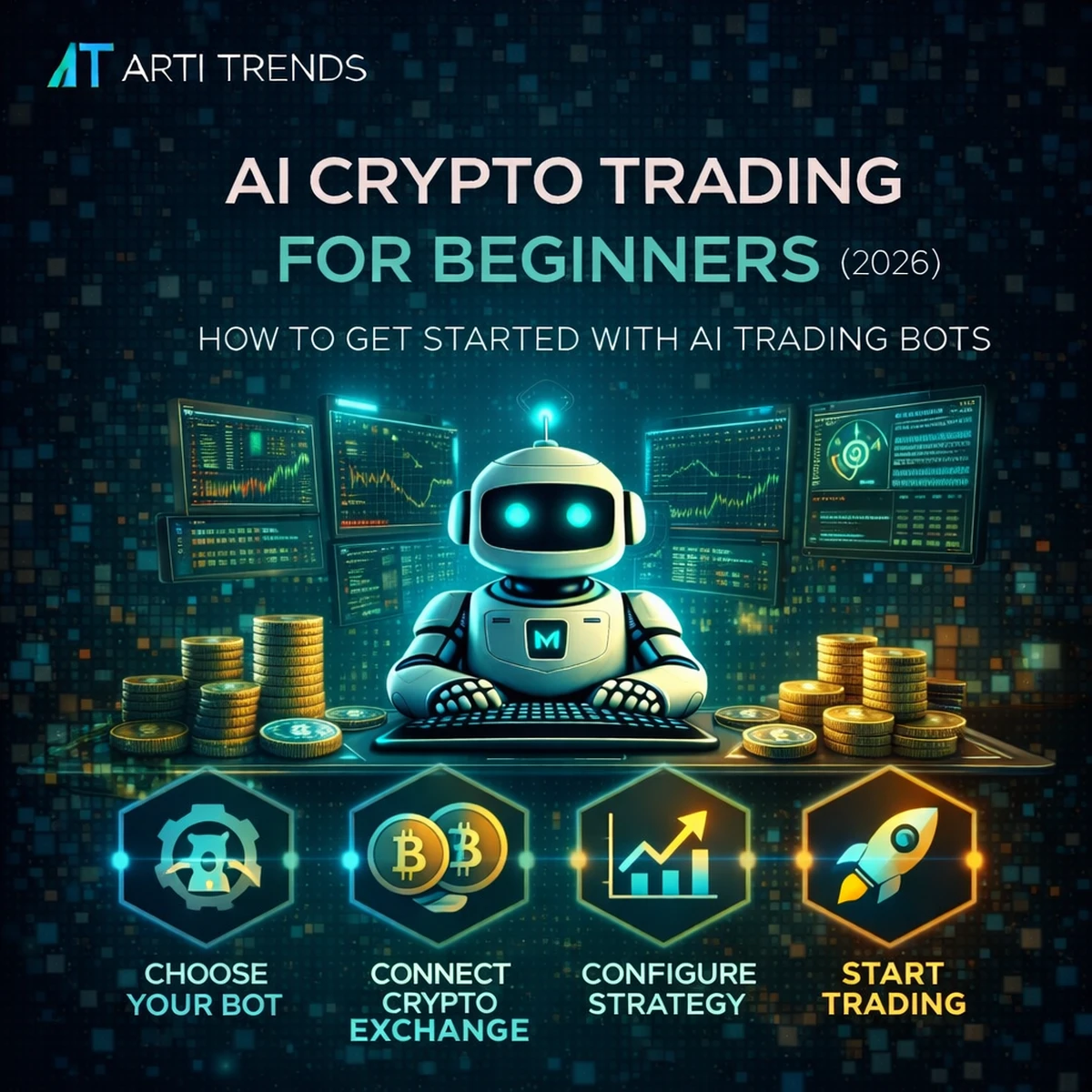
Here is a conservative five-step path most beginners can follow:
- Choose a reliable exchange. Prioritize liquidity, uptime, and compliance (see our exchanges comparison above).
- Pick a beginner-friendly AI bot. Look for simple setup, explicit risk controls, and transparent reporting. Use framework articles like Which AI Trading Bot Should You Choose? (2026 Decision Framework) to match features to goals.
- Start with conservative settings. Low leverage, small positions, limited exposure.
- Observe, don’t interfere. Let the system run long enough to see how it handles drawdowns and recoveries; avoid daily fiddling.
- Scale only after you understand risk. Increase capital or complexity gradually once performance and behavior are predictable.
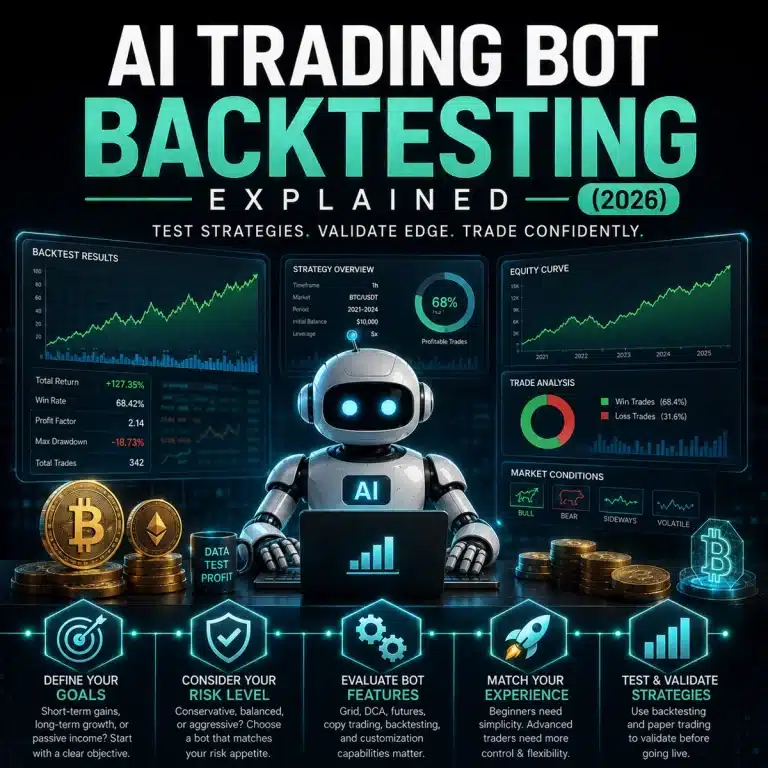
Before scaling, validate strategy robustness through historical testing and live paper-trading. If you want a practical primer on validating models and trade logic, read AI Trading Bot Backtesting Explained (2026).
Conclusion — How Beginners Should Approach AI Crypto Trading
AI crypto trading is not a shortcut to guaranteed profits. It is a way to apply disciplined strategies at machine speed while preserving human control over capital and risk. For beginners the advantage is clear: consistent execution and enforced discipline — but only when tools, exchanges, and expectations are aligned.
Further reading: If you want the full mechanics — from strategy design to portfolio automation — our Best AI Crypto Trading Bots (2026) guide and the AI Crypto Trading Hub connect strategies, platforms, and execution into a single system.
Update September 1, 2026: This article was refreshed to improve internal context and discovery signals.