AI isn’t one investment theme. It is an economic stack spanning energy, semiconductors, cloud infrastructure, AI software, robotics, autonomous systems and emerging AI networks.
This research hub helps you understand where value is being created across the AI economy, how different types of AI exposure work, and which areas deserve deeper research before putting capital at risk.
The key idea: Don’t start by asking, “Which AI stock should I buy?” Start by asking, “Which part of the AI economy do I want exposure to — and why?”
AI Investing in 60 Seconds
Before comparing individual stocks, ETFs, private companies or AI crypto projects, it helps to understand the structure of the AI economy first.
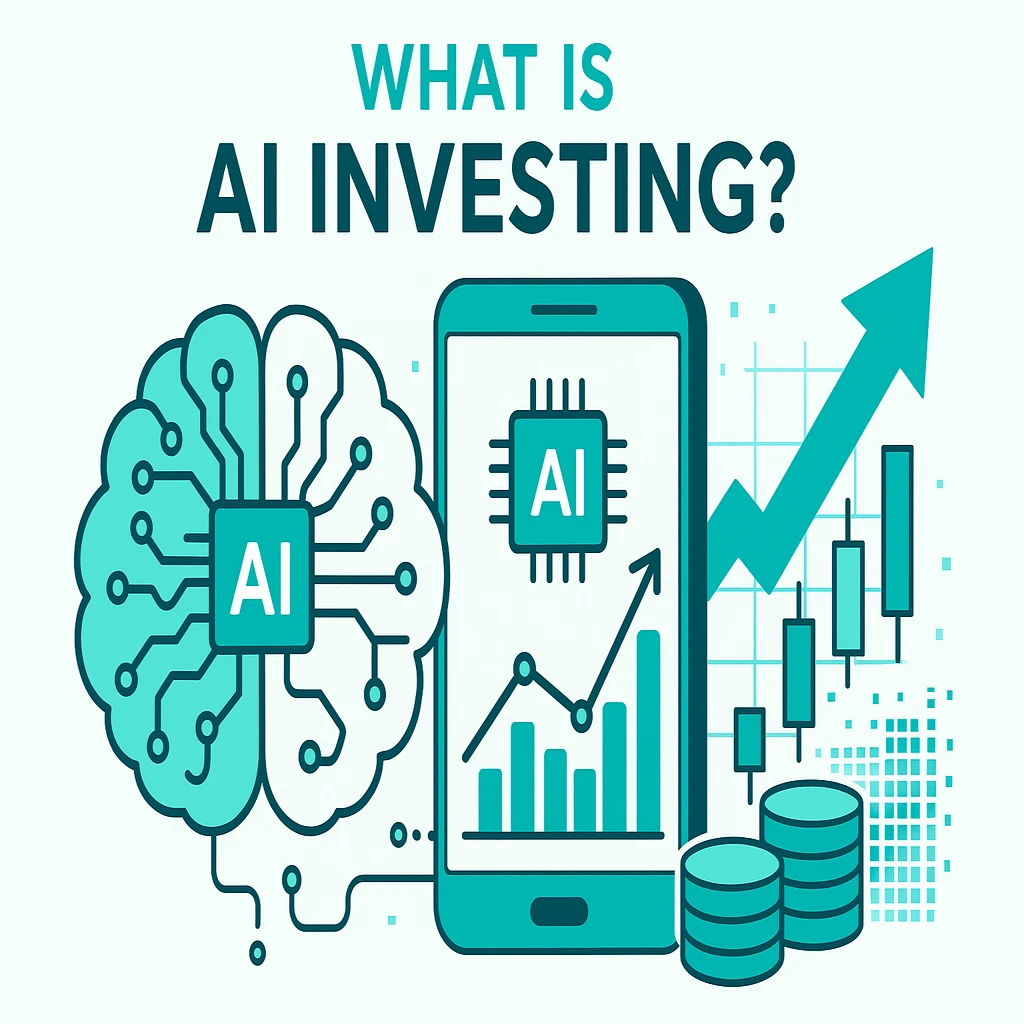
What is AI investing?
AI investing means allocating capital to companies, funds and networks whose long-term value creation is materially connected to artificial intelligence. That can include the infrastructure that powers AI, the companies building AI platforms, businesses applying AI in the real world, and emerging decentralized AI networks.
Why is AI investing different from general tech investing?
AI is not one technology sector. Its economic impact stretches across energy, semiconductors, cloud infrastructure, software, robotics, autonomous systems and other industries.
The opportunity therefore depends not only on whether AI continues to grow, but on which parts of the AI economy are able to capture that growth as lasting economic value.
How can you invest in AI?
Most AI investment exposure can be grouped into four broad vehicles:
- AI stocks — direct ownership in publicly traded AI-related companies. Explore AI Stocks →
- AI ETFs — diversified exposure to groups of AI-related companies. Explore AI ETFs →
- Private AI companies — exposure to startups and privately held AI businesses. Explore AI Startups →
- AI crypto — exposure to decentralized AI networks, compute markets and token-based ecosystems. Explore AI Crypto →
What matters most when researching an AI investment?
Strong AI investment research starts with five questions:
- Exposure: How directly does the investment benefit from AI adoption?
- Value capture: Does that adoption translate into revenue, cash flow or network value?
- Quality: Does the company or network have a durable competitive position?
- Valuation: How much future growth is already reflected in the price?
- Risk: What could permanently weaken the investment thesis?
The key idea: A powerful technology does not automatically make a good investment. Start by understanding where value is created, who captures it, and what price you are paying for that exposure.
If you are new to the topic, continue with How to Start Investing in AI →.
The State of AI Investing in 2026
AI investing has entered a different phase. The market is moving beyond the question of whether artificial intelligence will matter. The harder question is now where the enormous investment flowing into AI will ultimately create durable economic value.
Infrastructure spending remains exceptionally strong, AI-related investment products continue to attract capital, and the physical requirements of AI are expanding far beyond chips and software into data centers, electricity, cooling and grid infrastructure.
AI Investing Snapshot: 2026
- Infrastructure spending is accelerating. According to the International Energy Agency, capital expenditure by five major technology companies exceeded $400 billion in 2025 and is expected to increase by a further 75% in 2026, driven largely by data-center and AI infrastructure investment. Source: IEA →
- AI is becoming an energy investment story. The IEA projects global data-center electricity consumption to rise from roughly 415 TWh in 2024 to around 945 TWh by 2030. AI-driven accelerated computing is expected to be one of the biggest contributors to that increase. Source: IEA Energy and AI →
- Investor demand for AI exposure remains substantial. Morningstar identified 48 AI-related ETFs as of April 2026. Collectively, those funds held around $36.5 billion in net assets and had attracted more than $19 billion of net inflows over the previous 12 months. Source: Morningstar →
What Has Changed for AI Investors?
The first stage of the AI investment cycle was dominated by a relatively simple narrative: more AI required more compute, which created enormous demand for semiconductors and cloud infrastructure.
That infrastructure build-out is still important, but the investment question is becoming broader. Investors increasingly need to understand what happens after the infrastructure is built.
Can software companies turn AI features into recurring revenue? Can enterprises generate measurable productivity gains? Can robotics and autonomous systems move from demonstration to large-scale deployment? And can the energy and physical infrastructure required for AI expand quickly enough to support continued compute growth?
This means the AI opportunity is spreading across several parts of the economy:
- Power and data centers are becoming critical infrastructure for AI expansion.
- Semiconductors and networking remain central to the compute build-out.
- Cloud and model platforms are competing to become the infrastructure layer for AI applications.
- Enterprise AI software and agents are under increasing pressure to demonstrate real monetization.
- Robotics and autonomous systems represent the next major bridge between digital AI and the physical economy.
The 2026 Investment Question
The biggest opportunity may no longer be simply identifying companies connected to AI. As AI becomes embedded across the economy, the more useful question is:
Which companies and industries can convert rising AI demand into durable revenue, cash flow and competitive advantage?
This distinction matters because AI adoption and investment returns are not the same thing. An industry can grow rapidly while individual companies struggle with competition, high capital requirements or valuations that already assume years of future success.
Morningstar has also warned that AI-labelled investment products can provide dramatically different levels of actual AI exposure. The label alone therefore tells investors very little about what they really own. Read the Morningstar AI investment analysis →
Arti-Trends view: In 2026, understanding the AI investment opportunity requires looking beyond individual stocks and following the entire economic chain — from the electricity entering a data center to the software, machines and networks ultimately generating value from that compute.
Market data and research reviewed September 2026. Figures reflect the latest cited data available at the time of review and may change as new information becomes available.
The Arti-Trends AI Investment Stack™
AI investing becomes much clearer when you stop thinking about artificial intelligence as a single sector and start looking at it as an economic stack.
Every AI product ultimately depends on several layers working together: electricity must power the infrastructure, chips must provide the compute, cloud and model platforms must make that compute usable, software must turn it into workflows, and applications must create real economic value.
For investors, this matters because value is not captured equally across the stack. Different layers have different growth drivers, economics, competitive dynamics and risks.
1. Power & Physical Infrastructure
At the foundation of the AI economy sits the physical infrastructure required to keep increasingly large amounts of compute running.
This layer includes:
- electricity generation and grid infrastructure
- data centers
- cooling systems
- power management
- backup power and energy storage
- physical networking infrastructure
AI models may be digital, but the infrastructure supporting them is intensely physical. As training and inference demand increases, access to reliable electricity, land, cooling and data-center capacity can become an important constraint on AI growth.
Investor lens: The key question is not simply whether AI demand grows, but which infrastructure providers can benefit from that growth while earning attractive returns on the capital required to expand.
2. Compute & Semiconductors
The second layer provides the processing power required to train and operate AI systems.
This includes:
- GPUs and AI accelerators
- advanced CPUs
- high-bandwidth memory
- networking equipment
- semiconductor manufacturing
- chip-design tools and semiconductor equipment
Compute has been one of the clearest beneficiaries of the AI investment cycle because increasingly capable models require enormous processing capacity.
However, this layer is also highly competitive and capital intensive. Technology leadership can change quickly, manufacturing capacity matters, and valuations can rise far ahead of underlying earnings.
Investor lens: Look beyond headline AI demand and ask who has pricing power, technological leadership, manufacturing leverage and a durable position within the compute supply chain.
Public companies across this layer can be explored through the AI Stocks Hub →.
3. Cloud & Model Infrastructure
Compute becomes economically useful when developers and businesses can access it. That is the role of the cloud and model infrastructure layer.
This layer includes:
- cloud AI platforms
- frontier AI models
- model APIs
- AI inference infrastructure
- developer platforms
- data and model deployment tools
These businesses sit between raw computing power and the applications ultimately used by companies and consumers.
The strategic question is whether value will concentrate around a small number of dominant platforms or whether models and compute increasingly become interchangeable commodities.
Investor lens: Watch usage growth, recurring revenue, switching costs, developer adoption and the cost of delivering increasingly capable AI services.
4. Software & AI Platforms
This is where artificial intelligence begins to move from infrastructure investment into everyday economic activity.
Examples include:
- enterprise AI software
- AI agents and copilots
- cybersecurity automation
- analytics platforms
- developer tools
- AI-enabled productivity software
The opportunity in this layer can be enormous because software can scale with relatively low marginal distribution costs. But simply adding AI functionality does not guarantee durable value creation.
The strongest businesses must demonstrate that AI improves their product enough to increase customer adoption, pricing power, retention or operating efficiency.
Investor lens: Ask whether AI is creating measurable economic value or merely becoming another feature competitors can replicate.
5. Applied AI & Autonomy
The fifth layer brings artificial intelligence out of the digital environment and into the physical world.
This includes areas such as:
- robotics
- autonomous vehicles
- industrial automation
- healthcare diagnostics
- logistics
- defense and aerospace systems
- intelligent manufacturing
These markets can become extremely valuable because successful AI systems may replace or enhance expensive human processes. But they also face challenges that pure software companies often avoid: hardware costs, regulation, safety requirements and real-world reliability.
Investor lens: The important question is whether a technology can move beyond impressive demonstrations and achieve reliable, scalable and economically viable deployment.
6. Frontier & Decentralized AI
The final layer contains some of the youngest and most speculative parts of the AI economy.
This includes:
- decentralized compute networks
- AI-focused blockchain infrastructure
- tokenized data markets
- autonomous agent networks
- decentralized AI marketplaces
Rather than relying entirely on traditional companies and centralized infrastructure, these networks attempt to create new ways of supplying compute, data and AI services.
The potential upside can be significant, but so can the risk. Adoption is uncertain, token economics can be complex, regulation can change quickly and many projects may never develop sustainable demand.
Investor lens: Separate genuine network utility from speculative narratives. Usage, incentives, token economics and sustainable demand matter more than the popularity of the AI label.
For deeper research into this part of the market, visit the AI Crypto Investing Hub →.
Why the AI Investment Stack Matters
The most important takeaway is that AI growth does not automatically create equal investment opportunity across every layer.
A surge in demand at one level can benefit companies elsewhere in the stack. More AI applications may increase cloud usage. More cloud usage may increase demand for chips. More chips may require additional data-center capacity and electricity.
At the same time, value can shift. Infrastructure may dominate one stage of the cycle while software, robotics or other applications capture more value later.
That is why the first question in AI investing should not be:
“Which company will win AI?”
It should be:
“Where in the AI investment stack is durable economic value being created — and who is best positioned to capture it?”
If you prefer diversified exposure across multiple parts of the AI economy rather than selecting individual companies, explore the AI ETFs Hub →.
Where Value Is Actually Created Across the AI Stack
One of the most important principles in AI investing is also one of the easiest to overlook:
Growth in artificial intelligence does not automatically translate into attractive investment returns.
AI adoption can grow rapidly while individual companies struggle to convert that demand into durable profits. Infrastructure can experience enormous demand while capital requirements consume much of the economic benefit. Software companies can attract millions of users without developing meaningful pricing power. And an excellent business can still become a poor investment if expectations are already reflected in its valuation.
To understand where investment value may actually emerge, it helps to follow a simple economic chain:
1. Demand
Every investment thesis begins with real demand.
For AI, that demand can appear in different forms: companies purchasing compute, developers using model APIs, enterprises adopting AI software, manufacturers deploying robotics, or consumers using AI-enabled products.
The first question is therefore not whether a company mentions AI, but whether AI adoption is creating measurable demand for what that company actually sells.
2. Monetization
Demand only becomes economically meaningful when a company can convert it into revenue.
This distinction matters because usage and monetization are not the same thing. An AI platform can grow quickly while offering heavily subsidized access. A software company can add AI features without convincing customers to pay more. A decentralized network can attract attention without generating sustainable economic activity.
Investor question: Is AI increasing revenue, customer spending, transaction volume or another measurable source of economic value?
3. Margins and Capital Requirements
Revenue growth is only part of the story. Investors also need to understand what it costs to produce that growth.
This is particularly important in AI because different layers of the stack have very different economics.
- Data centers and infrastructure can require enormous upfront capital investment.
- Semiconductor companies may benefit from strong demand but remain exposed to manufacturing cycles and capacity constraints.
- Cloud and model providers must absorb significant compute and inference costs.
- Software platforms may achieve stronger margins if AI capabilities can be distributed efficiently across a large customer base.
- Robotics and autonomy combine software economics with hardware, manufacturing and deployment costs.
Two companies can experience similar AI-related revenue growth while producing completely different economic outcomes for investors.
Investor question: How much capital must be invested to generate each additional unit of growth?
4. Competitive Advantage
Attractive economics tend to attract competition.
That makes durability critical. A company may benefit enormously from the first stages of AI adoption, but those returns can disappear if competitors replicate the technology, customers switch easily or pricing power declines.
Potential sources of durable advantage can include proprietary technology, scale, distribution, ecosystem effects, customer switching costs, unique data, manufacturing capability or deeply embedded infrastructure.
The strongest AI investment theses therefore explain not only why demand will grow, but also why a particular company can continue capturing that demand.
5. Valuation
Even when demand, monetization, margins and competitive advantage are attractive, investors still have to consider the price being paid for that opportunity.
Markets often anticipate growth years before it appears in reported earnings. This is especially relevant in AI, where expectations can move much faster than fundamentals.
A company can be an exceptional AI business and still deliver disappointing investment returns if its valuation already assumes near-perfect execution.
Investor question: How much future AI growth is already priced into the investment?
The AI Value-Capture Chain
A useful way to think about AI investments is:
AI Adoption → Demand → Revenue → Margins → Competitive Advantage → Investment Value
Every step matters.
If adoption does not create demand, the thesis fails early. If demand cannot be monetized, growth may not create financial value. If margins remain weak, revenue can become expensive growth. If competitive advantages disappear, profits may attract competitors. And if the valuation already reflects an unrealistic future, even excellent execution may not be enough.
This is why Arti-Trends evaluates AI opportunities by looking beyond the technology itself.
The question is not simply whether AI will grow. The question is who can capture that growth, how much of it they can retain, and what investors are being asked to pay for it.
For a deeper framework on evaluating individual companies, continue with How to Analyze AI Stocks →.
Before increasing exposure, also review the AI Investing Risks Guide → to understand how valuation, competition, technological disruption and capital intensity can affect investment outcomes.
Four Ways to Invest in AI
There is no single way to gain exposure to artificial intelligence.
Investors can access the AI economy through several different vehicles, each with its own advantages, risks and level of complexity. The right choice depends on whether you want direct ownership, diversification, early-stage exposure or access to emerging decentralized networks.
1. AI Stocks
AI stocks provide direct ownership in publicly traded companies whose revenues, products or competitive position are materially connected to artificial intelligence.
This can include semiconductor companies, cloud providers, enterprise software businesses, robotics companies, data-center operators and other firms positioned across the AI investment stack.
Main advantage: Direct exposure to individual companies that may benefit strongly from AI adoption.
Main risk: Company-specific execution, competition, valuation and technological disruption can all have a major impact on returns.
Best suited for: Investors who are comfortable researching individual companies and accepting higher concentration risk.
2. AI ETFs
AI ETFs combine multiple AI-related companies into a single investment fund.
They can provide diversified exposure across different parts of the AI economy without requiring investors to identify individual winners. Depending on the fund, exposure may include semiconductors, cloud platforms, software, robotics, automation and other AI-related businesses.
Main advantage: Diversification reduces dependence on the performance of a single company.
Main risk: Not every fund marketed as an “AI ETF” provides meaningful or concentrated exposure to artificial intelligence. Holdings, methodology, fees and overlap with broader technology indexes should all be examined carefully.
Best suited for: Investors who prefer broader exposure, simpler portfolio construction and lower single-company risk.
3. Private AI Companies & Startups
Private AI investing provides exposure to companies before they are publicly listed.
This part of the market includes early-stage startups as well as larger private AI companies developing frontier models, robotics, infrastructure, industry-specific software and new AI platforms.
The potential upside can be significant because investors may gain exposure before a company reaches public markets. However, access is limited and risk is considerably higher.
Main advantage: Exposure to innovation and growth that may not yet be available through public markets.
Main risk: Low liquidity, limited financial transparency, uncertain valuations, dilution and a high probability of business failure.
Best suited for: Experienced investors who understand private-market risk and can tolerate long holding periods and potential capital loss.
4. AI Crypto & Decentralized AI Networks
AI crypto provides exposure to blockchain-based networks attempting to build decentralized markets for compute, data, AI services and autonomous agents.
Unlike stocks, these investments generally do not represent ownership in a company. Their value may instead depend on network activity, token economics, adoption and demand for the underlying decentralized service.
Main advantage: Exposure to emerging AI infrastructure and network models that operate outside traditional public companies.
Main risk: Extreme volatility, uncertain adoption, token dilution, regulatory risk and speculative narratives that may not translate into sustainable network usage.
Best suited for: Investors who understand digital assets and are willing to accept substantially higher uncertainty and volatility.
Explore the AI Crypto Investing Hub →
AI Stocks vs ETFs vs Private AI vs AI Crypto
| Investment Type | Exposure | Diversification | Liquidity | Complexity | Typical Risk Level |
|---|---|---|---|---|---|
| AI Stocks | Individual public companies | Low to Medium | High | Medium | High |
| AI ETFs | Portfolio of AI-related companies | High | High | Low to Medium | Medium |
| Private AI | Private companies and startups | Usually Low | Low | High | Very High |
| AI Crypto | Decentralized AI networks | Low | Variable | High | Very High |
Risk levels above are relative comparisons for educational purposes and do not indicate suitability for any individual investor.
Which AI Investment Vehicle Is Best?
There is no universally “best” way to invest in AI.
The most appropriate vehicle depends on what you are trying to achieve:
- If you want direct exposure to individual businesses, AI stocks provide the clearest route.
- If you want broader diversification, AI ETFs may be easier to manage.
- If you want early-stage private-market exposure, AI startups provide access to opportunities unavailable on public exchanges.
- If you want exposure to decentralized AI infrastructure, AI crypto represents the most speculative part of the market.
The important point is to choose the investment vehicle after understanding the type of AI exposure you want — not simply because an asset carries an AI label.
If you are still deciding where to begin, use our How to Start Investing in AI Guide → for a step-by-step introduction.
AI Investment Navigator™
Find the part of the AI economy that matches what you want to research. Choose your exposure, research complexity and objective to build a focused research path.
Research guidance only — not personalized investment advice.
What part of the AI economy do you want to explore?
Start with the type of exposure you want to understand.
How deep do you want your research to go?
Choose research complexity — this is not a personal financial risk assessment.
What do you want to accomplish?
We'll shape your research path around this objective.
Your AI Research Path
AI Investing Risks
Test the downside before focusing on the potential upside.
Review Risks → WHAT'S HAPPENING NOWLatest AI News
Follow developments that could strengthen or weaken the investment thesis.
View Latest News →How to Evaluate an AI Investment
Artificial intelligence can create extraordinary businesses, but identifying a strong technology trend is only the beginning of investment research.
The Arti-Trends AI Investment Lens™ is designed to help investors look beyond headlines and evaluate whether an AI opportunity has the economics, competitive position and valuation required to potentially create durable investment value.
The framework focuses on five questions:
1. AI Exposure — How Direct Is the Connection to AI?
The first step is understanding how directly a company, fund or network benefits from artificial intelligence.
Not every company using AI is an AI investment. AI may be central to a company’s product and revenue model, or it may simply be another productivity tool used internally.
Ask:
- Is AI central to the company’s products or services?
- Does AI materially influence revenue growth?
- Would increased AI adoption meaningfully improve the company’s economics?
- Is the AI connection structural, or mainly part of the marketing narrative?
Research principle: The stronger the connection between AI adoption and economic performance, the more meaningful the AI exposure.
2. Value Capture — Can AI Demand Become Economic Value?
Exposure to AI demand is not enough. The next question is whether that demand can be converted into measurable economic value.
A company may experience rapid usage growth without generating attractive profits. An AI platform may gain millions of users while spending heavily on compute. A hardware business may benefit from enormous demand while requiring equally enormous capital investment.
Look for evidence that AI is improving:
- revenue
- customer spending
- pricing power
- gross margins
- recurring revenue
- free cash flow
- network activity or economically meaningful usage
Research principle: AI adoption matters most when it can eventually be translated into sustainable economic returns.
3. Competitive Position — Why Should This Company Keep Winning?
Fast-growing markets attract competition quickly.
That means a strong AI investment thesis must explain more than why demand is increasing. It must also explain why a particular company or network is positioned to capture that demand better than competitors.
Potential advantages can include:
- proprietary technology
- manufacturing scale
- unique data
- distribution
- customer switching costs
- network effects
- developer ecosystems
- brand and customer trust
- cost advantages
Investors should also ask how quickly these advantages could disappear as models improve, open-source alternatives expand or new competitors enter the market.
Research principle: Growth creates opportunity, but durable competitive advantage determines who gets to keep the economics.
4. Capital & Economics — What Does Growth Cost?
Different layers of the AI economy require dramatically different amounts of capital.
Building data centers, semiconductor fabrication capacity or robotics platforms can require billions in upfront investment. Software companies may require less physical infrastructure, but increasingly face significant model-training and inference costs.
Important questions include:
- How much capital is required to support growth?
- Are margins improving as the business scales?
- Does the company consistently generate free cash flow?
- Is expansion being funded through internal cash generation, debt or dilution?
- Can returns on invested capital remain attractive as competition increases?
Research principle: Revenue growth becomes far more valuable when it can be achieved without requiring an equally rapid increase in capital.
5. Valuation & Risk — What Expectations Are Already Priced In?
The final part of the framework is often the most difficult.
A company can have exceptional technology, strong growth and an excellent competitive position — and still be an unattractive investment at the wrong valuation.
AI markets can price years of expected growth into a company long before that growth appears in financial results.
Investors therefore need to ask:
- What level of future growth does the current valuation appear to assume?
- How sensitive is the investment thesis to slower growth or lower margins?
- What happens if competitors gain market share?
- What could permanently damage the business model?
- Is the potential upside attractive relative to the downside?
Research principle: Never evaluate the quality of an AI business without also evaluating the expectations embedded in its price.
The Arti-Trends AI Investment Lens™
| Research Area | Core Question | What to Look For |
|---|---|---|
| AI Exposure | How directly does this investment benefit from AI adoption? | Revenue exposure, product relevance, customer demand |
| Value Capture | Can AI demand become sustainable economic value? | Revenue, margins, pricing power, cash generation |
| Competitive Position | Why can this company keep capturing value? | Moats, scale, technology, distribution, switching costs |
| Capital & Economics | How expensive is it to create additional growth? | Capex, margins, free cash flow, returns on capital |
| Valuation & Risk | What future success is already reflected in the price? | Valuation, expectations, downside scenarios, disruption risk |
From AI Story to Investment Thesis
The purpose of this framework is to move research through a logical sequence:
AI Trend → Business Exposure → Economic Value → Competitive Advantage → Financial Quality → Valuation → Investment Thesis
If one of those links is weak, the investment deserves deeper investigation.
This is also why Arti-Trends does not treat every company that mentions artificial intelligence as an AI investment. The technology story is only one part of the analysis.
A stronger question is: If AI adoption develops as expected, how much of that economic value can this company realistically capture — and how much future success am I already paying for today?
For a more detailed company-analysis framework, continue with How to Analyze AI Stocks →.
Before evaluating potential upside, also review the AI Investing Risks Guide → to understand the downside scenarios that can weaken an AI investment thesis.
Risks That Actually Matter in AI Investing
AI investing offers significant long-term opportunity, but the risks are just as important as the growth story.
The most dangerous mistakes usually happen when investors focus on adoption while underestimating valuation, competition, capital intensity or technological change.
The goal is not to eliminate risk. It is to understand where risk is concentrated and what could permanently weaken an investment thesis.
1. Valuation & Hype Risk
AI markets can move faster than fundamentals. New model releases, product launches and adoption headlines often push expectations higher long before earnings catch up.
A strong company can still become a weak investment if too much future success is already reflected in the price.
Watch for: extreme growth assumptions, rapidly expanding valuation multiples and investment narratives that depend on near-perfect execution.
2. Capital Intensity
Much of the AI economy requires enormous investment in chips, data centers, electricity, networking and model infrastructure.
Strong demand does not automatically mean strong returns if the capital required to support that growth increases just as quickly.
Watch for: rising capital expenditure, weakening free cash flow, debt growth, dilution and poor returns on invested capital.
3. Technology Disruption
AI evolves extremely quickly. New models, architectures, hardware and open-source alternatives can reduce the value of existing products faster than in many traditional industries.
Today’s technological leader may not remain the leader indefinitely.
Watch for: falling switching costs, rapid commoditization, weakening product differentiation and competitors achieving similar performance at lower cost.
4. Competition & Market Concentration
AI markets can concentrate quickly because scale, compute, data and distribution create powerful advantages.
At the same time, large profit pools attract new competitors. Open-source technologies and lower-cost alternatives can challenge even dominant companies.
Watch for: margin pressure, customer concentration, dependence on a small number of partners and weakening pricing power.
5. Regulation & Policy Risk
AI is becoming increasingly important to governments, regulators and national security policy.
Rules around data, model safety, copyright, competition, exports and sector-specific deployment can materially affect business models.
Watch for: regulatory dependence, geographic restrictions, export controls and business models that rely on uncertain legal frameworks.
6. Execution Risk
AI opportunity alone does not guarantee successful execution.
Companies still need to build products customers want, deploy them reliably, control costs and convert adoption into sustainable revenue.
This is especially important in robotics, autonomous systems and other areas where software must perform consistently in the physical world.
Watch for: repeated delays, weak monetization, high customer acquisition costs, poor unit economics and a widening gap between promises and commercial deployment.
7. Emerging Market & Liquidity Risk
Private AI companies, early-stage technologies and AI crypto networks introduce additional risk because pricing can be less transparent and liquidity can disappear quickly.
Potential upside can be substantial, but so can permanent capital loss.
Watch for: thin liquidity, unclear valuations, weak token economics, limited disclosure and dependence on speculative funding conditions.
A Simple AI Risk Check
| Risk | Core Question |
|---|---|
| Valuation | How much future success is already priced in? |
| Capital Intensity | How expensive is it to sustain growth? |
| Technology | How quickly could the current advantage disappear? |
| Competition | Why should this company keep its pricing power? |
| Regulation | Could policy materially change the business model? |
| Execution | Can management convert AI opportunity into profitable growth? |
| Liquidity | Can the investment be exited under difficult market conditions? |
The key principle: The strongest AI investment thesis is not the one with the biggest upside story. It is the one that still makes sense after you deliberately test what could go wrong.
For a deeper breakdown of downside scenarios, portfolio risk and the specific risks across stocks, ETFs, crypto and private AI, continue with the AI Investing Risks Guide →.
What’s Moving AI Investing Now
The AI investment landscape changes much faster than a traditional long-term investment guide can be rewritten.
That is why Arti-Trends separates the long-term investment framework from the developments that can change individual parts of the AI thesis.
These are some of the themes worth watching now.
AI Infrastructure & Compute
Compute remains one of the foundations of the AI economy, but the opportunity is expanding beyond hyperscale data centers. New AI hardware is increasingly moving closer to developers, businesses and consumers, creating new questions around deployment, utilization and monetization.
What investors should watch: semiconductor demand, hardware adoption, pricing power, inference economics and whether new forms of AI compute create sustainable customer demand.
NVIDIA Brings RTX Spark to Korea’s PC Bangs →
Enterprise AI & Monetization
The investment debate around AI software is increasingly shifting from capability to economic value.
Businesses can deploy powerful AI systems, but investors ultimately need evidence that those systems improve productivity, reduce costs, increase revenue or create products customers are willing to pay for.
What investors should watch: recurring revenue, measurable customer ROI, adoption beyond pilot programs, margins and whether AI functionality creates durable differentiation.
Orbio Raises $21M to Scale AI HR Automation →
AI Agents & Autonomous Work
AI agents represent one of the most important potential shifts in the software layer: moving from systems that generate answers to systems that can independently execute multi-step work.
If autonomous agents become reliable enough for real business processes, they could change the economics of software, labor and enterprise automation. But reliability, accountability and measurable productivity remain critical.
What investors should watch: real-world deployment, task completion rates, cost savings, human oversight and whether autonomous systems can move from demonstrations into repeatable commercial workflows.
Startup Let an Autonomous AI Agent Run Its $100M Fundraise →
Decentralized AI Networks
AI crypto is entering a stage where narrative alone is becoming less useful. The more important question is whether decentralized AI networks can generate genuine demand for compute, models, data or other services.
This creates a clear divide between projects driven primarily by speculation and networks developing measurable utility.
What investors should watch: network usage, sustainable demand, token incentives, decentralization, developer activity and whether economic activity continues without speculative price momentum.
Bittensor in 2026: TAO’s Shift From Speculation to Utility →
Explore the AI Crypto Investing Hub →
How to Use Current AI News as an Investor
Individual headlines should rarely determine a long-term investment decision.
Instead, use current developments as signals that test an existing investment thesis.
- Infrastructure news: Is AI demand strengthening or weakening?
- Company news: Is adoption translating into revenue and economic value?
- Product launches: Does the technology strengthen a competitive advantage?
- Funding activity: Where is new capital moving within the AI stack?
- Regulation: Could policy change the economics of an industry?
- AI crypto developments: Is network utility improving, or only the narrative?
The principle: News becomes more useful when it changes your understanding of demand, monetization, competition, risk or valuation — not simply because the headline is dramatic.
Explore the AI Investing Ecosystem
Choose the part of the AI investment landscape you want to explore next.
AI Stocks
Research individual companies positioned across the AI economy.
Explore Stocks →AI ETFs
Explore diversified AI exposure through thematic and technology funds.
Explore ETFs →AI Crypto
Research decentralized AI networks, compute markets and token ecosystems.
Explore Crypto →AI Startups
Explore private AI companies, emerging markets and early-stage innovation.
Explore Startups →AI Investing Risks
Stress-test valuation, competition, disruption and downside scenarios.
Review Risks →AI Trading Bots
Explore automated trading, execution systems and trading technology.
Explore Trading Bots →Move from understanding the AI economy to researching specific opportunities, comparing alternatives and evaluating risk.
Building a Durable AI Investment Strategy
Artificial intelligence is becoming part of the economic infrastructure behind computing, software, automation and increasingly the physical world.
For investors, the opportunity is therefore much broader than finding the next company with “AI” in its story. The more important challenge is understanding where value is being created across the AI economy, who is positioned to capture it, and how much future success is already reflected in the price.
A durable AI investment process starts with structure:
- Understand the AI investment stack before selecting individual opportunities.
- Separate AI adoption from economic value capture.
- Choose the right investment vehicle for the exposure you want to research.
- Evaluate quality, economics, competitive advantage and valuation.
- Stress-test the downside before focusing on potential upside.
AI markets will continue to evolve. Today’s infrastructure leaders may eventually be joined by new winners in software, robotics, autonomous systems and other emerging parts of the stack.
The goal is not to predict every winner. It is to build a research process that remains useful even as the technology, companies and narratives change.
If you are still deciding where to begin, start with How to Start Investing in AI →, or use the AI Investment Navigator™ above to choose your next research path.
Arti-Trends provides research and educational content only. Nothing on this page should be considered personalized financial advice or a recommendation to buy or sell any asset.
AI Investing FAQ
Clear answers to the most common questions about investing across the AI economy.
What is AI investing?
AI investing means gaining exposure to companies, funds or networks whose long-term value creation is materially connected to artificial intelligence.
This can include semiconductors, cloud infrastructure, AI software, robotics, ETFs, private AI companies and decentralized AI networks.
How can you invest in AI?
The main investment routes are AI stocks, AI ETFs, private AI companies and AI crypto.
Each provides a different type of exposure and carries different levels of diversification, liquidity and research complexity.
Explore the AI Stocks Hub or the AI ETFs Hub to compare public-market approaches.
What is the AI investment stack?
The AI investment stack is a way of viewing the AI economy as several interconnected layers rather than one single sector.
These layers can include power and physical infrastructure, semiconductors and compute, cloud and model infrastructure, software platforms, robotics and autonomy, and emerging decentralized AI networks.
The key idea is that different layers capture value in different ways and at different stages of the AI adoption cycle.
Is AI investing the same as investing in technology stocks?
No. AI investing overlaps with technology investing, but it extends far beyond traditional software companies.
AI demand can also benefit semiconductors, networking, data centers, energy infrastructure, industrial automation, robotics and other sectors.
Are AI ETFs a good way to gain AI exposure?
AI ETFs can provide diversified exposure across multiple AI-related companies and reduce dependence on a single investment.
However, investors should examine each fund's holdings, methodology, fees and concentration because an “AI ETF” label does not automatically mean the fund has strong or direct AI exposure.
Learn more in the AI ETFs Hub →.
Which parts of the AI economy actually make money?
Economic value can be created across multiple layers of the AI stack, including infrastructure, semiconductors, cloud services, enterprise software and applied AI.
The important question is not only where demand is growing, but who can convert that demand into revenue, margins, cash flow and durable competitive advantage.
Is AI investing risky?
Yes. Important risks include high valuations, technological disruption, competition, capital intensity, regulation, execution risk and market volatility.
Some areas such as private AI companies and AI crypto can carry substantially higher uncertainty and liquidity risk.
For a deeper breakdown, see the AI Investing Risks Guide →.
Is AI overvalued in 2026?
There is no single valuation for “AI.” Different companies and parts of the AI economy trade on very different expectations.
Some businesses may justify high valuations through strong growth, pricing power and cash generation, while others may already reflect years of optimistic assumptions.
The better question is: how much future AI growth is already priced into the specific investment being researched?
What is the difference between AI infrastructure and AI software investing?
AI infrastructure investing focuses on the systems required to power AI, such as semiconductors, networking, cloud infrastructure, data centers and energy.
AI software investing focuses on companies using that infrastructure to deliver applications, platforms, agents and enterprise tools.
Infrastructure is often more capital intensive, while software can potentially scale faster if customers are willing to pay for AI-driven functionality.
Can retail investors invest in private AI companies?
Direct access to private AI companies is often limited and may depend on jurisdiction, investor eligibility and the investment platform being used.
Private investments also generally involve lower liquidity, less financial disclosure and higher failure risk than public-market investments.
Explore the AI Startups Hub → for more on private AI markets.
What are AI crypto investments?
AI crypto investments provide exposure to blockchain-based networks related to areas such as decentralized compute, data markets, AI services and autonomous agents.
Unlike stocks, tokens generally do not represent ownership in a company. Their value may depend on network adoption, token economics, utility and speculative demand.
Learn more in the AI Crypto Investing Hub →.
What should you research before investing in an AI company?
Start by evaluating how directly the company benefits from AI adoption, whether that demand translates into economic value, and whether the company has a durable competitive advantage.
Then examine financial quality, capital requirements, valuation and downside scenarios.
Use the How to Analyze AI Stocks Guide → for a deeper framework.