Imagine a robotaxi approaching a cyclist who is about to move around a parked van. Before the vehicle can respond, its software must process what its cameras see and work out an appropriate movement. Every one of those calculations needs physical hardware.
Now imagine supplying the hardware for an expanding fleet of vehicles, robots and computing systems. The question becomes much bigger: where will all those chips come from?
Terafab is Elon Musk’s proposed answer. The semiconductor project brings chip manufacturing into the wider ambitions of Tesla and SpaceX. It also introduces a difficult challenge: turning a demand forecast into a factory that can reliably deliver working hardware.
What Is Terafab, Exactly?
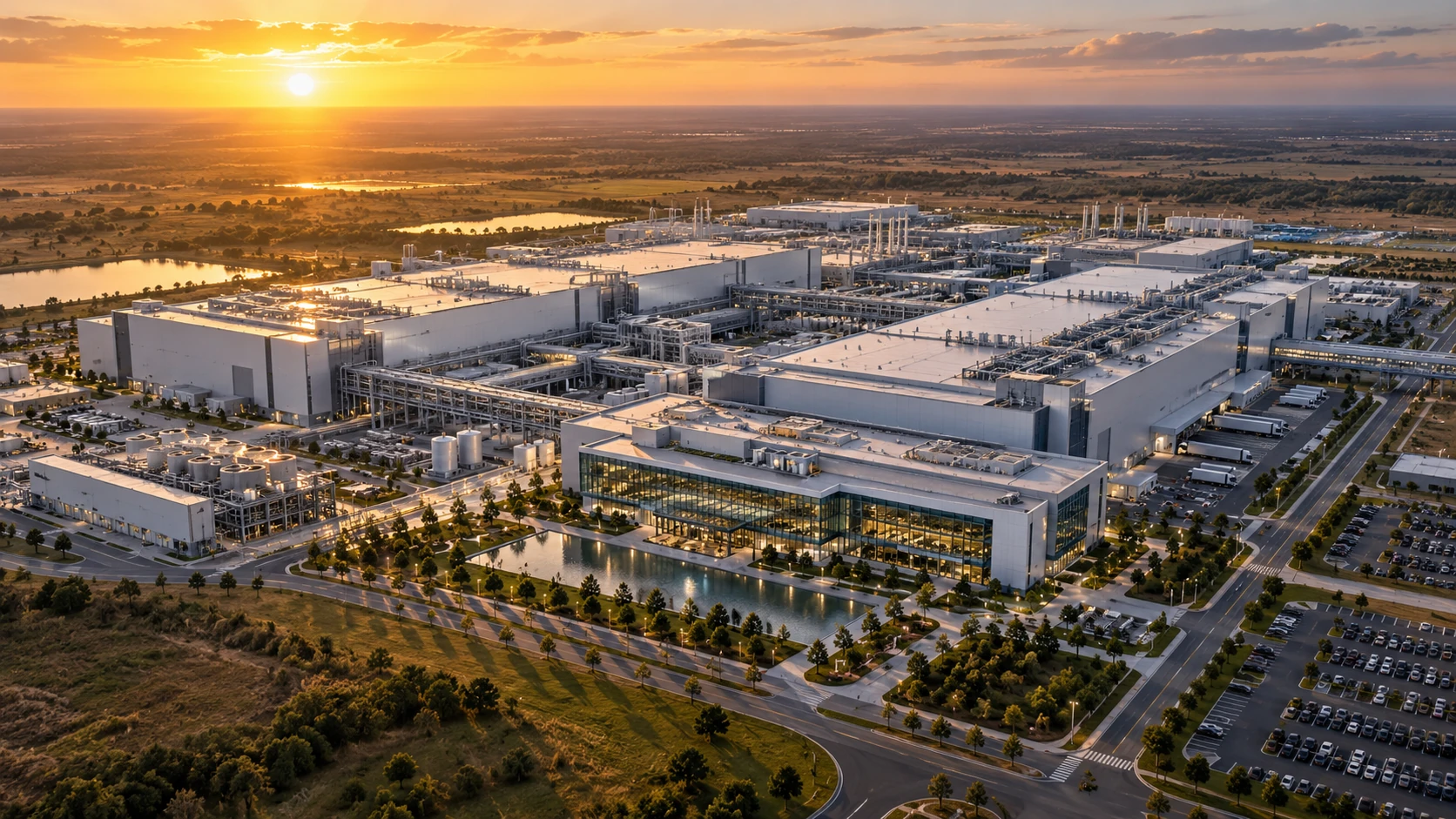
Terafab is a planned semiconductor manufacturing complex in Grimes County, Texas. On August 6, the Texas governor’s office announced a first phase representing more than $16.8 billion in capital investment and a projected 3,000 new jobs. The announcement describes a facility intended to combine logic, memory and advanced packaging. Texas governor’s announcement
A “fab” is a fabrication plant: a factory that manufactures semiconductor chips. Terafab’s significance lies in the ambition to bring several connected stages of production together.
| Project detail | Announced position |
|---|---|
| Location | Grimes County, Texas |
| First-phase investment | More than $16.8 billion |
| Employment | 3,000 projected new jobs |
| Manufacturing scope | Logic, memory and advanced packaging |
These figures describe the announced project. They should not be read as money already fully spent, jobs already filled or proven production capacity. Texas governor’s announcement
Why Not Just Buy More Chips?
Buying chips and making them are different businesses. Many semiconductor companies design processors while specialist manufacturers produce them. ASML describes this division between chip designers without their own factories and foundries that manufacture for customers. Owning a fab therefore means taking on work that companies can otherwise outsource. ASML’s chipmaking guide
The stated motivation for Terafab is future supply. Reuters reported that Tesla and SpaceX intend the project to help address the gap between available chips and their anticipated computing requirements. Intel is also involved through a partnership reported by Reuters. Reuters,
The strategic appeal is understandable: if hardware availability could restrict your products, controlling more production may offer greater flexibility. But ownership also transfers responsibility. Manufacturing problems become your problems, along with the cost of solving them.
For Terafab, the important question is whether that additional control can justify the expense and execution risk. A large expected need for chips provides a reason to try; it does not establish that building them internally will be the best solution.
What Does an AI Chip Actually Do?
An AI chip is a processor designed to handle the calculations used by artificial intelligence efficiently. A key technique is parallel processing: performing many calculations at the same time. AI workloads can benefit because they involve large numbers of related mathematical operations. IBM’s AI chip explainer
Think of a team dividing a large task into pieces and working simultaneously. The advantage depends on how well the work can be divided and how efficiently the results are combined.
There are also two different jobs to understand. Training develops a model from examples. Inference uses a trained model to process new information. For our imagined robotaxi, applying a model to incoming camera images belongs to the second category.
IBM describes AI processors supporting both model training and applications that process sensor information close to where it is generated. This helps explain why hardware for a computing facility and hardware inside a vehicle can serve different needs. IBM’s AI chip explainer
A more capable chip can support more computation. Whether that produces better driving still depends on the software, testing and complete vehicle system.
From Robotaxis to Robots—and Potentially Space

The intended applications extend beyond a single product. Reuters identifies Tesla’s Cybercab and Optimus robot, alongside SpaceX’s proposed space-based data centers, as targets for Terafab’s processors. It also reports that Tesla began work in April on a research facility at Giga Texas as a precursor to the larger project. Reuters
Those plans should be considered separately. Research activity, a proposed manufacturing complex and future computing infrastructure are different milestones. Progress on one does not automatically demonstrate readiness in the others.
For readers following the Cybercab story, this is the connection: Terafab concerns the hardware supply behind future products. It does not establish that a Cybercab on the road today contains a chip manufactured there.
Inside the Plan: From Silicon to Working Hardware
Chipmaking begins with a silicon wafer, a thin disc on which manufacturers build intricate structures. ASML explains that production involves hundreds of steps, with layers aligned at extremely small scales inside tightly controlled cleanrooms. Lithography helps define patterns used to form the chip’s structures. ASML’s chipmaking guide
The different parts have complementary roles. Logic handles processing; memory stores and supplies data. Packaging provides the physical and electrical connections that allow components to work within a usable device. Testing checks whether the result meets its requirements.
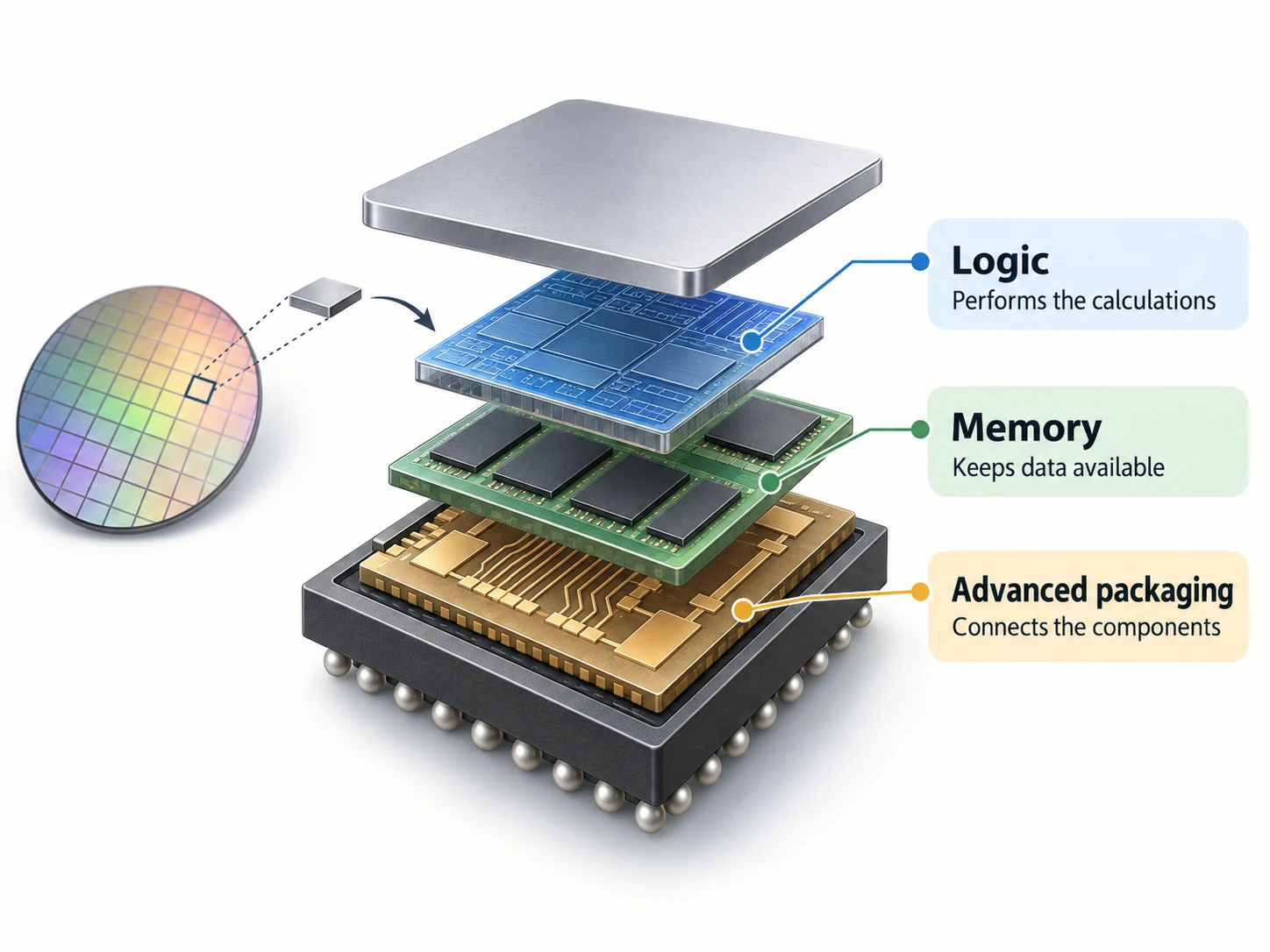
Terafab’s proposed integration brings these activities into a coordinated manufacturing operation. Reuters describes plans to manufacture, package and test logic and memory chips at the complex. Reuters
Our interpretation is that closer coordination could make it easier to investigate problems across production stages. However, putting activities together also creates a demanding coordination task. Each stage needs to deliver consistently for the overall operation to succeed.
Why Building the Factory Is Only Part of the Challenge
The precision required is unforgiving. ASML notes that contamination can ruin a chip and that manufacturing environments require strict controls. A completed building therefore represents only part of what a functioning fab needs. ASML’s chipmaking guide
One useful measure is yield: the proportion of manufactured chips that meet the relevant requirements. Producing a successful sample is a different achievement from repeatedly producing large quantities at an acceptable cost.
Consider an illustrative batch of 100 chips. If only 30 work as intended, the manufacturing effort behind the other 70 still has to be paid for. Improving that result can matter as much as increasing the number of batches.
That is why we would judge Terafab through production evidence as well as construction progress. The questions include whether its equipment works together, whether problems can be corrected consistently and whether output meets the needs of the products it is meant to support.
What Is Confirmed—and What Remains Open?
The public announcement establishes a location and a first-phase investment plan. It does not, by itself, establish commercial manufacturing performance. Texas governor’s announcement
For anyone tracking the project, the most informative next evidence would be:
- Equipment readiness: manufacturing systems installed and qualified.
- Working silicon: test chips that meet stated requirements.
- Repeatable production: results sustained across multiple batches.
- Product integration: chips validated in their intended applications.
- Economics: evidence that output, reliability and cost support expansion.
These are our proposed ways to assess progress, not a claim that Terafab has completed these steps or published a timetable for each.
Arti-Trends Take: The Factory Behind the AI Promise
Terafab makes an often overlooked part of the AI story visible. A vehicle or robot may be introduced through a striking demonstration, but scaling a product also requires dependable access to the hardware inside it.
Our assessment is that the project deserves attention because it attempts to connect ambitious product plans with manufacturing capacity. Its eventual value will depend on the quality and usefulness of the chips it produces, alongside the resources required to produce them.
For now, the distinction to keep in mind is straightforward: an announced factory expresses an ambition; sustained output demonstrates a capability.
The most revealing Terafab milestone will be the point at which working chips begin supporting real products in meaningful quantities. That is when the connection between the factory and the AI future becomes tangible.