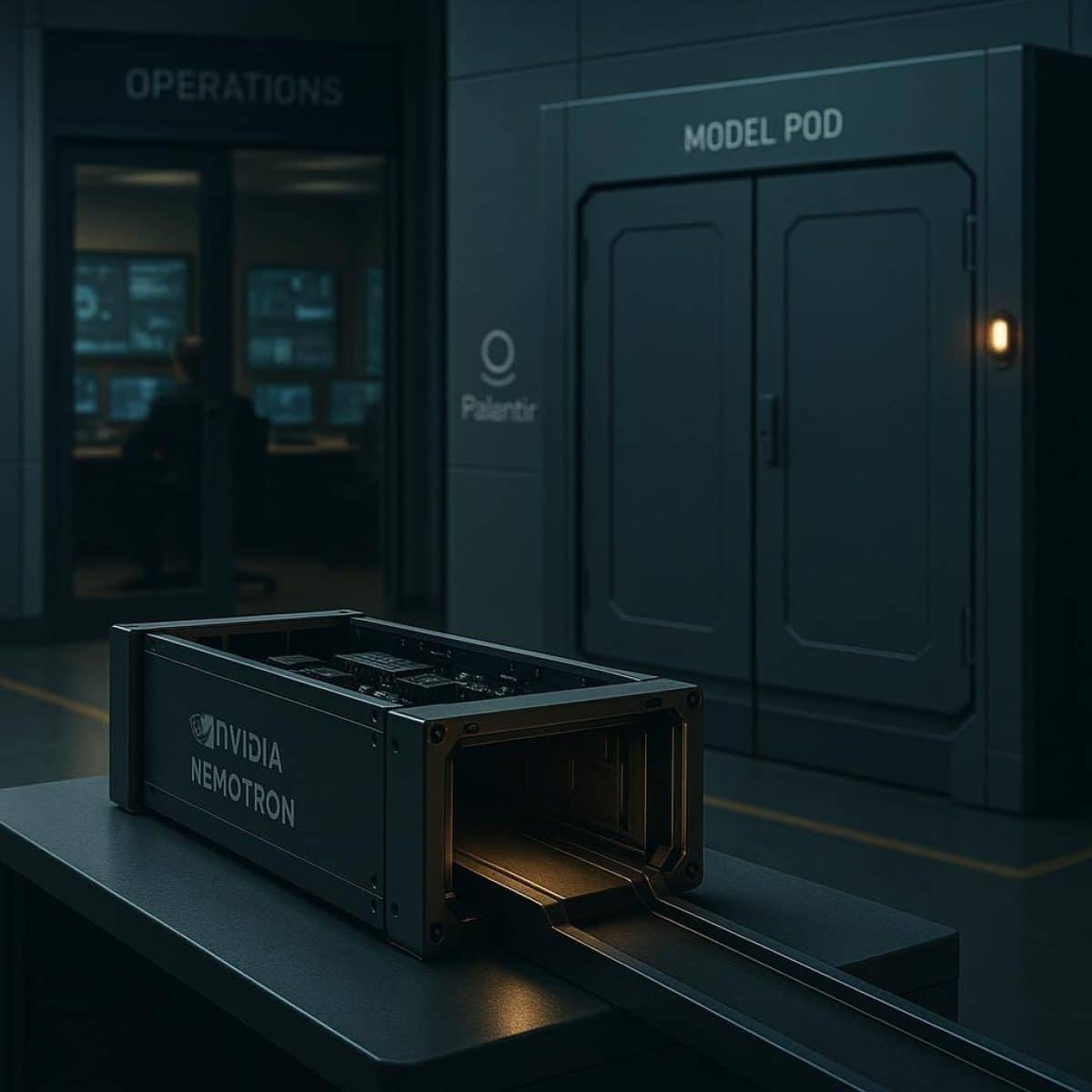
Palantir announced an intelligence engine that pairs NVIDIA’s Nemotron open models with Palantir’s hardened, isolation-first deployment for U.S. government agencies. The package aims to let agencies run open-source LLMs inside accredited, closed environments so sensitive data never has to move into public clouds.
The real issue
The fast takeaway: technical teams can now assemble capable, auditable AI stacks faster than rules and approvals can keep up. Palantir’s bundle – open weights from NVIDIA running inside Palantir’s isolation-focused runtime – is a clear example. It shows how model, runtime, and infrastructure can be stitched together into a system that looks ready for classified or air-gapped sites.
That modular design is important. Open model weights give agencies the chance to tune behavior and inspect what the model learned. Palantir provides the hardened runtime, access controls, and data segregation needed in sensitive settings. GPUs and accelerators determine where and how these stacks run; capacity and power still limit on-prem options, which is why hardware vendors matter here (see related GPU coverage).
Why this matters now
This deal matters because governments want the innovation of open models but must control risk, data, and oversight. Two practical implications follow for people deciding what to buy, build, or oversee.
open models can now be treated as real options for sensitive workloads – but only if the whole stack passes accreditation. That changes conversations from a simple cloud vs. private split to checking three things independently: the model weights, the runtime environment, and the underlying hardware and networking. Agencies can pick and mix, which could speed adoption if each piece meets security requirements.
accountability and proof have to move faster. Rapid deployments need independent security testing, public red-team results, and clear audit trails. Without those artifacts, agencies risk normalizing systems that oversight bodies or auditors might later block or limit.
Reader takeaway: decide whether your team can produce the accreditation artifacts – if not, don’t treat an on-prem open-model stack as a plug-and-play replacement for a vetted cloud service.
What to watch next
Watch whether accreditation milestones arrive before broad adoption becomes routine – that timing will decide if open models can safely run inside locked-down government environments.
For deeper Arti-Trends context, see Home.