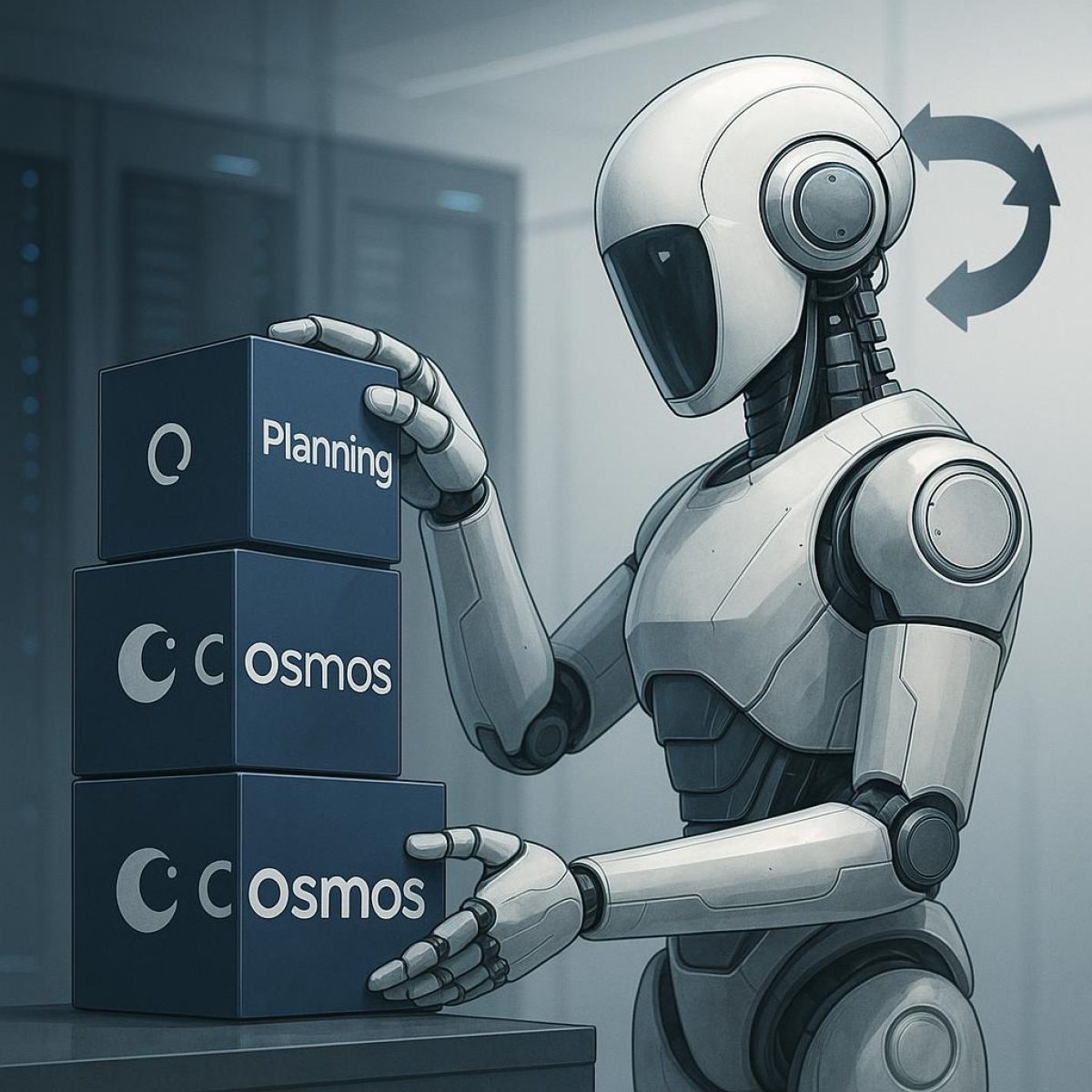
NVIDIA on Monday introduced Cosmos 3, an “open-world” foundation model and integrated simulation stack designed to let physical AI agents plan and reason through imagined futures before they move. The announcement signals a shift from reactive control loops toward anticipatory, simulation-driven behavior for robots and autonomous systems.
The real issue
What changed is concrete: Cosmos 3 bundles a large, real-time-capable model with NVIDIA’s Omniverse simulation runtime so agents can run fast imagined scenarios, score outcomes, and choose actions that account for likely downstream results. That moves decision work out of tight feedback loops and into short planning horizons that run on GPUs and simulated environments.
The commercial angle is simple and immediate. Making planning part of the control stack raises compute and integration requirements – and vendors that control GPUs, simulation runtimes and optimized stacks gain leverage. That dynamic already shows up in market signals such as Dell Technologies stock surges 32% as AI server revenue soars.
Why this matters now
Robotics and autonomous vehicle projects are leaving lab-scale demos and entering settings with more complex, unpredictable conditions. In those environments, reactive controllers can fail quietly and cause costly mistakes. Cosmos 3 promises a practical path to reduce those failures by letting agents evaluate imagined outcomes before acting.
That promise is credible because three enabling trends have converged: larger, faster models; higher-fidelity, real-time simulation (Omniverse); and cheaper access to GPU cycles at scale. NVIDIA’s prior work linking sim and reality is part of that lineage – see NVIDIA Research Advances Robotics From Simulation to the Real World – and Cosmos 3 packages the pieces into a single, vendor-led stack.
What to watch next
- Third-party benchmarks across real tasks. Independent tests that measure safety, task success and compute cost will show whether imagined planning actually reduces failures in varied settings.
- Licensing and openness. Will NVIDIA release model weights, training data details, or strict runtime limits? The answer will determine who can build open alternatives and how quickly competitors can plug into the stack.
- Partnerships and capacity deals. Watch announcements tying Cosmos 3 to cloud providers, OEM robots, or data-center capacity. Those deals will reveal whether the approach becomes a bundled product that favors high-end hardware partners.
Single-sentence takeaway: Cosmos 3 makes planning a product-level feature, and the next year will test whether simulation-first stacks become a competitive moat or another vendor-specific tooling layer.