In 2026, crypto trading automation extends far beyond simple buy-and-sell bots. Platforms increasingly combine rule-based automation with technical signals, copy trading and AI-assisted tools. Yet most retail trading outcomes still depend less on predictive technology than on structural discipline: position sizing, risk limits, consistent execution and the ability to follow predefined rules without emotional intervention.
This TradeSanta review 2026 therefore evaluates the platform from that structural perspective rather than from its marketing claims. Readers who are new to automated trading may first want to explore our complete guide to AI crypto trading bots before comparing individual platforms.
Updated August 2026
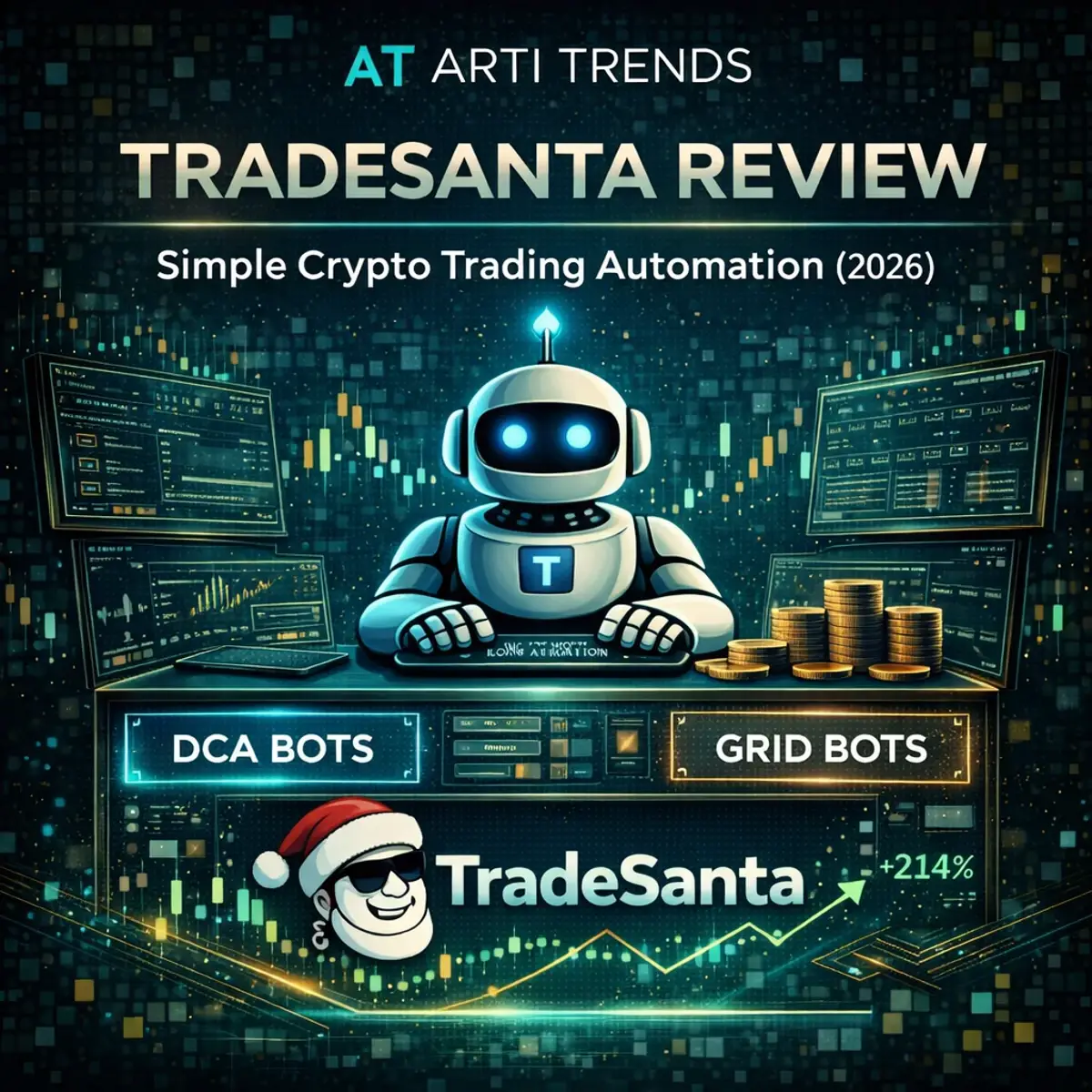
TradeSanta is no longer just a simple DCA and Grid bot platform.
The current platform includes Spot and Futures DCA/Grid automation, long and short strategies, Copy Trading, technical indicators, custom TradingView signals and mobile management. TradeSanta’s core bots remain rule-based rather than predictive AI, while an AI-powered trading assistant is offered separately. Current plans start at $25/month, with a 3-day trial available.
The central question is not whether TradeSanta can predict the market. It is whether the platform makes useful trading automation accessible while providing enough strategy flexibility and risk control for real-world use.
TradeSanta has traditionally been associated with straightforward DCA and grid automation, but its 2026 feature set is broader. Users can run spot and futures DCA or Grid bots, configure long and short strategies, use technical indicators and TradingView signals, and copy published strategies through the platform’s marketplace. This gives TradeSanta more flexibility than a basic template bot while keeping configuration largely no-code.
That does not make TradeSanta an open-ended strategy-engineering platform. Instead of constructing highly granular rule architectures such as those available through Coinrule or writing custom algorithmic code, users work within TradeSanta’s structured bot frameworks and configuration controls. The emphasis remains on making automation easier to deploy rather than offering unlimited strategy design.
Once configured, TradeSanta sends trading instructions to connected exchanges through API integrations. In this respect it shares characteristics with multi-exchange automation platforms such as 3Commas, although TradeSanta places greater emphasis on simplified bot creation, copy trading and accessible day-to-day management.
Automation itself does not create a trading edge. It converts trading rules into repeatable execution. When position sizing, entry conditions and exit logic are coherent, automation can reduce hesitation and improve consistency. When those rules are poorly designed, the same system can accelerate losses just as consistently.
The AI distinction also requires some nuance. TradeSanta’s core DCA, Grid and futures bots remain fundamentally rule-based rather than predictive AI systems. The company also offers an AI-powered trading and portfolio assistant through ChatGPT, but this should be viewed separately from the underlying bot engine. The assistant can support analysis and interaction; it does not turn the core automation layer into an autonomous market-prediction system.
Within the broader ecosystem of AI crypto trading bots, TradeSanta therefore occupies a useful middle ground. It offers substantially more than basic DCA or grid deployment, including TradingView-based signals, copy trading and futures automation, while remaining more accessible than platforms built around deep strategy engineering or custom algorithmic development.
Within the Three-Layer AI Crypto Trading Stack, we classify TradeSanta primarily within the strategy automation layer. It helps traders configure, trigger and manage predefined strategies, while final order execution still takes place through the connected exchange. Exchange-integrated platforms such as Pionex use a different architecture by embedding their automation directly within the trading venue.
This positioning is important for setting realistic expectations. TradeSanta can automate strategies, respond to predefined signals and reduce manual execution work, but it does not independently determine whether a strategy has a durable edge or dynamically govern total portfolio risk across changing market regimes.
This review applies the Arti-Trends Trading Bot Evaluation Framework to assess TradeSanta across automation capability, strategy flexibility, risk controls, usability, infrastructure and value for cost.
For a broader comparison of TradeSanta, 3Commas, Coinrule, Pionex and other architectures, see our guide to the Best AI Crypto Trading Bots in 2026.
TradeSanta Review Snapshot
Arti-Trends Score™: 80 / 100
Category: No-Code Crypto Trading Automation Platform
AI Stack Role: Strategy Automation Layer
Strategy Layer Coverage: Broad for No-Code Retail Automation
Primary Strength: Accessible Multi-Exchange Strategy Deployment
Positioning: User-Friendly Automation for DCA, Grid, Futures, TradingView Signals and Copy Trading
Best for:
Beginner and intermediate traders who want accessible no-code automation with enough flexibility to progress from basic DCA and Grid bots to futures, signal-based strategies and Copy Trading.
Less suitable for:
Advanced quantitative traders who require custom code, deeply nested conditional logic, institutional-grade execution infrastructure or centralized portfolio-level risk governance.
Methodology:
This review applies the Arti-Trends Trading Bot Evaluation Framework. The score measures automation capability, strategy flexibility, risk controls, usability, infrastructure and value for cost—not expected trading returns.
TradeSanta Review 2026: Framework Score & Pillar Analysis
To evaluate TradeSanta consistently against other crypto automation platforms, this review applies the Arti-Trends Trading Bot Evaluation Framework. Rather than relying on marketing claims, popularity rankings or promised returns, the framework measures platform quality across six weighted pillars: Automation Intelligence, Strategy Flexibility, Risk Controls, Usability, Infrastructure & Integrations, and Value for Cost.
Each pillar is scored on a 0–5 scale and weighted according to its importance in real-world trading workflows. The combined result produces the standardized Arti-Trends Score™ on a 0–100 scale, allowing platforms with different architectures and target users to be compared using the same methodology.
For 2026, TradeSanta receives an Arti-Trends Score™ of 80/100. Its strongest area remains usability: bot deployment is relatively accessible and configuration requires less technical overhead than more advanced automation environments. Strategy flexibility has also improved as TradeSanta has expanded beyond basic spot DCA and Grid bots to include futures automation, long and short workflows, TradingView signals and copy trading.
The score does not measure expected profitability. TradeSanta’s core automation remains predominantly rule-based: the platform executes the strategy parameters, signals and risk settings provided by the user rather than independently determining whether those rules create a durable market edge. Strong automation can improve consistency, but it can also accelerate losses when position sizing, DCA logic or risk limits are poorly configured.
Within the Arti-Trends framework, TradeSanta is therefore best understood as an accessibility-focused strategy automation platform. It offers more capability than a basic DCA or Grid bot, while deliberately avoiding the complexity of deep strategy engineering and custom algorithmic development. The key question is whether that balance between usability, flexibility, risk control and infrastructure is strong enough for the trader’s intended workflow.
TradeSanta - Accessible Multi-Exchange Strategy Automation
- Portfolio-level concentration and correlated exposure still require manual oversight
- Futures, martingale-style scaling and aggressive DCA settings can increase risk quickly
Explore TradeSanta’s DCA, Grid, futures and signal-based automation and see whether its accessibility-focused approach fits your trading workflow.
Explore TradeSanta →
What Is TradeSanta and How Does the TradeSanta Trading Bot Work in 2026?
TradeSanta is a cloud-based crypto trading automation platform that connects to supported exchanges through API integrations. Its main appeal is accessibility: traders can automate structured strategies without writing code or building a trading engine from scratch. While TradeSanta began with a strong focus on DCA and Grid automation, its current platform also supports spot and futures workflows, long and short strategies, TradingView signals and copy trading.
In practical terms, TradeSanta converts user-defined strategy settings and external signals into automated exchange orders. After connecting an exchange, traders choose a market and bot type, then configure variables such as position size, entry conditions, take-profit targets, extra orders, stop-loss rules and technical signals. Once activated, the bot monitors the configured conditions and sends trading instructions to the connected exchange automatically.
The platform remains fundamentally rule-based. TradeSanta does not independently determine whether a trade is profitable or continuously redesign strategy logic as market conditions change. Technical indicators and TradingView signals can determine when a bot acts, but the underlying rules and risk settings still originate from the trader, a predefined template or a copied strategy.
This distinction matters. Automation can improve execution consistency, but it does not create a trading edge by itself. Sensible position sizing, realistic entry conditions and disciplined exit rules can reduce hesitation and manual execution errors. Poorly configured rules can be executed just as efficiently and can therefore accelerate losses.
TradeSanta’s strategy coverage is now broader than simple spot DCA and Grid trading. DCA bots can scale into positions using predefined extra orders, while Grid bots automate repeated buying and selling across a configured price structure. Traders can also deploy long or short configurations and, on supported plans and exchanges, use dedicated futures DCA and Futures Grid bots. For more context on how these approaches behave in different market conditions, see our guide to AI crypto trading strategies.
TradingView expands the platform beyond its built-in configuration tools. Traders can use supported indicators and signals to trigger bots, while custom TradingView alerts can send webhook instructions into TradeSanta. This makes the platform useful for traders who want more control over entry timing without maintaining their own exchange-execution infrastructure.
Copy Trading adds another layer of accessibility. Instead of configuring every strategy from zero, users can explore published bot configurations and use them as starting points. This reduces setup friction, although copying another trader’s configuration does not remove the need to understand position sizing, market conditions and total portfolio exposure.
TradeSanta also offers an AI-powered trading and portfolio assistant through ChatGPT. This adds an AI-assisted interface around the broader trading workflow, but it should be evaluated separately from the bot engine itself. The DCA, Grid and futures automation systems remain predominantly rule-driven rather than autonomous predictive AI.
TradeSanta’s workflow therefore sits between basic template automation and more technically demanding algorithmic platforms. Its guided setup, mobile access, copy trading and no-code configuration make it approachable for beginner and intermediate users, while TradingView signals and futures functionality provide additional room to grow. Traders who require unrestricted conditional logic, custom code or sophisticated portfolio-wide orchestration may still find the architecture limiting.
Within the Three-Layer AI Crypto Trading Stack, TradeSanta operates primarily at the strategy automation layer. It helps users define, trigger and manage structured trading workflows, while actual order matching remains dependent on the connected exchange’s liquidity, API availability and execution infrastructure.
The central value proposition is therefore broader than simply making DCA and Grid bots easy to launch. TradeSanta combines accessible no-code automation with spot and futures strategies, external TradingView signals and copy trading while avoiding much of the complexity associated with professional algorithmic trading environments. Its strength is structured accessibility—not autonomous market prediction.
TradeSanta Bot Types and Automation Features
TradeSanta’s automation framework extends beyond basic DCA and Grid trading. The platform supports spot and futures bots, long and short strategies, technical entry signals, TradingView-based automation and Copy Trading. These tools are built around common AI crypto trading strategies while keeping configuration largely no-code.
DCA Bots
DCA bots build or adjust a position using predefined extra orders when price moves against the initial entry. Instead of relying on a single order, traders can average the entry price as additional orders are triggered at configured intervals.
Important DCA settings include:
- Initial order size
- Number and size of extra orders
- Extra-order spacing
- Take-profit target
- Stop-loss settings
- Technical or external entry signals
DCA can reduce the price movement required for a position to return to its take-profit level, but each additional order also increases capital exposure. Aggressive spacing or position scaling can therefore create large positions during prolonged trends. Traders should calculate the maximum fully deployed position before activating a bot.
Grid Bots
Grid bots automate repeated buying and selling across a configured price structure. They are generally designed for markets where price moves repeatedly within a range rather than trending strongly in one direction.
Grid configuration typically determines:
- Trading range or grid structure
- Order spacing
- Capital allocation
- Take-profit behavior
- Long or short direction where supported
Grid trading can benefit from repeated price oscillations, but the underlying market assumption matters. A strong breakout or prolonged trend can move price away from the configured range and leave capital exposed in positions that no longer match the original strategy.
Futures DCA and Futures Grid Bots
TradeSanta also supports dedicated Futures DCA and Futures Grid automation on supported exchanges and plans. These workflows apply similar automation logic to derivatives markets, where traders can use long or short positions and potentially incorporate leverage.
Futures increase both flexibility and risk. Leverage reduces the amount of adverse price movement required to create a significant loss, while DCA can simultaneously increase total position size as the market moves against the trade. Traders should therefore evaluate liquidation risk, margin requirements, funding costs and maximum exposure before using futures automation.
Long and Short Strategies
TradeSanta allows automation to be configured around both long and short market assumptions. A long bot is structured around benefiting from upward price movement, while a short strategy is designed around falling prices. This gives traders more flexibility than long-only spot automation, particularly when futures markets are used.
The direction itself does not create an advantage. Long and short bots still depend on appropriate entry conditions, risk limits and market assumptions.
TradingView and Technical Signals
TradeSanta can use technical signals to control when automated strategies enter the market. Supported tools include indicators such as RSI, MACD and Bollinger Bands, while advanced users can also connect custom TradingView alerts through webhooks.
This is an important expansion beyond simple always-on bot automation. Rather than opening a position immediately, traders can require specific signal conditions before the bot acts. Custom TradingView signals provide even more control by allowing strategy logic created in TradingView to trigger TradeSanta execution.
Copy Trading
Copy Trading provides a simpler route for users who do not want to build every configuration from scratch. Traders can explore existing strategies and use published configurations as starting points for their own automation.
Copying a configuration should not be confused with transferring the original trader’s future performance. Market conditions, account size, exchange fees and risk tolerance can differ substantially. Users should review position sizing and strategy settings before allocating capital to any copied bot.
Strategy Structure
Despite the broader feature set, TradeSanta remains a structured no-code automation platform rather than an unrestricted algorithmic development environment. Users choose a supported strategy framework, configure its parameters and optionally add technical or TradingView signals before allowing the system to execute through connected exchange APIs.
This balance is central to TradeSanta’s position in 2026: it provides more strategy flexibility than a basic DCA or Grid bot, while remaining considerably easier to configure than platforms built around custom code or complex multi-layer rule engines.
How to Configure a TradeSanta Bot in 2026
Setting up a TradeSanta bot is relatively straightforward, but easy configuration should not be confused with low risk. The platform guides users through the technical setup, while the trader remains responsible for choosing an appropriate strategy, position size, market and risk limits. For a broader walkthrough of exchange connections and automation basics, see our AI crypto trading setup guide.
1. Connect a Supported Exchange
The first step is connecting an exchange account to TradeSanta through API credentials. Use a dedicated API key with only the permissions required for trading and keep withdrawal permissions disabled. Where the exchange supports it, IP whitelisting provides an additional security layer.
Funds remain on the connected exchange. TradeSanta uses the API connection to send and manage orders rather than taking custody of the trading balance.
2. Choose Spot or Futures Trading
Next, decide whether the strategy will operate in the spot or futures market. Spot trading avoids liquidation mechanics associated with leveraged derivatives, while futures allow long and short exposure and may include leverage.
This decision materially changes the risk profile. Futures traders should understand leverage, margin mode, liquidation distance and funding costs before activating automation.
3. Select the Trading Pair and Bot Type
TradeSanta currently supports several structured automation workflows, including:
- Spot DCA bots
- Spot Grid bots
- Futures DCA bots
- Futures Grid bots
- Long and short strategies
The bot type should match the intended market behavior. DCA strategies progressively add exposure according to predefined rules, while Grid strategies are generally designed around repeated price movement within a structured range.
4. Define Position Size and Core Strategy Parameters
The next step is configuring how the bot will deploy capital. Depending on the strategy, important settings can include:
- Initial order size
- Extra orders or Grid structure
- Order spacing
- Volume scaling
- Take-profit target
- Stop-loss settings
- Maximum and minimum execution prices
For DCA strategies, traders should calculate the maximum fully deployed position rather than looking only at the initial order. Every additional order increases capital committed to the trade, and aggressive scaling can create substantially larger exposure than the first order suggests.
5. Configure Entry Signals and Filters
A TradeSanta bot does not always need to enter the market immediately. Users can apply supported technical filters and signals so that a deal starts only when predefined conditions are satisfied.
TradeSanta supports indicator-based workflows including RSI, MACD and Bollinger Bands. Higher-tier users can also connect custom TradingView alerts through webhooks, allowing strategy logic created in TradingView to trigger or stop TradeSanta automation.
This distinction matters. A continuously active bot and a signal-triggered bot may use the same DCA or Grid structure but enter the market under very different conditions.
6. Review the Risk Structure Before Activation
Before turning the bot on, review the entire position rather than each setting independently. Check how order size, extra orders, leverage, stop loss and concurrent bots interact under an adverse market move.
Running several bots across correlated assets can also create more total exposure than expected. Bot-level controls help manage individual strategies, but the trader still needs to monitor portfolio-wide concentration and available capital.
7. Activate and Monitor the Bot
Once the configuration has been reviewed, the bot can be activated. TradeSanta then monitors the relevant conditions and sends orders to the connected exchange according to the configured strategy.
The dashboard can be used to monitor active deals, positions and bot activity. Automation reduces the need for continuous manual order placement, but it should not eliminate oversight. Exchange errors, changing market conditions and unexpected position growth still require attention.
The key principle remains simple: TradeSanta automates the rules you configure; it does not validate whether those rules form a profitable strategy. Start with limited capital, observe how the bot behaves in real market conditions and scale only after you understand its maximum exposure and execution behavior.
Explore TradeSanta’s DCA, Grid, futures and signal-based automation and see how its no-code workflow fits your trading setup.
Start Using TradeSanta →
Common Beginner Mistakes When Using TradeSanta
TradeSanta makes automated trading relatively easy to configure, but a simple interface does not remove trading risk. Readers who are new to automation may first want to review our AI crypto trading for beginners guide before deploying their first bot.
One of the most common mistakes is running too many bots at the same time. Each strategy may look reasonable individually, but several bots trading correlated assets can create much larger portfolio exposure than expected. A broad market move can trigger multiple positions simultaneously.
A second mistake is configuring aggressive DCA scaling without calculating the maximum fully deployed position. Extra orders can reduce the average entry price, but they also commit more capital as the market moves against the trade. Tight spacing, large volume increases or too many extra orders can turn a small initial position into a much larger exposure.
Futures automation adds another layer of risk. Leverage can magnify both gains and losses, while liquidation and funding costs do not exist in the same way in ordinary spot trading. Combining leverage with aggressive DCA requires substantially more risk control than simply choosing a bot and activating it.
Traders also frequently underestimate execution costs. Grid and other high-frequency strategies may generate many relatively small trades, making exchange fees, spreads and slippage important to the final result. These costs are explained in more detail in our AI trading bot fees comparison.
Another error is assuming that technical indicators, TradingView signals or copied strategies automatically create an edge. Signals can improve entry discipline, while Copy Trading can reduce setup friction, but neither removes the need to understand why a strategy should work and how much capital it can lose.
Finally, traders often optimize configurations around one recent market environment. A Grid strategy that behaves well during sideways conditions may struggle when price begins trending strongly, while DCA settings calibrated for moderate volatility may become too aggressive during a larger market move.
A more disciplined approach is to begin with one strategy, conservative position sizing and limited capital. Observe how the bot behaves across different market conditions before adding more bots, leverage or larger allocations.
TradeSanta Review 2026: Strengths, Weaknesses and Structural Limitations
TradeSanta’s strongest characteristic remains accessibility. The platform provides a relatively clean no-code workflow for traders who want to automate strategies without programming their own execution system. Setup is structured, mobile management is available, and users can move from a basic configuration to more advanced workflows without immediately entering a professional algorithmic environment.
Its strategy coverage is also broader than its earlier DCA-and-Grid reputation suggests. TradeSanta now combines Spot DCA, Spot Grid, Futures DCA and Futures Grid with long and short strategies, technical indicators, TradingView signals and Copy Trading. This gives beginner and intermediate users meaningful room to expand beyond their first bot.
TradingView integration is particularly useful because it allows strategy logic created outside TradeSanta to trigger automated execution. Copy Trading provides another accessible route by allowing users to evaluate and reuse published configurations instead of building every setup from scratch.
TradeSanta also performs well on usability. The interface avoids much of the configuration overhead found in more advanced automation platforms, and mobile apps allow users to monitor and manage trading activity away from the desktop.
The trade-off is that TradeSanta is still not an unrestricted strategy-engineering environment. Traders looking for custom code, deeply nested conditional logic, sophisticated quantitative research tools or institutional execution infrastructure will find more flexibility elsewhere.
Portfolio-level risk management is another structural limitation. Bot-level settings can control individual deals, but the trader still needs to monitor total capital allocation, correlated positions and aggregate exposure across multiple strategies.
TradeSanta’s exchange footprint is also smaller than some leading multi-exchange competitors. Execution remains dependent on the connected exchange’s API availability, liquidity and order-matching infrastructure, which means TradeSanta cannot eliminate exchange-side latency, slippage or outages.
Overall, TradeSanta is best understood as an accessibility-focused strategy automation platform. Its strength is offering a useful amount of trading flexibility without forcing users into a highly technical workflow.
Is TradeSanta Safe? API Security and Trading Risk
TradeSanta uses exchange API connections rather than holding trading balances directly inside the platform. Funds remain on the connected exchange while TradeSanta receives permission to submit and manage trading orders.
Users should create dedicated API credentials for TradeSanta and grant only the permissions required for trading. Withdrawal permissions should remain disabled. TradeSanta also supports account-level two-factor authentication, and its documentation provides exchange-specific guidance for IP whitelisting where that feature is available.
This architecture reduces direct custody risk, but it does not make automated trading risk-free. Security depends on several layers: the TradeSanta account, the connected exchange, API permissions, device and email security, and the trader’s own configuration practices.
At the trading level, TradeSanta provides controls such as take-profit, stop-loss, order sizing, extra-order configuration and trailing functionality. These tools can limit how individual strategies behave, but they do not automatically solve portfolio concentration.
Several bots can still accumulate exposure to highly correlated assets at the same time. Futures bots add leverage, margin and liquidation risk, while DCA can increase capital committed to a position as price moves against it.
As explained in our guide to AI crypto trading risks, platform security and strategy risk should be evaluated separately. A technically secure API connection can still execute a badly designed strategy perfectly.
Minimum good practice: enable 2FA, use dedicated API keys, disable withdrawals, whitelist IP addresses where supported, monitor active deals and keep total automated exposure within a predefined capital limit.
TradeSanta Pricing in 2026: Basic, Advanced and Maximum
TradeSanta uses a subscription model rather than charging a percentage of trading profits. The current structure consists of Basic, Advanced and Maximum plans, with discounts available for longer subscription periods.
| Plan | Monthly price | Best fit |
|---|---|---|
| Basic | $25/month | Users starting with core automated trading workflows |
| Advanced | $45/month | More active traders who need additional automation features and capacity |
| Maximum | $90/month | Advanced users who need the broadest feature access, including higher-end signal and futures workflows |
TradeSanta also advertises a 3-day free trial, allowing users to explore the platform before committing to a paid subscription. Longer subscription periods can reduce the effective monthly price.
Feature access matters as much as the headline subscription price. For example, custom TradingView webhook signals are currently reserved for Maximum-plan users. Traders should therefore compare the required workflow against the actual plan limits rather than choosing only on bot count or monthly price.
The software subscription is also only one component of total trading cost. TradeSanta does not remove exchange trading fees, spreads, slippage or futures funding. A strategy that makes frequent small trades may be particularly sensitive to these costs. Our AI trading bot fees comparison explains how to evaluate them.
For smaller or low-frequency accounts, even a relatively affordable subscription can represent a meaningful percentage of deployed capital. For users running several automated strategies, the same fee may be much less significant. Value should therefore be judged relative to account size, trading frequency and which TradeSanta features are actually being used.
Final Verdict: Is TradeSanta Worth It in 2026?
Arti-Trends verdict: 80/100.
TradeSanta has evolved beyond the simple DCA-and-Grid platform it is sometimes assumed to be. In 2026, it combines accessible no-code automation with Spot and Futures DCA/Grid strategies, long and short trading, technical indicators, TradingView integration, Copy Trading, mobile management and an AI-assisted trading interface.
Its strongest advantage remains usability. TradeSanta provides enough structure for users to build and manage meaningful automated workflows without requiring programming knowledge or the configuration depth associated with professional algorithmic platforms.
Strategy flexibility is now stronger than in earlier versions of the platform, but TradeSanta still deliberately stops short of becoming an unrestricted development environment. Traders who need custom code, advanced quantitative research, highly complex conditional systems or institutional-grade execution infrastructure should look elsewhere.
Portfolio-wide risk governance also remains an important limitation. Individual bots can be configured with risk controls, but traders remain responsible for understanding how multiple DCA, Grid or futures strategies combine into total portfolio exposure.
TradeSanta’s core automation should also not be confused with autonomous predictive AI. Technical indicators, TradingView signals, Copy Trading and its AI-powered assistant can support decision-making and automation, but the underlying trading edge still depends on the strategy and risk framework supplied by the user.
Bottom line: TradeSanta is one of the stronger choices for beginner and intermediate traders who want accessible automation with more room to grow than a basic bot platform. Its combination of usability, DCA and Grid automation, futures, signals and Copy Trading makes it more capable than its simplicity-first positioning initially suggests.
Traders who need deeper strategy engineering or broader infrastructure should compare TradeSanta with other platforms in our guide to the best AI crypto trading bots of 2026.
Explore TradeSanta’s DCA, Grid, futures and signal-based automation and see whether its no-code workflow fits your trading strategy.
Explore TradeSanta →
Start with small allocations, understand the maximum exposure of your strategy and scale only after validating how the bot behaves in real market conditions.
Related Reading
If you want to understand how TradeSanta fits into the wider crypto automation ecosystem, these guides provide the most useful next steps:
- AI Trading Bots Hub — Start here for an overview of trading bot architectures, automation layers and platform types.
- AI Crypto Trading Bots: Complete Guide — Learn how modern crypto bots use rule-based automation, signals and exchange integrations.
- Best AI Crypto Trading Bots of 2026 — Compare TradeSanta with leading alternatives across usability, strategy flexibility, risk controls and infrastructure.
- AI Crypto Trading Strategies — Understand DCA, Grid and other automated strategy frameworks before deploying a bot.
- AI Trading Bot Fees — Understand how subscription costs, exchange fees, spreads, slippage and futures funding affect automated trading.
- Best Crypto Exchanges for AI Trading — Compare exchanges based on liquidity, fees, API quality and automation suitability.
Related Platform Reviews
Compare TradeSanta with other crypto automation platforms that take different approaches to strategy design and execution:
- 3Commas Review 2026 — Stronger multi-account execution, TradingView integration and advanced automation infrastructure.
- Cryptohopper Review 2026 — Broader strategy design, templates and marketplace-driven automation.
- Bitsgap Review 2026 — A strong alternative for Grid trading and multi-exchange automation.
- Coinrule Review 2026 — Better suited to traders who want transparent IF–THEN strategy construction.
- Hummingbot Review 2026 — A more technical option for developers who want open-source algorithmic control.
Frequently Asked Questions About TradeSanta
Is TradeSanta good for beginners?
Yes. TradeSanta is one of the more accessible crypto trading automation platforms because it combines guided no-code setup with DCA, Grid, signals and Copy Trading. Beginners can start with relatively simple configurations, while more advanced features such as futures and TradingView signals provide room to grow. However, easy setup does not remove trading risk, so new users should begin with small allocations and conservative settings.
Does TradeSanta use AI?
TradeSanta’s core trading bots are primarily rule-based rather than predictive AI systems. DCA, Grid and futures bots execute predefined parameters and signals rather than independently predicting market direction. TradeSanta also offers an AI-powered trading and portfolio assistant through ChatGPT, but this should be viewed separately from the underlying bot engine.
What trading strategies does TradeSanta support?
TradeSanta supports Spot DCA, Spot Grid, Futures DCA and Futures Grid automation, together with long and short strategies. Users can also incorporate technical indicators, TradingView signals and Copy Trading into their workflows. For more context on when these approaches may be suitable, see our guide to AI crypto trading strategies.
Does TradeSanta support futures trading?
Yes. TradeSanta supports dedicated Futures DCA and Futures Grid bots on supported exchanges and plans. Futures allow traders to automate long and short strategies and may involve leverage. Because leverage introduces liquidation, margin and funding risk, futures bots require stricter position sizing than ordinary spot automation.
Can TradeSanta use TradingView signals?
Yes. TradeSanta supports technical signals and custom TradingView alerts. Custom TradingView signals can be sent to TradeSanta through webhooks so that a bot starts or stops when specified TradingView conditions are met. Custom TradingView webhook signals are currently available on the Maximum plan.
Does TradeSanta offer Copy Trading?
Yes. TradeSanta includes Copy Trading, allowing users to explore published strategies and use existing bot configurations as starting points. Copying a strategy does not guarantee similar results because account size, market conditions, fees and risk tolerance can differ. Users should review the settings and maximum exposure before committing capital.
Is TradeSanta safe to use?
TradeSanta connects to exchanges through API credentials, so trading funds remain on the connected exchange rather than being deposited into TradeSanta itself. Users should enable two-factor authentication, use dedicated API keys, disable withdrawal permissions and use IP whitelisting where supported. Platform security does not eliminate trading risk: poorly configured DCA, futures or leveraged strategies can still generate substantial losses.
How much does TradeSanta cost in 2026?
TradeSanta currently lists three main subscription plans: Basic at $25 per month, Advanced at $45 per month and Maximum at $90 per month. Discounts may be available for longer subscriptions, and TradeSanta advertises a 3-day trial. The best-value plan depends on which features, bot limits and signal integrations you actually need.
Which exchanges does TradeSanta work with?
TradeSanta supports API connections to several major crypto exchanges. Its current documentation includes integrations for exchanges such as Binance, Binance US, Bybit, Kraken, OKX, HTX and HitBTC. Exchange availability and supported bot types can change, so traders should verify the latest integration list before subscribing or connecting capital.
Can TradeSanta guarantee profits?
No. TradeSanta cannot guarantee profits, and no legitimate trading bot should be treated as a profit machine. The platform can automate entries, exits, DCA orders and other trading rules, but results still depend on strategy quality, position sizing, fees, market conditions and execution. TradeSanta itself also states that there is no single bot configuration that guarantees profitable trading.
Is TradeSanta better than 3Commas?
TradeSanta is generally easier to approach for users who prioritize no-code setup, DCA and Grid automation, Copy Trading and straightforward strategy deployment. 3Commas offers deeper multi-account execution, broader API and TradingView infrastructure and more advanced execution workflows. The better choice depends on whether accessibility or execution depth is more important.
Is TradeSanta better than Cryptohopper?
TradeSanta is usually the simpler choice for traders who want accessible DCA, Grid, futures and signal-based automation without spending significant time building strategies. Cryptohopper provides a deeper strategy ecosystem, marketplace and customization environment but generally requires more setup and learning.
Who is TradeSanta best suited for?
TradeSanta is best suited to beginner and intermediate traders who want structured crypto automation without coding. It is particularly relevant for users interested in DCA, Grid, futures, TradingView signals or Copy Trading but who do not need unrestricted algorithmic development or institutional-grade execution infrastructure.