Bitsgap Review 2026 — Multi-Strategy Crypto Automation with AI Assistance
Bitsgap has changed significantly from the Grid-focused trading platform many crypto traders still associate with the brand. In 2026, the platform combines spot and futures automation, multiple bot architectures, multi-exchange connectivity, backtesting, smart trading tools and an AI-assisted portfolio layer inside one cloud-based interface.
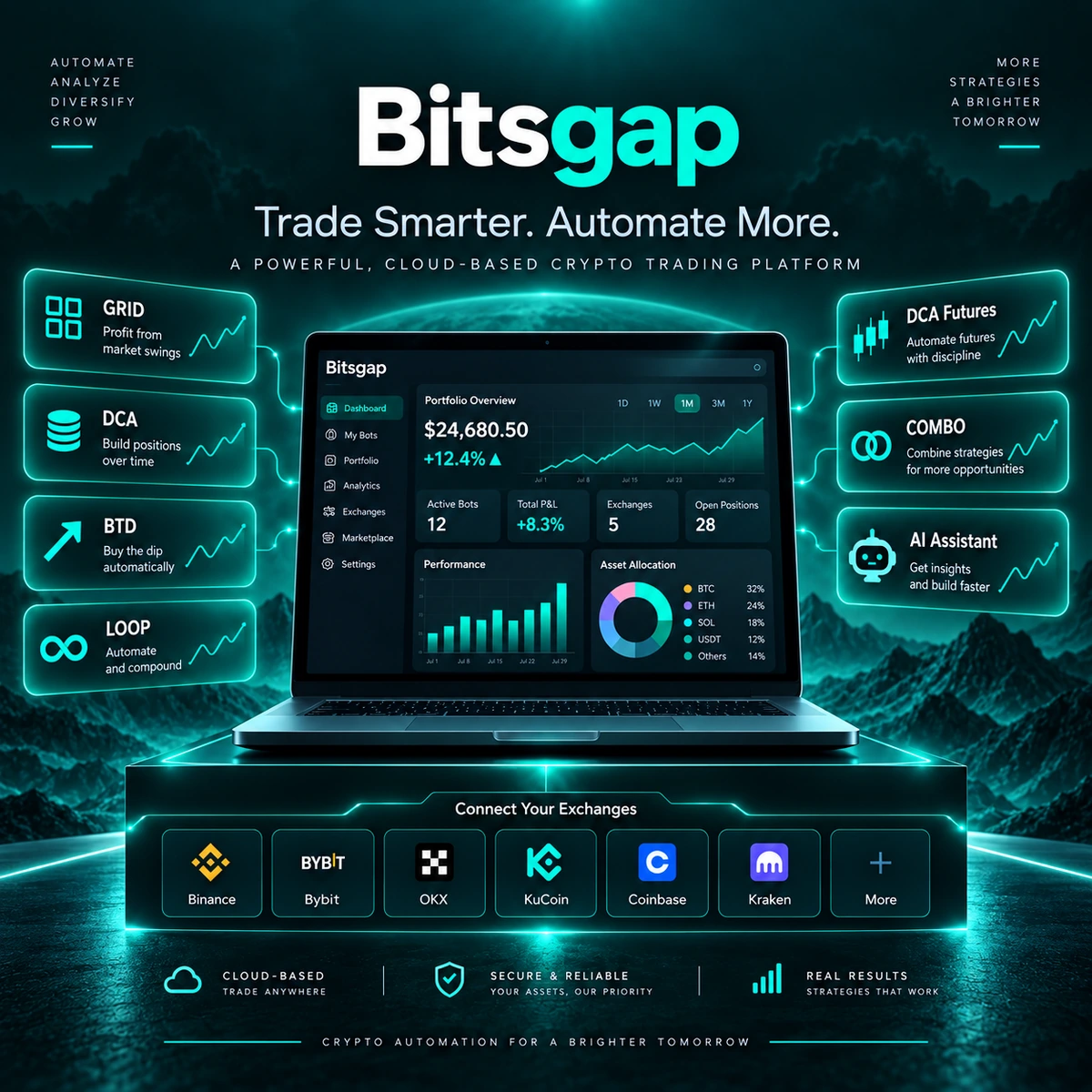
The current bot ecosystem includes GRID, DCA, Buy The Dip, LOOP, DCA Futures and COMBO strategies. Bitsgap has also introduced an AI Assistant that analyzes factors such as available capital, market conditions and historical volatility to help users construct and configure a diversified bot portfolio.
That does not make Bitsgap an autonomous AI trader. The AI Assistant helps with strategy selection, pair selection, diversification and configuration, while the underlying bots continue to execute predefined trading logic. In other words, AI assists the setup process; it does not independently predict the market or invent trades in real time.
This distinction matters because Bitsgap now sits across several layers of the modern crypto trading bot ecosystem. It combines strategy automation with multi-exchange execution, portfolio monitoring and increasingly sophisticated decision-support tools.
Futures have also become an important part of the platform. Bitsgap’s DCA Futures and COMBO bots support long and short strategies, while COMBO combines DCA-style position building with Grid-based profit taking. Supported futures workflows can use leverage, which increases both flexibility and risk.
The platform is therefore no longer best described as a tool designed only for sideways markets. GRID remains one of its core strengths, but DCA, LOOP, Buy The Dip and futures automation allow traders to build strategies around different market conditions and directional assumptions.
This Bitsgap review 2026 evaluates whether that broader platform actually delivers useful automation or simply adds complexity. We assess Bitsgap across Automation Intelligence, Strategy Flexibility, Risk Controls, Usability, Infrastructure & Integrations, and Value for Cost using the Arti-Trends Trading Bot Evaluation Framework.
For a direct comparison with competing platforms such as 3Commas, Cryptohopper, TradeSanta, Coinrule and Pionex, see our updated guide to the Best AI Crypto Trading Bots of 2026.
The central question is simple: does Bitsgap’s combination of multi-strategy bots, futures automation, exchange connectivity and AI-assisted portfolio construction justify its cost and complexity?
Bitsgap Review Snapshot
Arti-Trends Score™: 84 / 100Category: Multi-Strategy Crypto Trading Automation Platform
AI Stack Role: Strategy Automation, Execution & AI-Assisted Portfolio Layer
Strategy Layer Coverage: Very Strong
Primary Strength: Multi-Exchange Bot Automation Across Spot and Futures
Positioning: AI-Assisted Automation for Grid, DCA, Futures and Multi-Strategy Trading
Best for:
Beginner, intermediate and advanced retail traders who want accessible multi-exchange automation with a broad range of strategies including GRID, DCA, Buy The Dip, LOOP, DCA Futures and COMBO bots.
Less suitable for:
Professional quantitative traders who require unrestricted custom code, institutional low-latency execution or fully autonomous AI trading, and long-term investors who do not need active trading automation.
Methodology:
This review applies the Arti-Trends Trading Bot Evaluation Framework. The score measures automation capability, strategy flexibility, risk controls, usability, infrastructure and value for cost—not expected trading returns.
Bitsgap — AI-Assisted Multi-Strategy Crypto Automation
- Futures and leveraged COMBO or DCA strategies can increase losses and liquidation risk quickly
- The AI Assistant supports configuration and portfolio construction rather than autonomous market prediction
What Bitsgap Actually Does in 2026
Bitsgap is a cloud-based crypto trading automation platform that connects multiple exchange accounts to one interface and allows traders to run automated strategies without hosting their own trading software.
The platform has evolved well beyond its earlier reputation as primarily a Grid bot. Its current automation ecosystem includes GRID, DCA, Buy The Dip, LOOP, DCA Futures and COMBO bots, together with Smart Orders, Demo Mode, backtesting, portfolio monitoring and an AI Assistant. :contentReference[oaicite:0]{index=0}
This gives Bitsgap a broader role within the crypto trading bot ecosystem. Instead of specializing in one strategy, it provides several structured bot architectures designed for different market conditions and trading objectives.
GRID Bots
GRID remains one of Bitsgap’s core strategies. The bot divides a predefined price range into multiple levels and automatically places buy and sell orders as price moves between them.
This structure is most naturally suited to markets that fluctuate within a range. Rather than predicting the next major price move, the bot attempts to repeatedly capture smaller movements inside the configured boundaries.
DCA Bots
Bitsgap’s DCA Bot automates dollar-cost averaging by splitting capital across a series of purchases rather than entering a full position at once. Traders can use DCA to build exposure gradually while defining entry logic, order size and exit conditions.
DCA reduces the importance of one exact entry price, but it does not eliminate downside risk. If the market continues moving against the position, additional orders can increase total exposure.
Buy The Dip Bot
The Buy The Dip Bot is designed for traders who want to accumulate an asset after price declines and sell portions after subsequent recoveries. It uses a grid-style structure but focuses on increasing the amount of the base asset rather than simply generating quote-currency Grid profits.
LOOP Bot
The LOOP Bot repeatedly reinvests trading proceeds into a continuing cycle of buy and sell orders. After an order is completed, the bot recalculates and places the next order automatically.
This makes LOOP particularly relevant to longer-term traders who want automated accumulation and reinvestment rather than managing every individual order manually.
DCA Futures Bots
Bitsgap also supports dedicated DCA Futures automation. These bots can operate in both long and short directions and currently support leverage from 1x to 10x on compatible exchanges. Users can select Cross or Isolated margin and configure Take Profit, trailing exits and Stop Loss settings. :contentReference[oaicite:1]{index=1}
Futures substantially increase the platform’s strategy flexibility, but they also introduce liquidation, margin and leverage risk. A DCA strategy that gradually increases exposure can become significantly more dangerous when leverage is added.
COMBO Bots
The COMBO Bot combines elements of DCA and Grid trading within a futures strategy. It can build a position progressively while using Grid-style orders to realize gains as price moves through the configured structure.
COMBO can operate both long and short, making it one of Bitsgap’s more flexible bot architectures. It is also one of the higher-risk workflows because directional exposure, DCA scaling and leverage can interact simultaneously.
AI Assistant
Bitsgap’s AI Assistant adds a separate configuration and portfolio layer. Users select an exchange, investment amount and time horizon, after which the Assistant analyzes factors such as available balance, market conditions and historical volatility to propose a diversified portfolio of bots. :contentReference[oaicite:2]{index=2}
The distinction between AI-assisted setup and autonomous trading is important. Once the portfolio is launched, the individual bots still follow deterministic trading rules. The AI Assistant helps decide what to configure and how capital may be distributed; it does not continuously invent discretionary trades based on its own market predictions. :contentReference[oaicite:3]{index=3}
Demo Mode and Backtesting
Before deploying live capital, users can experiment in Bitsgap’s Demo Mode using simulated funds and market data from real exchanges. Demo Mode supports strategies including GRID, BTD, DCA, DCA Futures and COMBO, although the AI Assistant is not included in the demo environment. :contentReference[oaicite:4]{index=4}
Backtesting provides another way to inspect how a configuration would have behaved historically. This can help compare settings and identify obvious weaknesses, but historical results should not be interpreted as evidence that the same strategy will remain profitable under future market conditions.
Multi-Exchange Infrastructure
Bitsgap’s other major strength is exchange connectivity. The current supported-exchange directory includes major platforms such as Binance, Coinbase, Kraken, KuCoin, OKX, HTX, Bitget, Crypto.com, Gate, Aster, EVEDEX and others. Bots, balances and trading activity can be monitored from one interface instead of managing every exchange separately. :contentReference[oaicite:5]{index=5}
Execution still occurs through the connected exchange. Bitsgap provides the automation and control layer, while liquidity, matching quality, API availability and exchange-specific trading conditions remain dependent on the underlying venue.
In practical terms, Bitsgap in 2026 is best understood as a multi-strategy automation layer rather than a single Grid bot. Its value comes from combining several structured spot and futures strategies, centralized exchange connectivity and increasingly sophisticated AI-assisted configuration within one no-code environment.
How to Set Up a Bitsgap Bot in 2026
Bitsgap uses a structured no-code workflow, so traders can move from exchange connection to an active bot without installing software or writing strategy code. The technical setup is relatively simple, but the important decisions remain strategy selection, capital allocation and risk limits.
For a broader explanation of exchange APIs and automated trading setup, see our AI crypto trading setup guide.
1. Connect a Supported Exchange
The first step is connecting a crypto exchange to Bitsgap. Most connections use API credentials created inside the exchange account and then added through the My Exchanges section in Bitsgap.
Bitsgap uses the connection to read balances and send trading orders while the funds themselves remain on the exchange. Withdrawal permissions should not be enabled for a trading-bot API connection.
After connecting, users can verify that balances are visible inside the Bitsgap Portfolio before deploying a live strategy.
2. Start in Demo Mode
Before committing real capital, Bitsgap provides a Demo Mode using virtual funds and market data from real exchanges. This allows traders to experiment with bot settings without sending real orders.
Demo Mode currently supports strategies including GRID, BTD, DCA, DCA Futures and COMBO. The AI Assistant is not available inside the demo environment.
This is particularly useful for understanding how Grid levels, DCA orders, futures leverage and exit settings interact before moving to live trading.
3. Choose the Right Bot Architecture
From the Bots dashboard, users select Start New Bot and choose the strategy that best matches their intended workflow.
- GRID — structured buying and selling across predefined price levels
- DCA — gradual position building through scheduled or triggered orders
- BTD — accumulation-focused automation designed around price declines and recoveries
- LOOP — repeated trading and reinvestment cycles
- DCA Futures — leveraged long or short DCA automation
- COMBO — futures automation combining DCA position building with Grid-style execution
The bot should be selected based on its underlying market assumption rather than simply choosing whichever strategy produced the strongest recent backtest.
4. Select the Exchange and Trading Pair
After choosing a bot, select the connected exchange and the market the strategy will trade. Liquidity, volatility, minimum order requirements and exchange fees can materially influence how an automated strategy behaves.
Bitsgap also provides Quick Setup configurations for several bot types, offering predefined short-, medium- or longer-term parameter structures. These can simplify setup, but users should still understand what the selected settings mean before deploying capital.
5. Define the Investment and Strategy Parameters
The next step determines how the bot will use capital. The exact settings depend on the selected strategy.
For a GRID bot, this may include:
- total investment amount
- upper and lower price boundaries
- number of Grid levels
- order spacing
- Take Profit
- Stop Loss
- trailing features
DCA strategies introduce additional decisions around initial orders, subsequent orders and how aggressively exposure increases when price moves.
Futures strategies require even more care because users must also choose long or short direction, initial margin, leverage and margin mode. Bitsgap currently allows leverage of up to 10x within supported DCA Futures and COMBO workflows.
6. Review Maximum Exposure
Before activating a bot, traders should calculate how much capital the strategy can use if all configured orders are triggered.
This is especially important for DCA and futures bots. A small initial position can grow considerably as additional orders are placed, while leverage magnifies the resulting exposure.
Running several bots at the same time can also create correlated portfolio risk. Individual bot settings should therefore be reviewed together rather than treating each strategy as an isolated position.
For more detail, see our guide to AI crypto trading risks.
7. Backtest the Configuration
Bitsgap provides historical backtesting for supported bot strategies. Before launch, users can compare how the selected parameters would have behaved over previous market data and adjust the setup if necessary.
Backtesting is useful for identifying obvious configuration problems and understanding how a strategy reacts to different price movements. It should not be treated as a profitability forecast. Settings that fit one historical period may behave very differently when volatility, liquidity or market direction changes.
8. Launch and Monitor the Bot
Once the exchange, pair, investment amount, strategy parameters and risk limits have been reviewed, the bot can be activated.
Bitsgap then executes the configured strategy through the connected exchange while the dashboard tracks active orders, positions and bot performance.
Automation reduces manual order placement, but it does not remove the need for monitoring. Traders should periodically review whether the original market assumptions still apply, whether total exposure remains acceptable and whether exchange connectivity is operating normally.
The core principle is simple: Bitsgap can automate a strategy with considerable precision, but the trader remains responsible for choosing the strategy, defining the risk and deciding when the configuration no longer fits the market.
De setupflow hierboven sluit aan op Bitsgap’s actuele officiële procedures: exchange koppelen via My Exchanges, Demo Mode gebruiken vóór live deployment, daarna bot → exchange/pair → investment → settings → backtest → launch.Common Beginner Mistakes When Using Bitsgap
Bitsgap makes automated trading easier to configure, but the platform can also create a false sense of simplicity. The bot executes the parameters it receives; it does not determine whether the underlying strategy is appropriate for current market conditions.
For traders who are new to automation, our AI crypto trading for beginners guide explains the basic concepts that should be understood before deploying live capital.
1. Treating the AI Assistant as a Market Predictor
Bitsgap’s AI Assistant can help with pair selection, capital allocation and portfolio construction, but it should not be confused with an autonomous trading system that knows where prices will move next.
The individual bots still execute predefined trading structures. A portfolio suggested with AI assistance can therefore lose money if the selected markets move against the assumptions built into those strategies.
2. Choosing a Bot Without Understanding Its Market Assumption
Bitsgap now offers several different bot architectures, and they are not interchangeable.
- GRID generally works best when price repeatedly moves through a defined range.
- DCA gradually builds exposure and can increase capital committed to a falling position.
- BTD focuses on accumulating an asset during price declines.
- LOOP repeatedly reinvests completed trading cycles.
- DCA Futures adds directional exposure and leverage.
- COMBO combines futures, DCA-style position building and Grid execution.
Selecting a bot because it performed well recently is not the same as understanding why its structure may fit the expected market environment.
3. Using Too Much Capital in One Bot
Another common mistake is looking only at the first order instead of the maximum capital the bot can deploy.
DCA strategies may place additional orders as price moves against the position. Grid strategies distribute capital across multiple levels. Futures strategies can magnify exposure through leverage.
Before activation, traders should understand how much capital can ultimately be committed if every configured order is triggered.
4. Running Too Many Correlated Bots
Bitsgap makes it easy to manage several strategies from one dashboard, but more bots do not automatically create better diversification.
For example, separate bots trading BTC, ETH and several large-cap altcoins may all react to the same broad crypto market move. During a sharp sell-off, multiple positions can therefore move against the trader simultaneously.
Risk should be reviewed across the entire automated portfolio rather than only at the individual bot level.
5. Using Futures Leverage Too Aggressively
DCA Futures and COMBO make Bitsgap considerably more flexible than a spot-only automation platform, but they also introduce liquidation and margin risk.
Leverage increases exposure without requiring the same amount of initial capital. That can amplify gains, but it also reduces the distance between the current price and a potentially damaging loss.
Combining leverage with DCA-style scaling can be particularly aggressive because exposure may increase while the market is already moving against the position.
6. Ignoring Trading Fees and Funding Costs
Automated strategies can generate many transactions. A Grid bot may repeatedly buy and sell across relatively small price intervals, while futures positions can also incur funding costs.
A strategy that appears profitable before costs may become much less attractive after exchange fees, spreads, slippage and funding are included.
Our AI Trading Bot Fees Comparison explains why these execution costs matter so much for automated strategies.
7. Overfitting Backtests
Bitsgap’s backtesting tools can help users compare parameters before going live, but historical optimization has limits.
Repeatedly changing a Grid range, DCA spacing or other settings until the historical result looks exceptional can create a strategy that is overly dependent on one specific period.
A useful backtest should help reveal how a strategy behaves—not convince the trader that future returns are predictable.
8. Assuming Automation Means Hands-Off Trading
Once activated, Bitsgap can place and manage orders without constant manual input. That does not mean the strategy should be ignored indefinitely.
Market regimes change. A range can break, volatility can expand, correlations can increase and exchange conditions can deteriorate. Parameters that were reasonable when a bot was launched may eventually need to be reviewed.
As explained in our AI crypto trading risks guide, automation removes repetitive execution work; it does not remove market risk or the need for oversight.
A disciplined starting point is simple: begin in Demo Mode, move to limited live capital, understand the maximum exposure of each strategy and add more bots or leverage only after you understand how the existing configuration behaves.
Bitsgap Strengths, Weaknesses and Structural Limitations
Bitsgap’s biggest strength in 2026 is that it combines a broad set of trading strategies with multi-exchange infrastructure while keeping the workflow accessible to traders who do not want to write code.
Strong Multi-Strategy Bot Coverage
Bitsgap is no longer dependent on one Grid-based use case. Its current bot ecosystem spans GRID, DCA, Buy The Dip, LOOP, DCA Futures and COMBO, giving traders several ways to automate both spot and futures strategies.
This breadth makes Bitsgap more adaptable to different market assumptions. A trader can use Grid structures for range-based markets, DCA for gradual position building, BTD for accumulation-focused workflows and futures bots for directional long or short strategies.
Excellent Multi-Exchange Infrastructure
Multi-exchange connectivity remains one of Bitsgap’s clearest advantages. The platform currently supports more than 15 major exchanges and centralizes bots, balances, orders and performance monitoring inside one interface.
This reduces the operational friction of managing separate exchange dashboards and makes Bitsgap particularly useful for traders who maintain capital across several venues.
Futures support is more limited than overall spot connectivity. Bitsgap currently documents futures trading through exchanges including Binance, OKX, KuCoin, Bybit and Bitget.
Strong Futures Automation
DCA Futures and COMBO significantly expand Bitsgap beyond its traditional spot-trading identity. Both can operate in long or short directions, while supported configurations allow leverage between 1x and 10x and Cross or Isolated margin.
COMBO is particularly interesting because it combines Grid levels and DCA orders inside one futures strategy. That provides substantial flexibility without requiring traders to build their own execution engine.
Accessible No-Code Workflow
Despite the growing number of features, Bitsgap remains relatively approachable. Bot creation, exchange selection, strategy settings, backtesting and performance monitoring are presented through a visual cloud interface rather than code or command-line tooling.
Demo Mode also gives users a lower-risk environment for learning how different bot architectures behave before sending real orders to an exchange.
AI Assistance Adds Useful Setup Intelligence
The AI Assistant is a meaningful addition because it can help users move from an account balance to a more structured bot portfolio without configuring every decision manually.
However, this strength should be interpreted correctly. Bitsgap’s AI layer is primarily an assistance and configuration layer. The underlying trading bots still follow defined execution logic rather than allowing an autonomous AI model to continuously invent new trades.
Risk Controls Are Strong but Not Automatic Risk Management
Bitsgap provides useful controls including Take Profit, Stop Loss, trailing functionality, position sizing and strategy-specific limits. Futures bots also expose margin and leverage settings.
These tools improve control at the individual strategy level, but they do not remove the need to understand combined portfolio exposure. Several bots trading correlated assets can still produce concentrated risk during a broad market move.
Futures Add Significant Complexity
The same futures functionality that strengthens Bitsgap’s strategy coverage also increases its risk profile. Long and short exposure, leverage, margin mode, liquidation risk and DCA scaling can interact in ways that are substantially more complex than a standard spot Grid bot.
This makes the platform more capable, but it also means that advanced features should not be treated as simple extensions of beginner-friendly spot automation.
Execution Still Depends on the Exchange
Bitsgap provides the strategy and automation layer, but orders are ultimately executed through the connected exchange. Liquidity, API availability, order matching, spreads and exchange outages therefore remain outside Bitsgap’s direct control.
This is normal for API-connected trading platforms, but it means that a strong bot configuration can still experience poor execution if the underlying trading venue is unstable or illiquid.
Advanced Users May Want More Programmability
Bitsgap offers substantial no-code flexibility, but it is not an unrestricted quantitative development environment. Traders who want to write custom algorithms, control every element of execution logic or build institutional low-latency systems will find platforms such as Hummingbot structurally more flexible.
Overall: Bitsgap’s main advantage is balance. It offers considerably more strategy breadth than a simple Grid bot while remaining easier to deploy than developer-focused algorithmic infrastructure. Its main limitations come from the same expansion that makes it attractive: futures increase risk and complexity, AI remains assistive rather than autonomous, and execution quality still depends on the connected exchange.
De actuele Bitsgap-documentatie ondersteunt hier de bredere botmix en bevestigt futures op Binance, OKX, KuCoin, Bybit en Bitget. COMBO ondersteunt daarnaast long/short, Cross of Isolated margin en 1x–10x leverage.Is Bitsgap Safe? Security, API Permissions and Trading Risk
Bitsgap does not require users to transfer cryptocurrency into a Bitsgap-controlled wallet. Instead, trading funds remain on the connected exchange while Bitsgap sends trading instructions through API connections.
This architecture reduces custodial risk, but it does not make automated trading risk-free. Security should be considered across three separate layers: Bitsgap account security, exchange API security and the financial risk created by the trading strategy itself.
Your Funds Remain on the Exchange
Bitsgap operates as an automation and execution layer rather than a cryptocurrency custodian. Assets remain inside the user’s exchange account while Bitsgap uses API permissions to read balances and place or manage trades.
This means traders do not need to deposit funds directly with Bitsgap before running a bot.
Withdrawal Permissions Are Not Allowed
One of the most important safeguards is the restriction on API withdrawal permissions.
Bitsgap requires exchange API keys to provide the permissions needed for trading and account information, but withdrawal access must remain disabled. According to Bitsgap’s current documentation, an API key with withdrawal permissions enabled is rejected by the platform.
This limits what the Bitsgap connection can do. Even if the platform is allowed to place trades, the API connection should not be able to transfer cryptocurrency out of the exchange account.
API Keys and Account Data Are Encrypted
Bitsgap states that passwords and API keys are stored in encrypted form and that API credentials are encrypted during transmission. Its current security documentation also specifies 2048-bit encryption for stored data.
For supported exchanges, Bitsgap can additionally use trusted IP addresses. Some exchanges require Bitsgap’s IP addresses to be added to the API whitelist before the connection can continue operating.
IP whitelisting adds another restriction because the exchange can limit where API requests using that key are accepted from.
Two-Factor Authentication and Hardware Security Keys
Users can enable two-factor authentication (2FA) on their Bitsgap account. Bitsgap also currently supports FIDO2-compatible hardware security keys for an additional authentication layer.
The platform also monitors account access. Bitsgap says that logins from unfamiliar devices or locations can require email confirmation, while repeated failed login attempts may result in a temporary IP lockout.
One API Key Cannot Simply Be Reused Across Multiple Bitsgap Accounts
Bitsgap also operates an API Account Lock system designed to prevent the same exchange API key from being reused across multiple Bitsgap accounts.
If the system detects that a key has already been associated with another Bitsgap account, the connection can be blocked and the original account may receive a notification.
This adds another safeguard around compromised or incorrectly reused exchange credentials.
No Withdrawal Access Does Not Mean Zero API Risk
It is important not to overstate the protection provided by trade-only API keys.
A trading-enabled API key can still place orders. If such credentials were compromised, an attacker might not be able to withdraw funds directly, but unauthorized trades could still cause losses.
Bitsgap itself highlights this distinction in its current API-security guidance: restricting withdrawals removes an important attack path, but secure credential storage, IP restrictions and account protection still matter.
For that reason, traders should use a dedicated API key for Bitsgap, disable every permission that is not required and enable additional exchange-side protections whenever they are available.
Bitsgap Security Does Not Remove Exchange Risk
Because the assets remain on the exchange, users continue to depend on the security and operational reliability of that exchange.
An exchange breach, account restriction, API outage, liquidity problem or trading interruption can still affect a Bitsgap bot even if the Bitsgap platform itself is functioning normally.
This makes exchange selection an important part of the overall automation setup. See our best exchanges for AI trading guide for more detail.
Trading Risk Is Separate from Platform Security
A secure API connection cannot protect a trader from an unsuitable strategy.
GRID bots can suffer when markets leave their configured range. DCA strategies can continue increasing exposure during prolonged declines. Futures strategies add leverage, margin requirements, funding costs and liquidation risk.
COMBO and DCA Futures deserve particular attention because several risk mechanisms can operate at the same time: directional exposure, additional DCA orders and leverage.
Take Profit, Stop Loss and trailing controls can help manage these risks, but they cannot guarantee that losses remain within an expected range under every market condition.
For a deeper breakdown, see our AI crypto trading risks guide.
Practical Bitsgap Security Checklist
- Keep withdrawal permissions disabled on every exchange API key connected to Bitsgap.
- Enable 2FA on both Bitsgap and the connected exchange.
- Use exchange API IP whitelisting where supported or required.
- Create a dedicated API key for Bitsgap rather than reusing credentials across services.
- Remove unused API keys from exchange accounts.
- Use a unique password and consider a FIDO2 hardware security key.
- Review active bots and API connections regularly.
- Treat futures risk separately from cybersecurity and understand maximum strategy exposure before using leverage.
Our assessment: Bitsgap has a well-structured security model for an API-connected trading platform. Keeping assets on the exchange, rejecting withdrawal-enabled API keys, supporting 2FA and hardware security keys, encrypting API credentials and using exchange-side IP restrictions all reduce the attack surface.
However, Bitsgap should not be described as risk-free. Trading permissions remain powerful, the connected exchange remains part of the security chain and automated strategies can still generate substantial financial losses. This distinction is one reason Bitsgap scores strongly—but not perfectly—on Risk Controls & Safeguards at 4.2 / 5.
De securityclaims zijn opnieuw gecontroleerd op de actuele Bitsgap-documentatie. Bitsgap bevestigt dat fondsen op de exchange blijven, withdrawal-enabled API keys worden geweigerd, API-data wordt versleuteld en 2FA plus FIDO2 security keys worden ondersteund. Voor Binance, KuCoin, Kraken en Crypto.com documenteert Bitsgap momenteel ook trusted-IP requirements.
Bitsgap Pricing in 2026: Free, Basic, Advanced and Pro
Bitsgap uses a subscription model with four current tiers: Free, Basic, Advanced and Pro. The paid plans differ mainly in active bot limits, futures access, backtesting depth and advanced AI or portfolio features.
All new users can currently start with a 7-day PRO trial without providing a credit card. If no paid subscription is selected after the trial, the account moves to the Free plan.
| Plan | Monthly | Annual Billing | Bot Capacity | Key Features |
|---|---|---|---|---|
| Free | $0 | $0 | 20 active Demo bots plus limited Evedex COMBO access | Manual trading, Demo Mode and basic platform access |
| Basic | $29 / month | $23 / month equivalent | 3 Grid bots + 10 DCA/LOOP bots | AI Assistant, Smart Orders and up to 30 days of backtesting |
| Advanced | $69 / month | $55 / month equivalent | 10 Grid bots + 50 DCA/LOOP bots | Futures bots, DCA profit reinvestment, Grid trailing and up to 180 days of backtesting |
| Pro | $149 / month | $119 / month equivalent | 50 Grid bots + 250 DCA/LOOP bots | Futures, AI Portfolio Mode, AI-launched bot Take Profit, advanced Grid controls and up to 365 days of backtesting |
Prices shown in USD and reflect Bitsgap’s published pricing at the time of this 2026 review. Annual figures are monthly equivalents when paying for 12 months and may change over time.
Free Plan
The Free plan is primarily useful for exploring Bitsgap rather than running a full live multi-exchange bot portfolio. It currently includes 20 active Demo bots, unlimited manual trading and limited COMBO access through Evedex.
For most users, its main value is providing a way to stay inside the Bitsgap ecosystem after the PRO trial without immediately committing to a paid subscription.
Basic — $29 per Month
Basic is the first meaningful tier for traders who want to deploy automated spot strategies. It currently allows up to 3 active Grid bots and 10 active DCA/LOOP bots.
The plan also includes the AI Assistant, unlimited Smart Orders and historical backtesting of up to 30 days.
For traders focused mainly on spot Grid or DCA automation, Basic provides much of Bitsgap’s core functionality without paying for futures features they may not use.
Advanced — $69 per Month
Advanced is where Bitsgap becomes substantially more capable. Bot capacity rises to 10 Grid bots and 50 DCA/LOOP bots, while the plan also unlocks futures bots.
Additional features include DCA profit reinvestment, Grid trailing functionality and a longer published backtesting window of up to 180 days.
For traders who want both spot and futures automation, Advanced is likely the most balanced tier in the current lineup.
Pro — $149 per Month
Pro is aimed at users managing a larger number of automated strategies or who want access to Bitsgap’s most advanced portfolio and AI-related tools.
The limits increase to 50 active Grid bots and 250 DCA/LOOP bots, while the plan adds features such as AI Portfolio Mode, Take Profit for AI-launched bots, additional Grid controls and backtesting of up to 365 days.
The significantly higher subscription cost means Pro makes the most sense when the additional bot capacity or portfolio-level features are actually required. A trader running only a handful of relatively simple strategies may receive little practical benefit from paying for the highest tier.
What Does the Bitsgap Subscription Not Include?
The subscription fee is only the cost of using the Bitsgap platform. Trading still occurs on the connected exchange, so users can also incur exchange trading fees, spreads, slippage and—when using perpetual futures—funding costs.
These costs become particularly important for high-frequency Grid strategies because a large number of relatively small transactions can accumulate meaningful execution expenses.
See our AI trading bot fees guide for a broader explanation of the costs that should be considered when comparing automated trading platforms.
Is Bitsgap Good Value for Money?
Bitsgap scores 3.6 / 5 for Value for Cost in the Arti-Trends framework. The platform offers considerable functionality, but it is not one of the cheapest ways to run a basic crypto bot.
The value proposition becomes stronger when several Bitsgap capabilities are used together: multiple exchange connections, several bot architectures, centralized monitoring, Smart Orders, futures automation and AI-assisted portfolio setup.
For a trader who only needs one simple DCA or Grid bot, cheaper alternatives may be sufficient. For users who actively use Bitsgap’s broader multi-strategy ecosystem, the subscription becomes easier to justify.
Which Bitsgap Plan Makes the Most Sense?
Basic is the logical starting point for most spot-focused users. Advanced is the more relevant option for traders who specifically want futures automation or substantially higher bot limits. Pro is best reserved for heavier users who need large bot capacity, deeper backtesting or Bitsgap’s advanced AI portfolio features.
Because the current trial provides access to the PRO plan for seven days without requiring a credit card, new users can test the higher-tier functionality before deciding which subscription level actually fits their workflow.
Bitsgap vs 3Commas, Cryptohopper and TradeSanta
Bitsgap competes directly with several established crypto automation platforms, but the differences are larger than their feature lists initially suggest. All four platforms can automate crypto trading, yet they emphasize different combinations of strategy design, exchange connectivity, futures support, AI assistance and ease of use.
| Platform | Arti-Trends Score™ | Core Strength | Futures | AI / Intelligence Layer | Best Fit |
|---|---|---|---|---|---|
| Bitsgap | 84 / 100 | Broad native bot architecture across spot and futures | Yes | AI-assisted spot portfolio construction and bot setup | Multi-strategy no-code automation |
| Cryptohopper | 83 / 100 | Strategy design, signals, Marketplace and Algorithm Intelligence | No | Algorithm Intelligence for strategy and signal evaluation | Customizable spot automation |
| 3Commas | 82 / 100 | DCA, Grid and signal-based automation with strong external strategy connectivity | Yes | AI-assisted tools alongside rule-based bots and signal automation | Traders wanting signals and flexible automation workflows |
| TradeSanta | 80 / 100 | Accessible DCA, Grid, TradingView and copy trading workflows | Yes, on higher-tier plans | AI assistance with core execution remaining rule-based | Beginner-friendly automation |
Bitsgap vs Cryptohopper
Cryptohopper remains one of Bitsgap’s closest competitors, but the two platforms take different approaches.
Cryptohopper places greater emphasis on strategy creation, technical indicators, signals, templates and its Marketplace ecosystem. Its higher-tier Hero plan also includes Algorithm Intelligence features designed to evaluate strategies and signals.
Bitsgap is stronger when the priority is a broader selection of predefined bot architectures. GRID, DCA, BTD, LOOP, DCA Futures and COMBO provide several distinct execution structures without requiring the user to design a strategy from individual indicators.
The biggest structural difference is futures. Cryptohopper’s standard automated trading environment remains focused on spot trading, while Bitsgap offers dedicated DCA Futures and COMBO workflows.
Choose Bitsgap if native spot-and-futures bot variety is the priority. Choose Cryptohopper if deeper spot strategy construction, signals and Marketplace resources matter more.
Bitsgap vs 3Commas
3Commas is another strong alternative for traders who want both spot and futures automation.
3Commas currently emphasizes DCA, Grid and Signal Bots, with support for external signal workflows and Pine Script execution. This makes it particularly attractive to traders who want TradingView or external strategy logic to control automated execution.
Bitsgap takes a more packaged approach. Instead of relying as heavily on external strategy logic, it provides more specialized native bot structures such as BTD, LOOP, DCA Futures and COMBO alongside its traditional GRID and DCA tools.
Bitsgap also currently lists 17 supported exchanges, making multi-exchange infrastructure one of its strongest competitive advantages.
Choose Bitsgap for broad built-in strategy types and centralized multi-exchange automation. Choose 3Commas if external signals, Pine Script-based execution and highly configurable DCA workflows are more important.
Bitsgap vs TradeSanta
TradeSanta is generally the simpler of the two platforms. Its core proposition centers on accessible Grid and DCA automation, technical indicators, TradingView signals, copy trading and mobile management.
TradeSanta can also run futures bots, but futures access is currently reserved for its highest subscription tier. Bitsgap unlocks its broader futures functionality from the Advanced plan upward and provides more specialized futures architectures through DCA Futures and COMBO.
TradeSanta has an advantage for traders who value copy trading and straightforward deployment. Bitsgap is stronger for users who want to experiment with a larger selection of native bot architectures, more extensive multi-exchange infrastructure and AI-assisted portfolio configuration.
Choose Bitsgap for greater strategy breadth and infrastructure depth. Choose TradeSanta if simplicity, copy trading and accessible DCA/Grid automation are the main priorities.
Where Bitsgap Has the Clearest Advantage
Bitsgap’s strongest competitive position is not that it has one uniquely superior bot. Its advantage comes from combining several capabilities inside one environment:
- multiple native spot bot architectures
- dedicated futures automation
- 17 supported exchanges
- centralized Smart Orders and portfolio monitoring
- Demo Mode and historical backtesting
- AI-assisted spot bot portfolio construction
That combination gives Bitsgap one of the broadest no-code multi-strategy automation stacks among the major retail crypto bot platforms we evaluated.
Which Platform Scores Highest?
Under the Arti-Trends Trading Bot Evaluation Framework, Bitsgap currently scores 84 / 100, narrowly ahead of Cryptohopper at 83 / 100, 3Commas at 82 / 100 and TradeSanta at 80 / 100.
The difference is small enough that the scores should not be interpreted as a universal ranking for every trader. Bitsgap earns its advantage primarily through Strategy Flexibility, Infrastructure & Integrations and Usability. Another platform may still be the better choice when a trader specifically values TradingView workflows, strategy marketplaces, custom signals or copy trading.
See our Best AI Crypto Trading Bots 2026 comparison for the full ranking and methodology.
Who Should Use Bitsgap in 2026?
Bitsgap is best suited to traders who want a broad range of automated crypto strategies without building or hosting their own trading infrastructure.
Its strongest use case is the trader who has moved beyond a single basic Grid bot but still prefers a structured no-code environment over programming custom algorithms.
Bitsgap Is a Strong Fit For
- Beginner and intermediate bot traders who want guided setup, Demo Mode and predefined strategy architectures.
- Multi-exchange traders who want to monitor balances, bots and orders from one centralized interface.
- Grid and DCA users who want more flexibility than a single-purpose bot platform.
- Futures traders who want structured DCA Futures and COMBO automation without writing code.
- Active retail traders who want several bot types available inside one subscription rather than combining multiple services.
- Users interested in AI-assisted setup who want help selecting markets and constructing spot-bot portfolios while retaining control over the underlying strategy.
Bitsgap Is Less Suitable For
Bitsgap is not designed to replace a fully programmable quantitative trading environment.
Developers who want to write unrestricted strategy code, build proprietary execution algorithms, control low-level order routing or operate institutional low-latency infrastructure will likely find the no-code framework restrictive.
It is also less relevant for passive investors who primarily buy and hold cryptocurrency. In that case, the recurring subscription cost and active strategy tools may add complexity without providing much practical value.
Finally, traders looking specifically for a fully autonomous AI system that continuously predicts markets and creates its own trades should adjust their expectations. Bitsgap’s AI Assistant improves portfolio construction and bot setup, but the actual trading strategies remain structured and rule-based.
Best Bitsgap Use Case
The clearest Bitsgap use case is a trader who wants to operate several automated strategies across one or more exchanges while keeping the entire workflow inside a single visual platform.
A user might, for example, run a conservative spot DCA strategy alongside a GRID bot, experiment with BTD or LOOP automation and later add a carefully controlled futures strategy—all without changing platforms or maintaining custom software.
That breadth is a major reason Bitsgap performs well in the Arti-Trends framework. It provides considerably more strategic depth than a basic beginner bot while remaining much easier to deploy than developer-focused trading infrastructure.
In short: Bitsgap makes the most sense for retail traders who want to progress from simple automation toward a broader multi-strategy trading setup without making the jump to custom coding.
Bitsgap Review 2026: Final Verdict
Bitsgap has evolved into one of the more complete no-code crypto automation platforms in 2026. Its strength no longer comes from Grid trading alone, but from combining multiple spot strategies, dedicated futures bots, multi-exchange infrastructure and AI-assisted portfolio construction inside one platform.
Under the Arti-Trends Trading Bot Evaluation Framework, Bitsgap earns an overall score of 84 / 100.
The platform scores particularly well for Strategy Flexibility, Usability and Infrastructure & Integrations. GRID, DCA, Buy The Dip, LOOP, DCA Futures and COMBO provide significantly broader strategy coverage than a single-purpose trading bot, while centralized exchange connectivity makes it possible to manage several automated workflows from one dashboard.
The AI Assistant also adds genuine value, but it is important to describe that capability accurately. Bitsgap is not a fully autonomous AI trader. The Assistant helps with market selection, capital allocation and spot-bot portfolio configuration, while the underlying bots continue to execute structured trading logic.
That distinction is actually a strength for many users. The platform adds intelligence to configuration without making the execution process completely opaque.
What We Like Most
- Broad strategy coverage across Grid, DCA, accumulation, reinvestment and futures workflows.
- Strong multi-exchange infrastructure for managing automated trading from one environment.
- Dedicated futures automation through DCA Futures and COMBO.
- AI-assisted portfolio construction without pretending that rule-based bots are autonomous predictive AI.
- Accessible no-code setup with Demo Mode and historical backtesting.
- Useful bot-level risk controls including Take Profit, Stop Loss and trailing functionality.
Where Bitsgap Falls Short
The main limitation is programmability. Bitsgap offers substantial flexibility inside its predefined bot architectures, but advanced quantitative traders cannot freely build any algorithm or execution model they want.
Pricing is another consideration. The lower tiers provide useful spot automation, but traders who want futures, larger bot limits, deeper backtesting or advanced portfolio features need the more expensive subscriptions.
Futures also create a second trade-off. They make Bitsgap more capable, but leverage, liquidation risk and DCA-style position scaling can make the platform considerably more dangerous when configured aggressively.
Arti-Trends Score: 84 / 100
Automation Intelligence: 3.9 / 5
Strategy Flexibility: 4.3 / 5
Risk Controls & Safeguards: 4.2 / 5
Usability & User Experience: 4.4 / 5
Infrastructure & Integrations: 4.5 / 5
Value for Cost: 3.6 / 5
Final assessment: Bitsgap is one of the strongest choices for retail traders who want broad, structured crypto automation without building their own trading infrastructure. It is particularly compelling for users who want to combine spot and futures strategies across multiple exchanges while keeping setup, monitoring and portfolio management inside one no-code platform.
It is less suitable for traders who need unrestricted custom code or fully autonomous AI decision-making. But for its intended audience, Bitsgap offers an unusually strong balance between strategy depth, accessibility and infrastructure.
Arti-Trends Verdict: Recommended for beginner to advanced retail traders who want serious multi-strategy automation without moving into developer-level algorithmic trading.
Bitsgap FAQ 2026
Is Bitsgap a legitimate crypto trading platform?
Yes. Bitsgap is an established crypto trading automation platform that connects to supported exchanges through API integrations. Users keep their assets on the connected exchange rather than depositing cryptocurrency into a Bitsgap-controlled trading wallet.
Bitsgap provides the automation layer, while the exchange remains responsible for custody, liquidity and trade execution.
Is Bitsgap safe to use?
Bitsgap uses a non-custodial API-based structure in which funds remain on the exchange. Withdrawal-enabled API keys are not accepted, and users can protect their Bitsgap accounts with two-factor authentication and supported hardware security keys.
However, this does not remove trading or exchange risk. A trading-enabled API connection can still place orders, while automated strategies can lose money because of market movements, leverage or poor configuration.
Is Bitsgap really an AI trading bot?
Bitsgap includes an AI Assistant, but the platform should not be described as a fully autonomous AI trader.
The AI Assistant helps with tasks such as market selection, capital allocation and constructing spot-bot portfolios. Once deployed, the individual bots still execute predefined trading logic.
In the Arti-Trends AI trading stack, Bitsgap therefore sits primarily in the Strategy Automation, Execution and AI-Assisted Portfolio Layer.
Which trading bots does Bitsgap offer?
Bitsgap’s current automation ecosystem includes GRID, DCA, Buy The Dip, LOOP, DCA Futures and COMBO bots, alongside Smart Orders, Demo Mode, backtesting and AI-assisted portfolio tools.
The different bot architectures are designed for different trading assumptions, so there is no single Bitsgap bot that is automatically best under all market conditions.
Does Bitsgap still have an arbitrage bot?
Bitsgap was historically associated with crypto arbitrage as well as Grid trading, but a dedicated Arbitrage Bot is not part of the current official bot lineup we reviewed for 2026.
Current users should evaluate Bitsgap primarily as a multi-strategy Grid, DCA, accumulation and futures automation platform rather than as a dedicated crypto arbitrage service.
Can Bitsgap trade futures?
Yes. Bitsgap supports futures automation through dedicated DCA Futures and COMBO bots on compatible exchanges.
These strategies can introduce long or short exposure, margin and leverage. Futures therefore offer greater strategy flexibility than spot-only trading but also create substantially higher liquidation and loss risk.
Does Bitsgap’s AI Assistant trade futures?
No. Bitsgap’s current AI Assistant is designed for spot trading and spot-bot portfolio construction. Futures strategies such as DCA Futures and COMBO continue to use their own rule-based configurations rather than AI Assistant portfolio selection.
Is Bitsgap suitable for beginners?
Bitsgap is relatively beginner-friendly compared with developer-focused algorithmic platforms. Its visual interface, guided bot setup, Demo Mode and predefined strategies reduce the technical barrier to automated trading.
Beginners should still understand basic concepts such as Grid ranges, DCA exposure, Stop Loss settings and maximum capital allocation before using real funds. Futures and leverage are considerably less suitable for inexperienced users.
See our AI crypto trading for beginners guide for a simpler introduction.
Does Bitsgap hold my cryptocurrency?
No. Your cryptocurrency remains on the exchange connected to Bitsgap. The platform uses API permissions to access account information and send trading instructions.
This reduces direct custody risk at the bot-platform level, but users remain exposed to the security, solvency and operational reliability of the underlying exchange.
How much does Bitsgap cost in 2026?
Bitsgap currently offers a Free plan alongside three paid tiers. Published monthly prices at the time of this review are $29 for Basic, $69 for Advanced and $149 for Pro, with lower monthly-equivalent pricing when paying annually.
New users can also currently access a 7-day PRO trial without a credit card. Exchange trading fees, spreads, slippage and futures funding costs are separate from the Bitsgap subscription.
Is Bitsgap better than 3Commas or Cryptohopper?
There is no universal winner. Bitsgap currently scores 84 / 100 in the Arti-Trends framework because of its combination of strategy breadth, multi-exchange infrastructure, usability and spot-plus-futures automation.
3Commas may be more attractive to traders who prioritize external signals and highly configurable automation workflows, while Cryptohopper is particularly strong for customizable spot strategies, signals and its Marketplace ecosystem.
The best platform therefore depends on how the trader intends to build and manage strategies rather than the overall score alone.
Related AI Trading Bot Guides and Reviews
- Best AI Crypto Trading Bots 2026 — compare the leading platforms using the same Arti-Trends evaluation framework.
- AI Trading Bots Hub — explore our complete collection of trading bot research, reviews and guides.
- AI Crypto Trading Bots Guide 2026 — understand how automated crypto trading platforms actually work.
- AI Crypto Trading Strategies 2026 — compare Grid, DCA and other automated strategy structures.
- AI Crypto Trading Risks — learn about leverage, liquidation, API, exchange and strategy risk.
- AI Trading Bot Fees — understand subscriptions, exchange fees, spreads, slippage and futures costs.
- Best Exchanges for AI Trading — compare exchanges for API-based automated trading.
- 3Commas Review 2026
- Cryptohopper Review 2026
- TradeSanta Review 2026
Last reviewed: September 2026. Arti-Trends periodically rechecks product features, pricing, exchange support and platform changes. Scores may be updated when material changes affect one or more pillars of the Arti-Trends Trading Bot Evaluation Framework.