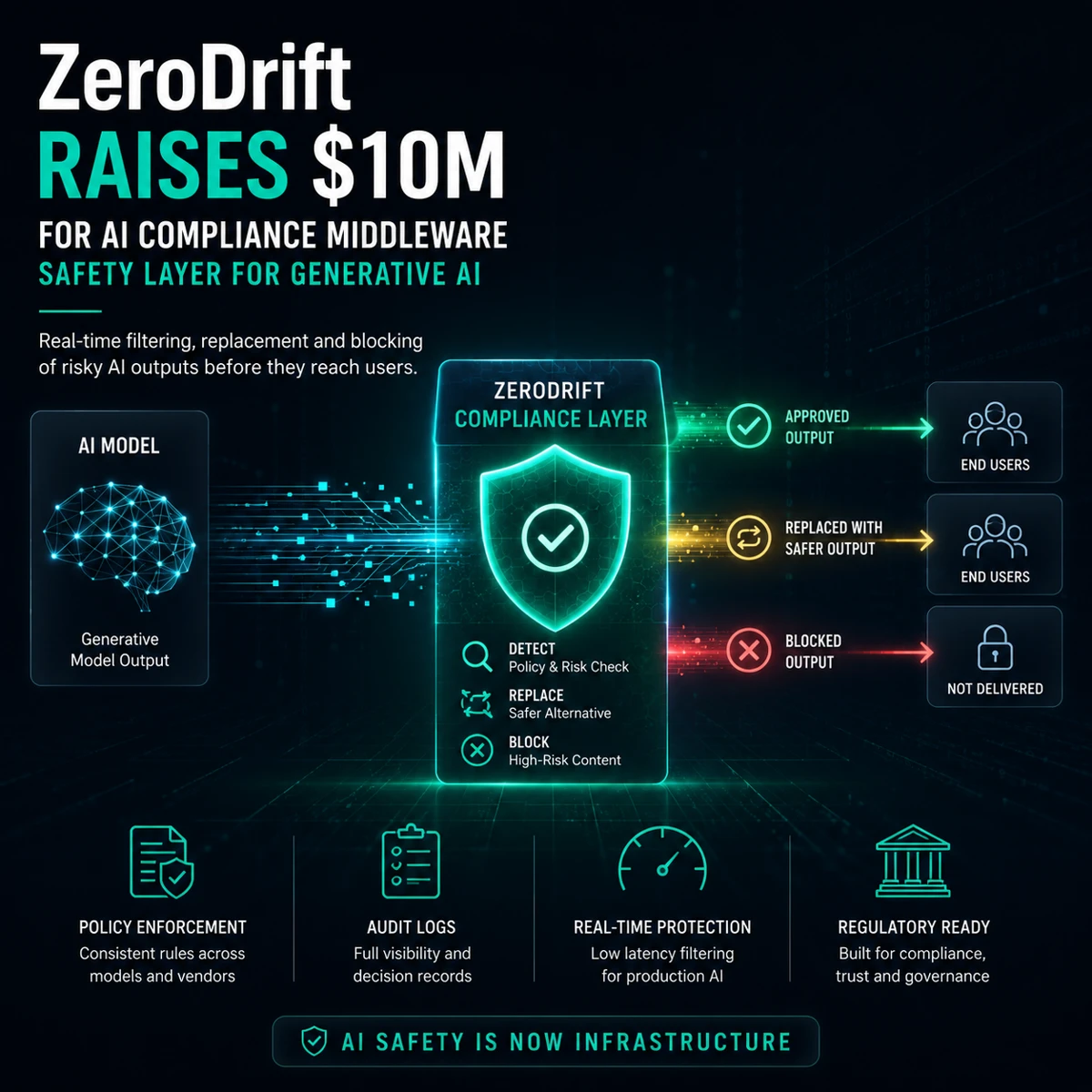
AI safety is becoming its own software layer. ZeroDrift raised $10 million to launch compliance middleware that sits between generative AI models and users, checking outputs before they reach production environments.
The product is designed to intercept model responses in real time, flag risky content, replace unsafe outputs with approved alternatives, or block responses that could create regulatory or policy risk.
The signal is bigger than one funding round: enterprises may increasingly buy AI safety as a separate layer in the stack, instead of relying only on built-in model guardrails.
ZeroDrift Funding Snapshot
| Metric | Details |
|---|---|
| Funding raised | $10 million |
| Category | AI compliance middleware |
| Core function | Real-time output filtering |
| Target market | Enterprise AI deployments |
| Main value | Policy enforcement across generative AI systems |
The Bigger Shift
The important part is not only that ZeroDrift raised money. It is that AI compliance is being packaged as a product.
Until now, many companies have depended on the guardrails built into individual AI models. That creates a problem for enterprises using multiple providers, models, internal tools and custom workflows.
A separate compliance layer changes the architecture.
Old model:
AI model → user
New model:
AI model → compliance layer → user
That gives companies a way to apply one set of rules across different AI systems, instead of trusting every model to enforce policy in the same way.
Why Enterprises Care
Enterprises are moving generative AI from pilots into production. That increases pressure from legal teams, compliance officers, security leaders and regulators.
For companies in finance, healthcare, insurance, legal services, customer support or regulated enterprise software, unsafe AI output is not just a quality issue. It can become a compliance issue.
A middleware layer can help organizations track:
- which outputs were allowed
- which outputs were blocked
- which rules were triggered
- which content was replaced or redacted
- how AI systems behaved across vendors and use cases
That creates something enterprises increasingly need: auditable AI control.
Practical Example
Consider a bank using an AI assistant to draft customer responses.
The assistant may generate useful recommendations, but the bank still needs to check for financial claims, privacy issues, misleading language, internal policy violations and regulatory risk.
In that workflow, compliance middleware can sit between the AI assistant and the customer-facing output.
- The model generates a response.
- The middleware checks it against policy rules.
- Risky language is flagged, replaced or blocked.
- The business keeps a record of the decision.
That is the commercial promise of ZeroDrift’s approach: safer AI output without forcing every team to rebuild compliance controls from scratch.
Practical Implications
For enterprise buyers, the trade-off is clear: more control, but more complexity.
- Compliance teams get a clearer way to enforce policy across AI systems.
- Security teams gain another control point between models and users.
- Product teams must account for latency, testing and user experience.
- AI vendors may need to support third-party safety and governance layers.
- Startups can build around AI governance instead of competing directly with model providers.
The key question is whether customers will accept added latency and vendor dependency in exchange for lower regulatory risk.
For more context on the tools side of enterprise AI adoption, see the AI Tools Hub and our overview of AI Automation Tools.
What to Watch Next
Arti-Trends View
ZeroDrift’s raise points to a broader shift in enterprise AI: safety is evolving from a model feature into a software category.
That matters because the companies that control policy enforcement may become as important as the companies building the models themselves.
For buyers, this creates a new stack decision. The question is no longer only which model to use. It is also which layer controls what the model is allowed to say.
If middleware providers can prove accuracy, speed and auditability, AI compliance could become a standard part of enterprise AI deployments. If not, it risks becoming another expensive safety net that slows teams down without earning trust.