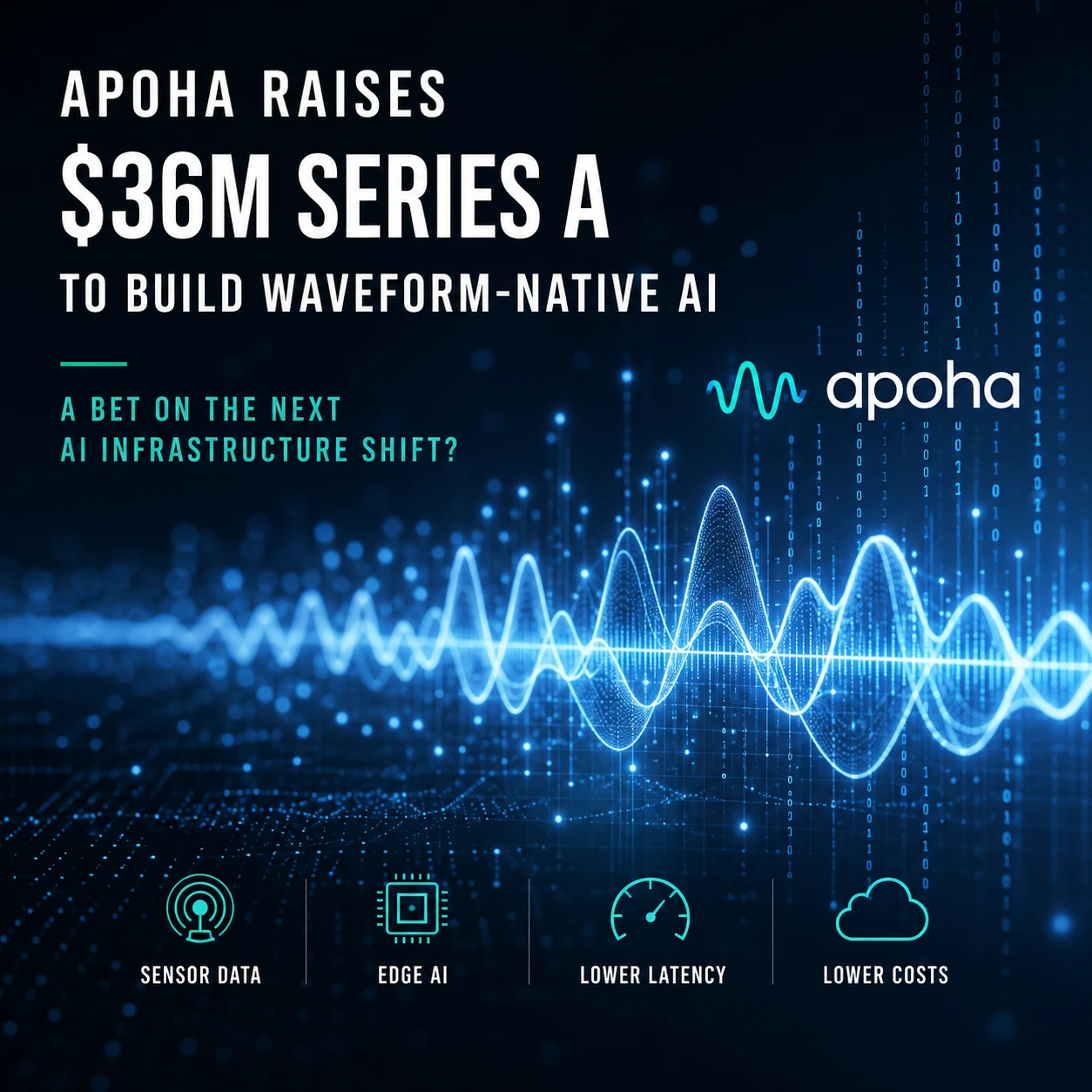
Apoha has raised a $36 million Series A to commercialize an unusual AI architecture: models that work directly with continuous waveform data instead of relying on discrete, tokenized inputs.
The funding round is not proof that Apoha’s approach will outperform today’s transformer-based systems. But it is a clear market signal: investors are now backing alternatives to token-based AI as compute costs, latency and data-processing limits become harder to ignore.
The real issue
The real story is not the size of the round. It is where the money is going.
Most modern AI systems depend on tokenization. Text, images, audio and other inputs are converted into discrete units before being processed by large models. That approach has scaled extremely well, but it is not always ideal for continuous data streams such as sensor signals, biosignals, industrial equipment data or geophysical readings.
Apoha is betting that some of those workloads may be better handled closer to their original form. Instead of forcing continuous signals through token-based pipelines, the company wants to train models on waveform-style data directly.
That matters because tokenization can add cost, delay and information loss in high-volume environments. If waveform-native AI can produce reliable results with less pre-processing, the value could shift away from heavy cloud-based model runs and toward specialized edge systems, sensor infrastructure and new hardware stacks.
For now, that remains a bet. Apoha still needs to prove that its approach delivers measurable gains in accuracy, speed or cost on real-world workloads. But the round shows that investors are willing to fund AI architectures that move beyond the dominant transformer playbook.
Why this matters now
The AI market is entering a more selective phase. Companies are no longer impressed by model size alone. Buyers want lower costs, faster deployment and clearer return on investment.
That creates space for alternative AI systems that solve specific problems better than general-purpose models. Sensor-heavy industries are especially relevant here because their data does not naturally behave like text.
| Area | Potential benefit |
|---|---|
| Industrial IoT | Less processing overhead for equipment and production data. |
| Healthcare | More direct analysis of biosignals such as ECG and EEG data. |
| Geophysics | Potentially faster interpretation of large continuous datasets. |
| Edge AI | Lower latency and reduced dependence on cloud infrastructure. |
The broader implication is simple: not every AI problem needs to be solved with the same architecture. If Apoha can demonstrate strong results in targeted industries, it could help drive a shift toward more specialized AI systems.
This is different from the current wave of generative AI tools and consumer-facing models. Apoha’s success will be determined by measurable business outcomes rather than model size, benchmark marketing or viral demos.
What to watch next
The key question is straightforward: can waveform-native AI deliver better economics than traditional token-based systems in specific markets?
If the answer is yes, Apoha’s $36 million raise may be remembered as an early signal of a broader shift in AI infrastructure. If not, it will remain another experiment in the search for alternatives to today’s expensive, token-centric AI stack.