Most people think AI crypto trading is about finding the right bot.
It isn’t.
The biggest misconception in AI-powered trading is that artificial intelligence somehow creates profits on its own. It doesn’t. AI is not a money-printing machine. It is a force multiplier that amplifies whatever strategy sits underneath it.
That is why two traders can use the same platform, the same exchange, and even the same market conditions, yet achieve completely different results. One compounds capital steadily. The other slowly loses money.
The difference is rarely the software.
The difference is the strategy.
In 2026, crypto markets are more competitive than ever. Retail traders are no longer competing against other individuals. They are competing against algorithms, hedge funds, market makers, and AI systems capable of analyzing thousands of market signals in real time.
Understanding how AI crypto trading strategies work is therefore far more important than choosing a trading bot. A bot is simply a vehicle. The strategy is the engine.
This guide explains the core AI crypto trading strategies used by both retail and professional traders, how they work, where they fail, and which approaches are best suited for different risk profiles and market conditions.
What Is an AI Crypto Trading Strategy?
An AI crypto trading strategy is a rules-based system that uses artificial intelligence to analyze market conditions, identify opportunities, manage risk, and execute trades automatically.
Unlike manual trading, where decisions are influenced by emotions and subjective judgment, AI systems rely on statistical probabilities, historical data, and real-time market signals.
The objective is not to predict the future. The objective is to consistently exploit repeatable patterns that occur in financial markets.
Modern AI trading systems may analyze:
- Price action
- Trading volume
- Order-book activity
- Funding rates
- On-chain metrics
- Market sentiment
- Whale transactions
- Derivatives positioning
These inputs are transformed into trading decisions through algorithms designed to identify opportunities faster and more consistently than human traders.
If you’re new to automated trading, our AI Crypto Trading for Beginners guide explains the fundamentals before moving into advanced strategies.
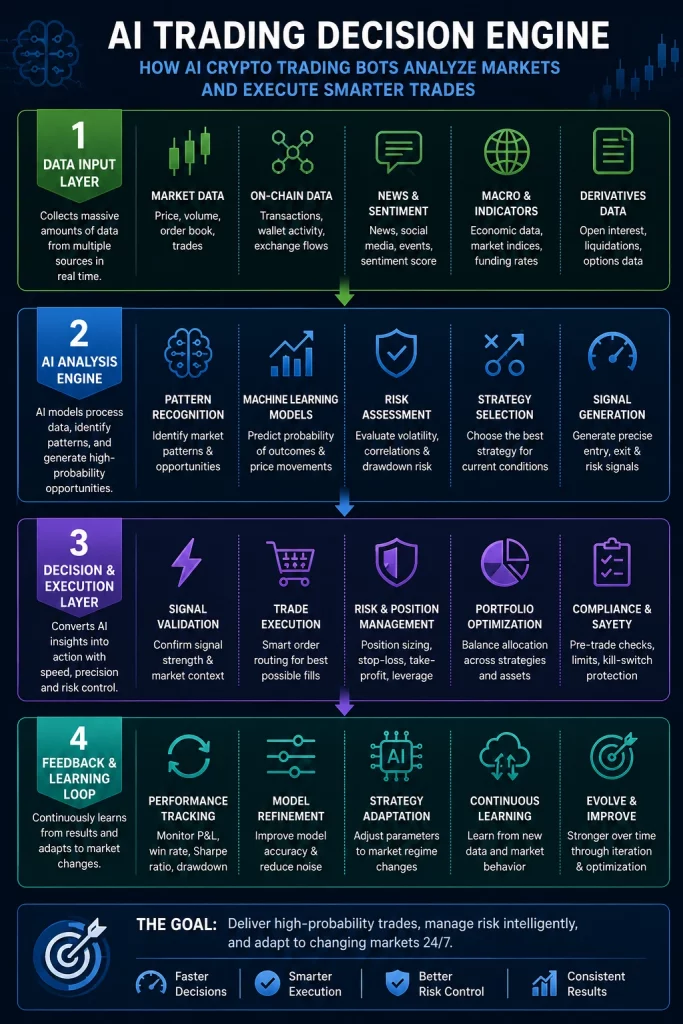
Why Strategy Matters More Than the Bot
One of the biggest mistakes in AI crypto trading is evaluating platforms before understanding strategy.
Most traders compare bots based on features, dashboards, or marketing claims. Professional traders start somewhere else: they evaluate the underlying trading logic.
For example, two AI trading bots may appear almost identical on the surface while running completely different systems underneath:
- One may be optimized for ranging markets through grid trading.
- One may focus on long-term accumulation through AI-driven DCA.
- One may specialize in momentum and trend-following.
- One may be designed for arbitrage and market-neutral returns.
Understanding these differences is critical because every strategy performs differently depending on market conditions.
This is also why traders should evaluate AI Trading Bot Backtesting results carefully. Strong performance in one market environment does not guarantee success in another.
The Five Building Blocks Behind Every AI Trading System
Although AI crypto trading platforms vary widely, most successful systems are built on the same five foundational components.
- Pattern Recognition
- Multi-Signal Confirmation
- Adaptive Position Sizing
- Automated Risk Management
- Continuous Learning and Optimization
These building blocks determine whether an AI trading system can survive changing market conditions or simply become another overfitted algorithm that performs well only in hindsight.
In the next section, we’ll break down the five core AI crypto trading strategies that dominate the market in 2026 and explain exactly when each one outperforms, underperforms, and should be used.
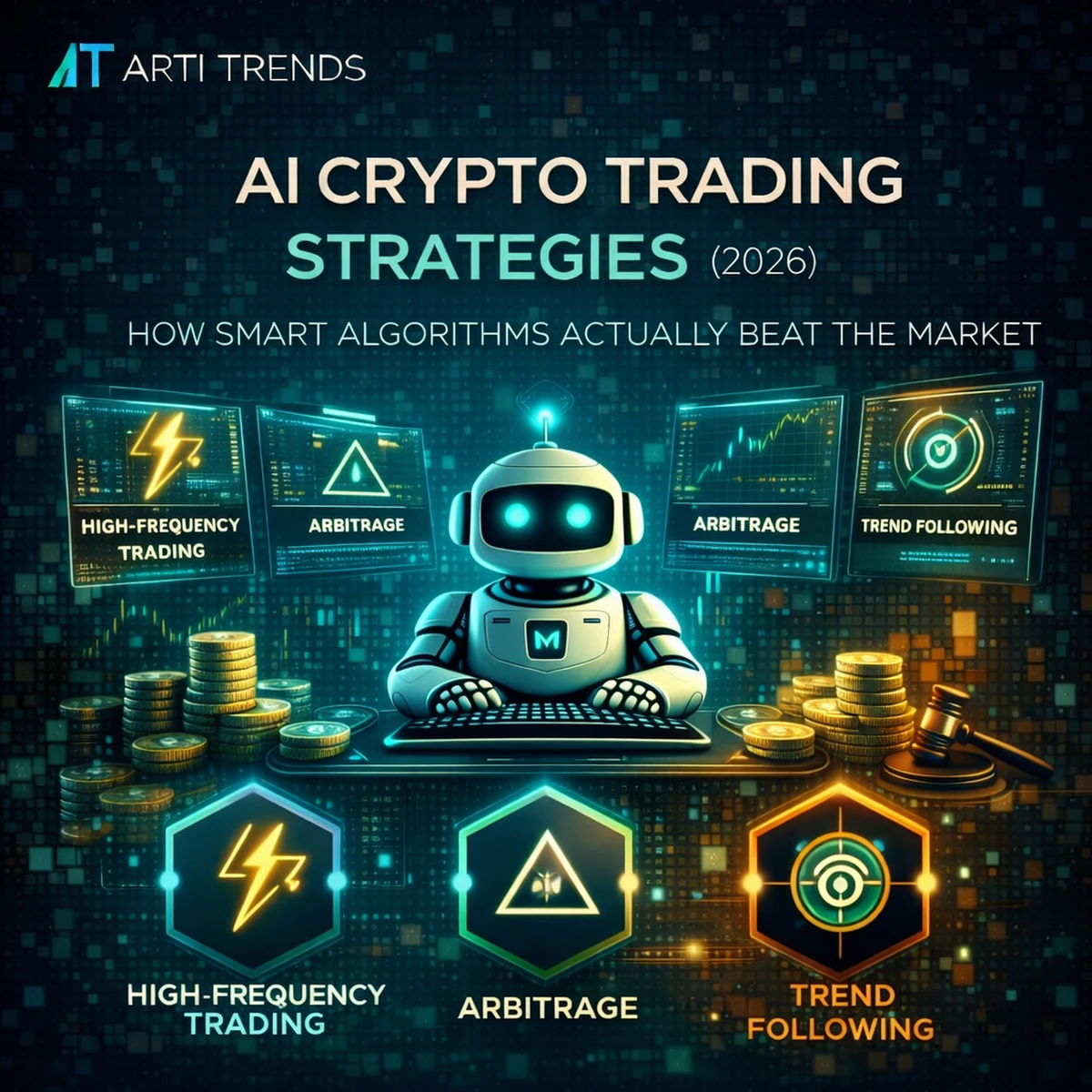
The 5 Core AI Crypto Trading Strategies in 2026
Despite the marketing claims made by many AI trading platforms, almost every profitable AI crypto trading system is built on one or more of five core strategies.
The difference between winning and losing is rarely the AI itself. The real edge comes from selecting the right strategy for the right market environment.
Before diving into each model, here’s a high-level comparison of the most important AI crypto trading strategies used today.
| Strategy | Risk | Return Potential | Best Market | Best For |
|---|---|---|---|---|
| AI DCA | Low | Medium | Long-Term Growth | Beginners & Investors |
| AI Grid Trading | Medium | Medium | Sideways Markets | Passive Income |
| AI Trend Following | High | High | Bull Markets | Growth Traders |
| AI Arbitrage | Low | Medium | All Conditions | Advanced Traders |
| AI Market Making | Medium | Medium-High | High Liquidity Markets | Professional Traders |
No single strategy dominates in every environment. Professional traders often combine multiple approaches to create a portfolio that can perform across different market regimes.
1. AI-Driven Grid Trading
Grid trading is one of the oldest algorithmic trading strategies in crypto. Instead of predicting market direction, the system profits from repeated price fluctuations inside a defined range.
Traditional grid bots use fixed price levels. AI-enhanced grid systems dynamically adjust grid spacing, position sizing, and capital allocation based on volatility and market conditions.
Best For: Sideways markets, passive income generation, traders seeking consistency.
Main Risk: Strong breakouts can cause price to escape the grid and trap capital.
If you’re evaluating platforms that specialize in this approach, see our guide to Best AI Crypto Trading Bots.
2. AI-Driven Dollar-Cost Averaging (DCA)
Traditional DCA buys fixed amounts at fixed intervals. AI-driven DCA adjusts buying behavior based on market conditions.
Instead of investing the same amount every week, AI systems may increase exposure during deep pullbacks and reduce buying activity when markets become overheated.
Best For: Long-term investors, beginners, portfolio accumulation.
Main Risk: Extended bear markets can delay recovery periods.
3. AI Trend-Following
Trend-following is responsible for many of the largest gains in crypto markets.
These systems attempt to identify momentum early and remain invested while trends continue. AI models improve performance by filtering false breakouts and adapting position sizes based on confidence levels.
Best For: Bull markets, growth-focused traders, momentum investing.
Main Risk: Sudden trend reversals can generate significant drawdowns.
4. AI Arbitrage
Arbitrage strategies exploit price differences across exchanges, derivatives markets, and liquidity pools.
Because opportunities often exist for only a few seconds, AI systems provide a significant advantage through speed and automation.
Best For: Market-neutral returns, lower directional risk.
Main Risk: Execution quality, fees, and liquidity constraints.
5. AI Market Making
Market-making strategies earn profits by continuously buying and selling around the current market price.
AI optimizes spread width, inventory exposure, and order placement to maximize profitability while controlling risk.
Best For: Advanced traders, liquidity provision, institutional-style trading.
Main Risk: Inventory risk during large directional moves.
Now that we’ve covered the five dominant strategies, the next question becomes more important: which strategy actually fits your capital, risk tolerance, and objectives?
Which AI Crypto Trading Strategy Is Right for You?
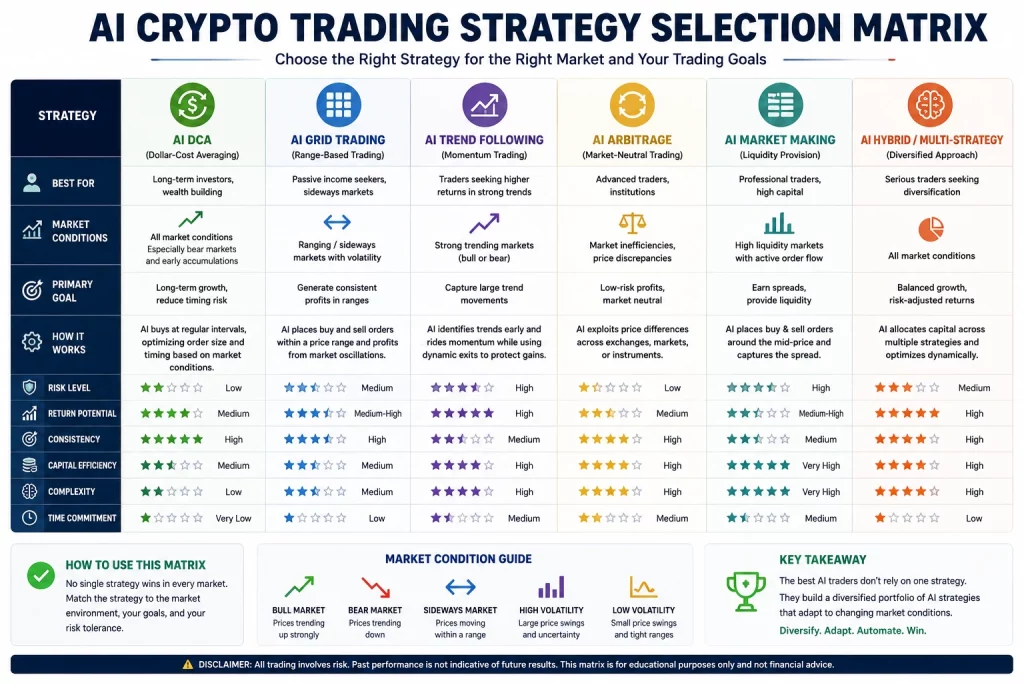
One of the biggest mistakes in AI crypto trading is searching for the “best” strategy.
There is no universal winner.
A strategy that performs exceptionally well for a trader with a $100,000 portfolio may be completely unsuitable for someone starting with $1,000. Likewise, a system designed for aggressive growth can be emotionally unbearable for investors seeking steady long-term returns.
Professional traders do not ask:
“Which strategy makes the most money?”
They ask:
“Which strategy fits my capital, risk tolerance, and objectives?”
The following framework helps identify which AI crypto trading strategy aligns best with your profile.
For Beginners: AI-Driven DCA
If you’re new to crypto investing, AI-driven dollar-cost averaging is often the safest place to start.
- Low emotional stress
- Simple to understand
- Lower volatility exposure
- Ideal for long-term accumulation
Rather than trying to predict short-term price movements, DCA focuses on steadily building positions over time.
For a complete beginner-focused walkthrough, see AI Crypto Trading for Beginners.
For Passive Income: AI Grid Trading
Traders looking for consistent activity rather than massive gains often gravitate toward AI grid strategies.
- Works well in ranging markets
- Generates frequent trades
- Can produce steady cash flow
- Requires limited day-to-day involvement
Grid trading performs best when markets move sideways and volatility remains relatively contained.
For Aggressive Growth: AI Trend Following
If your goal is maximizing upside during strong market cycles, trend-following strategies offer the highest growth potential.
- Captures major market moves
- Benefits from strong momentum
- Performs well during bull markets
- Higher drawdown potential
These strategies can generate exceptional returns during strong crypto cycles but require greater risk tolerance.
For Advanced Traders: AI Arbitrage
Arbitrage strategies appeal to traders who prioritize consistency and market-neutral opportunities.
- Lower directional risk
- Works in bull and bear markets
- Less dependent on market forecasts
- Requires strong execution infrastructure
The challenge is not identifying opportunities. The challenge is executing them quickly enough to remain profitable.
For Professionals: AI Market Making
Market-making sits closest to institutional trading.
- Provides liquidity
- Benefits from large capital bases
- Optimizes bid-ask spreads
- Requires sophisticated risk controls
While historically limited to professional firms, modern AI trading platforms increasingly make simplified market-making strategies accessible to advanced retail traders.
Why Professional Traders Combine Strategies
Retail traders often search for a single winning strategy.
Professional traders build systems.
No strategy performs well in every market environment. Trending markets reward momentum systems. Sideways markets reward grid trading. Volatile conditions often create arbitrage opportunities.
Rather than relying on one approach, professional portfolios often allocate capital across multiple AI strategies simultaneously.
| Example Portfolio | Allocation |
|---|---|
| AI DCA | 40% |
| AI Grid Trading | 25% |
| AI Trend Following | 25% |
| AI Arbitrage | 10% |
This diversification reduces dependency on any single market condition and improves long-term consistency.
Next, we’ll examine the three-layer framework behind every profitable AI crypto trading system and why most traders focus on the wrong layer entirely.
The Three-Layer Model Behind Every Profitable AI Crypto Trading System
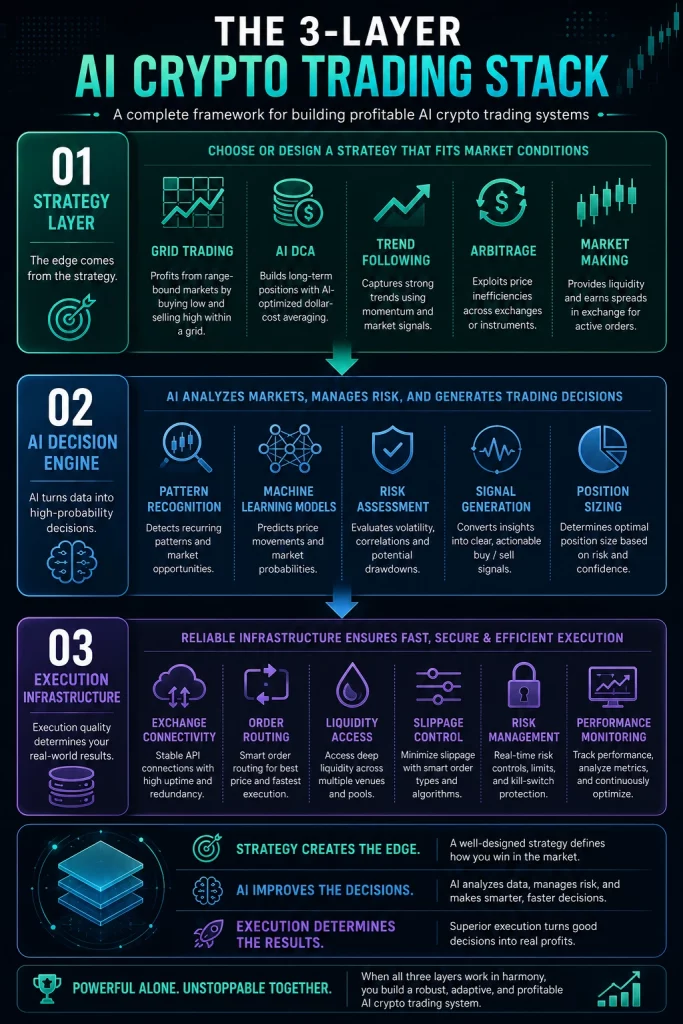
Most retail traders think AI crypto trading is about finding the right bot.
Professional traders know it is about building the right system.
This is one of the biggest misconceptions in algorithmic trading. Traders often compare dashboards, features, and marketing claims while completely ignoring the underlying structure that actually drives performance.
Every profitable AI crypto trading operation — from hedge funds and proprietary trading firms to sophisticated retail traders — is built on three interconnected layers.
If one of these layers fails, the entire system eventually breaks down.
Layer 1: Strategy
The first layer defines why a system should make money.
This is the economic logic behind the trading operation.
Grid trading, DCA, trend-following, arbitrage, and market-making are not bots. They are theories about how markets behave and where inefficiencies exist.
A strategy attempts to answer a simple question:
What repeatable market behavior creates an exploitable opportunity?
Without a genuine edge at the strategy level, artificial intelligence cannot create profitability. It can only automate losing decisions faster.
This is why understanding the five core strategies discussed earlier is more important than selecting a platform.
Layer 2: The AI Decision Engine
This is where artificial intelligence actually enters the picture.
The AI decision engine determines how the strategy is executed.
Modern systems continuously analyze large datasets, including:
- Price action
- Volume profiles
- Order-book dynamics
- On-chain activity
- Funding rates
- Market sentiment
- Whale transactions
- Derivatives positioning
The goal is not prediction. The goal is improving decision quality.
The AI engine decides:
- When to enter
- When to exit
- How much capital to allocate
- How much risk to take
- Which signals matter most
Two trading bots can run the same strategy yet produce dramatically different results because their AI decision engines evaluate risk and opportunities differently.
This is why strong backtesting and ongoing model evaluation are essential when selecting an AI trading platform.
Layer 3: Execution Infrastructure
This is the layer most retail traders completely ignore.
Even a brilliant strategy with a powerful AI model can fail if trades are executed poorly.
Execution infrastructure includes:
- Exchange connectivity
- Order routing
- Trading fees
- Liquidity access
- Slippage control
- API stability
- Latency management
This layer determines whether theoretical profits survive real-world market conditions.
A strategy with a 12% expected return can easily become unprofitable when execution costs are high enough.
This is one reason why professional firms invest heavily in infrastructure while many retail traders focus exclusively on signals.
Why Most Traders Focus on the Wrong Layer
Retail traders typically spend their time comparing bots.
Professionals spend their time evaluating systems.
Marketing often focuses on Layer 2 because AI sounds exciting. Yet long-term performance is usually determined by the interaction between all three layers.
A weak strategy cannot be saved by AI.
A great strategy can be destroyed by poor execution.
And a sophisticated AI model without risk controls eventually becomes a liability.
Why Most AI Crypto Traders Still Lose Money
At this point, a reasonable question emerges.
If AI systems can process more information, execute faster, and remove emotional decision-making, why do so many traders still lose money?
The answer has very little to do with artificial intelligence itself.
In the next section, we’ll examine the five structural mistakes that quietly destroy most AI crypto trading portfolios — even when the underlying technology is sound.
Why Most AI Crypto Traders Still Lose Money
One of the biggest myths in crypto trading is that artificial intelligence somehow guarantees profitability.
It doesn’t.
AI can improve execution, remove emotional decision-making, and process more information than any human trader. But it cannot eliminate risk, uncertainty, or poor strategy design.
This explains why many traders lose money despite using advanced AI trading platforms. In most cases, the technology is not the problem. The problem is how it is deployed.
These are the five most common reasons AI crypto trading systems fail in real markets.
1. Overfitting to Historical Data
Artificial intelligence learns from historical data. The danger arises when a model becomes too specialized in explaining what already happened.
This is known as overfitting.
An overfitted model may produce exceptional backtest results while failing completely in live markets. Instead of learning underlying market behavior, it learns historical noise.
Professional trading firms combat this through:
- Out-of-sample testing
- Walk-forward analysis
- Continuous retraining
- Market-regime detection
This is one reason why understanding AI trading bot backtesting is critical when evaluating platforms.
2. Poor Data Quality
AI is only as good as the data it receives.
Low-quality inputs lead to low-quality outputs.
Common issues include:
- Fake trading volume
- Incomplete exchange data
- Delayed order-book information
- Manipulated liquidity
- Incorrect sentiment signals
Professional trading systems invest heavily in data infrastructure because even small inaccuracies can compound into significant losses over thousands of trades.
3. Weak Risk Management
Many traders focus on maximizing returns while ignoring risk.
This is usually where accounts fail.
Successful AI trading systems prioritize survival before profitability.
Typical safeguards include:
- Stop-loss controls
- Maximum drawdown limits
- Position-size restrictions
- Exposure caps
- Portfolio diversification
Without these controls, one extreme market event can erase months of gains in a matter of hours.
For a deeper discussion of trading risks, see our guide on AI Crypto Trading Risks.
4. Strategy–Market Mismatch
No trading strategy works in every market environment.
Grid systems struggle during strong trends. Trend-following systems suffer in flat markets. Arbitrage opportunities shrink when liquidity conditions change.
The most successful AI systems continuously evaluate market conditions and adjust accordingly.
Professional traders spend far more time matching strategies to market regimes than searching for the perfect indicator.
5. Blind Trust in Automation
The most dangerous phrase in AI trading is:
“The bot knows what it’s doing.”
It doesn’t.
The system only follows the rules it was given.
Artificial intelligence cannot understand your personal financial goals, your risk tolerance, or your investment horizon. Those decisions remain your responsibility.
The best traders treat AI as a tool, not a replacement for judgment.
The AI Advantage vs Manual Trading
If AI systems still fail, why are professional traders investing billions into algorithmic trading infrastructure?
The answer lies in the structural advantages AI provides over human decision-making.
In the next section, we’ll compare AI-driven trading with manual crypto trading and explain why humans are increasingly at a disadvantage in algorithmic markets.
AI Trading vs Manual Crypto Trading
Most people assume AI trading outperforms manual trading because artificial intelligence is somehow smarter.
That is not the real reason.
AI trading wins because it is systematic. Human traders are not.
The same trading strategy can produce dramatically different results depending on whether it is executed by a person or by an algorithm.
The advantage comes from execution quality, emotional control, consistency, and scalability — not from magical predictions.
| Factor | Manual Trading | AI Trading |
|---|---|---|
| Execution Speed | Seconds to Minutes | Milliseconds |
| Emotional Influence | High | None |
| Consistency | Variable | Constant |
| Market Coverage | Limited | Hundreds of Markets |
| Data Processing | Limited | Massive Scale |
| Availability | Limited | 24/7 |
Execution Speed
Crypto markets move fast.
A trader may spend several seconds analyzing a setup, placing an order, and confirming execution. During volatile periods, the market may already have moved significantly.
AI systems execute instantly. Signals are evaluated, positions are opened, and risk controls are applied automatically.
In highly competitive markets, this speed advantage compounds over thousands of trades.
Emotional Control
Most trading mistakes are not analytical mistakes.
They are emotional mistakes.
- Panic selling during volatility
- Holding losers too long
- Taking profits too early
- Revenge trading after losses
- Overtrading during excitement
AI systems experience none of these problems.
They execute predefined rules regardless of fear, greed, confidence, or frustration.
Consistency
A human trader may follow a strategy perfectly for days, weeks, or even months.
Eventually, fatigue, stress, or market pressure leads to deviations.
AI never gets tired.
If a strategy calls for 1,000 identical decisions, the AI will execute all 1,000 decisions exactly as designed.
That consistency is often more valuable than intelligence itself.
Scalability
Most human traders can effectively monitor only a handful of markets at once.
AI systems can simultaneously track:
- Hundreds of trading pairs
- Multiple exchanges
- Derivatives markets
- On-chain activity
- Market sentiment
- Order-book dynamics
This dramatically increases the number of opportunities available to the system.
The Human Advantage
Despite all these benefits, humans still retain one important advantage.
Strategic judgment.
Humans decide:
- Which strategies to deploy
- How much capital to risk
- When market conditions have fundamentally changed
- Whether an AI system should continue operating
The strongest traders do not choose between AI and human decision-making.
They combine both.
Humans design the system. AI executes the system.
Why Professional Traders Use AI Trading Bots
This is why professional traders increasingly rely on AI trading platforms and automation tools.
The goal is not replacing human expertise. The goal is eliminating human inconsistency.
Modern AI trading bots allow traders to automate execution, enforce risk controls, monitor multiple markets simultaneously, and implement sophisticated strategies that would be difficult to manage manually.
However, not all bots are built equally. Strategy quality, risk management, execution infrastructure, and transparency vary dramatically between providers.
That’s why comparing platforms carefully is essential before committing capital.
Next, we’ll examine how professional traders combine multiple AI strategies into a single portfolio and why diversification often matters more than finding a single winning system.
The Professional Way to Combine AI Crypto Trading Strategies
One of the biggest differences between retail traders and professional trading firms is how they think about strategy.
Retail traders often search for a single winning system.
Professionals build portfolios of strategies.
This distinction is critical because no AI crypto trading strategy performs well in every market condition.
Markets continuously cycle through different regimes:
- Strong uptrends
- Bear markets
- Sideways consolidation
- High volatility environments
- Low liquidity periods
- News-driven market events
Each environment rewards different strategies while punishing others.
Why Single-Strategy Systems Eventually Fail
A common mistake among newer traders is becoming emotionally attached to a single strategy.
For example:
- Grid trading performs exceptionally well during ranging markets.
- Trend-following dominates during strong bull runs.
- Arbitrage thrives when market inefficiencies increase.
- DCA performs best when accumulating long-term positions.
The problem is that markets do not remain constant.
Eventually conditions change and previously successful strategies begin to underperform.
Professional traders expect this. Retail traders are often surprised by it.
The Multi-Strategy Portfolio Approach
Instead of relying on a single model, professional AI traders distribute capital across multiple strategies.
A typical diversified portfolio might look like this:
| Strategy | Allocation | Primary Goal |
|---|---|---|
| AI DCA | 40% | Long-Term Growth |
| AI Grid Trading | 25% | Passive Income |
| AI Trend Following | 25% | Growth & Momentum |
| AI Arbitrage | 10% | Market-Neutral Stability |
This structure allows different components of the portfolio to perform well under different market conditions.
When trend-following struggles, grid trading may compensate. When volatility collapses, DCA continues accumulating. When directional opportunities disappear, arbitrage can still generate returns.
Dynamic Capital Allocation
Modern AI systems increasingly go beyond fixed portfolio allocations.
Advanced platforms continuously monitor:
- Strategy performance
- Market volatility
- Liquidity conditions
- Momentum strength
- Risk-adjusted returns
Capital is then reallocated toward the strongest opportunities while reducing exposure to underperforming systems.
This process is one of the key advantages AI provides over traditional portfolio management.
How Hedge Funds Use AI Trading Systems
Professional quantitative funds rarely depend on a single model.
Instead, they operate entire ecosystems of algorithms designed to perform under different conditions.
Typical institutional systems combine:
- Trend-following models
- Market-making engines
- Arbitrage systems
- Risk overlays
- Capital allocation models
The objective is not maximizing returns from a single strategy.
The objective is building a machine that can survive and compound across changing market environments.
Why This Matters for Retail Traders
You do not need hedge-fund infrastructure to apply the same principles.
The lesson is simple:
Diversification across strategies is often more important than finding the perfect strategy.
The best AI crypto traders focus on system design rather than searching for a magical algorithm.
If you’re evaluating platforms capable of supporting multiple approaches, our guide to the Best AI Crypto Trading Bots compares the leading solutions available today.
What Changes in 2026 for AI Crypto Trading?
AI crypto trading in 2026 is not simply a faster version of what existed a few years ago.
The entire ecosystem is evolving. New data sources, institutional participation, AI agents, and regulatory oversight are fundamentally changing how trading systems operate.
Understanding these shifts is important because the strategies that worked in previous market cycles may not be sufficient in the years ahead.
1. On-Chain AI Becomes a Competitive Advantage
Historically, most trading systems focused on price, volume, and technical indicators.
Modern AI systems increasingly analyze blockchain activity directly.
This includes:
- Wallet activity
- Exchange inflows and outflows
- Stablecoin movements
- Whale transactions
- Smart-contract interactions
- Cross-chain capital flows
These signals often appear before major price movements, giving AI systems a valuable informational edge.
For traders focused on blockchain analytics, this trend is increasingly becoming part of modern AI Crypto Investing.
2. AI Agents Are Entering Financial Markets
Most current trading bots operate within predefined rules.
AI agents represent the next evolution.
Instead of merely executing trades, agents can:
- Monitor multiple markets
- Evaluate new opportunities
- Adjust risk parameters
- Allocate capital dynamically
- Generate reports and insights
While fully autonomous financial agents remain in their early stages, many trading platforms are already integrating agent-style capabilities into portfolio management and risk monitoring.
3. Institutional Capital Continues to Enter Crypto
Crypto markets are no longer dominated by retail traders.
Hedge funds, market makers, proprietary trading firms, and asset managers increasingly deploy AI-driven systems into digital asset markets.
This changes market structure in several ways:
- Faster price discovery
- Greater competition
- More sophisticated execution
- Improved liquidity
- Reduced inefficiencies
Retail traders who continue relying solely on intuition now compete directly against quantitative systems operating 24 hours a day.
This is one reason AI trading adoption continues to accelerate.
4. Regulation Is Becoming More Important
As AI-powered trading grows, regulators are paying closer attention.
Across major jurisdictions, regulators increasingly focus on:
- Transparency
- Risk disclosures
- Marketing claims
- Consumer protection
- Algorithmic accountability
This trend is likely to benefit professional platforms while creating additional challenges for poorly documented or purely marketing-driven trading products.
Understanding these risks is becoming an essential part of successful AI trading. Our guide on AI Crypto Trading Risks explores this topic in more detail.
Why These Trends Matter
Many traders focus on short-term performance.
Professional traders focus on long-term structural changes.
The growing importance of on-chain intelligence, AI agents, institutional participation, and regulation suggests that future success will depend less on finding isolated signals and more on building robust systems that can adapt continuously.
The future of AI crypto trading is not simply about faster algorithms.
It is about creating intelligent systems capable of understanding markets, managing risk, and adapting to changing conditions in real time.
Conclusion: Strategy Remains the Ultimate Edge
After exploring the major AI crypto trading strategies, portfolio construction methods, risk factors, and emerging trends, one conclusion becomes clear:
AI is not the edge. Strategy is the edge.
Artificial intelligence amplifies decision-making, improves execution, and removes emotional bias. But no amount of automation can compensate for weak strategy design or poor risk management.
The traders who succeed in AI-driven markets are not those chasing the newest bot. They are the ones building systems where strategy, execution, risk control, and infrastructure work together.
Whether you choose DCA, grid trading, trend-following, arbitrage, market-making, or a diversified portfolio approach, long-term success depends on selecting strategies that fit both market conditions and your personal objectives.
In algorithmic markets, consistency beats prediction.
And well-designed systems compound where emotional decision-making fails.
Frequently Asked Questions
What is the best AI crypto trading strategy?
There is no single best AI crypto trading strategy. The optimal approach depends on your goals, risk tolerance, capital, and market conditions. AI-driven DCA is often best for beginners, grid trading works well in ranging markets, trend-following excels during strong bull markets, while arbitrage and market-making are typically used by more advanced traders.
Can AI crypto trading beat the market?
AI can outperform manual trading by improving execution speed, consistency, and risk management. However, AI does not guarantee profits. Performance depends on the underlying strategy, data quality, market conditions, and execution infrastructure.
Is AI crypto trading profitable?
AI crypto trading can be profitable when combined with sound strategy design and disciplined risk management. Like all forms of trading, profitability is never guaranteed and losses remain possible.
What is the safest AI crypto trading strategy?
AI-driven dollar-cost averaging (DCA) is generally considered one of the lowest-risk AI trading approaches because it focuses on gradual accumulation rather than short-term speculation.
Are AI crypto trading bots legal?
In most jurisdictions, AI trading bots are legal. However, regulations vary by country and continue to evolve. Traders should always verify local laws, exchange requirements, and tax obligations before using automated trading systems.
Can ChatGPT create crypto trading strategies?
Large language models such as ChatGPT can help explain, analyze, and prototype trading strategies. However, they should not be relied upon as standalone trading systems and cannot replace rigorous testing, validation, and risk management.
What is better: AI trading or manual trading?
AI trading generally outperforms manual trading in execution speed, consistency, and scalability. Human traders still retain advantages in strategic thinking, judgment, and adapting to unusual market events. The most effective approach often combines both.
Related Reading
If you want to build a complete understanding of AI-powered crypto trading, these guides provide the next logical steps.
- AI Crypto Trading for Beginners — Learn the fundamentals of automated crypto trading, risk management, and bot selection.
- AI Crypto Trading Bots: Complete Guide — Understand how modern trading bots execute AI strategies in live markets.
- What Is an AI Trading Bot? — A beginner-friendly breakdown of how AI trading systems work.
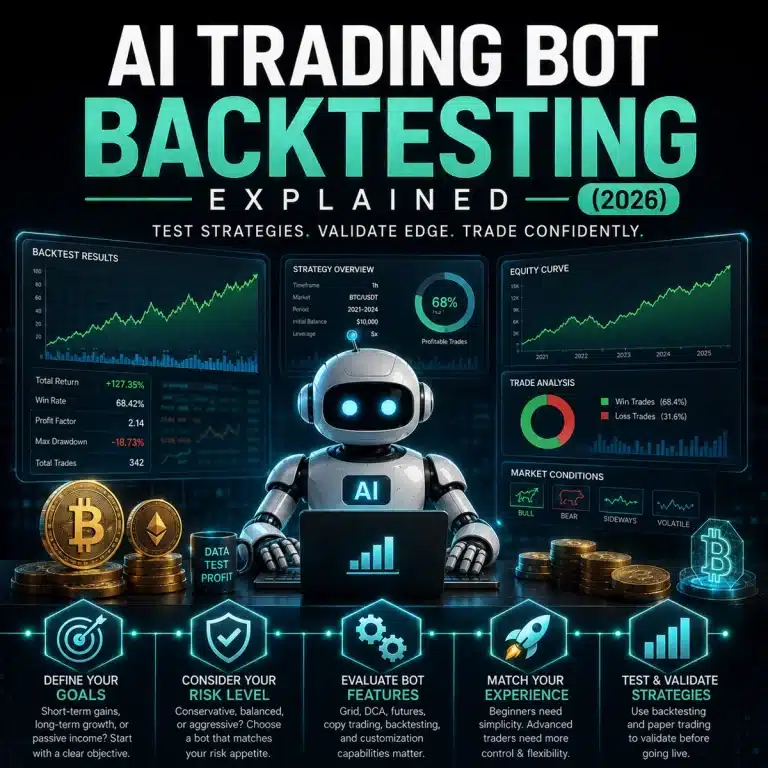
- AI Trading Bot Backtesting Explained — Learn how professional traders validate strategies before risking capital.
- AI Trading Bot Fees Explained — Understand how costs, spreads, and commissions impact long-term performance.
- AI Crypto Trading Risks — Explore the technical, financial, and regulatory risks associated with AI-powered trading.
- AI Crypto Trading vs Manual Trading — Compare human and algorithmic trading approaches in detail.
- Best AI Crypto Trading Bots of 2026 — Compare leading platforms, strategies, risk controls, and pricing.
- AI Trading Bots Hub — Explore the full ecosystem of AI-powered trading platforms.
- AI Crypto Hub — Discover AI crypto projects, investing guides, trading systems, and market intelligence.
Key Takeaway: Successful AI crypto trading is not about finding a magical bot. It is about combining the right strategy, AI decision engine, risk management framework, and execution infrastructure into a system that can adapt across changing market conditions.