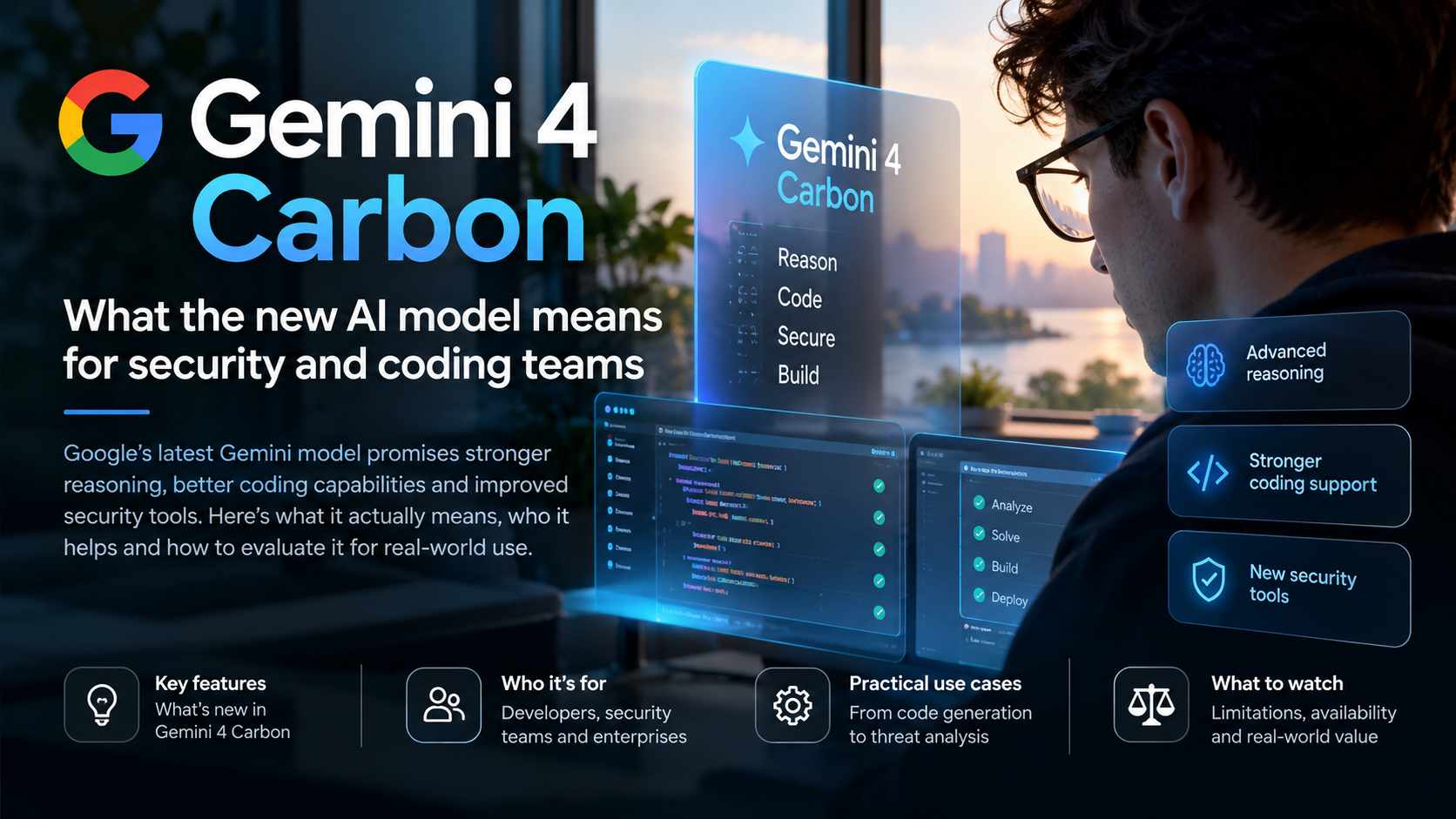
Google’s Gemini 4 Carbon announcement puts advanced coding and cybersecurity work in focus. For most teams, the immediate question is not whether to switch models, but whether they can access the release and verify its value against their existing workflow.
Google reports improvements in complex coding and security tasks. These are provider claims, not independent evidence of better outcomes for every organization. Early access is restricted, so readers should not treat the model as generally available.
What was announced?
Carbon is being introduced for selected cybersecurity users. Reported capabilities include extended agentic coding and vulnerability analysis. Benchmarks describe performance under specific test conditions; they do not guarantee reliability in an organization’s own repositories or systems.
What does access and pricing mean?
Reported introductory API prices are $2 per million input tokens and $10 per million output tokens. Verify eligibility, model availability and billing terms in Google’s official documentation before budgeting. Usage costs also depend on retries, tool calls, review time and safeguards. Do not assume that a quoted token rate is the full cost of a deployment.
Who should consider it?
Authorized security teams may find value in assisted code review and vulnerability triage, provided they retain human review, audit logs and controlled test environments. Developers should compare the model against existing tools on real, permitted tasks. Independent professionals and small teams have no reason to migrate solely because a model is newly announced.
How to evaluate a new AI model
- Choose five to ten representative tasks with known expected results.
- Record model version, input, tools, permissions and success criteria.
- Compare correctness, required corrections, latency and total cost against the current workflow.
- Test security tasks only in authorized environments and independently validate findings.
- Keep the current solution if the alternative is unavailable or shows no meaningful improvement.
Limitations worth understanding
Restricted access makes independent testing difficult. Security benchmarks cannot establish immunity to prompt injection or unsafe automated actions. The model’s performance on everyday business tasks remains to be demonstrated under comparable conditions.
For practical background, read how to use AI tools safely, how AI tools work, or visit the AI Tools Comparison Hub.
Sources
Google DeepMind announcements (official updates) and The Verge reporting, October 29, 2026. Provider claims are not independent testing.