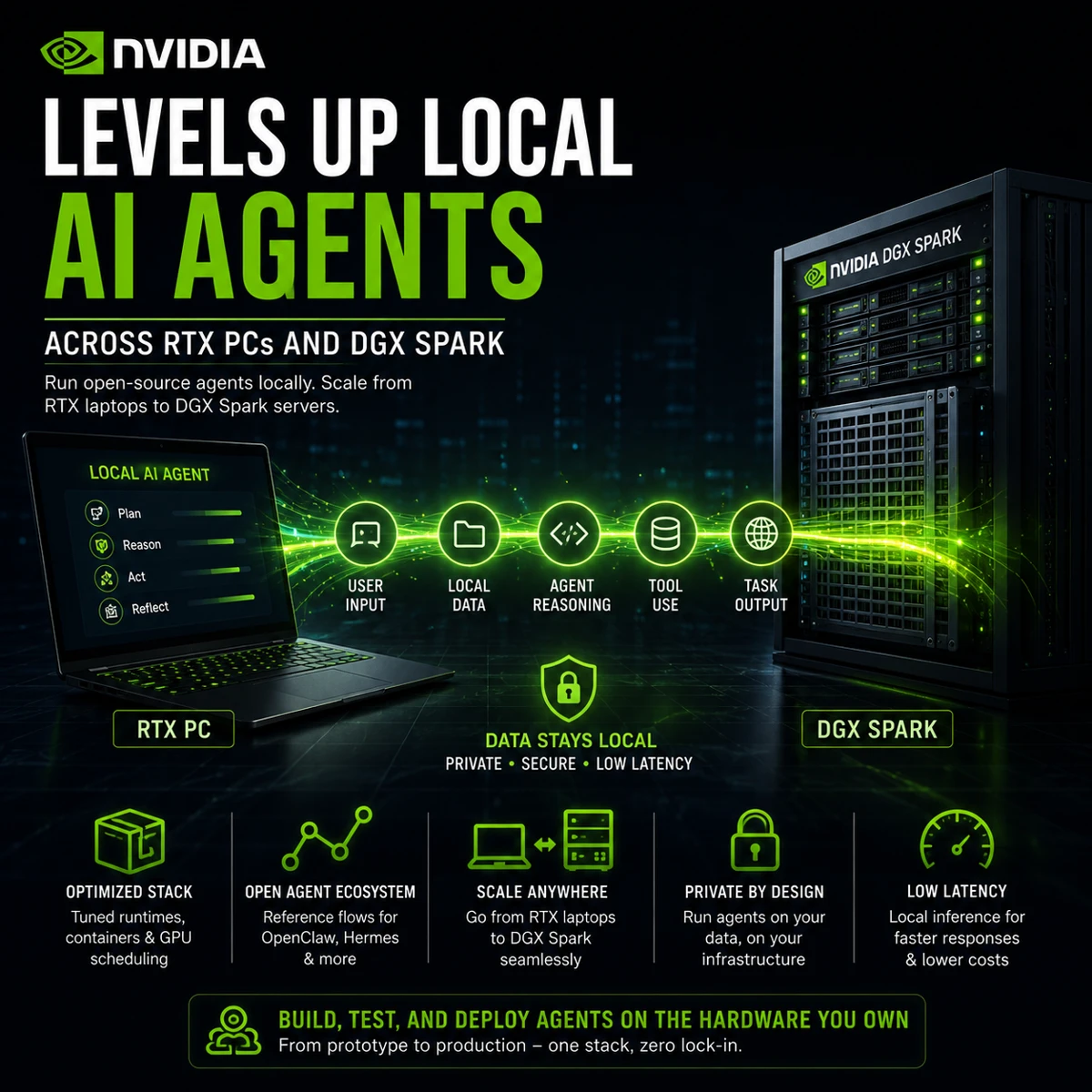
NVIDIA announced a coordinated software and hardware push to run local, agent-style LLM workloads across RTX consumer GPUs and DGX Spark servers. The move packages optimized runtimes, container images, and reference flows that make open-source agents – examples include OpenClaw and Hermes – practical on both consumer and datacenter NVIDIA hardware.
The real issue: NVIDIA’s coordinated stack
At its core the announcement is not a single new model but a distribution path: NVIDIA has tuned runtimes, container images, and reference agent flows so that projects built on open-agent frameworks can run on RTX laptops and scale up to DGX Spark. The company framed the work as a tested path for developers and systems teams to move proofs-of-concept from a single desktop to rack-scale servers without reworking the whole stack.
NVIDIA’s blog post describes optimized container images, runtime hooks for GPU scheduling, and reference integrations for agents that manage multi-step tasks. The result is a practical route to run local agents that can interact with applications, files, and local services while keeping data on-device rather than routing it to hosted inference services.
Why this matters now
Three trends converged to make this moment meaningful: compact, efficient local models that can run on consumer GPUs; rapid developer adoption of open-agent frameworks; and enterprise demand for private, low-latency automation. NVIDIA’s stack ties those pieces together into a distribution channel that reduces the engineering friction of running agents locally.
That matters for two immediate reasons. First, developers and ISVs can prototype and test agent-driven features across a broader hardware range without bespoke porting work. Second, organizations that must keep sensitive data on-premises or reduce cloud inference costs now have a clearer, vendor-supported path to deploy agents locally.
The change is practical, not theoretical: it affects how teams budget compute, decide where models run, and measure latency and energy costs for agent workloads. That also connects to agent design and human workflows, see Cognition’s Scott Wu: AI coding agents should augment, not replace humans.
What to watch next
- Real-world benchmarks and energy/latency comparisons between RTX-class GPUs and DGX Spark for agent workloads.
- Adoption and integration counts for open-agent projects such as OpenClaw and Hermes – and how quickly ISVs bake them into products listed in the AI tools hub.
- Partner moves from cloud and hardware vendors: bundling, licensing, or announced integrations that signal whether NVIDIA’s path becomes the default for private agents.
NVIDIA’s work compresses engineering steps developers used to handle manually. If the benchmarks and partner integrations line up, local-first agent deployments could shift from experiments to routine infrastructure choices for teams that need privacy or low latency.