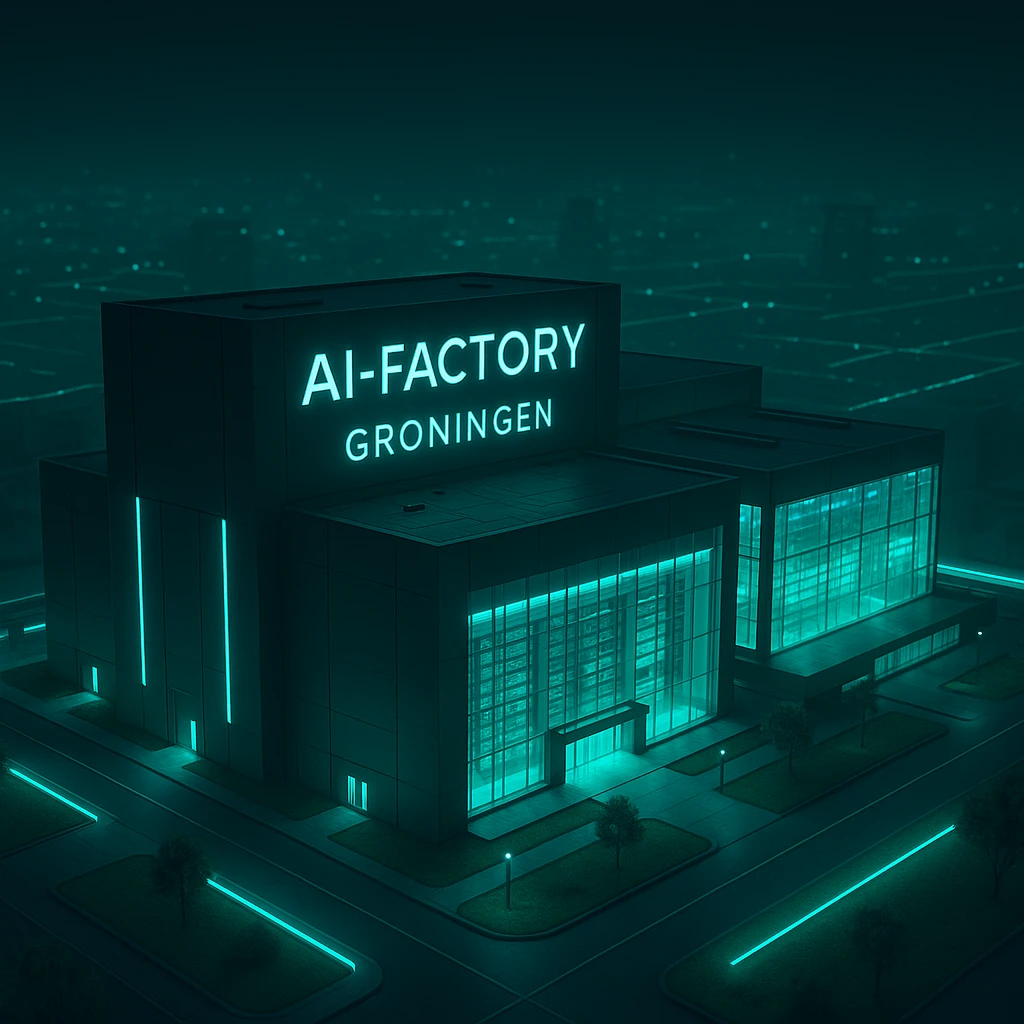
The AI Factory Groningen is no longer just a proposal — it has officially been approved. With €200 million now secured through European, national, and regional funding, the Netherlands is preparing to build one of Europe’s most important public AI infrastructure hubs.
This matters because artificial intelligence is no longer only about better models. It is increasingly about who controls the compute power, data infrastructure, and innovation ecosystem behind those models. Groningen is now becoming part of Europe’s answer to that challenge.
Arti-Trends Insight: The real AI race is shifting from software alone to infrastructure. Whoever controls the compute layer controls how fast models can be trained, tested, deployed, and governed.
Recent Developments at the AI Factory Groningen
EuroHPC JU has awarded €70 million in European funding for the Dutch AI Factory in Groningen. Combined with earlier national and regional support, the total available budget now reaches €200 million. According to TNO and SURF, the facility is expected to become fully operational in 2027.
The project is being developed by a Dutch consortium including SURF, TNO, the Dutch AI Coalition, Stichting Nederlandse AI Fabriek, Samenwerking Noord, several Dutch ministries, and regional investment support from Nij Begun.
The AI Factory will not function as a normal data center. It is designed as a full AI innovation ecosystem: compute infrastructure, expertise, datasets, support services, and access for startups, SMEs, researchers, public organizations, and education.
Why the AI Factory Groningen Matters
For years, European organizations have relied heavily on American cloud providers and Asian hardware supply chains to train and deploy advanced AI systems. That dependency creates cost, privacy, security, and sovereignty risks.
The Groningen AI Factory changes that direction. It gives Dutch and European organizations access to high-performance AI infrastructure under European rules, with stronger alignment around privacy, transparency, public value, and trustworthy AI.
In practical terms, this means Europe is not only regulating AI — it is also building the infrastructure needed to compete.
Strategic takeaway: Groningen is not just getting an AI facility. Europe is building part of its own AI power structure.
Why Groningen Was Chosen
Groningen is strategically positioned for this role. The region combines knowledge institutions, digital infrastructure, available innovation space, and a strong public-private ecosystem. TNO notes that the AI Factory will be housed in the Niemeyer Factory, an IT hub selected for its proximity to technological expertise.
The project also connects to a broader regional development strategy. For Groningen and North Drenthe, the AI Factory can create high-skilled jobs, attract startups, strengthen research activity, and position the region as a serious AI hub in Northern Europe.
That regional angle matters. AI infrastructure is becoming economic infrastructure. Just as ports shaped trade and cloud regions shaped the internet economy, AI factories may shape the next phase of industrial innovation.
Europe’s AI Race Is Becoming a Compute Race
The AI Factory Groningen fits into a wider European strategy. EuroHPC describes AI Factories as hubs that use supercomputing capacity to develop trustworthy cutting-edge generative AI models and support sectors such as health, manufacturing, climate, finance, and public services.
This is part of a larger shift: Europe wants to reduce dependence on foreign infrastructure and strengthen technological sovereignty. The EU’s broader AI strategy focuses on excellence, trust, competitiveness, and strategic autonomy.
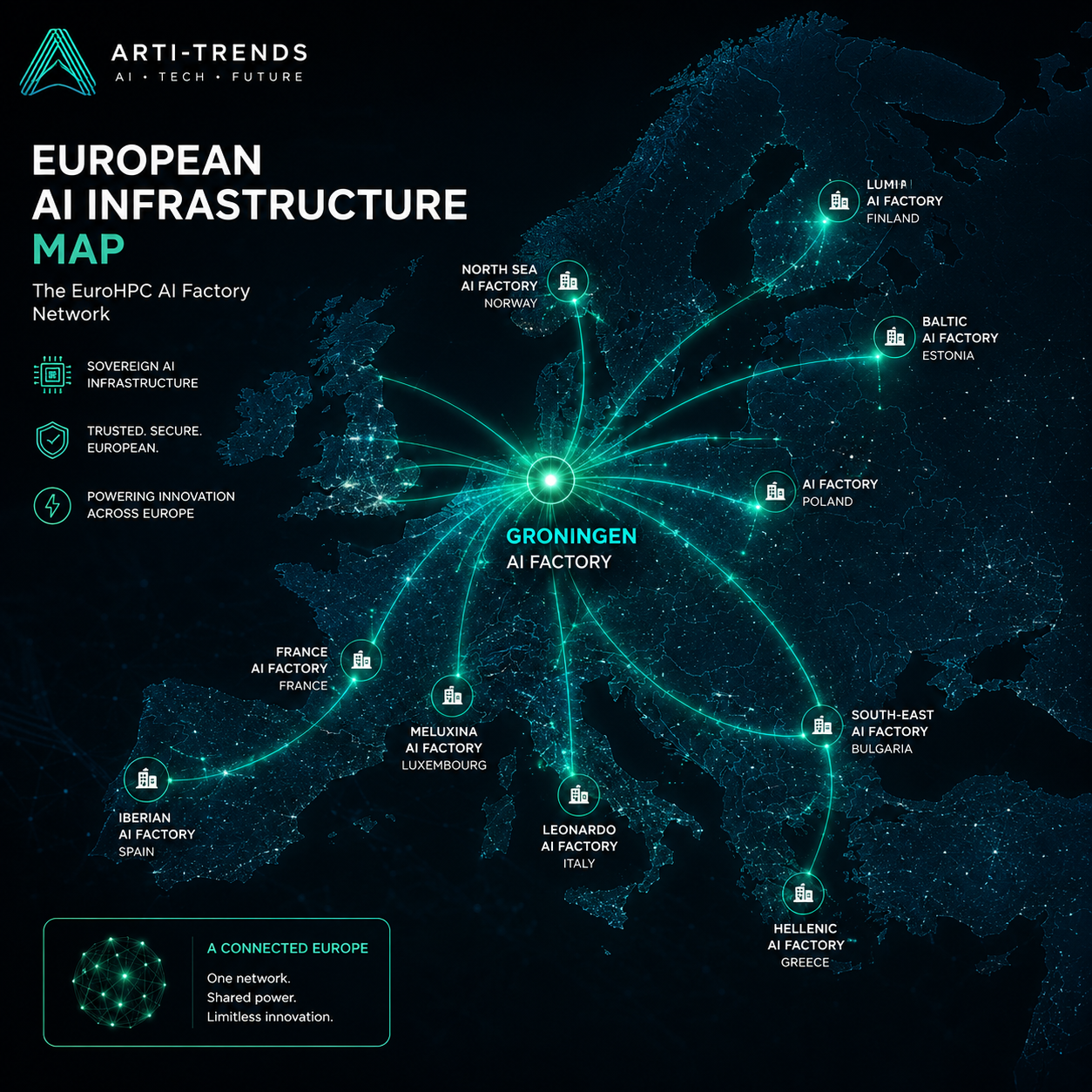
That makes the Groningen project more than a national investment. It is one node in a European network of AI infrastructure designed to help startups, researchers, and industry build AI systems closer to home.
Practical Implications for Businesses and Researchers
The most direct benefit is access. Startups, SMEs, universities, and public organizations often cannot compete with large technology companies for scarce GPU capacity. The AI Factory can lower that barrier by offering shared European infrastructure and support.
For companies, this could accelerate product development. For researchers, it could reduce waiting times for compute-heavy experiments. For public organizations, it could make it easier to build AI systems around sensitive datasets without immediately relying on foreign cloud platforms.
- Startups: faster prototyping and model development without hyperscaler-level budgets.
- SMEs: easier access to AI infrastructure for automation, analytics, and product innovation.
- Researchers: more compute power for scientific AI, simulation, and applied research.
- Public organizations: better conditions for privacy-sensitive and socially responsible AI.
For a broader view of how AI infrastructure affects the market, read our guide on AI data center investments.
Key Use Cases for the AI Factory Groningen
The AI Factory is expected to support practical AI development across several high-impact sectors. These are not abstract use cases — they are exactly the areas where compute power, reliable data, and domain expertise can turn AI from experiment into deployment.
Healthcare and Medical AI
Healthcare organizations need AI systems that are safe, explainable, and compliant with strict data protection rules. The AI Factory can support medical imaging, decision support, personalized treatment research, and administrative automation using European standards.
Related reading: AI in Healthcare Investing.
Energy, Climate, and Smart Grids
AI can help forecast energy demand, optimize grid performance, model climate scenarios, and improve industrial energy efficiency. With stronger compute infrastructure, these models can become faster, more accurate, and more useful for real-world decisions.
Industry, Robotics, and Digital Twins
Manufacturers can use AI to simulate factories, optimize production lines, predict maintenance needs, and improve supply chains. Digital twins and robotics require large amounts of simulation and training data — exactly the type of workload AI factories are built to support.
Cybersecurity and Digital Defence
As AI becomes more important in cybersecurity, Europe needs secure infrastructure for threat detection, anomaly analysis, and defensive AI systems. A public European AI facility can support this without placing sensitive workloads fully inside foreign-controlled platforms.
Related reading: AI News and Trends.
The Bigger Picture: AI Sovereignty
The AI Factory Groningen should be understood through one central concept: AI sovereignty. That means the ability to develop, train, deploy, and govern AI systems without being fully dependent on a small group of foreign technology providers.
This does not mean Europe will stop using global technology. It means Europe wants more strategic control over critical layers: compute, data, infrastructure, standards, and deployment environments.
That matters for businesses too. As AI regulation, cybersecurity requirements, and data protection rules become stricter, organizations will increasingly ask where their models run, where their data is processed, and who controls the infrastructure.
Editorial view: Europe’s biggest AI challenge is not talent. It has researchers, startups, and industrial expertise. The harder problem is infrastructure at scale — and that is exactly what AI Factories are meant to solve.
Risks and Open Questions
The project is promising, but it is not risk-free. AI infrastructure requires enormous amounts of capital, energy, hardware, and operational expertise. Europe also still depends heavily on non-European chip suppliers, which means compute sovereignty is not solved overnight.
- Hardware dependency: advanced AI chips are still dominated by non-European suppliers.
- Energy demand: large-scale AI infrastructure must prove it can scale sustainably.
- Access rules: startups and SMEs need simple, affordable ways to use the facility.
- Execution speed: Europe must move fast enough to stay relevant against U.S. and Chinese infrastructure growth.
The success of the Groningen AI Factory will depend not only on funding, but on execution: who gets access, how easy the platform is to use, how fast projects can launch, and whether the ecosystem produces visible results.
Future Outlook: What Happens Next?
The facility is expected to become fully operational in 2027. In the short term, the most important developments to watch are infrastructure build-out, governance rules, access models for companies and researchers, and the first pilot projects.
By 2030, the AI Factory Groningen could be part of a much larger European AI infrastructure network. If that network succeeds, Europe may become less dependent on external cloud giants and more capable of building AI systems around its own economic, scientific, and societal priorities.
For investors, founders, and policymakers, the signal is clear: AI infrastructure is becoming one of the most strategic markets in the world.
Related reading: Investing in AI Startups and Nvidia’s Q3 Results.
Conclusion
The AI Factory Groningen marks a turning point for Dutch and European AI. What started as an ambitious proposal has now become an officially funded €200 million infrastructure project with European strategic importance.
Its impact could reach far beyond Groningen. It may help startups access compute, researchers train advanced models, public organizations work with sensitive data more safely, and European companies reduce their dependence on foreign cloud infrastructure.
The deeper story is simple: Europe is no longer only debating AI. It is building the infrastructure to shape it.
FAQ: AI Factory Groningen
What is the AI Factory Groningen?
The AI Factory Groningen is a planned European AI infrastructure hub in the Netherlands. It will provide compute power, expertise, data support, and innovation services for startups, SMEs, researchers, education, and public organizations.
How much funding has been secured?
A total of €200 million has been made available, including €70 million in European funding from EuroHPC JU and earlier national and regional contributions.
When will the AI Factory Groningen be operational?
The facility is expected to become fully operational in 2027.
Why is the AI Factory important for Europe?
It supports Europe’s ambition to strengthen AI sovereignty, reduce dependence on foreign cloud infrastructure, and give European organizations better access to trustworthy AI compute resources.
Who can benefit from the AI Factory?
Startups, SMEs, researchers, universities, public organizations, and companies working in sectors such as healthcare, energy, manufacturing, cybersecurity, and climate technology can benefit from the facility.
Related Articles You’ll Want to Explore Next
AI in Healthcare Investing: How Artificial Intelligence Is Transforming Medicine and Markets
How AI is reshaping medical innovation — and the investment opportunities emerging as a result.
AI United States Datacenters: Google Announces $40 Billion Investment in Texas
A deep dive into AI data center expansion and what it means for global AI infrastructure.
AI Stocks Slide as Investors Brace for a Potential Bubble Burst
A sharp look at what happens when markets question the AI narrative.
Investing in AI Startups: How to Spot the Next Big Thing in Artificial Intelligence
A practical guide to identifying high-potential AI startups before they go mainstream.
Nvidia’s Q3 Results Signal a New Phase in the Global AI Race
What Nvidia’s latest earnings reveal about compute demand and AI infrastructure.