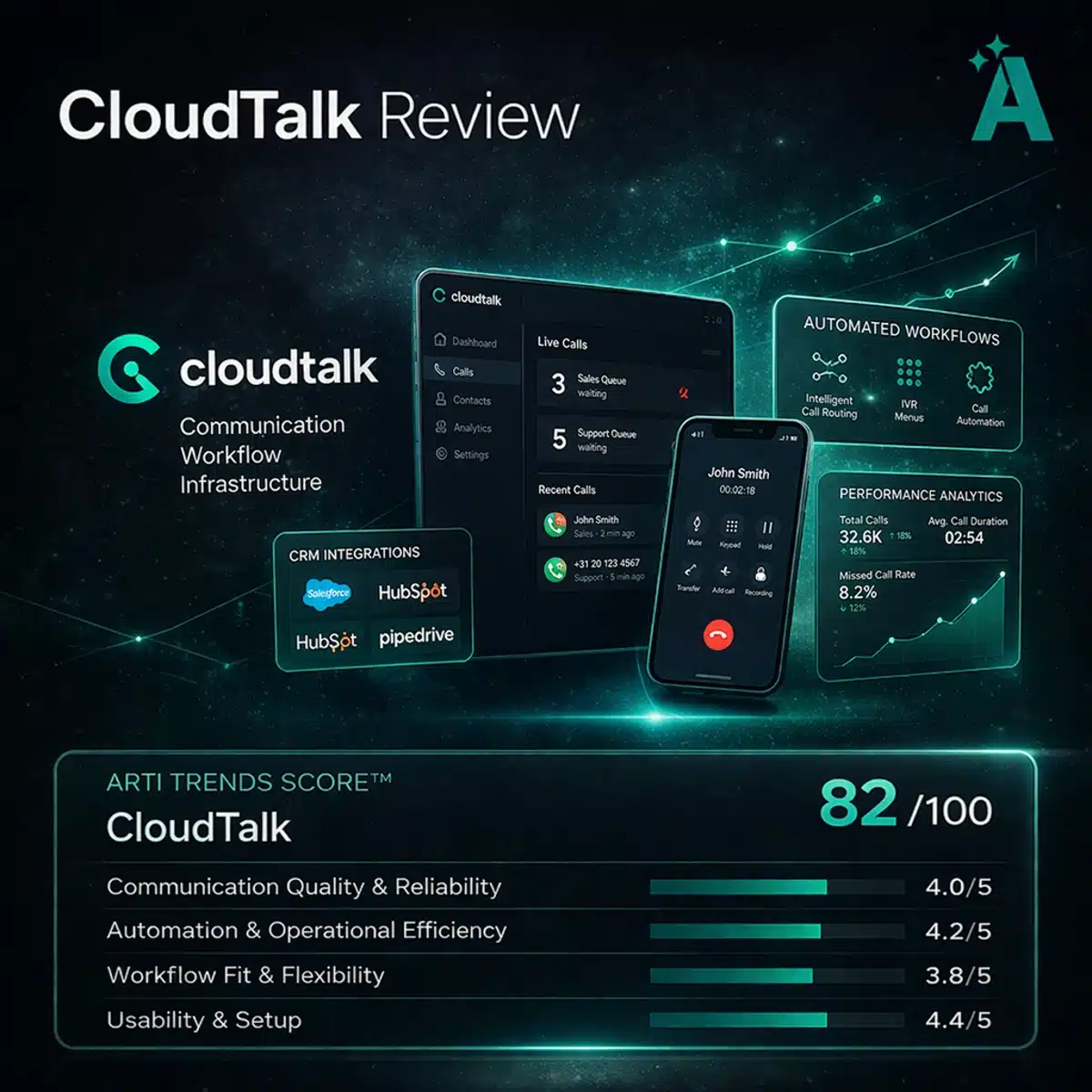
What is CloudTalk?
CloudTalk is a cloud-based business calling platform designed to help sales and support teams manage customer communication more efficiently through automation, integrations, and AI-driven insights.
In this hands-on CloudTalk review, we evaluate how the platform performs in real operational workflows — not just in theory.
Communication has become a critical bottleneck in modern business operations. As companies scale across regions, channels, and customer touchpoints, managing calls efficiently requires more than traditional telephony. Within the rapidly evolving communication software landscape, many platforms attempt to combine multiple functions into a single environment — from calling and messaging to analytics, automation, and customer data management. As competition intensifies, these platforms increasingly position themselves as all-in-one communication ecosystems designed to centralize customer interaction workflows.
CloudTalk takes a more focused approach. Instead of trying to replace the entire communication stack, it concentrates on a single, high-impact layer of the workflow: structured voice communication and call management. The platform is built to handle inbound and outbound calls at scale, integrate directly with CRM systems, and provide operational visibility through analytics and automation.
This review is based on a structured evaluation framework that focuses on real workflow performance, practical usability, and measurable operational impact. This positions CloudTalk less as a general communication tool and more as execution infrastructure within sales and support workflows. The central question is therefore not whether it can replace existing systems, but whether it meaningfully improves communication efficiency, increases team productivity, and enhances visibility across customer interactions in real-world business environments.
This article contains affiliate links. We may earn a commission at no extra cost to you. All reviews remain independent and based on real evaluation.
Review Snapshot
CloudTalk is built for structured communication workflows. It is not a simple calling tool, but a scalable system designed to manage, automate, and optimize customer conversations across sales and support teams. Its strongest value appears in environments where communication efficiency directly impacts performance.
Sales teams, support teams, and growing businesses that rely on structured call workflows and CRM integrations to manage customer communication at scale.
Individuals, freelancers, or small teams looking for simple, low-cost calling solutions without the need for advanced automation or integrations.
Pros
- Strong CRM integrations
- Advanced call routing and automation
- Scalable infrastructure for teams
Cons
- Setup requires structure
- Pricing scales with usage
- Not beginner-focused
What Is CloudTalk?
Core functionality explained
CloudTalk is a cloud-based business calling platform designed specifically for structured communication workflows within sales and support environments. The tool focuses on managing inbound and outbound calls, automating call routing, and providing real-time visibility into customer interactions through analytics and integrations. It can be deployed across customer-facing operations such as sales outreach, customer support, and account management. Rather than functioning as a full communication suite, it operates as a specialized execution layer within the broader business and AI tools ecosystem.
What problem does it solve?
In growing organizations, communication quickly becomes fragmented across teams, tools, and processes. Managing large volumes of calls manually leads to inefficiencies, missed opportunities, and limited insight into performance.
CloudTalk addresses this by structuring communication into a centralized system where calls are routed, tracked, and analyzed automatically. This reduces operational friction and enables teams to handle higher volumes of interactions with greater consistency and control. Within real-world workflows, this places the platform firmly in the Execute stage, where communication is carried out, measured, and optimized.
Who is it built for?
CloudTalk is primarily built for sales teams, customer support teams, and service-oriented businesses that rely on consistent, high-volume communication with customers. It is especially relevant for companies that use CRM systems and need to integrate calling directly into their existing workflows.
It is less suited for individuals or small teams that require only basic calling functionality. Instead, it fits best in environments where scalability, structure, and performance visibility take priority over simplicity.
If you want to see how CloudTalk works in practice, you can explore the platform directly.
CloudTalk Interface and Output Examples
Below are real interface examples and workflow outputs from CloudTalk to illustrate how the platform performs in practice.
Dashboard overview showing the call management interface, live call activity, and team performance metrics.
Example of structured call workflows, including automated routing, IVR menus, and call queue management.
Input-to-output transformation showing how incoming calls are routed, logged, and converted into actionable data within CRM systems and analytics dashboards.
CloudTalk Performance Breakdown (Arti-Trends Score)
CloudTalk — Communication Workflow Infrastructure
Key Features and Capabilities
Core features overview
CloudTalk is designed around one primary function: managing business communication at scale through structured calling workflows. The platform enables users to handle inbound and outbound calls, automate routing, and connect conversations directly to CRM systems and support tools. Its core feature set includes call routing, IVR systems, call recording, real-time analytics, and workflow automation that support efficient communication environments.
The system is built to reduce manual coordination by transforming incoming and outgoing calls into structured, trackable interactions. This makes it particularly effective in workflows where communication volume, response time, and consistency directly impact operational performance.
Unique capabilities vs competitors
What differentiates CloudTalk from broader communication tools is its focus on workflow-driven call management rather than simple telephony. Instead of functioning as a basic calling solution, the platform prioritizes structured communication, automation, and integration with existing business systems.
One of its key strengths is the ability to route, track, and analyze calls within a connected ecosystem, allowing teams to operate with greater visibility and control. This positions the platform closer to operational infrastructure than to standalone communication tools, especially in environments where efficiency and scalability are more important than simplicity.
Limitations of the feature set
While CloudTalk excels in structure and scalability, its feature set is not designed for simplicity. The platform requires proper setup, configuration, and workflow alignment to deliver its full value.
Users looking for lightweight or plug-and-play calling solutions may find the system more complex than necessary. Additionally, the effectiveness of the platform depends heavily on how well it is integrated into existing workflows and CRM systems. Without this, its advantages in automation and analytics become less impactful.
How CloudTalk Fits Into Real Workflows
Role inside the AI Workflow Stack
The Arti-Trends Workflow Stack™ explains how tools create value within real-world processes rather than in isolation. Instead of evaluating tools purely based on features, this framework focuses on where they operate within a workflow and how they contribute to measurable outcomes.
CloudTalk plays a concentrated role within this structure. It operates primarily in the Execute stage, where real customer interactions take place. In this context, the platform functions as a communication execution system designed to manage, route, and structure calls within broader business workflows.
Where it creates the most value
Within sales and support workflows, the Execute stage is directly linked to responsiveness, conversion rates, and customer experience. The ability to handle calls efficiently, route them correctly, and track interactions determines how effectively teams can operate at scale.
CloudTalk increases efficiency in this stage by automating call routing, structuring communication flows, and integrating conversations into CRM systems. This reduces manual coordination and enables teams to handle higher volumes of interactions without losing visibility or control.
However, the platform has limited influence outside this stage. It does not define upstream strategy (Capture), nor does it replace deeper analysis or long-term optimization processes (Learn). Its value is therefore highly concentrated but clearly defined within the broader workflow ecosystem.
Example real-world workflow
In a typical sales or support workflow, CloudTalk is used when customer interaction actually occurs. Strategy, targeting, and messaging are defined beforehand, after which the platform manages the execution of communication.
Incoming or outgoing calls are routed through predefined workflows, logged automatically, and connected to customer records. Teams can then act on this data, improving future interactions and operational efficiency.
Capture → Define customer segments, messaging, and contact strategy
Create → Prepare scripts, call flows, and routing logic
Execute → Manage calls and interactions with CloudTalk
Refine → Optimize call handling, scripts, and workflows
Learn → Analyze call data, performance metrics, and team output
This illustrates that CloudTalk does not replace the workflow, but structures and scales the execution layer. Its effectiveness depends on how well it is integrated into a broader system rather than how it performs in isolation.
Performance and Output Quality
Output quality evaluation
CloudTalk delivers structured, reliable communication output that aligns well with professional sales and support environments. Calls are handled with consistent routing logic, clear audio quality, and integrated data capture, making interactions immediately usable within CRM systems and operational workflows. For standard use cases such as customer support, outbound sales, and account management, the output quality is stable enough to support day-to-day operations without friction.
However, the quality of interactions is not determined by the platform alone. CloudTalk performs best when workflows are clearly defined, routing logic is properly configured, and teams follow structured communication processes. When setup is incomplete or poorly designed, the system can still function, but outcomes become less efficient and less consistent. This reinforces that the platform amplifies operational structure rather than replacing it.
Speed and scalability
One of the strongest aspects of CloudTalk is its ability to handle high volumes of communication in a structured and scalable way. What would traditionally require manual coordination across multiple systems can be centralized into a single workflow, allowing teams to manage more interactions with less overhead.
This has a direct impact on operational performance, as faster routing, reduced wait times, and streamlined call handling improve both efficiency and customer experience. In environments where response time and call volume directly influence outcomes, this level of scalability becomes a meaningful advantage rather than a marginal improvement.
Consistency and reliability
CloudTalk delivers consistent performance within its defined scope, particularly when used in stable, repeatable workflows. Call routing, logging, and data synchronization follow predictable patterns, which supports structured team operations and measurable performance tracking.
That said, consistency does not equal optimization. Outputs still depend on how well workflows are designed and maintained. Call scripts, routing logic, and team execution all influence final outcomes. The platform should therefore be viewed as an execution layer that ensures consistency, rather than a system that guarantees optimal performance on its own.
Real-World Performance Insight
In practical environments, the impact of CloudTalk is most visible in operational efficiency and visibility. By structuring communication and centralizing call data, teams gain clearer insight into performance, response times, and customer interactions.
Rather than improving individual conversations directly, the platform improves how communication is managed, tracked, and optimized over time. This makes it particularly valuable in environments where scale, consistency, and data-driven decision-making are critical to performance.
Pricing and Value for Money
Pricing structure explained
CloudTalk operates on a subscription-based pricing model, with multiple tiers based on features, number of users, and level of functionality. The platform typically includes plans that scale from basic calling capabilities to more advanced setups with analytics, automation, and integrations. This positions CloudTalk within the mid-to-premium range of business communication tools, reflecting its focus on structured, team-based workflows rather than simple telephony use cases.
Each pricing tier is designed to scale with operational complexity and usage. As teams grow and require more advanced routing, deeper analytics, and CRM integrations, the platform becomes more valuable. For organizations handling continuous customer communication, this structure aligns well with workflows where calling is a core operational function rather than an occasional activity.
Pricing Overview
| Plan | Best For | Key Access |
|---|---|---|
| Starter | Small teams and basic call operations | Core calling features, limited integrations |
| Essential | Growing teams with structured workflows | Advanced routing, analytics, CRM integrations |
| Expert | Scaling businesses and support teams | Automation features, deeper reporting, performance tools |
| Custom | Large organizations and enterprises | Full customization, dedicated support, tailored infrastructure |
Value for Money in Practice
The real value of CloudTalk is not measured by subscription cost alone, but by the cost per interaction handled and managed effectively.
In traditional workflows, managing high volumes of calls requires manual coordination, fragmented tools, and limited visibility into performance. With CloudTalk, communication is centralized, automated, and structured, shifting the economics from cost per call to cost per optimized workflow.
For sales and support teams, this is where the platform delivers its strongest return on investment: faster response times, improved call handling efficiency, and better visibility into team performance.
Is it worth the cost?
The value of CloudTalk depends largely on how it is integrated into operational workflows. For teams that rely heavily on inbound or outbound communication, the platform can significantly reduce inefficiencies and improve consistency, making it a cost-efficient solution compared to fragmented systems or manual processes.
In these environments, the return on investment is driven by improved team productivity, better customer experience, and more structured performance tracking. However, for small teams with low call volume or minimal workflow complexity, the subscription cost may outweigh the practical benefits. The platform delivers the most value when communication is a core operational function rather than a secondary activity.
Best plan by use case
For small teams or early-stage businesses, entry-level plans provide access to core calling functionality and basic integrations, making them suitable for straightforward communication needs or initial testing of the platform.
Mid-tier plans are typically the most balanced option for growing teams, offering advanced routing, analytics, and CRM integrations that support more structured workflows and higher communication volumes.
Higher-tier or custom plans are best suited for organizations managing large-scale operations or multiple teams, where automation, customization, and deep analytics become critical. In these cases, CloudTalk shifts from a supporting tool to a central component of operational infrastructure.
View current pricing and plans on CloudTalk.
Pros and Cons
Key advantages
CloudTalk delivers its strongest value in environments where communication volume, structure, and responsiveness directly influence performance.
High operational efficiency
The platform enables teams to handle large volumes of calls through automated routing, reducing manual coordination and improving response times.
Built for structured workflows
Call flows, IVR systems, and integrations are designed around organized communication processes rather than ad-hoc calling, making interactions more consistent and measurable.
Strong integration ecosystem
CloudTalk connects seamlessly with CRM systems and support tools, allowing teams to centralize communication data and improve visibility across workflows.
Key limitations
The platform’s structured approach also introduces clear limitations.
Requires setup and configuration
To unlock its full value, CloudTalk needs properly defined workflows, routing logic, and integrations. Without this, its advantages are reduced.
Less suitable for simple use cases
For individuals or small teams with minimal call volume, the platform may feel overly complex compared to basic calling solutions.
Dependent on workflow quality
The effectiveness of the platform depends heavily on how well processes are designed and maintained. Poor setup leads to suboptimal performance.
When this becomes a real limitation
In environments where simplicity and speed of setup are more important than structure and scalability, CloudTalk can feel unnecessarily complex. Teams that do not rely
Alternatives and Competitors
Best alternatives to CloudTalk
While CloudTalk is optimized for structured call management and workflow-driven communication, several other platforms operate within the broader business communication ecosystem with different strengths and positioning.
Tools such as Aircall and RingCentral offer similar cloud-based calling solutions with strong team collaboration features and integrations. These platforms are often well-suited for organizations looking for flexible communication systems that combine calling with broader collaboration capabilities.
Other platforms like JustCall and Dialpad focus more heavily on automation and AI-assisted communication. They can add value through features such as call transcription, sentiment analysis, and productivity insights, but may differ in how deeply they support structured workflow design compared to CloudTalk.
Within the segment of cloud telephony and business calling platforms, there are also providers that emphasize simplicity and ease of setup. These solutions can be more accessible for smaller teams but typically offer less control over routing logic, analytics, and integration depth.
In comparison, CloudTalk differentiates itself through its focus on structured communication workflows, scalability, and operational control. Rather than positioning itself as a simple calling tool, it operates as communication infrastructure within larger sales and support systems, where organization and visibility are critical to performance.
CloudTalk vs Alternatives
To understand where CloudTalk fits best, it helps to compare it with other cloud calling and communication platforms. The goal is not to identify a universal winner, but to show which tool creates the most value in each workflow.
| Tool | Core Strength | Main Limitation | Best Use Case | Workflow Role |
|---|---|---|---|---|
|
CloudTalk
Best for call workflows
|
Structured calling, routing, and analytics
i
Built for inbound and outbound communication with IVR, automation, analytics, and CRM-connected call handling.
|
Less broad than full communication suites
i
Strongest when calling is central to the workflow, not when a team needs a full all-in-one communication environment.
|
Sales and support teams with structured call operations
i
Best for organizations that depend on scalable call workflows, CRM visibility, and operational control.
|
Execute • Comm. layer |
|
Aircall
|
Ease of use and fast team deployment
i
Strong fit for teams that want quick setup, intuitive workflows, and broad CRM/helpdesk integrations.
|
Less workflow depth for complex operations
i
Better for simplicity and speed than for organizations that need deeper routing logic or operational control.
|
Teams prioritizing simplicity and integrations
i
Good for companies that want cloud calling with minimal friction and fast onboarding.
|
Execute • Calling Layer |
|
Dialpad
|
AI-native transcription and conversation intelligence
i
Strong in live transcription, summaries, coaching, and AI-supported insight across daily conversations.
|
Broader platform than some teams need
i
Can feel more platform-heavy than necessary if the main requirement is straightforward cloud calling.
|
AI-led sales and support environments
i
Best for teams that want communication plus real-time intelligence, summaries, and coaching.
|
Execute / Learn • AI Layer |
|
RingCentral
|
Broad unified communications ecosystem
i
Combines calling, messaging, meetings, and enterprise communication tools inside one broader platform.
|
More extensive than some teams require
i
Better for broader communication infrastructure than for teams seeking a focused call-center workflow layer.
|
Organizations needing all-in-one communications
i
Useful for companies that want phone, messaging, meetings, and broader enterprise communication in one stack.
|
Execute • Unified Comms Layer |
CloudTalk is not trying to be every kind of communication platform. Its strength is a focused environment for teams that depend on calling, routing, analytics, and CRM-connected workflows. Where Aircall leans into simplicity, Dialpad leans into AI intelligence, and RingCentral leans into broader communications, CloudTalk stands out as structured communication infrastructure for modern sales and support teams.
When to choose an alternative
CloudTalk is not the optimal choice in every scenario. Teams that need a lightweight calling solution, minimal setup, or a simpler user experience may be better served by more straightforward platforms such as Aircall or other ease-of-use-first communication tools.
In addition, when the workflow is less dependent on structured routing, high call volumes, or deep CRM-connected communication, the added value of CloudTalk can be limited. In these cases, a simpler VoIP or business calling solution may be sufficient without the added complexity of workflow configuration and operational controls.
For organizations that need a broader all-in-one communication environment with meetings, messaging, and enterprise-wide collaboration built into the same platform, larger unified communications suites may be a better fit. CloudTalk delivers its greatest value when it is used as a specialized communication infrastructure layer inside structured sales and support workflows, not as a replacement for every communication tool in the stack.
Final Verdict
Who should use CloudTalk
CloudTalk is best suited for teams that rely heavily on structured voice communication as part of their daily operations. This includes sales teams, customer support departments, and growing businesses that need to manage inbound and outbound calls at scale while maintaining visibility and control.
In these environments, the platform functions as a communication infrastructure layer. It enables teams to standardize call handling, automate routing, and integrate directly with CRM systems, improving both efficiency and operational clarity. When embedded in a structured workflow, CloudTalk can significantly enhance productivity and provide better insight into customer interactions.
Who should avoid it
CloudTalk is less suitable for users who need a simple, plug-and-play calling solution with minimal setup. Smaller teams or individuals with low call volume may find the platform more complex than necessary for their needs.
It is also not ideal for organizations looking for a fully unified communication suite that includes messaging, video conferencing, and collaboration tools in one environment. In these cases, broader all-in-one platforms may provide a better fit.
Overall recommendation
CloudTalk is not a general communication tool, nor is it designed to replace every system in the communication stack. Its strength lies in doing one thing well: structuring and scaling voice communication within sales and support workflows.
For teams where call handling is a critical part of operations, it can deliver clear value by improving efficiency, consistency, and visibility. For others, its benefits will be more limited. As with most AI-driven tools, its effectiveness depends less on the platform itself and more on how well it is integrated into a broader workflow.
If you are looking to bring structure, automation, and scalability to your business calling processes, CloudTalk is worth considering within a real operational setup.
Frequently Asked Questions
These answers address the most common questions users have when evaluating CloudTalk within structured communication workflows.
What is CloudTalk and how does it work?
CloudTalk is a cloud-based business calling platform that manages inbound and outbound communication through automation, call routing, and CRM integrations. It centralizes call handling and provides analytics to improve operational performance.
Is CloudTalk an AI tool or a VoIP system?
CloudTalk is primarily a VoIP system enhanced with AI-driven features such as call analytics and automation. It functions as communication infrastructure rather than a standalone AI tool.
Who should use CloudTalk?
CloudTalk is best suited for sales teams, customer support teams, and businesses that handle high call volumes and require structured workflows with CRM integration and performance visibility.
Does CloudTalk integrate with CRM systems?
Yes, CloudTalk integrates with major CRM platforms such as Salesforce, HubSpot, and Pipedrive, enabling automated call logging and aligned customer data across workflows.
Is CloudTalk easy to use?
The platform is relatively intuitive, but its full value depends on proper setup. Advanced features like routing and automation require configuration to unlock their full potential.
Is CloudTalk worth it?
CloudTalk is worth it for teams where communication efficiency directly impacts performance. Its value comes from improving structure, automation, and visibility within workflows.