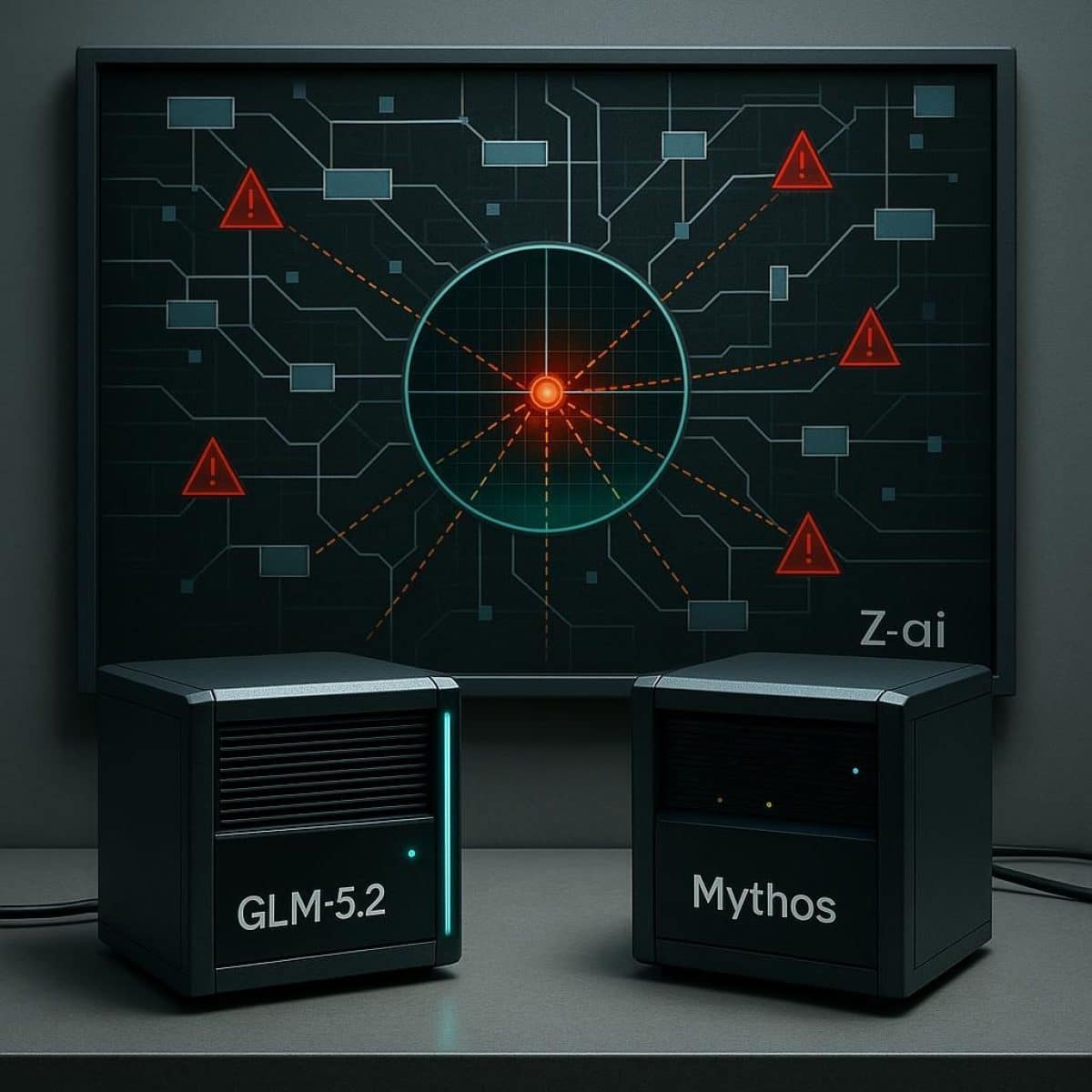
Zhipu AI (Z.ai) released an open-weight model called GLM-5.2, and early researcher tests say it can match Anthropic’s Mythos on narrow cybersecurity tasks like bug-finding and exploit-surface discovery. The claim is focused: GLM-5.2 is said to close gaps on specific red-team workflows, not to equal top Western models across all benchmarks. Reporting first appeared in The Verge AI.
The real issue
The main point is not raw size or speed. It’s that an open-weight Chinese model now appears capable in a vertical that matters for both defenders and attackers.
Those capabilities-finding software bugs, mapping attack surfaces, suggesting exploit routes-can be turned into working tools quickly. Because GLM-5.2’s weights are public, researchers and vendors can run and inspect the model locally, tune it for defensive workflows, and build it into code-audit pipelines.
That same openness lowers the technical bar for misuse. When the model’s internals are available, techniques and prompt chains that discover vulnerabilities are easier to copy, adapt, or repurpose. The Mythos comparison gives the claim a familiar benchmark; see recent coverage of Anthropic and Mythos for background. The important nuance is this is a targeted capability advance, not blanket parity across AI tasks.
Why this matters now
Two linked reasons raise the urgency. First, GLM-5.2 is available in a jurisdiction where many organizations prefer domestic tools for sensitive infrastructure. That speeds legitimate defensive adoption while also making similar tooling easier to produce outside Western clouds and controls.
deployment is moving faster than rules. Policies and enforceable controls for dual-use models remain limited. That gap matters because practical exploit-finding tools can be used for both defense and offense.
Practical implications:
1) Companies adding model-driven security tools should require clear audit trails and source history before deployment. Local testing and provenance matter when a model can be modified freely.
2) Observers should track where investment goes: to firms that pair performance with auditable safety practices, or to those that only tout headline benchmarks.
What to watch next
One clear next signal will determine market reaction: credible, repeatable third-party tests that confirm or refute the Mythos comparison.
For deeper Arti-Trends context, see Home.