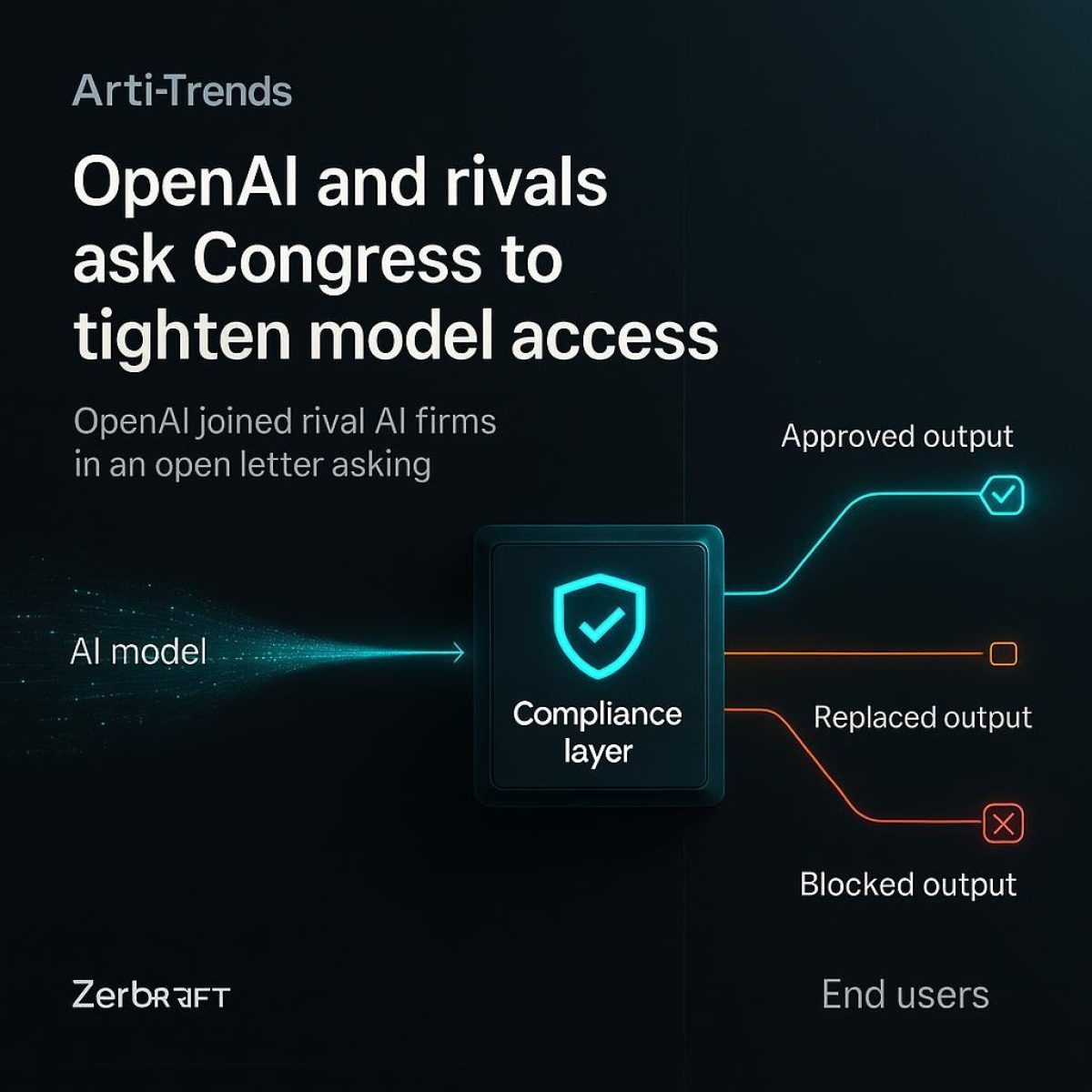
Some of the AI industry’s biggest competitors – including OpenAI, Google DeepMind, Anthropic and Microsoft – publicly urged Congress to close what they describe as a growing biosecurity gap, according to The Verge AI. The companies asked lawmakers to create legal controls on who can access powerful models and how those models may be used, framing access policy as a national-security and public-health priority.
The real issue
The core signal is unusual: rival firms that normally spar on safety, product and market terms put that aside to request binding rules. Arti-Trends’ reading is that this is less about altruism and more about liability and operational friction. When firms face near-term legal exposure from misuse, they have stronger incentives to push for clear rules – and for rules that set a predictable compliance baseline they can build around.
In practice, That matters because major providers already control the gates to the most capable models. If Congress creates legal limits on model access or requires mandatory safety controls for biological-design tasks, platform providers will have both the incentive and the obligation to harden those gates. That will change how product teams design access tiers, how security teams audit usage, and how customers request advanced capabilities.
That also connects to product-level trade-offs between capability and control, teams should watch how platforms adapt tools and APIs. Recent Arti-Trends coverage flagged governance trade-offs when companies ship multi-agent enterprise features – a reminder that technical changes often create new attack surfaces and new compliance headaches for platform operators. OpenAI and Anthropic ship multi-agent enterprise agents – a governance warning
Why this matters now
This moment is actionable because two technical trends have converged: foundation models can generate biological designs in plain language and lab automation is cheaper and more accessible than before. Together, those trends shrink the time and expertise needed to design or iterate on biological agents – and that raises the political pressure for rules that make misuse harder.
Two practical implications follow. First, platform teams will likely accelerate layered access controls and safer-by-default defaults for anything that touches biological design. Second, companies that already treat safety as a product feature stand to benefit from clearer, enforceable rules that reduce legal unpredictability.
Product and security teams should also re-evaluate tool inventories and risk checks; linking AI capabilities to concrete lab workflows is now a more plausible regulatory trigger. For product context and tooling options, see the broader AI tools library. AI tools hub
What to watch next
One reader takeaway: this is a market-driven pressure test – watch whether legal controls arrive before broad, normalised deployment does.