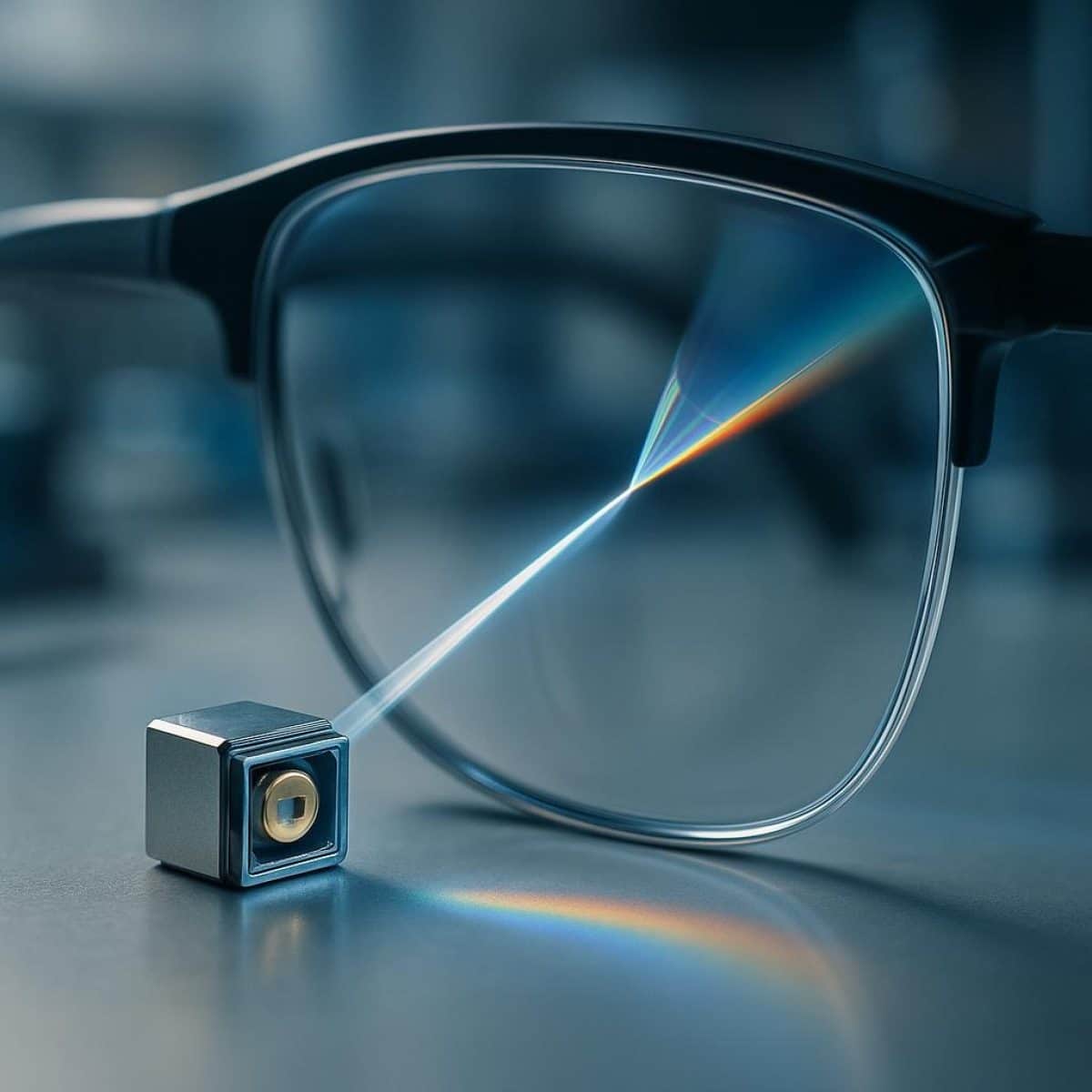
LetinAR has built a thumbnail-sized optical module that could turn optics from bespoke R&D curiosities into a standardized, manufacturable building block for AI glasses. TechCrunch reported the development on May 18; the significance is practical not poetic: weight, comfort and repeatable production are the gating items for any consumer-grade AR device, and LetinAR’s module targets all three at once.
What happened
That move shifts optics from one-off engineering fixtures toward something closer to a commodity component that phone and headset makers can design around. TechCrunch is the primary source for this piece; Arti-Trends treats the company’s product claims as source-reported until corroborating design wins, test data or procurement notices appear.
What changed: LetinAR’s miniaturized optics
Historically, high-end optics for AR have been custom assemblies-large, expensive, and slow to iterate. LetinAR’s reported advance is not a single optical trick but a manufacturing-minded recomposition: smaller physical size, repeatable assembly, and performance good enough for near-eye displays. That converts optics from a bespoke engineering constraint into a potential standardized module.
Put another way: where optics were previously a bottleneck that drove bespoke mechanical redesigns, LetinAR’s approach aims to let device designers treat optics like a supplier-provided black box. That’s a material change in how product roadmaps, supply chains, and BOM trade-offs are decided.
The market signal: why investors and builders should care
This is an investor-facing signal, not financial advice. If the module performs as claimed and LetinAR can scale production, three linked effects follow. First, component-level competition returns to center stage: optics, sensors, and low-power compute become competitive levers again rather than mere integration chores. Second, manufacturability will determine which AR form factors reach consumers-not just demonstration prototypes. Third, supplier economics will reshape margins and strategic partnerships across the hardware stack.
For product teams, the practical takeaway is immediate: a small, manufacturable optics module lowers the engineering cost of trying new frame geometries and battery trades. For investors, the story is where capital and risk will concentrate next-on suppliers that can deliver volume with acceptable yields, not only on brands promising AI features.
For developers of hardware and developer-facing platforms, consider revisiting assumptions about allowable weight budgets and optical tolerances: a smaller, standardized optical module narrows the gap between prototype and production-ready designs. If you maintain a component roadmap, re-evaluate whether optics should be a first-class procurement target rather than an outsourcing afterthought.
Practical implications: winners, losers and supply-chain dynamics
- Who benefits: AR hardware startups and OEMs that need compact optics to meet consumer comfort targets; suppliers able to scale production; South Korea’s photonics ecosystem; and investors positioned early in optics manufacturing capacity.
- Who is at risk: incumbent optics and waveguide vendors with slow scale-up processes; OEMs that depend on single-source suppliers; and consumers if early scarcity concentrates pricing or constrains device choice.
- Platform consequences: If optics become a modular, licenseable piece of the stack, expect more licensing deals and possible standardization efforts-similar to how camera modules and SoCs evolved in mobile phones.
Operationally, the clearest shift is procurement: engineering teams must add optics yield, supply redundancy, and qualification cycles to near-term checklists. Investors should ask startups about supplier diversification and gross-margin sensitivity to optics cost curves.
Risks investors should not ignore
The headline-miniaturized optics-sounds decisive. Reality is messier. Key unknowns remain: independent optical-performance comparisons versus incumbent waveguide or mirror-based approaches; actual manufacturing yield at volume; thermal and alignment tolerances over device lifetimes; and whether LetinAR can protect or license its IP effectively.
Another risk is market timing. Rumored product pushes from big players like Apple and Meta create windows for component vendors, but missing an early design win can lock a supplier out for a product cycle. That makes early pilot orders and announced design wins the highest-value signals to monitor.
Where value may concentrate
Value will likely cluster around three use points:
- Manufacturing scale and yield: Suppliers that master volume, testing, and automated alignment will win margin and contract use.
- Integration breadth: Modules that package optics with sensors, calibration firmware, or thermal-management features reduce integration risk for OEMs and command higher multiples.
- Supply resilience: Regional capacity, dual-sourcing options, and favorable trade or subsidy positions will matter, especially if governments view photonics as strategic infrastructure.
Strategic investors should also watch licensing plays-component-level standards could create recurring revenue streams similar to camera module or GPU IP licensing models. Hardware teams should shortlist suppliers by both optical specs and by demonstrated production throughput.
For readers exploring adjacent product-level context, Arti-Trends maintains a resource hub for developer and product teams at the AI tools hub.
Arti-Trends view
LetinAR is less a single-company story than a signal about where AI capital and risk are moving next. The move from bespoke optics to a thumbnail, manufacturable module matters because the constraints that decide consumer adoption are physical: weight, comfort, battery life and cost. If LetinAR’s claims hold, the competitive frontier shifts from applications and cloud-side models back to hardware components-optics, sensors, and low-power compute.
That shift favors companies and investors that focus on supply-side execution rather than only customer-facing AI features. It also raises a governance and policy vector: national industrial policy and export controls that touch photonics will become material to valuation and procurement decisions.
For strategic readers, treat this as a supplier signal. Re-evaluate procurement, BOM sensitivity, and concentration risk now rather than after design freezes. For investors, look past narrative momentum and demand evidence of scalable manufacturing and early design wins before repositioning portfolio exposure.
Readers who want market-focused analysis can also follow broader AI capital flows and hardware signals via the AI investment hub.
Arti-Trends read: If optics become standardized modules, the AI glasses race will look more like the smartphone camera wars-component suppliers will win attention and value before many device brands do.
What to watch next
TechCrunch AI is the primary source for the underlying reporting; Arti-Trends frames the development as an investor and product-supply signal rather than definitive proof of market disruption.
One-sentence thesis
LetinAR is less a single company story than a signal about where AI capital and risk are moving next: from models and features back to the component suppliers that enable consumer hardware.
Source
Reporting by TechCrunch AI, published May 18, 2026. Source URL: https://techcrunch.com/2026/05/18/south-koreas-letinar-is-building-the-optics-behind-ai-glasses/
Editorial judgment: The real test is not whether the component looks impressive in isolation, but whether it can survive manufacturing, cost, and device-integration pressure.