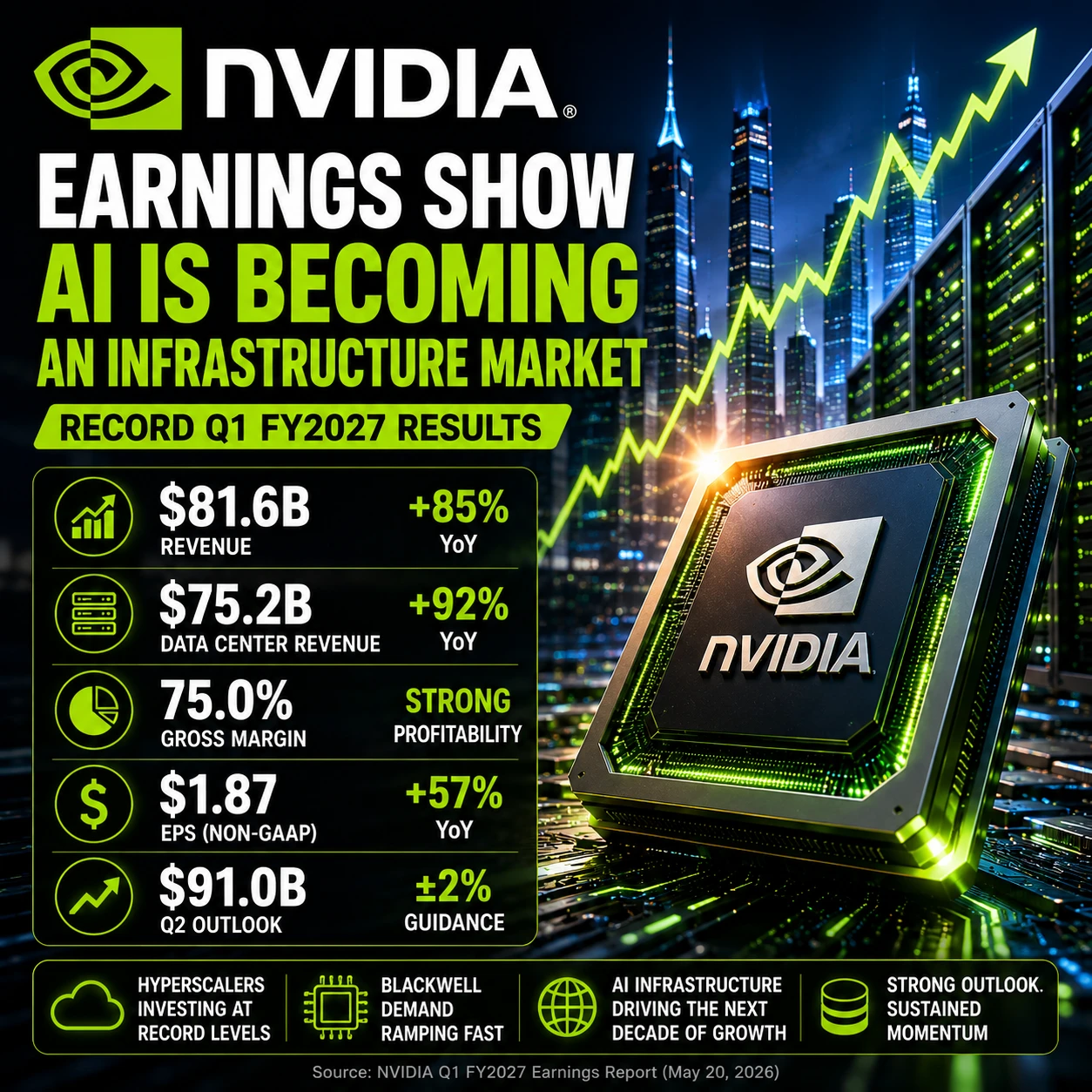
NVIDIA reported another record quarter, reinforcing its position at the center of the global AI infrastructure buildout.
The company generated $81.6 billion in revenue, driven primarily by continued demand for Blackwell-based AI systems and large-scale hyperscaler deployments.
The results suggest that AI spending is shifting from experimentation toward long-term infrastructure investment.
NVIDIA Q1 FY2027 Earnings Snapshot
| Metric | Result | Change |
|---|---|---|
| Total revenue | $81.6 billion | +85% YoY |
| Data Center revenue | $75.2 billion | +92% YoY |
| Non-GAAP gross margin | 75.0% | Strong profitability |
| Non-GAAP EPS | $1.87 | +57% YoY |
| Q2 FY2027 revenue outlook | $91.0 billion | ±2% |
The Market Signal
The signal from NVIDIA’s quarter is simple: AI is becoming an infrastructure market.
For the past two years, the AI race has mostly been framed around models, chatbots and software features (Anthropic ban shows U.S. treating advanced models as geopolitical assets).
NVIDIA’s results show that the deeper economic layer is compute.Hyperscalers are no longer buying GPUs only for experiments.
They are building long-term AI capacity for training, inference, AI agents, enterprise copilots and managed AI services (see Hands Free, AIs Forward: NVIDIA XR AI Brings Agents to AR Glasses).
That makes Data Center revenue the key number. At $75.2 billion, it shows where the money in the AI boom is concentrating.
What Changed
The story is no longer just H100 demand. The next growth phase is increasingly about Blackwell.
Blackwell systems are designed for large-scale AI factories, where companies run training, inference and reasoning workloads at industrial scale.
That changes the investment narrative. AI demand is not only about who builds the best model. It is also about who owns the hardware, software runtime and deployment layer needed to run AI at scale.
This strengthens NVIDIA’s position because its advantage is not limited to chips. It also includes software, developer tools, networking, customer relationships and ecosystem lock-in.
Practical Implications
For investors, NVIDIA remains the clearest AI infrastructure winner.
But the broader signal matters for the full AI supply chain — related coverage includes SpaceX is buying Cursor for billion – infrastructure-first AI.
- GPU demand: NVIDIA remains central to large AI workloads.
- Memory suppliers: AI systems need high-performance memory at scale.
- Advanced packaging: larger AI accelerators increase demand for packaging capacity.
- Foundries: advanced chip manufacturing remains strategically important.
- Cloud providers: hyperscalers can monetize GPU capacity through managed AI platforms.
For AI builders, the message is equally clear: compute is now a strategic decision.
Building on NVIDIA’s stack can improve performance and speed up deployment. But it can also increase dependency on one ecosystem.
That trade-off matters more as AI products move from demos into production workflows.
For more context on the investment side of the AI stack, see the AI Investment Hub. For tool-side exposure, explore the AI Tools Hub.
Risks to Watch
- Customer concentration: a small group of hyperscalers drives a large share of AI infrastructure demand.
- Capex slowdown: weaker cloud spending could pressure growth expectations.
- Supply constraints: memory, packaging and manufacturing capacity remain important bottlenecks.
- Competition: AMD, Intel and custom chips are trying to reduce dependence on NVIDIA.
- Export controls: restrictions on advanced AI chips can limit international growth (see Inside the fight over Claude Mythos 5: US export controls force Anthropic to suspend access).
- Margin pressure: rapid scaling can create supply costs, pricing pressure or execution risk.
Arti-Trends View
NVIDIA’s latest quarter confirms the main shift in the AI market: value is moving deeper into the infrastructure layer.
The AI race is no longer only about better models, better chatbots or better interfaces. It is increasingly about who controls the compute layer underneath them.
That matters for investors because revenue quality depends on whether hyperscaler AI spending remains durable. It matters for builders because hardware, runtime and deployment choices now shape cost, speed and product flexibility.
The next thing to watch is whether NVIDIA’s $91.0 billion revenue outlook becomes another reset in AI infrastructure expectations — or the first sign that the market is pricing in near-perfect execution.
This article is for informational purposes only and is not financial advice.