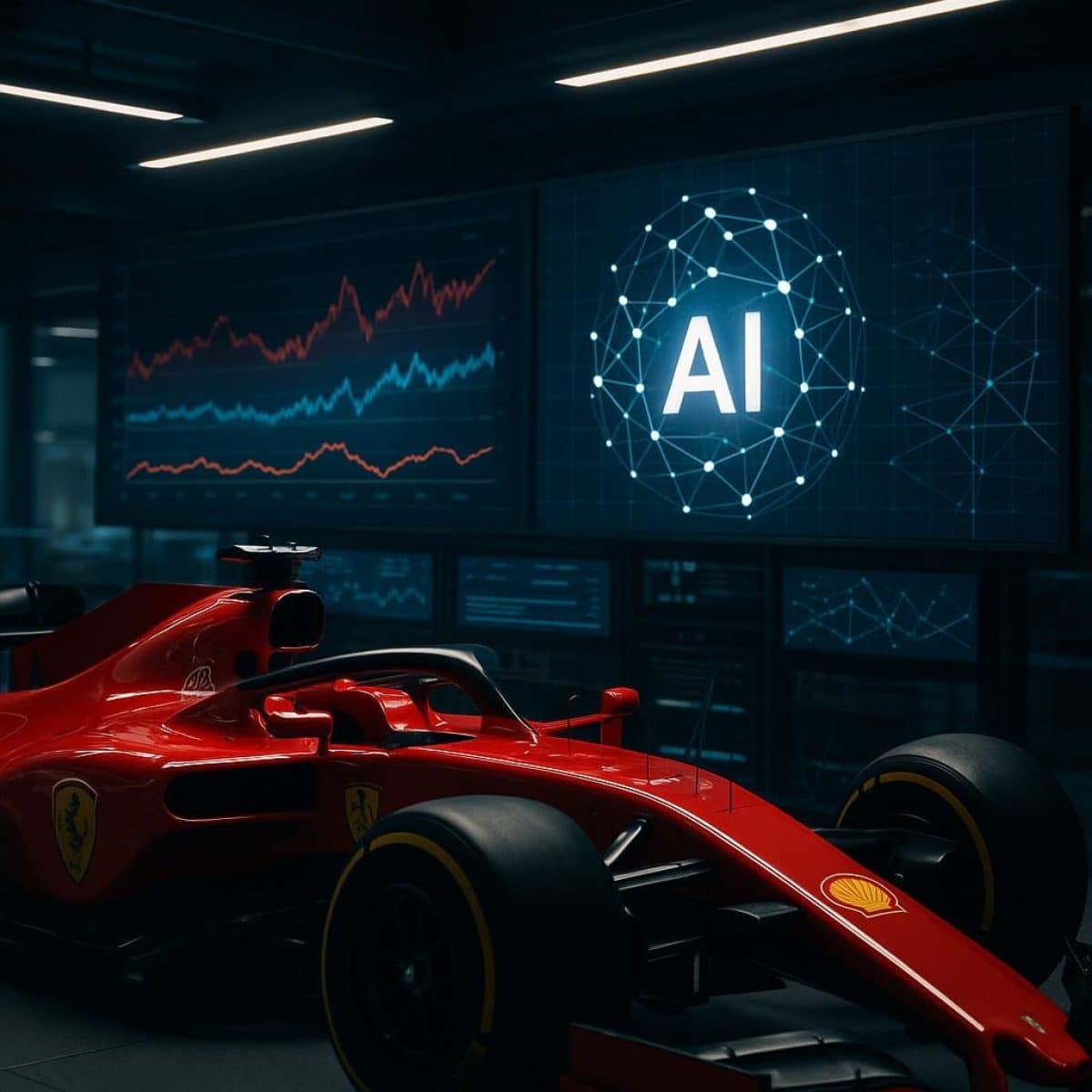
Scuderia Ferrari is working with IBM to use enterprise AI to create hyper-personalized “superfans,” TechCrunch reported. The project stitches together telemetry, viewing habits and commercial signals to deliver bespoke content, offers and experiences – moving beyond match-day apps and highlights toward an operationalized fan-revenue pipeline.
Scuderia Ferrari’s AI push
According to TechCrunch AI, Ferrari and IBM are using watsonx and related enterprise tooling to aggregate multiple data streams about fans and races. The goal is explicit: identify and activate high-value fans with tailored content, exclusive access and targeted offers that deepen retention and monetization. The pair frame this as personalization at scale, not just richer highlights.
The bigger pattern: what changed
This is not simply a new feature. It signals a shift from lightweight personalization to full fan orchestration: teams are pairing proprietary telemetry (car and race data), platform viewing behavior, commercial interactions and marketing signals into a single activation layer. That allows real-time segmentation and offer delivery tied to actual race events and fan context.
Why that matters now: the economics of live sports have become urgent. With third-party tracking weakening and sponsors asking for clearer ROI, franchises need first-party customer data and predictable revenue models. Enterprise AI platforms like IBM’s have become production-ready enough to operate these pipelines at global F1 scale in 2026 – making the move commercially viable where it previously looked experimental.
Business implications: who wins and who faces pressure
For Ferrari and its commercial partners, the upside is concrete. Hyper-personalized engagement can increase conversion on merchandise, ticketing and sponsor offers; it can also create premium, gated experiences fans will pay for. Sponsors gain finer-grained measurement: a sponsor’s offer can be served to fans who watched a driver’s on-track battle, increasing measured engagement.
That commercial clarity explains why this is a watershed moment for sports businesses. Teams that control proprietary telemetry and have enterprise AI partners can turn global reach into recurring revenue and valuable first-party profiles. Smaller teams without those data assets or deep AI partnerships risk a widening commercial gap.
For readers mapping AI to business strategy, this is also a practical product signal: invest in reliable ingestion and identity stitching now, because creating audience-first revenue engines depends more on clean data plumbing and activation rules than on flashy ML models. If you run product or growth teams, start with experiments that connect event signals to small, monetizable experiences and iterate from there. If you manage sponsorships or partnerships, demand testable engagement metrics tied to activation flows rather than vanity impressions.
Technology implications: what’s being stitched and how it runs
The technical claim is straightforward: telemetry (speed, sector times, pit events), streaming viewership signals (which camera or feed a fan watches, duration), CRM/purchase history and marketing signals are being combined into a real-time decision layer. That requires several capabilities to work well: low-latency data pipelines, reliable identity resolution across devices and platforms, privacy-preserving feature engineering, and an activation stack that can push content across mobile apps, email, partner platforms and on-site experiences.
This is also an infrastructure story. Teams will need to operationalize data quality (telemetry is messy), map identifiers across broadcast and web players, and instrument offers so outcomes are measurable. That favors enterprise vendors who can deliver both the plumbing and the controls to run at scale – a classic advantage for established AI vendors in 2026.
If you want a practical starting point, look at tools and integrations first: a robust event bus, deterministic identity stitching, consent-aware feature stores and a rules-and-ML hybrid for activation (simple business rules to catch obvious cases; ML to surface non-obvious superfans). The model is less about exotic algorithms and more about running the data loop end to end.
For teams and builders wanting context on tool evaluation, Arti-Trends maintains a practical library of platform and product reviews in the AI tools hub.
Privacy, regulation and attention risk
Collecting and profiling fans at this granularity raises predictable tensions. Fans stand to gain more relevant content and exclusive experiences, but they also risk deeper engagement loops, new paywalls and attention capture. Regulators and privacy advocates will focus on identity stitching, biometric or inferred signals, cross-platform tracking and how opt-outs are implemented.
Operationally, teams must bake privacy and consent into the activation layer: explicit consent flows, transparent data-use notices, clear opt-out buttons, and mechanisms to audit who sees which profile-derived offers. Public scrutiny will come quickly because sports fans are global and highly visible; a single privacy mishap could undo commercial gains.
Arti-Trends analysis: why this matters for enterprise AI
Scuderia Ferrari’s effort is a useful early example of enterprise AI shifting from features to revenue architecture. The core signal is not that personalization is improving – it is that teams are treating AI as the backbone of customer economics. That changes procurement, product roadmaps and sponsor negotiation tactics.
From an investment and market perspective, this pattern favors vendors that supply repeatable stacks: data ingestion and identity, consent-aware feature stores, activation APIs, and measurement frameworks that link spend to behaviors. Readers interested in commercial angles can explore implications and capital flows in the AI investment hub.
Arti-Trends read: This is less about smarter highlights and more about restructuring how a franchise captures value from attention. The teams that first operationalize identity, consent and activation will set the commercial baseline for the sport.
What to watch next
Final judgment
Scuderia Ferrari’s partnership with IBM is a clear signal that enterprise AI is being used to rewire commercial models in live entertainment. The immediate winners will be teams and sponsors who can measure activation and control consent flows; the immediate risk is to casual fans and smaller teams that lack similar data scale. For operators, the practical takeaway is simple: prioritize reliable identity, consent-first data design and end-to-end activation experiments – those capabilities will separate firms that monetize attention from those that merely track it.
Source: TechCrunch AI. Arti-Trends will track rollout, sponsor contracts, and any regulatory responses as the story develops.
Editorial judgment: The practical question is whether users gain a smoother workflow or simply inherit a more concentrated dependency on one product surface.