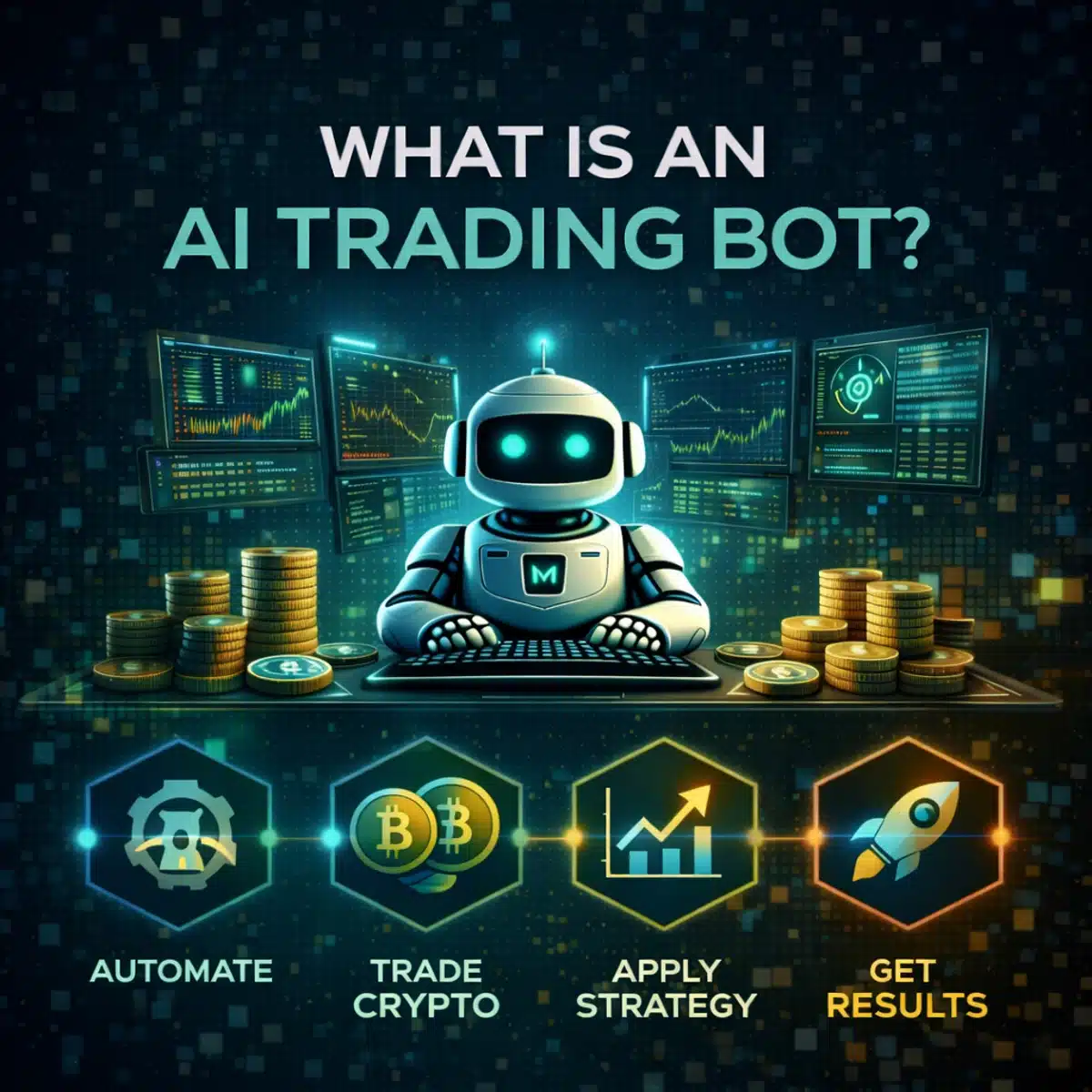
What is an AI trading bot?
An AI trading bot is a software system that automatically executes trades based on predefined rules, signals, or data-driven logic. In crypto markets, these bots help traders automate strategy execution, reduce emotional decision-making, and operate 24/7.
The rise of AI trading bots has transformed how individuals interact with financial markets, particularly in crypto where trading never stops. Platforms increasingly promise “AI-powered trading,” “automated profits,” and “intelligent market analysis.” But behind these claims lies a more nuanced reality.
Most AI trading bots do not outperform the market because they are more intelligent. They outperform because they enforce structure.
They remove hesitation, eliminate emotional decision-making, and execute predefined strategies with consistency. In a 24/7 market where timing, discipline, and risk management matter more than prediction, this alone can make a significant difference.
For readers who are new to this space, it is worth first understanding the basics of AI crypto trading for beginners before exploring automation in depth. Because without a clear understanding of how trading itself works, automation can amplify mistakes just as easily as it improves execution.
This article takes a different approach from most “AI trading bot” guides. Instead of focusing on platform rankings or performance claims, it explains how these systems actually function.
What they automate.
What they don’t.
And where the real value—and risk—comes from.
By the end, you will not only understand what an AI trading bot is, but also how to evaluate whether it fits your trading approach and where it belongs within a broader AI crypto trading bots guide.
What is an AI trading bot?
An AI trading bot is software designed to automatically execute trades on financial markets based on predefined rules, data inputs, or algorithmic models. Instead of manually placing buy and sell orders, the bot connects to an exchange and carries out trading actions on behalf of the user.
In crypto markets, this typically happens through API integrations that allow the bot to access market data, monitor price movements, and execute trades in real time. Because cryptocurrency markets operate 24/7, this type of automation enables continuous participation without the need for constant manual intervention.
At a fundamental level, an AI trading bot performs three core functions:
- It analyzes data (such as price movements, indicators, or external signals)
- It applies decision logic (rules, conditions, or models)
- It executes trades automatically
This structure is what allows traders to move from reactive decision-making to systematic execution.
For a broader overview of how these systems fit into the crypto ecosystem, see the AI crypto trading bots guide 2026, which explains how different platforms approach automation and where they sit within the trading stack.
It is important to clarify that not every “AI trading bot” actually uses advanced artificial intelligence. Many platforms rely on rule-based systems that follow predefined conditions rather than adaptive learning models. The term “AI” is often used broadly to describe automation, even when no machine learning is involved.
Understanding this distinction is critical. Because what a trading bot does is not determined by its label, but by how its logic is structured and how it interacts with the market.
How AI trading bots work in practice
To understand how AI trading bots actually operate, it helps to think of them as systems that continuously process data, apply logic, and execute actions without human intervention.
At a high level, every trading bot follows the same operational loop. First, the bot collects market data from exchanges, including price movements, trading volume, order book activity, and technical indicators such as RSI or moving averages. Some platforms also integrate external signals or third-party data sources.
Based on this data, the bot applies predefined decision logic. This can range from simple rules like “if price drops by 5%, then buy” to more complex strategies combining multiple indicators, trend conditions, or signal confirmations. This is where the actual trading strategy is defined.
Once conditions are met, the bot automatically executes trades via API connections to the exchange. This includes market orders, limit orders, and structured strategies such as DCA or grid trading. The key advantage here is consistency. Bots execute instantly, without hesitation or emotional interference.
After execution, the bot continues to monitor the market and manage positions. It can adjust stop-loss levels, take-profit targets, or re-enter trades based on updated conditions. For a practical breakdown of how to configure this workflow, see AI crypto trading setup, where the full process is explained step by step.
What makes this system effective is not intelligence, but discipline. A human trader may hesitate, override a plan, or react emotionally. A bot does not. It follows the defined structure every time. This is why performance differences in automated trading rarely come from better predictions, but from better execution and risk control.
The bot is not the edge. The structure behind it is.
How an AI Trading Bot Works in Practice work flow
Most trading bots follow the same core loop: they collect market data, apply decision logic, execute trades, and continue monitoring positions in real time.
Data Input
The bot pulls live market data from exchanges, including price action, volume, order book activity, and technical indicators such as RSI or moving averages.
Decision Logic
It applies predefined rules, signals, or strategy conditions to determine whether market circumstances match the setup defined by the trader.
Trade Execution
When conditions are met, the bot sends orders to the exchange through an API connection, using market, limit, grid, or DCA-based order structures.
Monitoring
After entering a position, the bot continues tracking market changes and can manage stop-losses, take-profits, re-entries, or other automated actions.
The difference between rule-based bots and AI-driven bots
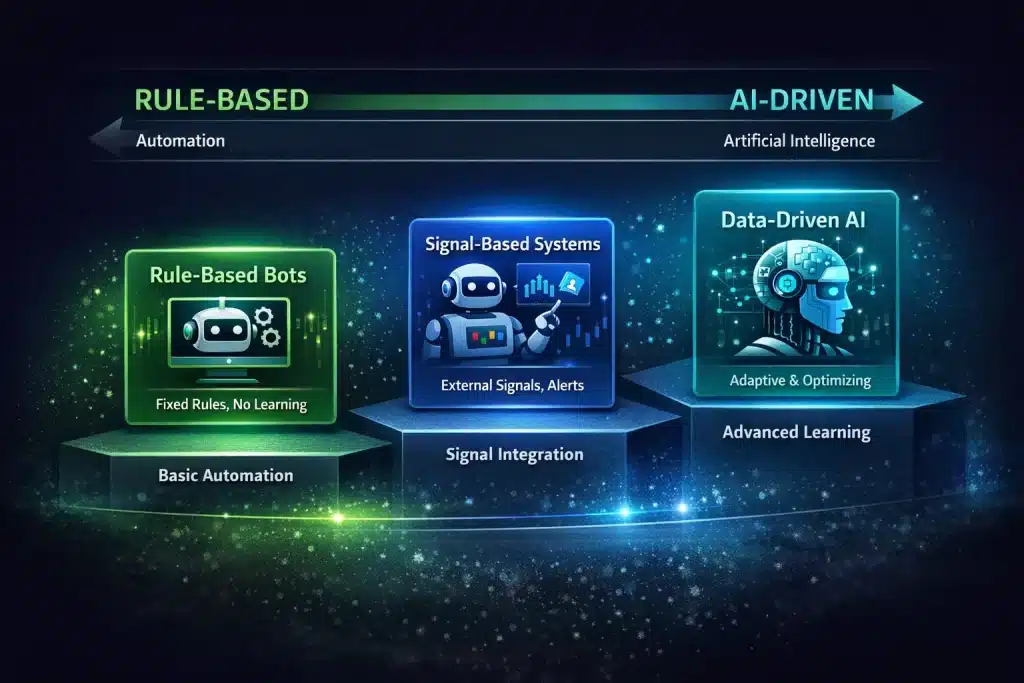
Not every AI trading bot actually uses artificial intelligence in the same way. In practice, most platforms fall somewhere on a spectrum between simple rule-based automation and more adaptive, data-driven systems.
Rule-based bots follow predefined instructions. A trader sets the conditions, and the bot executes them exactly as written. For example, a bot may buy when a moving average crosses above another indicator, or sell when a position reaches a fixed profit target. These systems are structured, predictable, and easy to understand, which is why they remain the foundation of many retail trading platforms.
AI-driven bots, in contrast, aim to go further. Instead of only following static instructions, they may use pattern recognition, probability models, or adaptive logic to respond to changing market conditions. In theory, this allows them to identify relationships in data that are too complex for simple rule systems. In practice, however, this level of intelligence is still limited across most retail crypto trading platforms.
That distinction matters. Because many bots marketed as “AI-powered” are, in reality, advanced automation tools rather than self-learning systems. They may combine indicators, optimize execution, or integrate trading signals, but they do not necessarily learn or improve autonomously over time.
This is one reason why the difference between automation and intelligence is often misunderstood. The real value of many trading bots does not come from artificial intelligence alone, but from their ability to apply structure consistently. For readers comparing this approach with discretionary trading, AI vs manual crypto trading offers a useful next step.
In other words, the label matters less than the logic underneath it. A bot can still be useful without being truly “intelligent.” But traders need to understand what type of system they are using, because expectations built on marketing language often lead to poor decisions.
The three layers of AI crypto trading
To fully understand how AI trading bots operate, it is not enough to look at individual features or platforms. What matters is where a bot fits within the broader trading system.
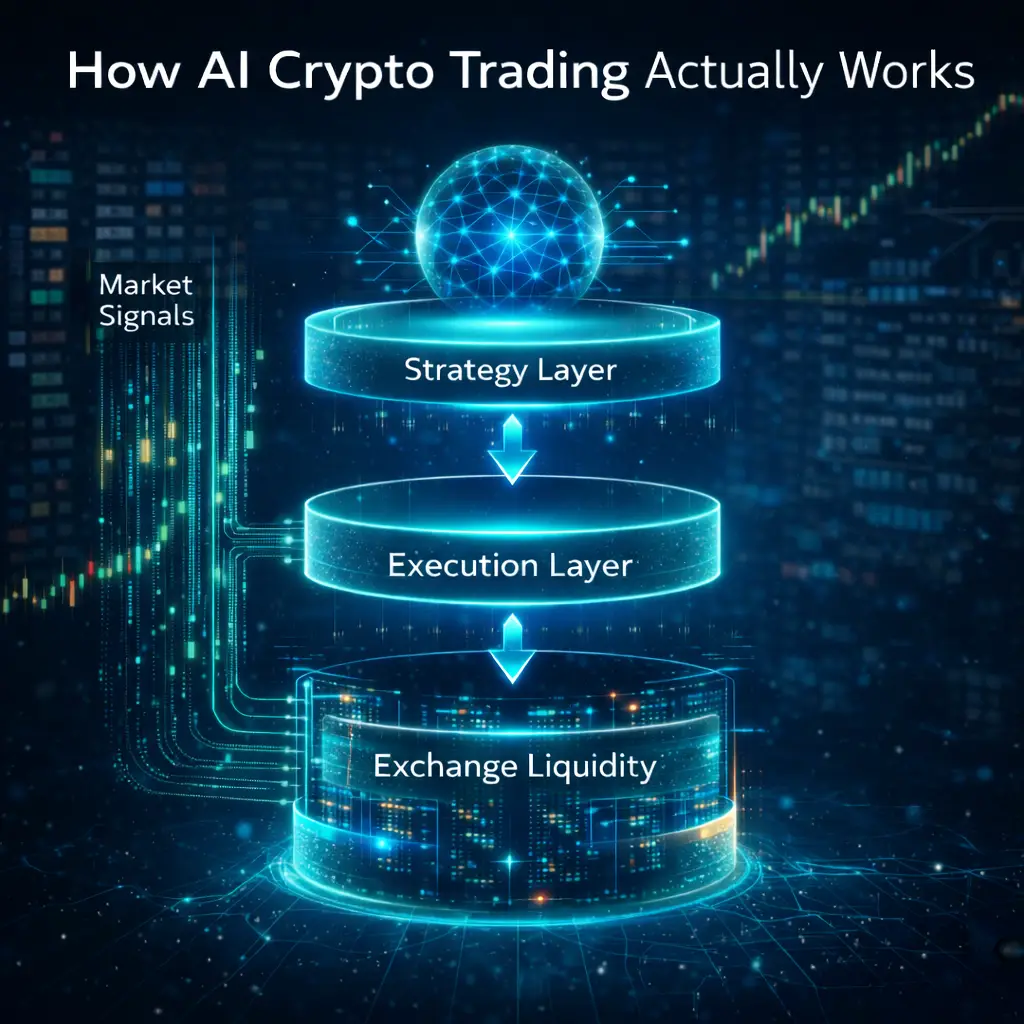
At Arti-Trends, we approach this through a structured model: the three layers of AI crypto trading. This framework explains why different bots behave differently, and why performance is often determined by factors beyond the bot itself.
Strategy Layer
The strategy layer defines what to trade, when to enter or exit positions, and how capital is allocated. This is where trading logic is created. It includes rules, indicators, signal inputs, and risk management parameters.
Some platforms focus heavily on this layer by offering strategy builders, backtesting environments, and condition-based automation. These tools allow traders to design and refine their approach before execution.
The key insight is that no bot can compensate for a weak strategy. If the logic is flawed, automation will simply execute that flaw more efficiently.
AI Execution Layer
The execution layer determines how trades are placed in the market. This includes order timing, order types, position scaling, and how strategies are translated into actual trades.
This is where many popular trading bots operate. They do not define the strategy, but they optimize how it is executed. Features such as DCA bots, grid trading systems, and smart order routing belong to this layer.
Execution quality has a direct impact on results. Even a strong strategy can underperform if trades are executed poorly, with high slippage, delays, or inefficient order placement.
For a broader comparison of how platforms differ at this level, see best AI crypto trading bots in 2026, where these differences become more visible across tools.
Exchange & Liquidity Layer
The final layer is the environment in which trades take place. This includes the exchange, available liquidity, trading fees, spreads, and market conditions.
No trading bot operates in isolation. Every strategy and execution decision is affected by the underlying market structure. High fees, low liquidity, or poor order book depth can significantly impact performance, regardless of how advanced the bot is.
This is also why choosing the right exchange is critical. Even the most well-structured system can fail if the trading environment is not supportive.
Understanding these three layers changes how trading bots should be evaluated. Most comparisons focus on features, but features alone do not determine outcomes. Results emerge from the interaction between strategy, execution, and market conditions.
A trading bot is not a standalone solution. It is one component within a larger system.
And in that system, structure matters more than labels.
What AI trading bots can actually automate
AI trading bots are often presented as intelligent systems that can “trade for you.” In reality, their strength lies in automation, not prediction. They are designed to execute predefined processes with consistency, speed, and discipline.
In practice, this allows traders to automate several key parts of the trading workflow.
Trade execution is the most fundamental function. Bots can enter and exit positions automatically based on predefined conditions, without the need for manual intervention. This ensures that trades are executed exactly when the strategy requires it.
Position management is another critical area. Bots can manage open trades by adjusting stop-loss levels, setting take-profit targets, and reacting to changing market conditions. This reduces the need for constant monitoring and helps maintain consistency in risk management.
Structured strategies such as dollar-cost averaging (DCA) and grid trading are also commonly automated. These approaches rely on systematic execution over time, which makes them particularly well suited for bots. For a deeper look at how these strategies are applied, see AI crypto trading strategies 2026.
Portfolio-level automation is increasingly supported as well. Some platforms allow traders to manage multiple positions, rebalance allocations, or run several strategies simultaneously across different markets.
Bots can also integrate external signals. This means they can execute trades based on third-party inputs, such as trading signals, alerts, or predefined strategy templates. In this case, the bot acts as an execution engine rather than a decision-maker.
Finally, risk parameters can be enforced automatically. This includes position sizing rules, exposure limits, and predefined exit conditions. By embedding these rules into the system, bots help prevent impulsive decisions and maintain discipline.
What all of these functions have in common is that they are structural. They do not require intelligence in the sense of predicting the market. They require consistency in applying a defined approach.
This is where trading bots create real value. Not by finding opportunities, but by executing them without deviation.
What AI trading bots cannot do reliably
While AI trading bots can automate large parts of the trading process, there are clear limitations to what they can realistically achieve. Understanding these limitations is essential, because most mistakes in automated trading come from unrealistic expectations.
AI trading bots cannot consistently predict the market. Financial markets are influenced by a wide range of variables, including macroeconomic events, liquidity shifts, sentiment, and unexpected news. Even advanced models struggle to account for this complexity in a reliable way.
They also cannot guarantee profits. Any platform suggesting otherwise is oversimplifying or misrepresenting how trading works. A bot executes a strategy, but it does not change the underlying probabilities of that strategy.
Another common misconception is that bots can fix a bad strategy. In reality, automation amplifies whatever logic is built into the system. A strong strategy becomes more consistent. A weak strategy becomes consistently unprofitable.
Bots also do not eliminate risk. They can help enforce risk management rules, but they cannot remove exposure to volatility, drawdowns, or market shocks. For a deeper understanding of these risks, see AI crypto trading risks, where the main limitations are explained in detail.
Execution is not perfect either. Factors such as slippage, latency, and liquidity constraints can affect trade outcomes. Even if a strategy is well designed, real market conditions may lead to different results than expected.
Finally, AI trading bots cannot replace judgment entirely. Markets evolve, and strategies need to be adjusted over time. Relying fully on automation without understanding the underlying logic often leads to poor decisions.
A trading bot is a tool, not a solution.
It can improve execution, enforce discipline, and reduce emotional decision-making. But it cannot replace strategy, eliminate risk, or guarantee outcomes.
Understanding this is what separates structured trading from blind automation.
Are AI trading bots really using artificial intelligence?
The term “AI trading bot” suggests a level of intelligence that goes beyond simple automation. In practice, however, the use of artificial intelligence in retail trading platforms is often more limited than the name implies.
Most trading bots do not operate as fully autonomous, self-learning systems. Instead, they fall into different categories based on how decisions are made and how much adaptability is built into the system.
At the most basic level are rule-based bots. These systems follow predefined instructions without deviation. They do not learn, adapt, or improve over time. Their strength lies in consistency, not intelligence.
A step above are signal-based systems. These bots execute trades based on external inputs such as trading signals, alerts, or third-party strategies. In this case, the “intelligence” is not in the bot itself, but in the source of the signals.
More advanced platforms may incorporate elements of data-driven optimization. This can include parameter tuning, pattern recognition, or probability-based decision support. While these features are sometimes described as AI, they are typically limited in scope and do not resemble fully adaptive machine learning systems.
True AI-driven trading systems — capable of learning, adapting, and improving autonomously — are rarely accessible at the retail level. These types of systems are more commonly found in institutional or quantitative trading environments, where they are supported by large datasets, specialized infrastructure, and continuous model development.
This distinction is important because expectations shape behavior. When traders assume that a bot can think, learn, or predict markets independently, they often delegate too much responsibility to the system.
In reality, most trading bots function as structured execution tools.
Not as autonomous decision-makers.
For a broader view of how these systems are positioned within the evolving market, see AI crypto trading market 2026, where the role of automation and AI is analyzed in context.
Who should use an AI trading bot?
AI trading bots are not designed for one specific type of trader. Their usefulness depends on how they are applied and what role they play within a broader trading approach.
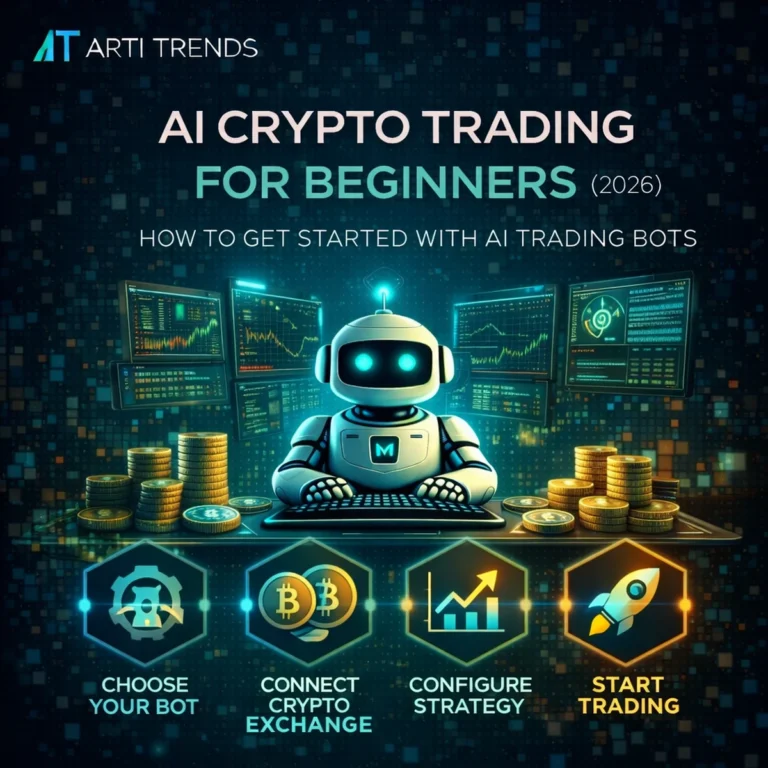
For beginners, trading bots can provide structure in an otherwise overwhelming environment. Instead of manually making decisions in a fast-moving market, they can rely on predefined strategies and automated execution. This reduces emotional decision-making and helps build discipline. For those starting out, it is recommended to first understand the fundamentals through AI crypto trading for beginners before relying heavily on automation.
Intermediate traders often use bots to improve consistency and efficiency. At this stage, the focus shifts from learning the basics to refining strategies and optimizing execution. Bots can help manage multiple positions, apply structured strategies such as DCA or grid trading, and reduce the need for constant monitoring.
Advanced traders typically use bots as part of a broader system. Rather than relying on a single platform, they combine strategy design, execution tools, and exchange infrastructure. Some may use more flexible or developer-oriented solutions to build custom trading systems, as seen in platforms like Hummingbot review 2026, which operates more as a trading framework than a plug-and-play tool.
The key difference between these groups is not the bot itself, but how it is used. Beginners benefit from simplicity and structure, while more advanced users prioritize flexibility and control.
For those exploring which platforms match their level and approach, the best AI crypto trading bots in 2026 overview provides a structured comparison of how different tools fit into these use cases.
Common mistakes when using AI trading bots
While AI trading bots can improve structure and execution, many traders use them incorrectly. Most failures in automated trading are not caused by the technology itself, but by how it is applied.
One of the most common mistakes is assuming that a trading bot will generate profits on its own. Traders often rely on default settings or copy strategies without understanding the underlying logic. When results fall short, the problem is not the bot, but the lack of a defined strategy.
Another frequent issue is poor risk management. Automation can execute trades consistently, but it cannot protect against excessive exposure, large drawdowns, or poorly defined position sizing. Without clear risk parameters, losses can accumulate just as systematically as gains.
Over-optimization is also a common trap. Traders may continuously tweak settings based on past performance, trying to “perfect” a strategy. This often leads to systems that perform well in historical data but fail in live market conditions.
Many users also underestimate the impact of fees, spreads, and execution quality. Even small inefficiencies can significantly affect performance over time, especially for high-frequency or grid-based strategies. For a deeper breakdown of how costs influence results, see AI trading bot fees.
Another mistake is choosing the wrong type of bot for the intended use. Some traders select complex platforms when they need simplicity, while others use basic tools when their strategy requires more flexibility. This mismatch often leads to frustration and inconsistent results.
Finally, many traders rely too heavily on automation without ongoing oversight. Markets change, conditions shift, and strategies need to be adjusted. Treating a trading bot as a fully autonomous system often results in underperformance.
How to choose the right AI trading bot
Choosing the right AI trading bot is not about finding the most advanced platform. It is about selecting a system that aligns with how you actually trade.
Different bots solve different problems. Some focus on strategy design, others on execution, and some are integrated directly into exchanges. Understanding this distinction is more important than comparing features in isolation.
The first step is to identify where you need support. Traders who want to build and test strategies should focus on platforms that offer flexible rule systems, backtesting, and signal integration. Those who already have a defined approach may benefit more from execution-focused tools that optimize how trades are placed and managed.
Simplicity versus flexibility is another key factor. Beginner-friendly platforms prioritize ease of use and structured setups, while more advanced tools offer greater control at the cost of complexity. Choosing the wrong level often leads to underutilization or unnecessary friction.
Risk management capabilities should also be a core consideration. Features such as position sizing, stop-loss automation, and exposure limits are not optional. They are fundamental to long-term performance.
Costs play a role as well. Subscription models, trading fees, and execution efficiency all impact results over time. Even small differences can compound significantly, especially for active strategies.
Finally, consider how the bot fits into the broader trading system. A bot is not a standalone solution. It interacts with your strategy, your exchange, and your risk management approach.
For a structured comparison of how different platforms address these factors, the best AI crypto trading bots in 2026 overview breaks down where each tool fits and what type of trader it is best suited for.
Choosing a trading bot is not about automation.
It is about alignment between your strategy, your tools, and your level of experience.
Real examples of AI trading bots
Understanding how AI trading bots work in theory is useful. Seeing how they are applied in real platforms makes the differences much clearer.
Not all trading bots operate in the same way. Each platform is designed around a specific role within the trading process, which determines how it should be used.
Some platforms focus primarily on execution. Tools like 3Commas review 2026 provide structured trade management, smart order execution, and automation features such as DCA bots. These systems are designed to improve how trades are executed rather than define the strategy itself.
Others combine strategy and execution in a single environment. Platforms like Cryptohopper review 2026 allow users to build rule-based strategies, integrate signals, and automate execution across multiple exchanges. This makes them suitable for traders who want more control over their logic.
There are also exchange-integrated solutions. Pionex review 2026 is a strong example, offering built-in trading bots directly within the exchange environment. This simplifies the setup process and reduces complexity, especially for beginners.
For users looking for simplicity, platforms like TradeSanta review 2026 focus on easy-to-use automation with predefined strategies such as DCA and grid trading. These tools prioritize accessibility over deep customization.
Rule-based automation platforms such as Coinrule review 2026 emphasize transparency and structured logic. They allow users to define trading rules without requiring coding, making them approachable while still offering flexibility.
Some platforms expand into portfolio-level automation. Bitsgap review 2026 combines trading bots with portfolio management tools, helping users manage multiple positions and strategies in one interface.
At the more advanced end of the spectrum, developer-focused solutions like Hummingbot review 2026 operate as open trading frameworks. These platforms are not plug-and-play tools, but infrastructure for building custom strategies such as market making or arbitrage.
These examples illustrate an important principle.
There is no single “best” AI trading bot.
Only the best fit for a specific use case.
For a structured comparison across all major platforms, including how they differ in strategy flexibility, execution quality, and risk control, the best AI crypto trading bots in 2026 overview provides a complete breakdown.
Final verdict: AI trading bots are execution tools, not profit machines
AI trading bots have changed how traders interact with markets, but not in the way they are often presented. They do not create an edge on their own. They enforce one.
Their primary value lies in execution. They remove hesitation, apply structure consistently, and allow strategies to operate without emotional interference. In fast-moving and continuous markets like crypto, this can significantly improve discipline and consistency.
However, the outcome still depends on the underlying logic. A well-designed strategy becomes more reliable when automated. A poorly designed strategy becomes consistently ineffective. The bot does not change this dynamic. It amplifies it.
This is why understanding the system behind the bot is more important than the bot itself. Strategy, execution, and market conditions work together. No single component determines the result in isolation.
For traders evaluating different platforms, the goal should not be to find the most “intelligent” bot, but the one that best fits their approach. The best AI crypto trading bots in 2026 overview provides a structured comparison of how different tools operate and where they fit within the trading stack.
Frequently Asked Questions
These answers address the most common questions readers have when trying to understand what AI trading bots are, how they work, and what they can realistically do in crypto markets.
What is an AI trading bot?
An AI trading bot is software that automates trading decisions and execution based on predefined rules, signals, or data-driven models. In most retail crypto platforms, the real value lies in structured automation and consistent execution rather than fully autonomous artificial intelligence.
Do AI trading bots really use artificial intelligence?
Not always. Many so-called AI trading bots are rule-based systems that follow fixed logic. Some platforms include signal integrations, optimization tools, or pattern-based decision support, but truly self-learning AI trading systems are rare at the retail level.
How do AI trading bots work in crypto trading?
Most AI trading bots follow the same loop: they collect market data, apply decision logic, and execute trades through exchange APIs. They can also monitor positions, manage risk parameters, and automate structured strategies such as DCA or grid trading. For a practical walkthrough, see AI crypto trading setup.
Can AI trading bots guarantee profits?
No. AI trading bots cannot guarantee profits. They execute strategies consistently, but the outcome still depends on the quality of the strategy, the market environment, execution conditions, and risk management.
Are AI trading bots safe to use?
AI trading bots can be used safely, but they still carry risk. Traders remain exposed to volatility, strategy failure, slippage, and exchange-related issues. Automation improves consistency, but it does not remove market risk. A deeper breakdown is available in AI crypto trading risks.
Are AI trading bots suitable for beginners?
Yes, but beginners should approach them carefully. Bots can reduce emotional decision-making and provide structure, but they are most useful when the user understands the basics of trading first. A good starting point is AI crypto trading for beginners.
What can AI trading bots actually automate?
AI trading bots can automate trade execution, stop-loss and take-profit management, DCA strategies, grid trading, signal-following, and portfolio-level workflows. Their strength lies in enforcing structure and discipline rather than “thinking” like a human trader.
What is the best AI crypto trading bot?
There is no single best AI crypto trading bot for everyone. The right choice depends on your strategy, experience level, and whether you need simplicity, flexibility, or execution control. For a structured platform comparison, see best AI crypto trading bots in 2026.
Do I need coding skills to use an AI trading bot?
No. Many retail trading bot platforms are designed for non-technical users and offer visual strategy builders or predefined automation templates. More advanced frameworks, however, may require coding knowledge if you want full customization.
What is the difference between rule-based bots and AI-driven bots?
Rule-based bots follow fixed instructions created by the user, while AI-driven bots attempt to incorporate more adaptive or data-driven behavior. In practice, most retail platforms still rely heavily on structured rule systems, even when they are marketed as AI-powered.
This guide is based on the Arti-Trends Trading Bot Evaluation Framework (2026), where AI trading bots are analyzed as technical infrastructure rather than promotional products.