What is ElevenLabs?
ElevenLabs is an AI voice generation platform designed to convert text into highly realistic speech using advanced neural voice synthesis and voice cloning technology.
In this hands-on ElevenLabs review, we evaluate how the platform performs in real production workflows — not just in isolated demos.
Communication has become a bottleneck in modern content and product workflows. As companies and creators scale across platforms, formats, and audiences, producing high-quality audio at speed requires more than traditional recording and editing processes. Within the rapidly evolving AI landscape, many tools attempt to combine multiple capabilities — from text generation and video creation to automation and analytics — into unified environments. As competition increases, these platforms position themselves as all-in-one creative ecosystems designed to streamline digital production.
ElevenLabs takes a more focused approach. Instead of attempting to replace the entire content stack, it concentrates on a single, high-impact layer of the workflow: voice generation. The platform is built to transform text into realistic speech at scale, offering advanced voice synthesis, cloning capabilities, and API-based deployment for integration into broader systems. Rather than acting as a general creative tool, ElevenLabs operates as a specialized engine for producing high-quality audio outputs.
This review is based on a structured evaluation framework that focuses on real workflow performance, practical usability, and measurable output quality. This positions ElevenLabs less as a standalone application and more as infrastructure within modern content, product, and automation workflows. The central question is therefore not whether it can replace traditional voice production, but whether it meaningfully improves production speed, output quality, and scalability in real-world environments.
This article contains affiliate links. We may earn a commission at no extra cost to you. All reviews remain independent and based on real evaluation.
Review Snapshot
ElevenLabs operates as a specialized voice generation engine within modern AI workflows. It is not a general-purpose content tool, but a high-performance system designed to produce realistic, scalable audio outputs. Its strongest value appears in environments where voice quality, speed, and production scalability directly impact content and product workflows.
Content creators, developers, and businesses that need high-quality voice generation at scale for videos, applications, courses, and automated workflows.
Users looking for full audio editing environments, music production tools, or simple one-click voice solutions without configuration.
Pros
- Industry-leading voice realism
- Scalable via API and automation
- Strong voice cloning capabilities
Cons
- Requires structured input for best results
- Pricing scales with usage
- Limited editing environment
What Is ElevenLabs?
Core functionality explained
ElevenLabs is an AI voice generation platform that converts text into highly realistic speech using advanced neural synthesis and voice cloning technology. The platform focuses on producing natural-sounding audio with control over tone, pacing, and voice characteristics, enabling users to generate consistent voice outputs at scale.
It can be deployed across a wide range of use cases, including content creation, applications, education, and automated systems. Rather than functioning as a full media production suite, ElevenLabs operates as a specialized processing engine within the broader AI and content workflow ecosystem — transforming text inputs into production-ready audio outputs.
What problem does it solve?
In modern workflows, audio production is traditionally slow, expensive, and difficult to scale. Recording voiceovers requires coordination, editing, and iteration, which introduces friction and limits speed. As content volume increases, this bottleneck becomes more pronounced.
ElevenLabs addresses this by converting text directly into high-quality speech, removing the need for manual recording in many use cases. This reduces production time, lowers cost, and enables scalable audio generation across multiple formats and platforms.
Within real-world workflows, this places the platform firmly in the Processing stage, where input (text) is transformed into usable output (voice). It acts as a core transformation layer that enables downstream creation, distribution, and automation.
Who is it built for?
ElevenLabs is built for content creators, developers, and businesses that require scalable, high-quality voice generation as part of their workflow.
This includes use cases such as video narration, podcasts, e-learning, applications, and AI-driven products where voice output is a core component. It is especially relevant for teams that want to integrate voice generation into automated or API-driven systems.
It is less suited for users looking for full audio editing environments or traditional recording workflows. Instead, it fits best in environments where speed, scalability, and consistent output quality take priority over manual control.
If you want to see how ElevenLabs works in practice, you can explore the platform directly.
ElevenLabs Interface and Output Examples
Below are real interface examples and workflow outputs from ElevenLabs to illustrate how the platform performs in practice.
Voice generation interface showing text input, voice selection, and real-time audio generation with controls for stability, clarity, and style.
Example of voice cloning and customization workflows, including the creation of custom voices and adjustment of tone, pacing, and emotional expression.
Input-to-output transformation demonstrating how written text is converted into natural-sounding speech, which can then be exported or integrated into content, applications, or automated workflows.
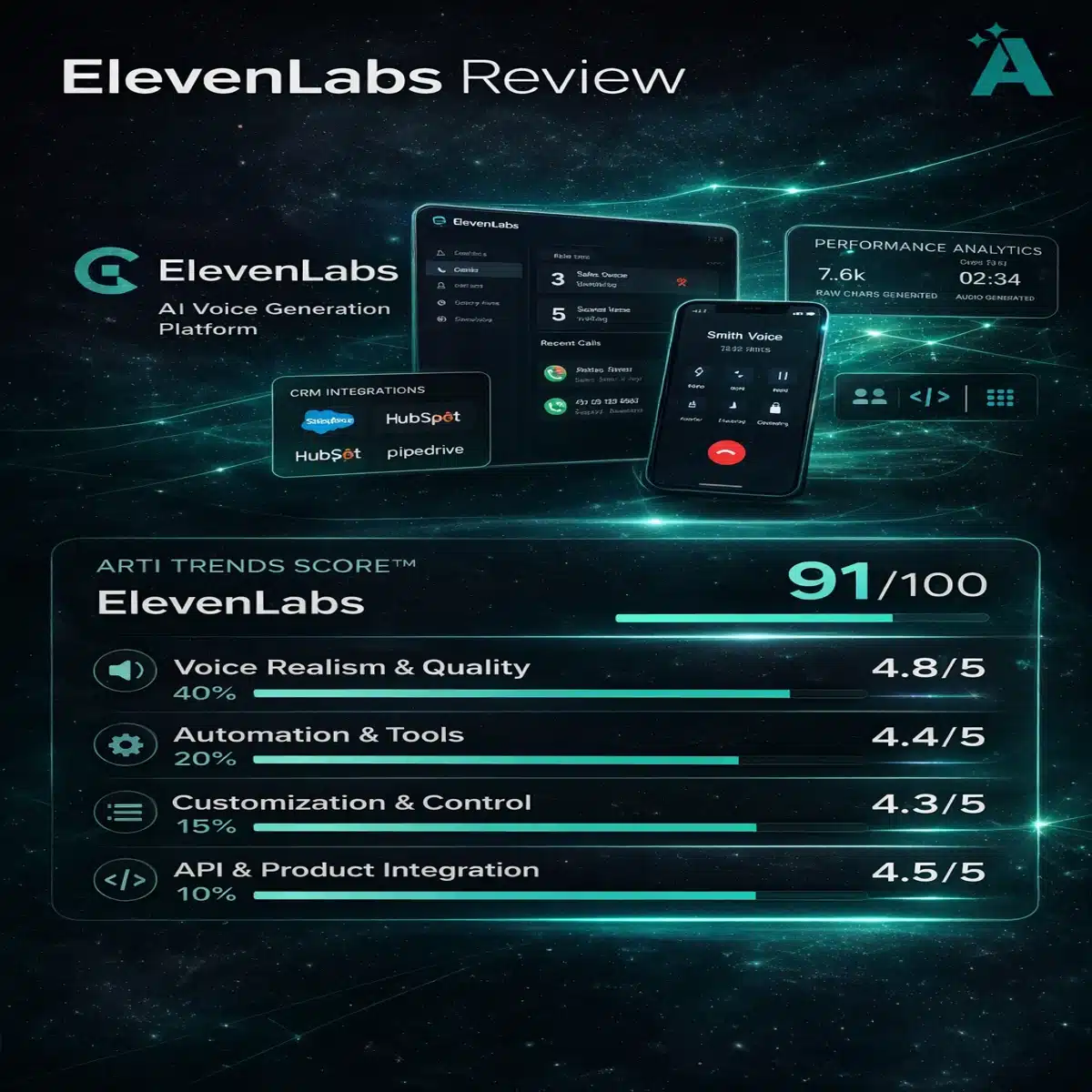
ElevenLabs Performance Breakdown (Arti-Trends Score)
ElevenLabs — AI Voice Generation Engine
Key Features and Capabilities
Core features overview
ElevenLabs is designed around one primary function: generating highly realistic voice output from text through advanced AI voice synthesis. The platform enables users to create natural-sounding speech, clone voices, customize delivery, and deploy audio generation across content, product, and automation workflows. Its core feature set includes text-to-speech generation, voice cloning, multilingual support, voice library access, API integration, and export functionality that support scalable audio production.
The system is built to reduce the friction of traditional voice production by transforming written input into structured, reusable audio output. This makes it particularly effective in workflows where speed, consistency, and output quality directly affect production efficiency.
Unique capabilities vs competitors
What differentiates ElevenLabs from more traditional text-to-speech tools is its focus on realism, controllability, and workflow scalability rather than basic speech conversion alone. Instead of functioning as a simple voice utility, the platform prioritizes natural delivery, expressive synthesis, and integration into broader production systems.
One of its key strengths is the ability to generate convincing voice output that feels closer to production-ready narration than standard synthetic speech. Combined with voice cloning, multilingual support, and API accessibility, this positions the platform closer to voice infrastructure than to a standalone creator tool — especially in environments where output quality and scalability matter more than one-click simplicity.
Limitations of the feature set
While ElevenLabs excels in voice quality and production leverage, its feature set is not designed to replace the full audio workflow. The platform is strongest at generation, not at editing, mastering, or collaborative audio production.
Users looking for a complete end-to-end audio workstation may therefore find the system narrower than expected. In addition, output quality still depends heavily on structured text input, appropriate voice selection, and thoughtful usage. Without that, the gap between technical capability and practical result becomes more noticeable.
How ElevenLabs Fits Into Real Workflows
Role inside the AI Workflow Stack
The Arti-Trends Workflow Stack™ explains how tools create value within real-world processes rather than in isolation. Instead of evaluating tools purely based on features, this framework focuses on where they operate within a workflow and how they contribute to measurable outcomes.
ElevenLabs plays a concentrated role within this structure. It operates primarily in the Processing stage, where input is transformed into usable output. In this context, the platform functions as a voice generation engine designed to convert structured text into production-ready audio within broader content and product workflows.
Where it creates the most value
Within modern content, media, and product workflows, the Processing stage is directly linked to speed, scalability, and output quality. The ability to transform written input into usable assets determines how efficiently teams can produce and distribute content at scale.
ElevenLabs increases efficiency in this stage by automating voice generation, enabling consistent output, and removing the need for manual recording in many scenarios. This allows teams to produce audio faster, iterate more easily, and scale voice-based content across multiple formats and platforms.
However, the platform has limited influence outside this stage. It does not define upstream strategy (Input), nor does it manage distribution or execution (Execution). It also does not replace long-term optimization systems such as analytics or performance tracking (Optimization). Its value is therefore highly concentrated but clearly defined within the broader workflow ecosystem.
Example real-world workflow
In a typical content or product workflow, ElevenLabs is used when text is converted into audio output. Strategy, messaging, and scripting are defined beforehand, after which the platform transforms this input into usable voice assets.
Text input is processed into speech, exported, and then integrated into content, applications, or automated systems. Teams can then refine outputs or distribute them across channels depending on the use case.
Input → Define content, messaging, and scripts
Processing → Generate voice output with ElevenLabs
Creation → Integrate audio into video, courses, or products
Execution → Publish or deploy content across platforms
Optimization → Analyze performance, engagement, and usage
This illustrates that ElevenLabs does not replace the workflow, but powers a critical transformation layer within it. Its effectiveness depends on how well it is integrated into a broader system rather than how it performs in isolation.
Performance and Output Quality
Output quality evaluation
ElevenLabs delivers exceptionally high-quality voice output that approaches human-level realism across a wide range of use cases. Generated speech demonstrates natural pacing, clear pronunciation, and convincing tonal variation, making it suitable for professional applications such as video narration, e-learning, and product integrations.
Unlike traditional text-to-speech systems, the platform produces output that is immediately usable in production environments without requiring heavy post-processing. This significantly reduces the gap between generation and deployment, allowing teams to move from script to finished audio asset with minimal friction.
However, output quality is not determined by the model alone. ElevenLabs performs best when input text is well-structured, voice selection is appropriate, and parameters such as stability and style are properly configured. When these elements are misaligned, output remains usable but becomes less natural and less consistent. This reinforces that the platform amplifies input quality rather than replacing it.
Speed and scalability
One of the strongest aspects of ElevenLabs is its ability to generate high-quality audio at scale with minimal time investment. What would traditionally require recording sessions, editing, and coordination can be reduced to a text-based workflow with near-instant output generation.
This has a direct impact on production efficiency, as teams can create, iterate, and deploy audio content significantly faster. In environments where content volume and turnaround time matter — such as media production, education, and product development — this level of scalability becomes a structural advantage rather than a marginal improvement.
The availability of API access further extends this capability, enabling automated pipelines where voice generation is embedded directly into applications, platforms, or content systems.
Consistency and reliability
ElevenLabs delivers strong consistency within its defined scope, particularly when the same voice settings and structured inputs are used repeatedly. Voice characteristics remain stable across multiple generations, which supports scalable production workflows and predictable output quality.
That said, consistency does not equal full control. Subtle variations can still occur depending on phrasing, punctuation, and parameter settings. As a result, achieving fully deterministic output requires some iteration and refinement.
The platform should therefore be viewed as a high-performance processing layer that ensures strong baseline consistency, rather than a system that guarantees identical outputs across all scenarios without adjustment.
Real-World Performance Insight
In practical environments, the impact of ElevenLabs is most visible in production speed, cost efficiency, and output scalability. By removing the need for manual recording in many workflows, teams can produce significantly more audio content with fewer resources and less coordination.
Rather than improving creative direction or content strategy directly, the platform improves how audio is generated, scaled, and integrated into broader systems. This makes it particularly valuable in environments where output volume, speed, and consistency are critical to performance.
Pricing and Value for Money
Pricing structure explained
ElevenLabs operates on a usage-based pricing model, combined with tiered subscription plans that scale based on character limits, feature access, and API usage. The platform typically offers a free tier for basic experimentation, followed by paid plans that unlock higher generation limits, voice cloning capabilities, and advanced deployment options.
This positions ElevenLabs within the mid-to-premium range of AI content infrastructure tools, where pricing reflects not just feature access, but production capacity. Rather than paying for seats or users, pricing is primarily linked to output volume — specifically the amount of audio generated from text.
Each pricing tier is designed to scale with production intensity. As usage increases — whether through content creation, product integration, or automation pipelines — the platform becomes more valuable, but also more cost-sensitive. For teams generating audio occasionally, lower tiers are sufficient. For organizations embedding voice generation into core workflows, higher tiers become necessary to maintain performance and throughput.
Pricing Overview
| Plan | Best For | Key Access |
|---|---|---|
| Free | Individuals testing voice generation | Limited character usage, basic voice generation, restricted features |
| Starter | Creators and small-scale projects | Higher character limits, access to voice library, basic voice customization |
| Creator | Content creators and professionals | Increased generation limits, voice cloning, improved quality control |
| Pro | High-volume creators and growing teams | Large-scale generation, advanced voice features, priority processing |
| Scale / Enterprise | Businesses and API-driven applications | API access, custom limits, scalable infrastructure, dedicated support |
Value for Money in Practice
The real value of ElevenLabs is not measured by subscription cost alone, but by the cost per unit of audio generated and deployed effectively.
In traditional workflows, producing voice content requires recording sessions, editing, coordination, and iteration. This introduces both time cost and operational complexity. With ElevenLabs, audio production is transformed into a text-driven process, shifting the economics from cost per recording to cost per generated output.
For creators, teams, and businesses, this is where the platform delivers its strongest return on investment: faster production cycles, reduced dependency on manual recording, and the ability to scale audio output without proportional increases in effort.
Is it worth the cost?
The value of ElevenLabs depends largely on how it is integrated into production workflows. For teams that generate audio frequently — such as video creators, educators, and product teams — the platform can significantly reduce time, cost, and coordination overhead, making it a highly efficient alternative to traditional voice production.
In these environments, return on investment is driven by increased output volume, faster iteration, and consistent quality across assets. However, for low-frequency use cases or occasional voice generation, the pricing advantage becomes less clear, as the platform’s value is tied to scale rather than sporadic usage.
The platform delivers the most value when voice generation is a core component of the workflow rather than a secondary feature.
Best plan by use case
For individuals or early-stage creators, the free and entry-level plans provide sufficient access to core voice generation capabilities, making them suitable for experimentation, small projects, and low-volume production.
Mid-tier plans are typically the most balanced option for active creators and professionals, offering higher generation limits, voice cloning capabilities, and improved control over output quality. These plans align well with workflows where audio production is consistent and growing.
Higher-tier and enterprise plans are best suited for teams and businesses that rely on large-scale voice generation or API-driven workflows. In these cases, ElevenLabs shifts from a creative tool to a core component of production infrastructure, supporting automation, scalability, and integration into broader systems.
View current pricing and plans on ElevenLabs.
Pros and Cons
Key advantages
ElevenLabs delivers its strongest value in environments where audio quality, production speed, and scalability directly influence output and performance.
High output quality
The platform produces highly realistic voice output with natural pacing and tone, making it suitable for professional use cases such as video narration, e-learning, and product integration.
Scalable production
Voice generation can be executed at scale without the need for recording sessions, enabling faster iteration and significantly higher content throughput.
API-driven workflow integration
ElevenLabs integrates well into modern workflows through API access and automation, allowing voice generation to become part of larger content, product, or agent-driven systems.
Key limitations
The platform’s focus on generation also introduces clear limitations.
Not a full audio production environment
ElevenLabs is designed for voice generation, not for editing, mixing, or mastering audio. Additional tools are often required for post-production workflows.
Dependent on input quality
Output quality is closely tied to how well text is structured and how voice parameters are configured. Poor input leads to less natural results.
Usage-based cost scaling
Pricing increases with output volume, which requires careful management in high-scale workflows to maintain cost efficiency.
When this becomes a real limitation
In environments where full creative control, audio editing, or collaborative production workflows are required, ElevenLabs can feel incomplete. Teams that rely on detailed sound design or post-production will still need additional tools to complete the workflow.
Similarly, for low-frequency or experimental use cases, the platform’s value may not fully materialize, as its strength lies in consistent, scalable production rather than occasional usage.
Alternatives and Competitors
Best alternatives to ElevenLabs
While ElevenLabs is optimized for high-quality voice generation and scalable audio production, several other platforms operate within the broader AI voice ecosystem with different strengths and positioning.
Tools such as Murf.ai and PlayHT offer similar text-to-speech capabilities with a stronger focus on usability and ready-to-use voice libraries. These platforms are often well-suited for creators and teams looking for fast deployment and simplified workflows without deep technical setup or API integration.
Other platforms like Descript and WellSaid Labs position themselves closer to content production environments. They combine voice generation with editing, collaboration, and media workflows, making them more suitable for teams that require end-to-end audio production rather than standalone generation.
There are also solutions that emphasize accessibility and simplicity, targeting users who need occasional voice output rather than scalable production. These tools typically offer lower barriers to entry but provide less control over voice quality, customization, and workflow integration.
In comparison, ElevenLabs differentiates itself through its focus on voice realism, scalability, and API-driven infrastructure. Rather than functioning as a simple voice tool, it operates as a production layer within modern content and AI workflows, where output quality and automation are critical to performance.
ElevenLabs vs Alternatives
To understand where ElevenLabs fits best, it helps to compare it with other AI voice and audio generation platforms. The goal is not to identify a universal winner, but to show which tool creates the most value in each workflow.
| Tool | Core Strength | Main Limitation | Best Use Case | Workflow Role |
|---|---|---|---|---|
|
ElevenLabs
Best for voice realism
|
Highly realistic AI voice generation and strong multilingual output
i
Built for realistic text-to-speech, voice cloning, and scalable audio generation with strong natural pacing and tone quality.
|
Less complete than full audio production environments
i
Strongest when voice generation is the priority, not when a team needs full editing, mastering, or collaborative audio production in one platform.
|
Creators, developers, and businesses needing scalable production-ready voice output
i
Best for video narration, e-learning, product experiences, localization, and AI-powered applications where realistic voice output matters.
|
Processing • Voice layer |
|
Murf AI
|
Accessible voiceover creation with user-friendly editing tools
i
Strong fit for users who want a simpler voice generation workflow with built-in editing, business narration, and presentation-friendly tooling.
|
Less advanced realism and weaker infrastructure feel
i
Better for usability and polished creator workflows than for teams prioritizing top-tier realism or API-first voice infrastructure.
|
Marketing teams, educators, and creators prioritizing usability
i
Good for presentations, training content, and marketing voiceovers where ease of use matters more than maximum realism.
|
Create • Content layer |
|
PlayHT
|
Developer-friendly API access and scalable voice deployment
i
Strong in API-driven workflows, developer tooling, and deployment scenarios where voice generation needs to plug into software products or services.
|
Less consistent realism across outputs than ElevenLabs
i
Valuable for technical workflows, but often less convincing when the primary requirement is the most natural or premium-sounding narration.
|
Developers building voice-enabled products and automated systems
i
Best for apps, automation pipelines, and embedded voice experiences where technical deployment and API flexibility are core priorities.
|
Processing / Execute • API layer |
|
Descript
|
Integrated audio and video editing with collaborative production tools
i
Combines transcription, editing, publishing, and media workflows inside one broader production environment.
|
Voice generation is not the core specialization
i
Better for end-to-end media production than for users who specifically want the strongest possible standalone AI voice generation engine.
|
Teams managing full podcast, video, and editing workflows
i
Useful for creators and media teams that need editing, transcription, collaboration, and publishing in one integrated content workflow.
|
Create / Refine • Editing layer |
ElevenLabs is not trying to be every kind of audio platform. Its strength is a focused environment for teams and creators that depend on realistic voice generation, scalable output, and API-ready workflows. Where Murf AI leans into usability, PlayHT leans into developer deployment, and Descript leans into broader editing workflows, ElevenLabs stands out as premium voice generation infrastructure for modern content and product systems.
When to choose an alternative
ElevenLabs is not the optimal choice in every scenario. Users who need a lightweight voice tool, minimal setup, or a more guided editing environment may be better served by platforms such as Murf AI or other usability-first voice generation tools.
In addition, when the workflow is less dependent on premium voice realism, API integration, or scalable audio production, the added value of ElevenLabs can be limited. In these cases, a simpler text-to-speech platform may be sufficient without the added focus on infrastructure, customization, and production-level output quality.
For organizations that need a broader end-to-end media environment with editing, transcription, and collaborative production built into the same platform, tools such as Descript may be a better fit. ElevenLabs delivers its greatest value when it is used as a specialized voice generation layer inside structured content, product, and automation workflows, not as a replacement for every audio tool in the stack.
Final Verdict
Who should use ElevenLabs
ElevenLabs is best suited for creators, developers, and teams that rely on high-quality voice output as part of their core workflow. This includes video creators, e-learning platforms, product teams, and businesses building AI-driven applications where voice is a key interface.
In these environments, the platform functions as a voice generation infrastructure layer. It enables scalable audio production, reduces dependency on manual recording, and allows teams to integrate voice directly into content pipelines or products. When embedded in a structured workflow, ElevenLabs can significantly increase production speed while maintaining a high level of output quality.
Who should avoid it
ElevenLabs is less suitable for users who need a simple, plug-and-play voice tool with minimal setup or occasional use. Individuals or teams with low audio production needs may not fully benefit from its capabilities.
It is also not ideal for workflows that require full audio editing, mixing, or collaborative production within a single platform. In these cases, tools that combine generation with editing and media workflows may provide a better fit.
Overall recommendation
ElevenLabs is not a general-purpose audio tool, nor is it designed to replace every component in the audio production stack. Its strength lies in doing one thing exceptionally well: generating realistic, scalable voice output.
For teams where voice is a critical part of content, product, or user experience, it can deliver significant value by improving speed, consistency, and production efficiency. For others, its advantages will be more limited. As with most AI-driven tools, its effectiveness depends less on the platform itself and more on how well it is integrated into a broader workflow.
If you are looking to bring realism, scalability, and automation to voice generation, ElevenLabs is a strong option within a structured production environment.
Start Using ElevenLabs Today
If you’re looking to generate realistic, scalable voice output for content, products, or automation workflows, ElevenLabs stands out as one of the most advanced AI voice platforms available today.
Try ElevenLabs →Frequently Asked Questions
These answers address the most common questions users have when evaluating ElevenLabs within modern voice generation workflows.
What is ElevenLabs used for?
ElevenLabs is used for generating realistic AI voice output from text. It is commonly applied in video narration, e-learning, audiobooks, product interfaces, and AI-driven applications where natural-sounding speech is required at scale.
How good is ElevenLabs voice quality?
ElevenLabs is widely considered one of the most realistic AI voice generators available. Its output quality stands out due to natural pacing, tone variation, and human-like intonation, especially compared to traditional text-to-speech systems.
Is ElevenLabs free to use?
Yes, ElevenLabs offers a free plan with limited usage. Paid plans increase character limits, unlock advanced features such as voice cloning, and support higher-scale production workflows.
Can ElevenLabs clone voices?
Yes, ElevenLabs supports voice cloning. Users can create custom voices based on audio samples, allowing for personalized or branded voice output. This feature is particularly useful for content creators and businesses.
What are the best alternatives to ElevenLabs?
Popular alternatives include Murf AI for ease of use, PlayHT for API and developer workflows, and Descript for editing and content production. The best choice depends on whether you prioritize realism, usability, or full production workflows.
Is ElevenLabs worth it?
ElevenLabs is worth it for users who generate voice content frequently or at scale. Its value comes from high-quality output and production efficiency. For occasional use, simpler or lower-cost tools may be sufficient.