In the ecosystem of automated crypto trading platforms, most trading bots operate as external automation layers connected to exchanges through API integrations. Platforms such as 3Commas, Cryptohopper, and TradeSanta follow this model. They provide strategy interfaces, automation logic, and risk controls while execution ultimately takes place on third-party exchanges.
This architecture introduces several structural dependencies. Execution quality depends on API stability, latency between systems, and the reliability of external exchange infrastructure. For many retail traders, these dependencies remain invisible until market volatility exposes them.
Pionex takes a fundamentally different approach.
Rather than operating as an external automation platform, Pionex integrates automated trading bots directly inside its own cryptocurrency exchange infrastructure. Trading strategies, order execution, and market liquidity operate within a single environment. This architecture removes the API layer that most trading bots rely on and instead embeds automation into the exchange itself.
Within the broader ecosystem of AI crypto trading bots, this model places Pionex closer to the exchange layer of the trading stack rather than the external automation platforms that dominate the market.
The result is a hybrid platform that combines three components:
• cryptocurrency exchange
• automated trading bot framework
• execution infrastructure
This structural difference significantly affects how the platform behaves in practice. Integrated bots can simplify automation and reduce technical friction for beginners, but they also limit the flexibility that external strategy platforms provide.
This Pionex review 2026 evaluates the platform from that structural perspective. Instead of asking whether the platform predicts markets, we examine whether its exchange-native architecture improves execution reliability, strategy consistency, and automation accessibility.
Using the Arti-Trends Trading Bot Evaluation Framework, we analyze how Pionex performs across automation intelligence, strategy flexibility, risk controls, infrastructure reliability, usability, and overall value within the broader AI crypto trading bots ecosystem.
For a broader comparison of automation platforms and their structural differences, see our guide to the Best AI Crypto Trading Bots (2026).
Review Snapshot
Arti-Trends Score™: 77 / 100
Category: Exchange-Integrated Crypto Trading Bots
AI Stack Role: Execution & Exchange Infrastructure
Strategy Layer Coverage: Limited
Positioning: Best Beginner-Friendly Exchange With Built-In Trading Bots
Best for:
Retail traders who want simple automated strategies such as grid trading or DCA without managing external APIs, bot subscriptions, or multi-platform infrastructure.
Less suitable for:
Advanced traders seeking deep strategy customization, multi-exchange automation, or algorithmic trading environments with programmable strategy logic.
Methodology:
This review applies the Arti-Trends Trading Bot Evaluation Framework
What Is Pionex and How Do Pionex Trading Bots Work in 2026?
Pionex is a cryptocurrency exchange that integrates automated trading bots directly into its trading infrastructure. Unlike most crypto trading bot platforms, which operate as external automation layers connected through exchange APIs, Pionex embeds automation inside the exchange environment itself. For readers who are new to automated trading, our guide on AI crypto trading for beginners explains how these systems typically work and why many platforms rely on external exchange connections.
This architectural difference significantly changes how automated trading works on the platform.
On most automation platforms, traders must first connect an exchange account using API keys. The bot platform then sends trading signals through those APIs, which the exchange executes in the order book. Each step introduces additional latency, potential connectivity issues, and operational complexity.
Pionex removes that intermediate layer.
Because the bots run directly inside the exchange environment, strategy execution and order placement occur within the same infrastructure. This allows users to deploy automated strategies without configuring API permissions, managing third-party integrations, or paying separate bot subscription fees.
Instead of acting purely as a strategy engine, the platform combines three functional components:
• cryptocurrency exchange
• automated trading bot framework
• execution infrastructure
Within this environment, users can launch automated strategies such as grid trading, dollar-cost averaging (DCA), and arbitrage bots. These strategies operate continuously according to predefined parameters, executing trades automatically as market conditions change.
However, it is important to understand that most Pionex bots rely on rule-based automation rather than predictive artificial intelligence. The bots follow deterministic strategy logic defined by the user. They do not independently analyze markets or generate new strategies.
Automation therefore does not replace strategy design.
Instead, Pionex’s bots function primarily as execution tools that enforce trading discipline, helping traders implement systematic strategies without constant manual monitoring.
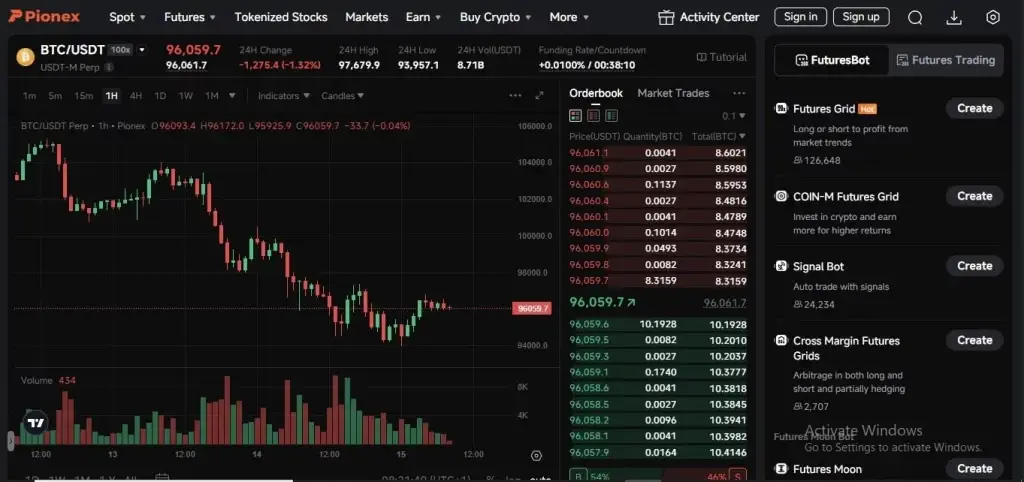
The Pionex trading interface showing built-in automation tools, orderbook liquidity and the BTC/USDT trading chart.
Pionex Review 2026 — Framework Score & Pillar Analysis
To ensure consistent and transparent comparisons across automated trading platforms, Arti-Trends evaluates every trading bot using the Arti-Trends Trading Bot Evaluation Framework.
Rather than ranking platforms based on popularity, marketing claims, or affiliate promotion, the framework analyzes how effectively each system performs across six structural pillars that determine whether automation genuinely improves trading discipline, execution reliability, and risk control.
These pillars evaluate:
• how intelligently the automation logic operates
• how flexible trading strategies can be configured
• how effectively risk can be managed and capital allocated
• how stable and efficient the execution infrastructure is
• how usable the platform is in real trading workflows
• how sustainable and competitive the pricing model remains over time
Each pillar receives a score between 0 and 5, weighted according to its relative importance within automated trading systems.
The table below shows how Pionex performs across the six pillars of the Arti-Trends Trading Bot Evaluation Framework, based on structural platform analysis, feature testing, and real-world workflow evaluation.
Where Pionex Fits in the AI Crypto Trading Stack
Automated crypto trading systems operate across three structural layers that together determine how strategies are created, executed, and filled in real market conditions.
The Strategy Layer defines when trades are triggered, how capital is allocated, and under which conditions positions are opened or closed.
The Execution Layer converts strategy logic into real market orders. This layer affects latency, order routing, slippage, and execution consistency.
The Exchange Layer is the market infrastructure itself, including liquidity, order books, and the matching engine that fills trades.
Most trading bot platforms operate mainly in the strategy layer and rely on API connections to access execution and liquidity on third-party exchanges.
Pionex follows a different model.
Because it combines an exchange with built-in automation, the platform operates natively in both the execution layer and the exchange layer, while offering limited strategy-layer flexibility compared with external bot platforms.
This is why Pionex is best understood not as a full strategy-engineering environment, but as an exchange-native automation system designed for simplified execution.
Pionex — Exchange-Integrated Crypto Trading Bots
- Limited strategy engineering depth compared with platforms such as 3Commas or Cryptohopper
- Bots operate only within the Pionex ecosystem, which reduces flexibility for multi-exchange workflows
Explore the Pionex Platform
You can explore Pionex directly on the official platform and test its built-in grid, DCA, and automated trading tools to see whether its exchange-native setup matches your trading style.
Key Pionex Trading Bots Explained
One of the defining characteristics of Pionex is the large number of automated trading strategies available directly inside the exchange interface. Many of these strategies fall into the same categories discussed in our breakdown of AI crypto trading strategies, which explains how algorithmic trading approaches are typically structured.
The platform currently provides more than a dozen built-in trading bots, each designed for different market structures and trading approaches.
While the list of available bots is extensive, most users rely on a smaller group of core automation strategies. These bots cover the most common automated trading use cases in cryptocurrency markets.
Below are the most important Pionex trading bots and how they function in practice.
Grid Trading Bot
The Grid Trading Bot is the most widely used automation strategy on Pionex and the feature that originally made the platform popular among retail traders.
The bot divides a predefined price range into multiple levels, creating a grid of buy and sell orders. As the market moves between those levels, the bot automatically buys at lower prices and sells at higher prices.
This approach is designed to capture profits from sideways market volatility.
When prices oscillate within a defined range, the bot repeatedly executes small trades that accumulate incremental gains over time.
Key characteristics of the Grid Bot include:
• automated buy-low, sell-high execution
• predefined price ranges and grid spacing
• continuous trading without manual monitoring
However, grid strategies perform best in range-bound markets. When strong trends develop, the bot may accumulate positions against the market direction.
For this reason, correct range selection and capital allocation remain essential when deploying grid automation.
Infinity Grid Bot
The Infinity Grid Bot is a variation of the traditional grid strategy designed for markets that trend upward over longer time horizons.
Instead of operating within a fixed price range, the Infinity Grid adjusts the trading grid as the market moves higher. This allows the strategy to continue capturing volatility even when prices gradually rise.
This approach is particularly popular among traders who want to automate strategies in long-term bullish markets while still benefiting from short-term price fluctuations.
Compared with a traditional grid bot, the Infinity Grid reduces the risk of the strategy becoming inactive when price breaks above the predefined trading range.
DCA Bot
The DCA Bot (Dollar-Cost Averaging Bot) automates a strategy commonly used by both traders and long-term investors.
Rather than entering a full position at once, the bot gradually accumulates assets over time by placing a series of buy orders as the price moves.
This strategy helps reduce the impact of market timing and smooths entry prices during volatile market conditions.
On Pionex, the DCA bot can be configured to:
• accumulate positions during market dips
• average down entry prices during volatility
• automatically exit positions when target profit levels are reached
DCA strategies are particularly popular in cryptocurrency markets because of their high volatility and frequent price swings.
Arbitrage Bot
The Arbitrage Bot attempts to capture price differences between spot and futures markets.
In theory, arbitrage strategies exploit temporary inefficiencies where the same asset trades at slightly different prices across market segments.
Because Pionex operates as both the automation environment and the exchange infrastructure, the arbitrage bot can execute trades without relying on external APIs.
However, the profitability of arbitrage strategies depends heavily on market conditions such as:
• funding rates
• liquidity levels
• short-term price deviations between markets
As a result, arbitrage bots should be viewed as opportunistic strategies rather than guaranteed profit mechanisms.
How to Set Up a Pionex Trading Bot (Video Tutorial)
For readers who want to see how the platform works in practice, the video below demonstrates how to configure and launch a trading bot on Pionex. The tutorial below shows how to configure and deploy a trading bot on Pionex. While the interface has evolved slightly since the video was recorded, the core setup process for grid bots and automated strategies remains largely the same.
The tutorial walks through the process of selecting a strategy, configuring grid parameters, and deploying the bot inside the exchange interface.
Seeing the setup process visually helps illustrate how Pionex simplifies automation compared with external bot platforms that require API connections and third-party integrations.
Always start with a small allocation when testing a new trading bot. Even rule-based automation strategies like grid bots behave differently across market conditions.
Pionex Fees and Pricing Structure
One of the most distinctive characteristics of Pionex is its pricing structure. Unlike most automated trading platforms, Pionex does not charge a separate subscription fee for access to its trading bots.
Most competing platforms operate as software layers that connect to exchanges through APIs. These services typically require a monthly subscription in addition to normal exchange trading fees.
Pionex follows a different model.
Because the trading bots are integrated directly into the exchange infrastructure, the platform generates revenue primarily through trading fees rather than automation subscriptions.
This significantly lowers the barrier to entry for automated trading.
For traders comparing automation environments, our guide to crypto exchanges for AI trading explains why exchange liquidity, fee structures, and execution quality play such an important role in automated strategies.
Pionex Pricing Overview
| Cost Component | Pionex |
|---|---|
| Bot subscription | Free |
| Spot trading fee | ~0.05% |
| Futures trading fee | ~0.02–0.05% |
| API access | Not required |
| Bot deployment | Included |
This pricing model makes Pionex one of the most accessible automated trading platforms for beginners, particularly for traders experimenting with strategies such as grid trading or DCA automation.
However, users should still consider that trading fees accumulate over time, especially when running high-frequency automated strategies.
Even small fees can meaningfully affect profitability when strategies execute hundreds or thousands of trades.
Pionex Pros and Cons in 2026
Like any automated trading platform, Pionex offers clear advantages but also carries structural limitations depending on the trader’s experience level and strategy requirements.
Advantages
Integrated exchange and bot infrastructure
Because Pionex operates as both the exchange and the automation layer, users do not need to configure API connections or manage multiple platforms.
Low barrier to entry
Automated trading bots can be deployed quickly without requiring technical setup or programming knowledge.
No bot subscription fees
Unlike many competitors, Pionex includes automation tools within the exchange environment without charging additional monthly costs.
Beginner-friendly interface
The platform focuses on simplified strategy configuration, making it accessible for retail traders exploring automation for the first time.
Limitations
Limited strategy customization
Advanced traders may find the platform restrictive compared with automation platforms that allow complex strategy engineering.
Single-exchange environment
Pionex bots operate only within the Pionex exchange ecosystem, limiting cross-exchange arbitrage or portfolio automation.
Rule-based automation
Despite the marketing terminology used across the industry, most Pionex bots rely on deterministic strategy logic rather than adaptive AI models.
Common Beginner Mistakes When Using Pionex
Automation tools simplify execution, but they do not eliminate trading risk. Many beginners misunderstand how automated strategies behave in different market conditions.
Several mistakes appear frequently among new users.
Using grid bots during strong market trends
Grid strategies perform best in sideways markets. When strong trends develop, the bot may continuously accumulate positions against the dominant direction.
Over-allocating capital to a single bot
New traders often deploy too much capital in a single automated strategy before understanding how it behaves across different volatility environments.
Running multiple correlated bots
Deploying several bots trading similar assets can unintentionally increase exposure to the same market movement.
Ignoring trading fees
High-frequency strategies can execute hundreds of trades. Even small fees accumulate over time and should be considered when evaluating strategy performance.
For readers exploring automation for the first time, our guide to AI crypto trading for beginners explains how traders typically approach risk management and strategy testing when using automated systems.
The most successful users treat trading bots as execution tools within a broader trading framework, rather than as autonomous profit engines.
Pionex vs Other Trading Bot Platforms
Pionex is not directly comparable to every trading bot platform, because its architecture is fundamentally different. The table below shows where it fits relative to external automation tools such as 3Commas, Cryptohopper, and TradeSanta.
How Pionex Compares to Other Crypto Trading Bot Platforms
Not all trading bot platforms operate in the same part of the stack. This comparison shows how Pionex differs from external automation tools such as 3Commas, Cryptohopper, and TradeSanta.
| Platform | Type | Best For |
|---|---|---|
|
Pionex
Featured
|
Exchange with built-in bots | Beginners who want simple automation |
| 3Commas | External automation platform | Advanced strategy configuration |
| Cryptohopper | Strategy marketplace ecosystem | Signal-based automation |
| TradeSanta | Simplicity-focused automation | Fast retail bot deployment |
Pionex integrates trading bots directly into the exchange, while most competitors operate as external automation layers connected through APIs.
If you want to compare the broader ecosystem of platforms and automation approaches, see our benchmark comparison of the best AI crypto trading bots of 2026, where different trading infrastructures and strategy models are evaluated.
This difference explains why Pionex excels at simplicity but offers less flexibility for complex strategy design.
Final Verdict — Is Pionex Worth Using in 2026?
Pionex remains one of the most accessible entry points into automated crypto trading in 2026.
Its biggest advantage is not advanced intelligence or deep customization, but structural simplicity. By integrating bots directly into the exchange environment, the platform reduces friction, lowers setup complexity, and makes automation far more approachable for retail users.
That makes Pionex particularly effective for traders who want to deploy simple, disciplined strategies such as grid trading or DCA without building a more complex multi-platform workflow.
For advanced users, the same simplicity becomes the main limitation. Traders who need deeper strategy engineering, broader exchange coverage, or programmable logic will typically outgrow the platform.
For beginners and intermediate users, however, Pionex remains one of the strongest simplicity-first automation platforms currently available.
Related Reading
If you want to understand how Pionex fits into the wider AI-driven trading ecosystem, the following resources provide additional context:
- AI Trading Bots Hub — An overview of how AI trading platforms, strategies, and execution layers work together
- AI Crypto Trading Bots: Complete Guide — How modern AI trading systems are designed and deployed
- Best AI Crypto Trading Bots of 2026 — A benchmark comparison of leading platforms across different trading styles
- Best Crypto Exchanges for AI Trading — Why exchange fees, liquidity, and execution quality matter
- AI Crypto Trading Strategies — A breakdown of the most common algorithmic trading approaches used with tools like 3Commas
Related Platform Reviews
Frequently Asked Questions
Is Pionex safe to use?
Pionex operates as a cryptocurrency exchange with integrated trading bots. As with any exchange, users should apply standard security practices such as enabling two-factor authentication and avoiding excessive capital exposure.
Are Pionex trading bots really AI?
Most Pionex bots are rule-based automation systems rather than machine-learning models. They execute predefined strategies such as grid trading or DCA according to user-defined parameters.
Does Pionex charge a fee for trading bots?
No. Pionex includes automated trading bots directly within the exchange platform. Users only pay standard trading fees when executing trades.
Can Pionex bots trade on other exchanges?
No. Pionex bots operate exclusively within the Pionex exchange environment and cannot connect to external exchanges.