
AI crypto trading bots are entering a new phase — and most traders haven’t adjusted their thinking yet.
In 2026, automated crypto trading is no longer about simple rule-based bots that buy and sell on fixed signals. The most effective systems now operate as adaptive execution layers — processing real-time market data, adjusting position sizing dynamically, and enforcing risk rules with a level of consistency that manual trading cannot match.
That shift matters.
Crypto markets increasingly move at machine speed. Liquidity can change within seconds, spreads can widen abruptly during volatility spikes, and short-lived opportunities often disappear before a human trader can react. In this environment, better analysis alone is not enough. Disciplined, automated execution has become the real edge.
Yet most “best AI trading bot” lists still compare platforms as if they were interchangeable products. They are not.
Performance differences rarely come from surface features or marketing claims. They are driven by how trading systems are structured, where decisions are made, and how risk is enforced when markets behave unpredictably.
To evaluate AI crypto trading bots properly, you need to think in three distinct layers:
- Strategy layer — where signals, portfolio logic, and automation rules are defined (and where most traders stop thinking)
- Execution layer — where orders are placed, optimized, and monitored in real time (and where most performance is won or lost)
- Exchange layer — where fees, liquidity, and API reliability determine whether strategies survive real market conditions
To evaluate AI crypto trading bots properly, you need to think in three distinct layers:
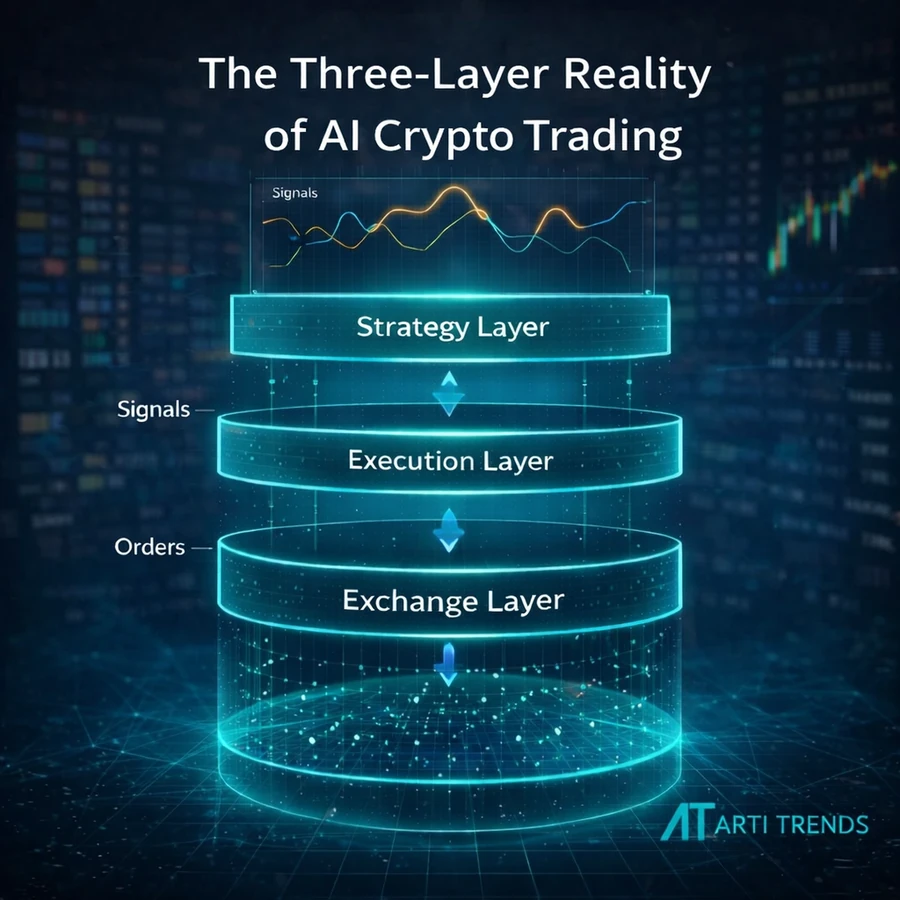
Most retail traders only focus on the strategy layer. Professional traders optimize all three — because weaknesses at any layer can invalidate even the best strategy.
This guide explains what AI crypto trading bots actually are in 2026, how they work under the hood, where they deliver real advantages, and where their limitations remain. We break down the major bot categories, the risks you must understand before deploying capital, and a practical decision framework to match trading systems to your time horizon, experience level, and drawdown tolerance.
If you want a platform-focused shortlist first, you can jump ahead to our independent breakdown of the best AI crypto trading bots of 2026.
If you’re looking for broader context on adoption trends, regulation, and capital flows, explore our AI crypto trading market overview for 2026.
Important note: This content is educational. Crypto markets are volatile, and automation can amplify mistakes when configured poorly. Trading bots should be treated as execution tools — not profit guarantees.
Use the table of contents below to jump directly to specific bot types, risks, setup steps, and strategic considerations.
What AI Crypto Trading Really Means in 2026
In 2026, AI crypto trading no longer means “a bot that buys and sells based on indicators.”
It refers to a full execution stack in which machine-learning models, real-time data pipelines, and automated risk controls work together to deploy capital across volatile digital markets.
This distinction matters because most traders are no longer competing against other humans.
They are competing against algorithms.
Modern crypto markets are dominated by:
- automated market makers
- high-frequency trading systems
- liquidity-seeking algorithms
- and institutional execution engines
AI trading bots exist to give retail and professional traders access to that same environment — using data, models, and automation instead of manual reactions.
From an investing perspective, this places AI crypto trading inside a much broader shift.
Just as AI investing uses machine intelligence to decide what to own, AI trading uses that intelligence to decide when and how to buy and sell it.
In practice, those decisions are generated in the strategy layer, but they only create real performance in the execution layer, where orders are routed, priced, and filled on an exchange.
That execution layer is where most performance is won or lost.
Crypto markets amplify this reality. Price moves are faster than in equities. Liquidity shifts across exchanges in seconds. Funding rates, liquidation cascades, and sentiment-driven spikes create environments where hesitation is punished. AI-driven systems can continuously scan for those conditions and react instantly — often within milliseconds — while enforcing risk rules that humans struggle to apply consistently.
This is why professional traders increasingly separate strategy from execution, using specialized engines and exchange infrastructure rather than all-in-one apps.
To understand why adoption is accelerating so quickly, it helps to look at the market itself. Capital flowing into crypto is increasingly algorithmic, exchange infrastructure is becoming more API-driven, and professional trading tools are no longer limited to hedge funds. This is explored in more detail in our AI crypto trading market overview for 2026, but the takeaway is simple: execution quality now matters as much as strategy.
That is why AI crypto trading bots are no longer niche tools.
They are becoming part of the standard infrastructure through which serious traders operate.
What Are AI Crypto Trading Bots?
An AI crypto trading bot is not just a piece of software that buys and sells assets.
It is a data-driven decision and execution system that connects strategy, market data, and exchange infrastructure into a continuous trading loop.
At a minimum, every AI trading system operates across three functional layers:
- a data layer that collects prices, order books, funding rates, and sometimes on-chain or sentiment data
- a decision layer that evaluates this information and determines what action to take
- an execution layer that turns those decisions into real orders on one or more exchanges
What makes a bot “AI-powered” is the decision layer.
Traditional trading bots follow static rules such as:
“If RSI is below 30, buy. If RSI is above 70, sell.”
AI-driven systems instead evaluate many signals at once, assign probabilities to different market outcomes, and continuously update how aggressively they trade, how much capital they deploy, and when they reduce risk.
Rather than acting on a single indicator, they answer questions like:
“How likely is this move to continue?”
“How volatile is this market relative to recent history?”
“What is the risk of a sudden reversal?”
This distinction is especially important in crypto, where market regimes change quickly. A strategy that works in a trending environment often fails in sideways or high-volatility conditions. AI models can detect these shifts and adjust parameters such as position size, entry timing, or exit thresholds without manual intervention.
It is also important to understand that not all AI trading bots are built the same way.
Some platforms combine strategy design, AI models, and execution inside a hosted SaaS application. These systems emphasize convenience, presets, and user interfaces.
Others separate strategy from execution and allow traders to connect their own models to professional-grade execution engines such as Hummingbot. These setups give traders far more control over latency, fees, and order routing, which becomes critical for arbitrage and market-making strategies.
In practice, two traders can use the same “AI trading platform” and get very different results — because their risk settings, capital allocation, exchange selection, and execution layer are part of the system.
The key takeaway is this:
An AI crypto trading bot is not a magic profit machine.
It is an automated decision and execution framework that applies data-driven logic at speed, with defined risk controls.
That framework can be powerful — but only when it is matched to the right strategy, exchange, and risk profile.
How AI Bots Trade Crypto
To understand what AI crypto trading bots really do, it helps to see them not as “apps,” but as automated trading systems built on four tightly connected layers: data, intelligence, execution, and risk.
Every professional-grade AI trading setup is built on this stack.
The data layer collects real-time information from multiple sources. This includes price feeds, order books, funding rates, volatility metrics, and sometimes on-chain or sentiment data. In fast-moving crypto markets, even small delays or missing data can turn a profitable setup into a losing trade, which is why modern bots rely on direct exchange APIs rather than web scraping or delayed feeds.
The intelligence layer is where AI models interpret that data. Instead of reacting to a single indicator, the system evaluates multiple signals at once and estimates the probability of different market outcomes. It determines whether current price action is more likely to continue, reverse, or consolidate, and adjusts entries, exits, and position sizing accordingly.
The execution layer is where those decisions become real trades. This layer connects the strategy to one or more cryptocurrency exchanges and handles order routing, pricing, and fills. Execution quality is critical: slippage, latency, fee structure, and liquidity all directly affect performance. For this reason, professional AI traders often separate strategy from execution, using dedicated execution engines and exchange infrastructure rather than all-in-one apps.
The risk layer controls how much damage any single idea can do. It defines position limits, stop-loss logic, exposure caps, drawdown thresholds, and sometimes dynamic leverage. In well-designed AI systems, risk management is not an afterthought — it is embedded in every decision the model makes.
Together, these layers allow an AI trading bot to behave less like a script and more like an automated trader. It observes the market, evaluates scenarios, places trades, and adjusts its behavior continuously as conditions change.
This architecture also explains why results vary so widely between platforms. Two bots may use similar indicators, but if one has better data, smarter models, or tighter execution, the performance gap can be significant.
Types of AI Crypto Trading Bots
AI crypto trading is not a single strategy. In 2026, the market consists of several distinct categories of bots, each designed to solve a different trading problem — and each placing different demands on execution, fees, and infrastructure.
Understanding these categories is essential, because choosing the wrong type of bot is one of the fastest ways to lose money, even if the software itself is technically advanced.
AI DCA and Accumulation Bots
These bots are designed for long-term investors who want to build positions gradually rather than time the market.
They use AI to adjust how aggressively capital is deployed based on volatility, trend strength, and drawdown risk. In sideways or choppy markets, this often outperforms manual dollar-cost averaging because position sizes and timing are dynamically adapted rather than fixed.
These systems are typically run on strategy-focused platforms that prioritize ease of use and portfolio-level control rather than ultra-low-latency execution.
AI Trend-Following Bots
Trend-following bots aim to capture sustained price movements rather than predict exact tops or bottoms.
AI improves these systems by distinguishing between real trend shifts and short-lived noise, reducing the number of false entries that plague traditional indicator-based strategies. These bots perform best in strong bull or bear markets, where directional moves dominate.
Execution quality still matters, but strategy logic and risk management are the primary drivers of performance.
AI Arbitrage Bots
Arbitrage bots look for price differences between exchanges, trading pairs, or derivatives markets and exploit those inefficiencies before they disappear.
This category is heavily execution-dependent. Profitability is determined by:
- latency
- fees
- liquidity
- and API stability
Because arbitrage opportunities often last only seconds, these systems rely on fast order routing and low trading costs rather than prediction.
AI Portfolio and Rebalancing Bots
Portfolio bots treat crypto assets as a diversified investment basket.
Instead of trading individual coins aggressively, they continuously adjust allocations based on performance, correlation, and risk. AI helps optimize these reallocations, aiming to maximize returns while controlling volatility.
These systems are commonly used by long-term investors who want exposure to crypto without actively managing every trade.
AI Futures and Leverage Bots
Futures bots trade leveraged contracts rather than spot markets.
This allows them to profit from both rising and falling prices, but it also introduces much higher risk. AI is used to manage position size, liquidation risk, and entry timing — making execution quality and exchange choice especially important.
Because leverage amplifies both gains and losses, these systems require strict risk controls and reliable infrastructure.
Each of these bot types plays a different role inside an AI-driven trading stack. Some prioritize strategy and portfolio construction, others depend heavily on low-latency execution and fee efficiency.
In the next section, we look at what these systems can realistically achieve — and where their limitations remain.
What AI Crypto Trading Bots Can (and Cannot) Do
AI crypto trading bots can significantly improve how trades are executed — but they do not change the fundamental nature of financial markets.
Understanding where these systems add real value, and where their limits remain, is essential for using them responsibly.
What AI Trading Bots Can Do Well
AI excels at processing large volumes of data and applying rules consistently. In crypto trading, this creates several concrete advantages.
First, AI systems can react faster than humans. They monitor multiple markets, order books, and indicators simultaneously and can place trades the moment predefined conditions are met. In fast-moving crypto environments, this speed often determines whether an opportunity is captured or missed.
Second, AI bots enforce discipline without emotion. Fear, greed, hesitation, and overconfidence are some of the biggest causes of trading losses. An automated system follows its model and risk rules regardless of how dramatic price movements look on the chart. This is why many traders find that AI-driven systems outperform manual trading over long periods — not because the models are perfect, but because consistent execution and risk control compound over time, as explained in AI crypto trading vs manual trading.
Third, modern AI bots can adapt to changing market regimes. Instead of relying on a single fixed strategy, they adjust how aggressively they trade, how much capital they deploy, and when they step back based on volatility, trend strength, and liquidity conditions.
What AI Trading Bots Cannot Do
At the same time, AI bots are not omniscient, and they do not eliminate risk.
They cannot predict black-swan events such as exchange outages, regulatory shocks, or sudden macroeconomic news. When liquidity disappears or markets gap violently, even the best model can suffer.
They cannot turn a bad strategy into a good one. If a bot is configured with excessive leverage, poor risk parameters, or unrealistic profit targets, automation will simply apply those mistakes faster and more consistently.
They also cannot guarantee profits. Markets are competitive and adaptive. When a strategy becomes widely used, its edge often erodes. AI can adjust, but it cannot escape the fundamental uncertainty of trading.
This is why choosing the right platform, exchange, and risk framework matters just as much as the intelligence of the software itself.
Risks of AI Crypto Trading
AI-powered trading systems can improve execution and consistency, but they do not remove the underlying risks of cryptocurrency markets. In some cases, automation can even amplify those risks if it is poorly designed or incorrectly configured.
Understanding these limitations is essential before deploying real capital.
Market & Liquidity Risk
Crypto markets are highly sensitive to news, macroeconomic shifts, and sudden changes in liquidity. Even advanced AI models are trained on historical data, which means they can struggle during unprecedented events such as exchange failures, regulatory announcements, or extreme sentiment-driven selloffs.
When liquidity dries up, price gaps widen and even well-designed strategies can suffer losses regardless of how accurate their signals were.
Model & Strategy Risk
AI trading bots rely on assumptions about how markets behave. If those assumptions no longer hold — because of a regime change, structural shift, or new trading dynamics — model performance can deteriorate quickly.
Automation does not protect against this. In fact, it can cause losses to accumulate faster because trades are executed consistently and at speed.
Configuration & Leverage Risk
Position sizing, leverage, stop-loss logic, and exposure limits determine how much damage a losing streak can cause.
A technically advanced AI bot with aggressive settings can be more dangerous than a simpler system with conservative risk controls. This is especially true in leveraged futures trading, where small price moves can trigger liquidations.
Exchange & Infrastructure Risk
AI bots execute trades through centralized or decentralized exchanges. If an exchange experiences outages, liquidity problems, or security issues, open positions can be affected regardless of how good the trading model is.
API stability, withdrawal rules, and jurisdictional access are all part of this risk, which is why exchange selection matters just as much as the bot itself.
Regulatory & Operational Risk
Crypto trading and automated execution are regulated differently across jurisdictions, and the rules continue to evolve. Some platforms restrict access based on location, and certain products — such as leveraged derivatives — may not be available everywhere.
These regulatory and operational constraints are explored in more detail in AI crypto trading risks & regulation.
Used carefully, AI trading bots can reduce emotional errors and improve execution quality. Used carelessly, they can accelerate losses. The difference lies in risk management, platform choice, and a clear understanding of what these systems can and cannot control.
Who Should Use AI Crypto Trading Bots?
AI crypto trading bots are used by a wide range of market participants in 2026 — from first-time investors to professional trading desks. What differs is how they are used and which layer of the trading stack they operate on.
Long-Term Investors
Long-term investors often use AI bots for accumulation and portfolio rebalancing.
Instead of trying to time the market manually, they let algorithms adjust buying pace and asset allocation based on volatility, trend strength, and drawdown risk. This approach allows them to build crypto exposure gradually while avoiding emotional overtrading, which is why many beginners start with guided setups, as explained in AI crypto trading for beginners.
These users typically rely on strategy-focused platforms with strong portfolio and risk management tools rather than ultra-low-latency execution.
Active Traders
Active traders use AI bots to execute short-term strategies with more speed and consistency than is possible by hand.
Whether the goal is to trade momentum, breakouts, or volatility, automation allows them to apply their rules continuously without hesitation or emotional bias, because speed and discipline matter more than manual reactions, as explored in AI crypto trading strategies (2026).
For these users, both strategy quality and execution efficiency are important.
Professional & Semi-Professional Traders
Professional traders and advanced individuals use AI systems to operate at a scale that would be impossible manually.
Multi-exchange execution, 24/7 monitoring, and systematic risk controls allow them to deploy capital continuously while focusing their time on research and model development rather than order placement, which is why execution engines and exchange infrastructure become central at higher volumes, a topic we cover in detail in the Hummingbot review (2026).
What all of these groups have in common is not a desire for guaranteed profits, but a need for structured, disciplined execution in a fast and unpredictable market.
In the next section, we translate that into a practical framework for choosing the right AI crypto trading bot.
How to Choose the Right AI Crypto Trading Bot
Choosing an AI crypto trading bot is less about finding the “most powerful” system and more about selecting the right combination of strategy, execution, and exchange for your trading style and risk tolerance.
This decision framework helps avoid the most common mistakes.
1. Start With Your Trading Objective
Before comparing platforms, define what you actually want to do.
Are you trying to:
- accumulate crypto over the long term
- trade short-term trends
- exploit arbitrage opportunities
- or run a diversified portfolio
Each of these requires a different type of bot and a different execution setup. These use cases are broken down in AI crypto trading strategies (2026).
2. Check Exchange Compatibility
A trading bot is only as good as the markets it can access.
Look for:
- deep liquidity
- stable APIs
- competitive fees
- and legal availability in your region
High-frequency and arbitrage strategies are especially sensitive to exchange quality, which is why professional traders focus on venues optimized for automated execution, as covered in best crypto exchanges for AI trading.
3. Evaluate the Execution Layer
Most users compare bots by features and dashboards. Professionals compare them by execution quality.
Ask whether the platform:
- places orders directly via exchange APIs
- allows low-latency execution
- supports multiple exchanges
- and gives you control over order routing
This is where open execution engines such as Hummingbot differ from hosted SaaS platforms, a distinction we explore in depth in the Hummingbot review (2026).
4. Understand the Cost Structure
Bot fees are not just subscriptions.
You need to account for:
- platform fees
- profit-sharing models
- and exchange trading fees
Over time, these costs compound and can have a major impact on net performance. A side-by-side breakdown is available in AI trading bot fees comparison.
5. Match Complexity to Your Experience
Some traders want preset strategies and visual interfaces. Others want full control over models, parameters, and execution.
Beginners often benefit from guided platforms and conservative risk controls, which is why many start with AI crypto trading for beginners. More advanced users may prefer flexible systems that allow deeper customization and integration.
The goal is not to find the “best” AI bot in isolation, but to assemble the right AI trading stack for your objectives.
Once you understand these trade-offs, the next step is to compare specific platforms. That is exactly what we do in our independent ranking of the best AI crypto trading bots of 2026.
The AI Crypto Trading Ecosystem
AI crypto trading does not happen inside a single app. It operates within a broader ecosystem of exchanges, execution engines, strategy platforms, and data providers that work together to move capital through digital markets.
Understanding this ecosystem is critical, because performance is determined by how these layers interact.
Exchanges: Where Trades Actually Happen
Crypto exchanges are the venues where orders are executed, liquidity is provided, and prices are formed.
For AI-driven systems, exchange quality is decisive. Stable APIs, deep order books, and fast order processing determine whether a strategy is implemented accurately or suffers from slippage and missed fills. This is why professional traders pay close attention to which platforms their bots connect to, as outlined in best crypto exchanges for AI trading.
Strategy Platforms: Where Trading Logic Is Defined
Strategy platforms focus on building and managing trading logic.
Some tools emphasize visual strategy builders and signal marketplaces, such as Cryptohopper, while others specialize in volatility-based systems and multi-exchange automation, such as Bitsgap. These platforms are designed to make AI-driven trading accessible without requiring deep technical skills, which is why they are often used by retail and semi-professional traders.
Independent reviews of these platforms are available in our Cryptohopper review (2026) and Bitsgap review (2026).
Execution Engines: Where Performance Is Won or Lost
Execution engines turn strategy decisions into real orders.
This layer determines latency, order routing, fee optimization, and fill quality — all of which directly affect profitability, especially for arbitrage and market-making strategies.
Open-source execution frameworks such as Hummingbot allow professional traders to run their own self-hosted trading infrastructure with full control over exchange connectivity and execution behavior, which we analyze in detail in the Hummingbot review (2026).
Data & Analytics Providers
AI models depend on high-quality data.
Price feeds, order books, on-chain metrics, and sometimes sentiment or derivatives data all feed into the decision layer of an AI trading system. Poor data quality leads to unreliable signals, regardless of how advanced the model itself may be.
Together, these components form the AI crypto trading stack.
Understanding how strategy platforms, execution engines, and exchanges interact is what allows traders to build systems that are both scalable and resilient — rather than relying on a single tool to do everything.
The Future of AI Crypto Trading (2026–2030)
The next phase of AI crypto trading will not be defined by better indicators, but by more autonomous, interconnected trading systems.
Instead of running one fixed strategy, future AI trading platforms will dynamically allocate capital across multiple models — trend following, arbitrage, hedging, and portfolio rebalancing — based on real-time market conditions. This is already happening in professional trading desks and is now moving into advanced retail platforms.
A second major shift is multi-exchange execution optimization. AI systems will increasingly route orders to whichever exchange offers the best combination of liquidity, fees, and fill probability at that moment. This reduces slippage and improves long-term performance, but it also makes execution infrastructure and API reliability more important than ever.
Regulation will also play a role. As crypto trading becomes more automated and institutional, regulators are focusing on leverage, transparency, and consumer protection. The likely outcome is not a ban on AI trading, but a market in which compliant platforms with clear risk controls gain a structural advantage — similar to what happened in traditional algorithmic trading.
From an investing perspective, these trends tie directly into the broader evolution of AI-powered investing. As AI systems increasingly handle analysis, allocation, and execution, the boundary between investing and trading becomes less rigid. Capital will flow to wherever models detect the best risk-adjusted opportunities — whether in crypto, equities, or other digital markets.
For individual traders, this means that learning how to work with AI systems will become a core financial skill. Those who understand how to configure, monitor, and combine automated strategies will be able to operate with a level of discipline and scale that was once reserved for institutional desks.
How to Start With AI Crypto Trading
Getting started with AI crypto trading does not require advanced programming skills or a professional trading desk. What it does require is a clear understanding of your goals, your risk tolerance, and the tools you plan to use.
Step 1 — Build the Right Foundation
Before deploying any capital, make sure you understand how AI trading systems work, what types of bots exist, and how risk is managed.
This guide provides that overview. If you are completely new, AI crypto trading for beginners offers a more step-by-step introduction.
Step 2 — Define Your Risk Profile
Decide in advance:
- how much capital you are willing to allocate
- what level of drawdown you can tolerate
- whether you want spot exposure, futures, or a diversified portfolio
These choices determine which type of bot and which exchange will be suitable.
Step 3 — Choose a Reliable Exchange
Your bot can only trade where liquidity and infrastructure exist.
Look for exchanges that offer:
- API-based trading
- deep order books
- competitive fees
- and regulatory clarity
We maintain a curated list of the best crypto exchanges for AI trading to help you compare the most suitable platforms.
Step 4 — Select the Right Trading Platform
Some users prefer visual strategy builders and preset bots. Others want multi-exchange execution or full control over their own models.
A side-by-side evaluation of the leading options is available in the best AI crypto trading bots of 2026.
Step 5 — Start Small and Scale Gradually
Run your bot with limited capital first.
Monitor how it behaves in different market conditions. Check whether it respects your risk limits, how often it trades, and how it handles volatility.
Only increase position size once you understand how the system performs in practice.
Used responsibly, AI crypto trading bots are not shortcuts to easy money. They are tools that help you apply structure, consistency, and data-driven decision-making in one of the most volatile financial markets in the world.
Conclusion: AI Crypto Trading Is Becoming the Execution Layer of Investing
AI crypto trading bots are no longer experimental tools used by a small group of technically skilled traders.
In 2026, they are becoming part of the core infrastructure through which capital is deployed, managed, and protected in digital markets.
What distinguishes modern AI trading systems from earlier generations of bots is not just automation, but adaptive execution. By combining real-time data, probabilistic models, and automated risk controls, these platforms allow traders to operate with a level of discipline and consistency that is difficult to achieve manually — especially in highly volatile crypto markets.
At the same time, this technology does not remove risk. Markets remain uncertain, and no model can predict every event. The true advantage of AI trading lies in structured execution: applying a well-defined strategy repeatedly, without emotional interference, while maintaining control over exposure and drawdowns.
For investors following the broader AI investing trend, AI crypto trading represents the execution layer that turns analysis into market participation. It bridges the gap between insight and action — whether through strategy platforms, professional execution engines, or exchange infrastructure.
The key is not to find a single “perfect” bot, but to understand how strategies, execution, and exchanges fit together.
That is why this guide connects directly to our in-depth ranking of the best AI crypto trading bots of 2026 and the supporting resources available in the AI Trading Bots Hub.
Explore the AI Crypto Trading Hub (Tools, Reviews & Strategies)
If you want to go deeper into specific areas of AI-driven crypto trading, these guides map the full ecosystem — from beginner education to professional-grade execution, platform selection, and risk management.
Learn the Foundations
- AI Crypto Trading for Beginners — A step-by-step introduction to automated crypto trading, risk management, and first-time bot setup
- AI Crypto Trading Strategies (2026) — How trend-following, arbitrage, DCA, and portfolio bots are used in real markets
- AI Crypto Trading Risks & Regulation — Legal, technical, and market risks every AI trader should understand
- AI Crypto Trading vs Manual Trading — Why algorithmic execution often outperforms discretionary trading in volatile markets
Choose the Right Tools
- Best AI Crypto Trading Bots of 2026 — Independent comparison of Cryptohopper, Bitsgap, 3Commas, and other leading platforms
- Best Crypto Exchanges for AI Trading — Where AI bots actually execute trades, with a focus on liquidity, fees, and API reliability
- AI Trading Bots on HTX — How low-fee execution improves AI bot profitability
Specialized AI Trading Systems
- AI Crypto Arbitrage Bots — How bots exploit price differences across exchanges
- AI Futures Trading Bots — How AI systems trade leverage, trends, and perpetual contracts
- AI Portfolio Trading Bots — How long-term AI systems manage diversified crypto portfolios
Together, these pages form the AI Crypto Trading Cluster inside Arti-Trends — designed to help you move from understanding AI-powered trading to executing real-world strategies with professional-grade tools and risk control.