How to find, use, and master the most powerful prompt libraries in the world.
In just a few years, AI has evolved from a niche productivity tool into a full creative and strategic ecosystem — and prompt libraries have become the backbone of that ecosystem. Whether you’re a marketer, developer, founder, designer, researcher, or professional creator, prompt libraries help you move faster, think more clearly, and produce consistently higher-quality results with AI.
But the real advantage isn’t speed alone.
It’s structured inspiration.
It’s repeatable workflows.
It’s best practices turned into reusable systems.
And most importantly, it’s learning how experienced practitioners actually think when they prompt AI.
Prompt libraries transform individual experimentation into shared intelligence. Instead of starting from a blank prompt, you start from a proven way of thinking — refined through real-world use, iteration, and community feedback.
This guide explores the best prompt libraries and AI communities in 2026: the platforms where creators discover high-quality prompts, learn advanced structures, and accelerate their prompting skills through practical examples.
This article is part of the Arti-Trends Prompt Writing Cluster, where we break down how to communicate with AI clearly, consistently, and strategically.
If you’re looking for the complete foundation of modern prompting, start with the AI Prompt Writing Guide — the cornerstone article that explains how effective prompts are designed, structured, and refined.
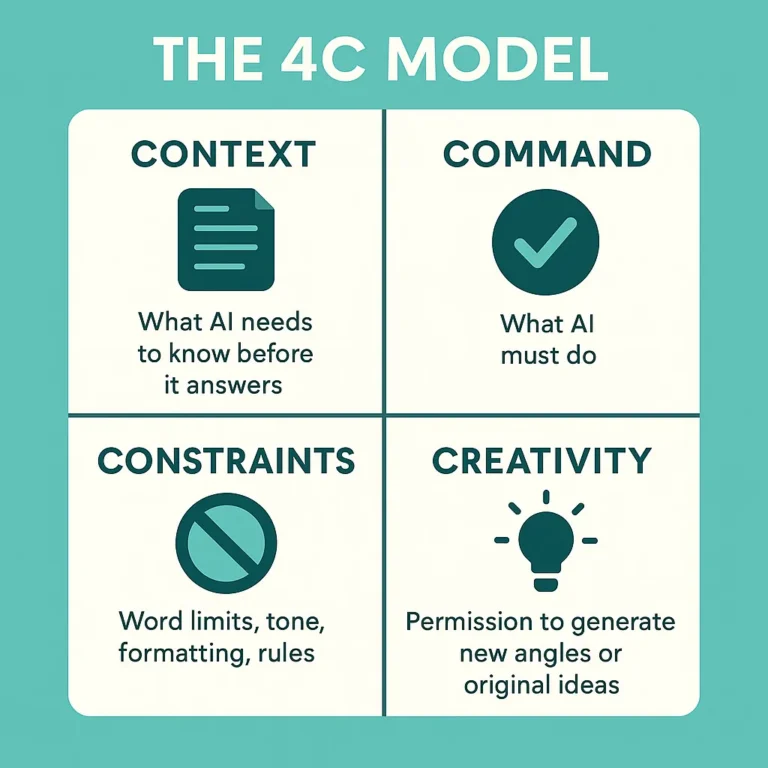
To understand the structural logic behind many of the prompt systems found in libraries and communities, explore AI Prompt Frameworks (4C Model), where professional prompt frameworks are explained in depth.
Let’s dive in.
What Are Prompt Libraries?
Prompt libraries are curated collections of ready-to-use prompts, templates, frameworks, systems, and workflows designed to help creators work faster, think more clearly, and produce more reliable AI output.
At their core, prompt libraries help creators:
- produce consistent results
- speed up content creation
- improve reasoning and structure
- solve business and analytical tasks
- generate both creative and technical output
- train teams more efficiently
- build repeatable, scalable processes
Rather than reinventing prompts from scratch, libraries provide proven starting points based on real-world use.
The Main Types of Prompt Libraries
Prompt libraries typically fall into five categories:
1. Prompt Collections
Simple lists of prompts organized by purpose — such as marketing, coding, business, productivity, design, or learning. These are ideal for quick inspiration and fast execution.
2. Prompt Templates
Structured prompt formats that guide the AI step-by-step. These templates define roles, goals, constraints, and outputs — similar to the systems outlined in Prompt Templates for Marketers & Creators.
3. Prompt Framework Libraries
Advanced libraries built around reasoning models and mental structures, such as the 4C Framework or Chain-of-Thought prompting. These focus less on wording and more on how the AI should think.
4. Community Libraries
Crowd-sourced prompt collections where practitioners submit, test, refine, and vote on prompts. High-performing prompts rise to the top through real-world validation.
5. AI-Integrated Libraries
Prompt systems embedded directly into tools like Jasper, Notion AI, PromptPerfect, or TypingMind — allowing prompts to be reused as part of daily workflows rather than copied manually.
Prompt libraries are not shortcuts — they are idea accelerators.
They don’t replace thinking; they improve it by exposing you to better structures, clearer logic, and more effective ways of communicating with AI.
Why Prompt Libraries Matter for AI Creators
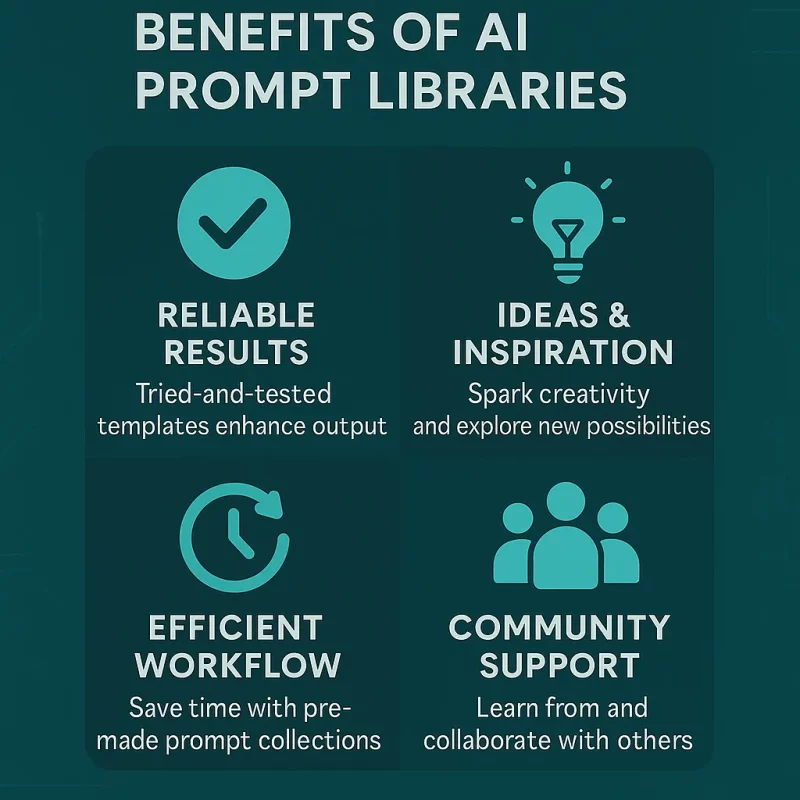
Prompt libraries play a critical role in modern AI workflows because they turn individual experimentation into repeatable systems. Instead of starting from a blank prompt, creators begin with proven structures that already reflect best practices.
Below are the core reasons prompt libraries matter — especially for professional creators and teams.
A) Faster, More Consistent Workflows
Creators no longer have to reinvent prompts for every task.
Prompt libraries provide ready-made structures that accelerate execution while maintaining consistency across outputs — a requirement for teams, agencies, and scalable workflows.
B) Higher Output Quality and Better Reasoning
Prompts found in high-quality libraries are rarely random. They embed proven patterns such as:
- clear constraints
- example-driven guidance
- role assignment
- step-by-step reasoning
- structured frameworks
These are the same foundational principles explained in the AI Prompt Writing Guide, applied in practical, reusable form.
C) Access to Expert-Level Thinking
Prompt libraries allow you to adapt prompts created by experienced practitioners, including:
- marketers
- strategists
- developers
- analysts
- founders
- researchers
Using these prompts is like borrowing someone else’s mental model — learning how experts frame problems, define goals, and guide AI reasoning.
D) Accelerated Learning Curve
Libraries are not just tools for execution; they are tools for education.
By studying high-performing prompts, you learn:
- what makes a prompt effective
- how experts structure instructions
- how examples influence output quality
- how Chain-of-Thought improves reasoning
These concepts are explored in depth in Few-Shot vs Zero-Shot Prompting and Chain-of-Thought Prompting, but libraries show them in action.
E) Community Insight and Collaboration
The strongest prompt libraries are powered by communities.
Creators continuously share, test, refine, and improve prompts — allowing effective patterns to evolve faster than any individual could achieve alone. This collective iteration is one of the fastest ways to stay aligned with emerging best practices in AI prompting.
The Best Prompt Libraries in 2026 (Deep Breakdown)
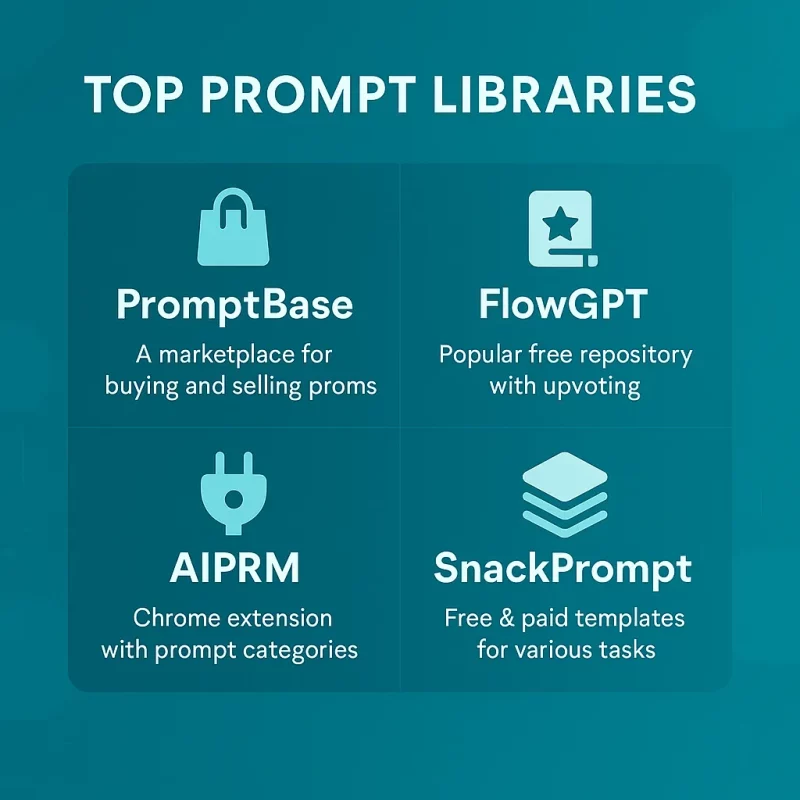
Below is a curated selection of the most valuable, credible, and actively used prompt libraries in 2026. Each serves a different purpose — from fast inspiration to enterprise-grade prompt systems.
A) AIPRM — Chrome Extension
Best for: instant access to community prompts
What it offers
A massive public prompt library covering SEO, marketing, business, coding, analysis, and automation — directly inside ChatGPT.
Strengths
- Huge user base (1M+ users)
- Prompts ranked and filtered by community
- One-click prompt insertion
- Extremely fast experimentation
Best for
Creators who want immediate access to proven prompts without building everything from scratch.
B) PromptHero — Prompt Marketplace
Best for: image & multimodal prompting
What it offers
High-quality prompts for image models such as Midjourney, DALL·E, and Stable Diffusion — with growing support for text prompts.
Strengths
- Strong visual prompting expertise
- Excellent for style exploration and creative direction
- Clear prompt breakdowns
Best for
Designers, brand creators, artists, and multimodal workflows.
C) FlowGPT — Prompt Sharing Platform
Best for: community-validated prompts
What it offers
One of the largest crowdsourced prompt platforms, where users share, test, and rank prompts.
Strengths
- Real-world usage and voting
- High-quality prompts surface naturally
- Active Discord and creator community
Best for
Anyone who wants prompts validated by real users rather than theory alone.
D) Jasper — Prompt Library
Best for: marketing & business teams
What it offers
Professionally designed templates for marketing, sales, planning, email, brand voice, and content systems.
Strengths
- Enterprise-ready workflows
- Strong brand-voice consistency
- Optimized for conversion-focused output
Best for
Businesses, marketing teams, agencies, and content operations.
E) Notion AI — Template Libraries
Best for: planning, operations & knowledge work
What it offers
Community-shared AI workflows embedded directly into Notion — spanning strategy, research, SOPs, and productivity systems.
Strengths
- Deeply integrated into daily workflows
- Easy to customize and adapt
- Ideal for documentation and planning
Best for
Teams already using Notion as their operational hub.
F) Anthropic / Claude Prompt Library
Best for: deep reasoning & analysis
What it offers
Claude-specific prompt examples focused on reasoning, summarization, planning, and long-context workflows.
Strengths
- Excellent Chain-of-Thought examples
- Strong analytical depth
- Long-context optimization
Best for
Analysts, researchers, operators, and strategists.
G) OpenAI Prompt Examples Repository
Best for: foundational learning
What it offers
Official prompt examples and patterns for ChatGPT / GPT-5 models.
Strengths
- Clean, minimal examples
- Updated with new model releases
- Strong baseline for understanding prompt mechanics
Best for
Beginners, developers, and anyone learning core prompt principles.
H) GitHub Prompt Engineering Collections
Best for: technical & agent-based workflows
What it offers
Curated repositories created by researchers, ML engineers, and developers focusing on advanced prompting.
Strengths
- High technical depth
- Covers agents, Chain-of-Thought, tools, workflows
- Open-source experimentation
Best for
Developers, engineers, and technical creators building advanced systems.
I) TypingMind — Prompt Library
Best for: private internal prompt systems
What it offers
Customizable, private prompt libraries that can be saved, organized, and reused across projects.
Strengths
- Excellent UX
- Works across multiple models
- Ideal for internal knowledge bases
Best for
Teams building reusable, internal prompt repositories.
Strategic takeaway
Not all prompt libraries solve the same problem:
- Speed & inspiration → AIPRM, FlowGPT
- Professional output → Jasper, Notion AI
- Deep reasoning → Claude, GitHub
- Internal systems → TypingMind
The best creators don’t rely on one library — they combine community insight, framework knowledge, and internal prompt systems.
The Best Communities for AI Creators (2026)
Great prompts rarely emerge in isolation. They are refined through discussion, experimentation, and peer feedback. The communities below are where prompting techniques evolve fastest — and where creators learn what actually works in real-world workflows.
(r/PromptEngineering, r/ChatGPT, r/AIHackers)
Best for: practical problem-solving & iteration
- Real-world prompting challenges and fixes
- Live feedback on prompt structure and output quality
- Frequent discovery of new prompt patterns and techniques
Ideal if you want to see how others debug prompts in production scenarios.
Discord Communities
(Midjourney, FlowGPT, AI/ML servers)
Best for: real-time collaboration & experimentation
- Creator-to-creator prompt sharing
- Strong focus on image and multimodal prompting
- Fast experimentation cycles and immediate feedback
Perfect for hands-on creators who learn by testing and iterating live.
X (formerly Twitter)
Best for: trends, research, and emerging techniques
- Home of prompt researchers, indie AI builders, and agent developers
- Early access to new prompting ideas and frameworks
- Fast-moving discussions around model behavior and updates
Best used as a signal channel — discover ideas here, then test them elsewhere.
Indie Hackers & Product Hunt
Best for: business-driven prompting
- Prompt use cases tied to startups, products, and monetization
- Practical examples of AI-assisted growth, marketing, and operations
- Strong overlap with real-world execution
Ideal for founders and builders applying prompts to business outcomes.
GitHub Prompt Engineering Groups
Best for: technical depth & advanced workflows
- High-quality prompt repositories from engineers and researchers
- Coverage of agents, Chain-of-Thought, tools, and complex systems
- Open-source experimentation and documentation
Best for developers and technical creators building advanced AI systems.
Strategic takeaway
Each community serves a different role in your prompting journey:
- Learning & debugging → Reddit
- Experimentation & collaboration → Discord
- Trends & research signals → X
- Business application → Indie Hackers & Product Hunt
- Technical mastery → GitHub
The most effective AI creators don’t rely on a single community. They observe trends, test ideas, and systematize what works into their own prompt libraries and workflows.
How to Choose the Right Prompt Library
Not every prompt library fits every creator or workflow. The right choice depends on what you do, how you work, and how deep you want to go. Use the criteria below to select a library that actually improves your results — not just your speed.
1) Your primary use case
Different libraries excel at different outcomes:
- Business & strategy → Jasper, Notion AI
- Creative & visual work → PromptHero
- Technical & engineering tasks → GitHub prompt repositories, Claude prompt library
- General-purpose prompting → AIPRM, FlowGPT
Start with the library that matches your dominant workload, not occasional experiments.
2) Your existing workflow
The best prompt library is often the one that integrates naturally with tools you already use.
- If your work lives in Notion → Notion AI templates
- If you rely on ChatGPT daily → AIPRM, FlowGPT
- If you build systems or agents → GitHub, Claude workflows
Friction kills adoption. Integration accelerates mastery.
3) Depth vs. speed trade-off
Ask yourself what you need most right now:
- Speed → ready-made templates and one-click prompts
- Depth → structured reasoning systems and reusable frameworks
If you want to understand why prompts work — not just reuse them — prioritize libraries built on clear structures such as AI Prompt Frameworks Explained: The 4C Model and Beyond and Chain-of-Thought Prompting.
4) Community activity and signal quality
Active communities produce better prompts over time.
- More testing → faster improvement
- Feedback loops → higher-quality patterns
- Voting and discussion → signal over noise
A smaller but active community often beats a massive but stagnant library.
Bottom line
Choose a prompt library the same way you’d choose a tool or a team member:
based on fit, context, and long-term usefulness — not popularity alone.
The best creators don’t just collect prompts.
They adapt, refine, and systematize the best ones into their own workflow.
How Prompt Libraries Fit Into Your Prompt Mastery System
Prompt libraries are a powerful acceleration layer — but they are not a complete system on their own. They deliver the most value when combined with the core prompting fundamentals that shape reasoning, structure, and intent.
Used in isolation, libraries create speed.
Used within a system, they create mastery.
Here’s how prompt libraries fit into a complete prompting workflow:
Frameworks (4C Model)
Frameworks provide the underlying logic that makes prompts predictable and reusable. Libraries built on clear structure align naturally with AI Prompt Frameworks Explained: The 4C Model and Beyond, where context, constraints, and intent are engineered upfront.
Role-based prompting (Act as…)
Many high-performing library prompts start by assigning a clear role. This ensures professional reasoning, appropriate tone, and domain-specific thinking — a principle explained in Act as… Prompts: How Roles Transform AI Output.
Few-shot examples (Few-Shot vs Zero-Shot)
Libraries often include example-driven prompts that teach AI how to respond, not just what to do. This pattern-based learning is the foundation of Few-Shot vs Zero-Shot Prompting, where consistency and quality are dramatically improved.
Chain-of-Thought reasoning (CoT)
Advanced prompts in top libraries frequently rely on step-by-step reasoning to improve accuracy and transparency. This aligns directly with Chain-of-Thought Prompting, especially for strategy, analysis, and complex decision-making tasks.
Template guidance (Prompt Templates)
Libraries don’t replace templates — they enrich them. The strongest prompts you’ll find are structured templates refined through real-world use, iteration, and feedback, as explored in Prompt Templates for Marketers and Creators.
The key principle
Prompt libraries are not meant to replace critical thinking.
They are meant to externalize it.
They show you how experienced practitioners structure intent, reasoning, and constraints — so you can adapt, refine, and systematize those patterns inside your own workflow.
Used this way, prompt libraries stop being collections of prompts
and become training grounds for better thinking with AI.
Conclusion
Prompt libraries and AI communities are shaping how creators, operators, and builders think with AI. They provide speed, structure, and inspiration — but their real value lies in exposing you to proven ways of reasoning, structuring intent, and guiding models toward high-quality output.
When you combine the right prompt library with the right frameworks, examples, templates, and reasoning techniques, prompting stops being trial-and-error and becomes a deliberate, repeatable system. You’re no longer guessing what might work — you’re building on patterns that already do.
For a complete overview of all prompt guides, frameworks, templates, tools, and real-world use cases, visit the AI Prompts Hub — the central entry point of the Arti-Trends prompting ecosystem.
To deepen your mastery, continue with:
- AI Prompt Writing Guide — the foundational system behind all effective prompting
- AI Prompt Frameworks Explained — how structure drives clarity and reasoning
- Prompt Templates for Marketers and Creators — turning patterns into reusable workflows
- Chain-of-Thought Prompting — guiding AI reasoning step-by-step for accuracy and insight
Prompt libraries show you what’s possible.
Mastery comes from understanding why it works — and applying it with intent.
Related Reading from the Prompt Cluster
If you want to deepen your understanding of structured prompting, reasoning techniques, and reusable AI workflows, these guides expand on the core ideas in this article:
- AI Prompt Writing Guide 2026 — The complete foundation for modern prompting, prompt structure, and human–AI collaboration.
- How to Write Better ChatGPT Prompts (with Examples) — Practical, copy-and-paste examples showing how small wording changes dramatically improve output quality.
- AI Prompt Frameworks Explained: The 4C Model and Beyond — How professional frameworks create clarity, reduce ambiguity, and improve reasoning consistency.
- Act as a… Prompts: How Roles Transform AI Output — Why role assignment sharpens tone, expertise, and domain-specific reasoning.
- Prompt Templates for Marketers and Creators — Ready-to-use prompt blueprints that turn best practices into scalable workflows.
- Few-Shot vs Zero-Shot Prompting: When to Use Which — Learn how examples teach structure, patterns, and reasoning alignment.
- Chain-of-Thought Prompting: Make AI Think Step-by-Step — Techniques that improve accuracy by guiding reasoning explicitly.
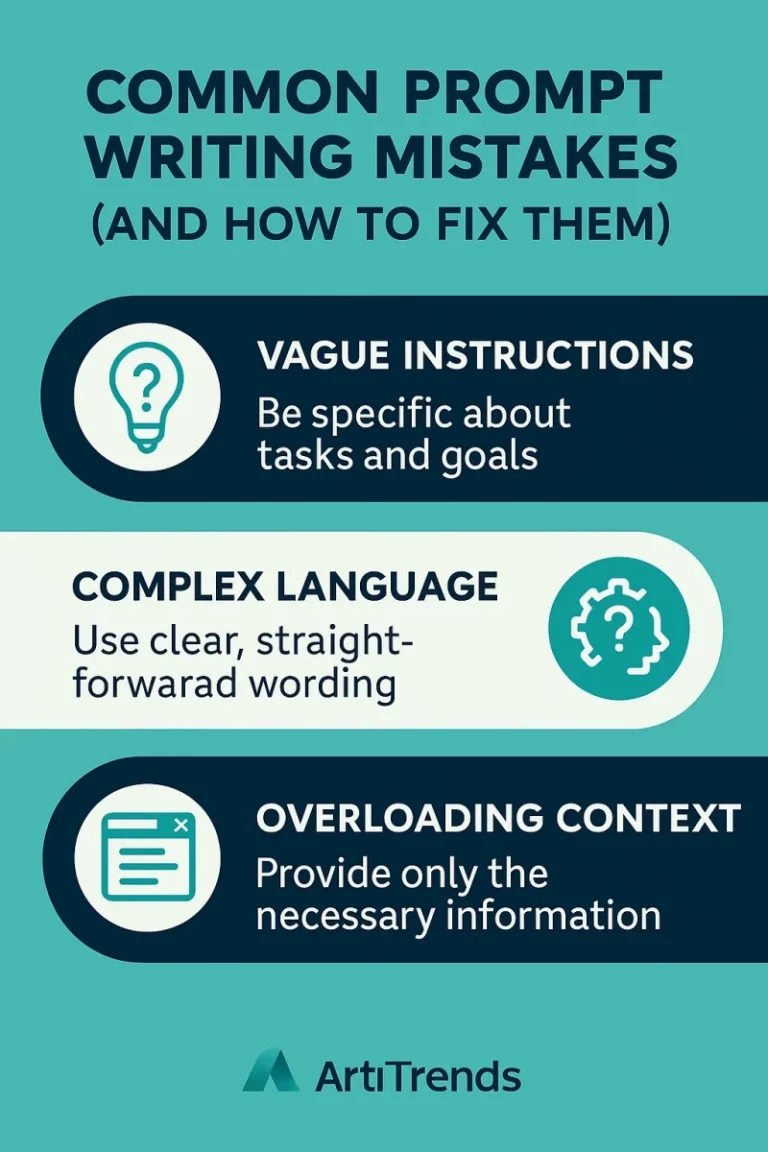
- Common Prompt Writing Mistakes (and How to Fix Them) — A diagnostic guide to identifying weak prompts and correcting structural flaws.
- Top AI Prompt Tools to Boost Productivity in 2026 — Platforms and tools that support structured prompting, testing, and iteration.