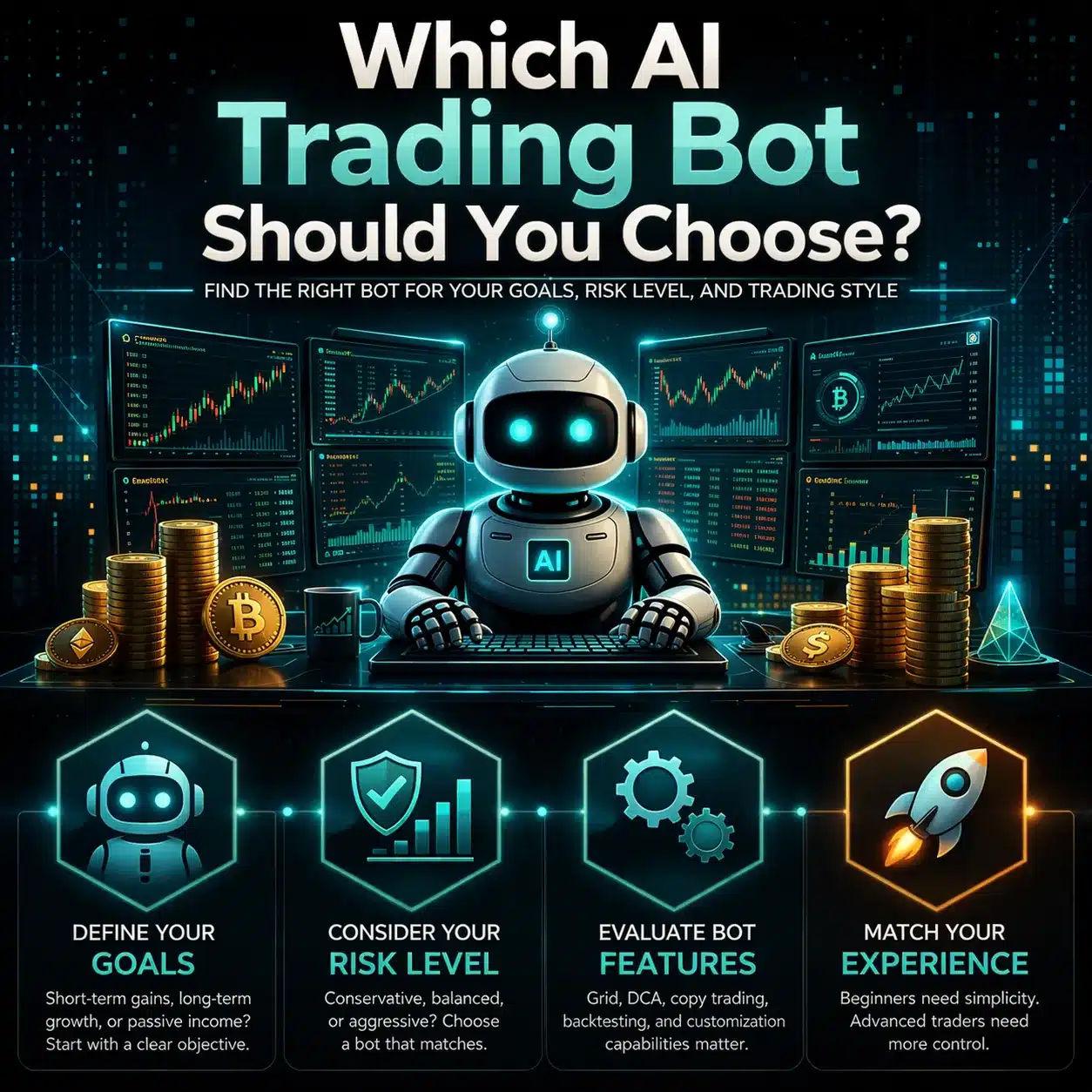
Choosing an AI trading bot in 2026 seems easier than ever. There are more platforms, more features, and more claims of “AI-powered performance.” From grid bots and DCA systems to advanced strategy builders, the options appear endless — and at first glance, increasingly similar. But that’s exactly where most traders go wrong.
They compare features, dashboards, and sometimes even past performance, but they rarely compare fit. In practice, AI trading bots do not fail because they lack intelligence — they fail because of misalignment between how a trader thinks, how a strategy behaves, and how a system executes.
This is why two traders can use the same platform and experience completely different outcomes. The difference is not the bot. It’s the structure behind the decision.
In this guide, we move away from “best bot” rankings and introduce a decision framework designed to help you choose the right AI trading bot based on your trading role, strategy type, and risk profile. If you’re new to automated trading, you may first want to explore our complete guide to AI crypto trading bots to understand how these systems are structured before making a decision.
Instead of asking “Which AI trading bot is best?”, you’ll learn how to answer the only question that actually matters: Which AI trading bot is right for you?
Why Choosing the Right AI Trading Bot Is More Complex Than It Looks
At first glance, most AI trading bots appear similar. They all promise automation, efficiency, and improved trading outcomes. But beneath the surface, these platforms operate on very different layers — and understanding those layers is what separates informed decisions from expensive mistakes.
In practice, every AI trading system consists of three core components: the strategy layer, where trading decisions are generated; the execution layer, where orders are placed and managed; and the exchange layer, where trades are ultimately executed. Each platform emphasizes these layers differently, which is why two bots with similar features can behave completely differently in real market conditions.
This is also why the idea of a single “best trading bot” is misleading. A platform that excels at strategy design may offer flexibility but weaker execution control, while an execution-focused platform may perform efficiently but limit how strategies are built. Exchange-native bots simplify the process even further, but often at the cost of customization and control.
Most comparisons fail because they focus on visible features instead of structural differences. Traders evaluate what they can see — dashboards, indicators, automation settings — but overlook how these systems actually function underneath.
Understanding this distinction is critical not only for choosing the right platform, but also for setting realistic expectations around performance and cost. For example, many traders underestimate how execution quality and trading frequency influence overall profitability, a dynamic explored in our analysis of AI trading bot fees
If you want to understand how these layers translate into real-world setups, including how strategies, risk management, and execution interact, see our crypto trading setup guide.
The Arti-Trends AI Trading Bot Decision Framework
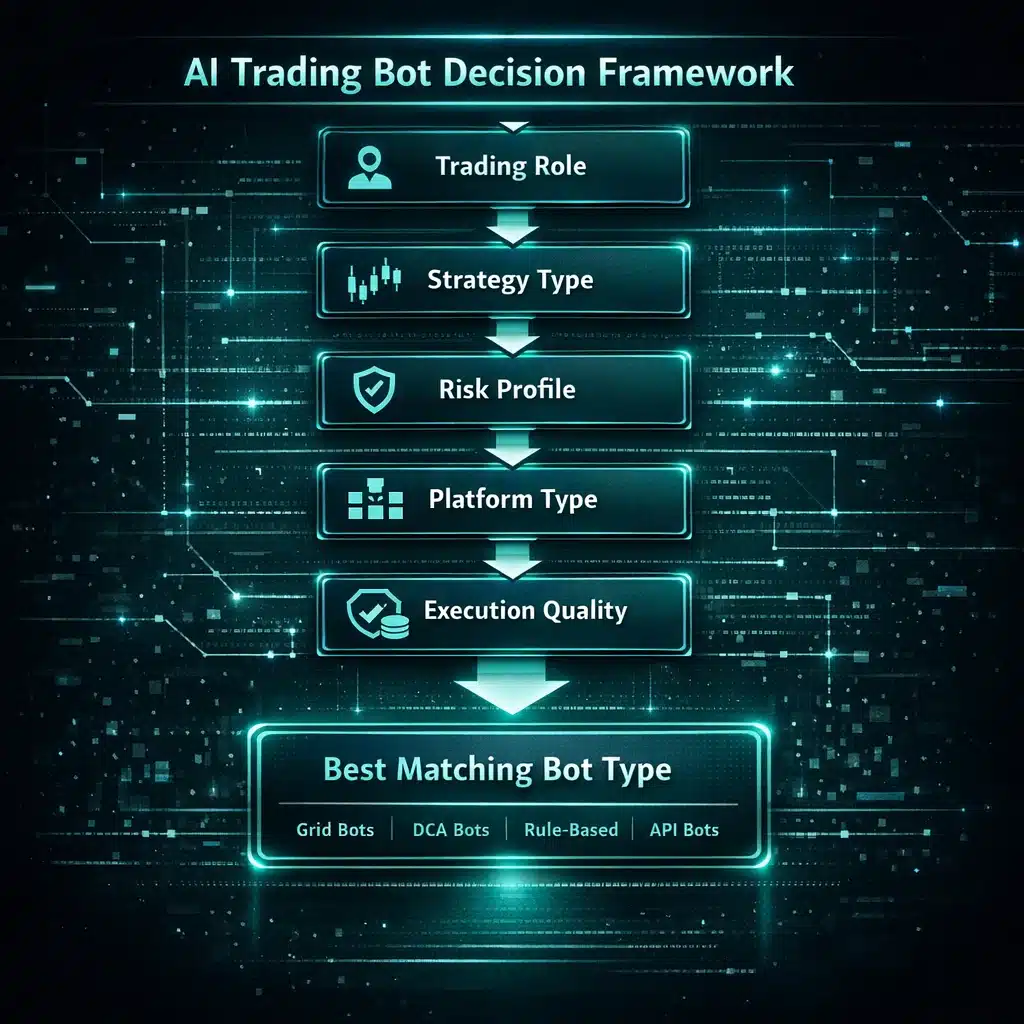
Instead of asking which AI trading bot is “best,” a more useful approach is to understand which type of system fits your trading behavior. The right choice is not determined by features or popularity, but by alignment between your role, your strategy, and the way a platform operates.
To make this practical, we break the decision process down into five steps. Each step reduces complexity and helps narrow down the type of bot that actually fits your workflow.
Step 1 — Define Your Trading Role
The first step is to identify how you interact with the market in practice, not how you intend to trade.
Some traders prefer a passive approach, where positions are managed automatically with minimal intervention. Others take a more active role, monitoring positions, adjusting parameters, and reacting to market conditions. A smaller group focuses on building and testing strategies, treating trading as a structured system rather than a set of individual decisions.
Each of these roles requires a different type of platform. Passive traders benefit from simplicity and stability, while active traders need flexibility and control. Strategy builders require tools that allow them to translate ideas into structured logic.
Choosing a bot without defining your role often leads to unnecessary complexity or lack of control.
Step 2 — Choose Your Strategy Type
Once your role is clear, the next step is understanding how the bot is expected to behave in the market. This is determined by the underlying strategy.
Some systems are designed to perform in sideways markets, capturing small price movements through grid-based execution. Others focus on gradual position building through DCA, reducing timing risk over longer periods. More advanced approaches include arbitrage strategies or systems that react to signals and indicators.
The key point is that the strategy defines the behavior of the bot — not the platform itself. A mismatch between strategy and expectations is one of the most common reasons traders become dissatisfied with automated systems.
For a detailed breakdown of how these strategies function and when they perform best, see our AI crypto trading strategies guide.
Step 3 — Understand Your Risk Tolerance
Automation does not reduce risk — it standardizes how risk is applied.
This makes it even more important to define boundaries upfront. Consider how much drawdown you are willing to accept, how capital is allocated across positions, and how the system behaves under adverse market conditions.
Many traders overestimate the safety of automated systems because they execute consistently. In reality, consistency without proper constraints can amplify losses just as efficiently as it executes gains.
If you are not clear on how risk behaves within automated trading systems, it is worth reviewing our AI crypto trading risks analysis before selecting a platform.
Step 4 — Select the Right Platform Type
With your role, strategy, and risk profile defined, the next step is selecting the type of platform that supports it.
Some bots are built directly into exchanges, offering a simplified and integrated experience. Others operate as external platforms, connecting to exchanges via API and offering more flexibility. At the highest level, developer-focused frameworks allow full customization but require technical knowledge.
Each category comes with trade-offs. Simplicity reduces friction but limits control. Flexibility increases possibilities but adds complexity. Understanding where you sit on that spectrum helps avoid choosing a system that is either too restrictive or unnecessarily complicated.
Step 5 — Match Execution Capabilities
The final step is evaluating how well a platform executes trades in practice.
Execution quality becomes critical once strategies are defined and capital is deployed. Factors such as order types, latency, slippage, and multi-exchange support determine whether a strategy performs as expected or degrades under real market conditions.
This is particularly important for higher-frequency strategies, where small inefficiencies compound over time.
At this stage, the goal is not to find the most advanced execution system, but the one that reliably supports your chosen strategy under realistic conditions.
Matching AI Trading Bots to Your Profile
Once your trading role, strategy, and risk profile are clear, the number of relevant options drops significantly. Instead of comparing dozens of platforms, you are effectively filtering for systems that match how you actually trade.
At this stage, the goal is not to find the most feature-rich platform, but the one that aligns with your workflow and reduces friction in execution. Different types of traders consistently gravitate toward different categories of bots — not because one is objectively better, but because it fits their use case.
Best AI Trading Bots for Beginners
For beginners, simplicity matters more than flexibility. The priority is to reduce complexity, avoid configuration errors, and start with structured automation that behaves predictably.
Exchange-native and user-friendly platforms such as Pionex and TradeSanta are often strong entry points. These platforms provide pre-configured strategies like grid and DCA bots, allowing users to get started without designing systems from scratch.
The trade-off is reduced customization, but for most beginners, that is an advantage rather than a limitation.
Best AI Trading Bots for Strategy Builders
Traders who want to actively design and refine their strategies need a different type of environment. Instead of plug-and-play automation, they require platforms that allow them to translate ideas into structured logic.
Tools such as Coinrule and Cryptohopper offer rule-based systems where users can combine indicators, conditions, and triggers into automated workflows.
These platforms introduce more complexity, but they also enable iteration, testing, and optimization — which are essential for traders who treat automation as a process rather than a tool.
Best AI Trading Bots for Advanced Traders
Advanced traders typically prioritize execution control, flexibility, and integration across multiple exchanges. At this level, the focus shifts from ease of use to precision.
Platforms such as 3Commas provide more advanced order management and multi-exchange capabilities, while developer-focused frameworks like Hummingbot offer full control over strategy logic and execution behavior.
These environments are not designed for simplicity — they are designed for control.
Best AI Trading Bots for Passive Income Automation
For traders who prefer a low-maintenance approach, structured automation is key. Instead of actively managing trades, the focus is on consistent exposure and long-term positioning.
DCA bots and portfolio-based systems are commonly used in this context, as they reduce the need for timing decisions and enforce disciplined capital allocation.
If you want to explore how this approach works in practice, see our portfolio trading bots guide.
Explore the Platforms Mentioned in This Guide
If you already know which type of AI trading bot fits your workflow, explore the most relevant platforms below.
Cryptohopper
Strategy BuilderBuilt for traders who want more control over strategy design and automation logic.
Bitsgap
Grid / PortfolioFocused on multi-exchange automation, structured bot deployment, and portfolio workflows.
Pionex
Beginner FriendlyA good fit for traders who want simple, exchange-integrated bot automation.
TradeSanta
Simple AutomationStraightforward bot automation for users who want less setup complexity.
Coinrule
Rule-Based AutomationWell suited for users who want to build rule-based strategies with more flexibility.
Common Mistakes When Choosing an AI Trading Bot
Even with a structured framework, many traders still make decisions based on assumptions that do not hold up in real market conditions. These mistakes rarely come from a lack of effort — they come from focusing on the wrong signals.
One of the most common mistakes is choosing a bot based on profit claims. Marketing often highlights potential returns, but those results are highly dependent on strategy, market conditions, and execution quality. Without understanding how those results are generated, performance figures can be misleading.
Another frequent issue is ignoring the full cost structure. Many traders focus only on subscription fees, while overlooking trading fees, spreads, and slippage. Over time, these costs compound and can significantly impact net performance, especially in higher-frequency strategies. This dynamic is explored in more detail in our AI trading bot fees analysis.
A third mistake is using a strategy without understanding how it behaves. Automated systems follow predefined logic. If a trader does not understand that logic, they cannot evaluate whether the system is performing correctly or simply reacting to unfavorable conditions.
Closely related to this is overtrading through automation. The ability to execute trades continuously can create the illusion of productivity, but more activity does not necessarily translate into better results. In many cases, it increases exposure to fees and volatility without improving outcomes.
Finally, many traders underestimate the importance of risk management within automated systems. Automation enforces consistency, but without proper constraints, that consistency can amplify losses just as effectively as it executes gains. If you want to understand how risk behaves in these systems, reviewing our AI crypto trading risks guide can help put these dynamics into perspective.
Decision Shortcut — Use the AI Trading Bot Selector
Even with a structured framework, choosing the right AI trading bot can still feel overwhelming. There are multiple platforms, different strategies, and subtle differences in how systems behave under real market conditions.
If you want to simplify this process, the fastest way to move forward is to use the AI Trading Bot Selector on Arti-Trends.
Instead of manually comparing platforms, the selector helps you narrow down the most relevant options based on how you actually trade. By answering a few targeted questions — such as your trading role, preferred strategy type, and level of experience — the tool filters out unnecessary complexity and highlights the platforms that best match your profile.
How to choose the right trading bot for your goals
Choose your experience level, preferred bot style, and main priority. This quick selector highlights the trading bots that best fit your setup — without forcing you to scan every platform manually.
${bot.name}
${bot.desc}
The goal is not to replace the framework, but to apply it instantly. What normally takes hours of research can be reduced to a structured shortlist in seconds.
How This Framework Fits Into the Full AI Trading System
Choosing an AI trading bot is only one part of a much larger system. While platforms and automation tools receive most of the attention, they do not operate in isolation.
In practice, trading performance is shaped by the interaction between multiple components: strategy design, risk management, execution quality, and market conditions. The bot itself simply translates these elements into consistent actions.
This is why two traders using the same platform can experience completely different outcomes. One may operate within a structured system with clear constraints and expectations, while the other relies on the tool without fully understanding how it behaves under different conditions.
Understanding this broader context is essential for making better decisions. A trading bot should not be viewed as a shortcut to performance, but as an extension of a well-defined approach.
If you want to see how these components come together in practice — from setup to execution — explore our AI crypto trading setup guide or our broader analysis of the AI crypto trading market.
Final Thoughts — The Best Bot Is the One That Fits Your System
There is no universally best AI trading bot.
The right choice depends on alignment — alignment between your strategy, your risk tolerance, and how you actually operate in the market. Platforms differ in features, flexibility, and execution quality, but those differences only matter in relation to how they are used.
Traders who focus on this alignment tend to build more stable systems over time. Those who chase features or performance claims often end up switching platforms without solving the underlying issue.
Automation can improve consistency, reduce emotional decision-making, and enforce discipline. But it does not create an edge on its own. That edge comes from structure.
Choosing the right AI trading bot is not about finding the most powerful tool. It’s about selecting the system that fits your approach — and then using it consistently.
Frequently Asked Questions
These answers address the most common questions readers have when deciding which AI trading bot fits their strategy, risk profile, and trading workflow.
Which AI trading bot should a beginner choose?
Beginners are usually best served by platforms that prioritize simplicity, structured automation, and low setup complexity. Tools such as Pionex or TradeSanta can be strong starting points because they reduce friction and make it easier to understand how automated trading behaves in practice.
What is the most important factor when choosing an AI trading bot?
The most important factor is alignment. The right bot should match your trading role, strategy type, and risk tolerance. Features matter, but they matter far less than whether the platform fits how you actually trade and what level of control you need.
Are AI trading bots profitable in 2026?
AI trading bots can be profitable, but profitability depends on strategy quality, execution efficiency, market conditions, and cost structure. Automation alone does not create an edge. For a deeper breakdown of structural costs, see AI trading bot fees.
Do I need coding skills to use an AI trading bot?
No. Many retail trading bot platforms are designed for non-technical users and offer visual builders or pre-configured strategies. However, more advanced frameworks may require coding if you want full control over strategy logic and execution behavior.
What is the difference between exchange bots and external trading bot platforms?
Exchange bots are built directly into an exchange and are usually easier to use, but they often offer less flexibility. External platforms connect through exchange APIs and typically provide broader strategy options, multi-exchange support, and more control over automation.
Is it better to use one AI trading bot or multiple bots?
That depends on your experience and system design. Multiple bots can improve diversification if they use different strategies or assets, but they also increase complexity and risk management demands. Beginners are usually better off mastering one structured system before expanding.
What are the biggest risks when choosing the wrong trading bot?
The biggest risks include strategy mismatch, poor execution fit, hidden cost drag, and weak risk controls. A bot that looks impressive on paper can still perform poorly if it does not match your use case. For a deeper breakdown, read AI crypto trading risks.
How much capital do I need to start with an AI trading bot?
The required capital depends on the platform, exchange minimums, and strategy type. Some bots can be used with relatively small amounts, but low capital often reduces flexibility and increases the relative impact of fees. Position sizing and risk control matter more than chasing a specific minimum amount.
Can one bot work for every type of trader?
No. There is no single best AI trading bot for everyone. Some platforms are better for beginners, others for strategy builders, and others for advanced traders who need execution control. This is why choosing based on fit is more useful than looking for a universal “best bot.”
How can I choose the right AI trading bot faster?
The fastest approach is to start with your role, your preferred strategy, and your level of experience rather than comparing feature lists. If you want a shortcut, use the AI Trading Bot Selector to narrow down the most relevant platforms more quickly.