
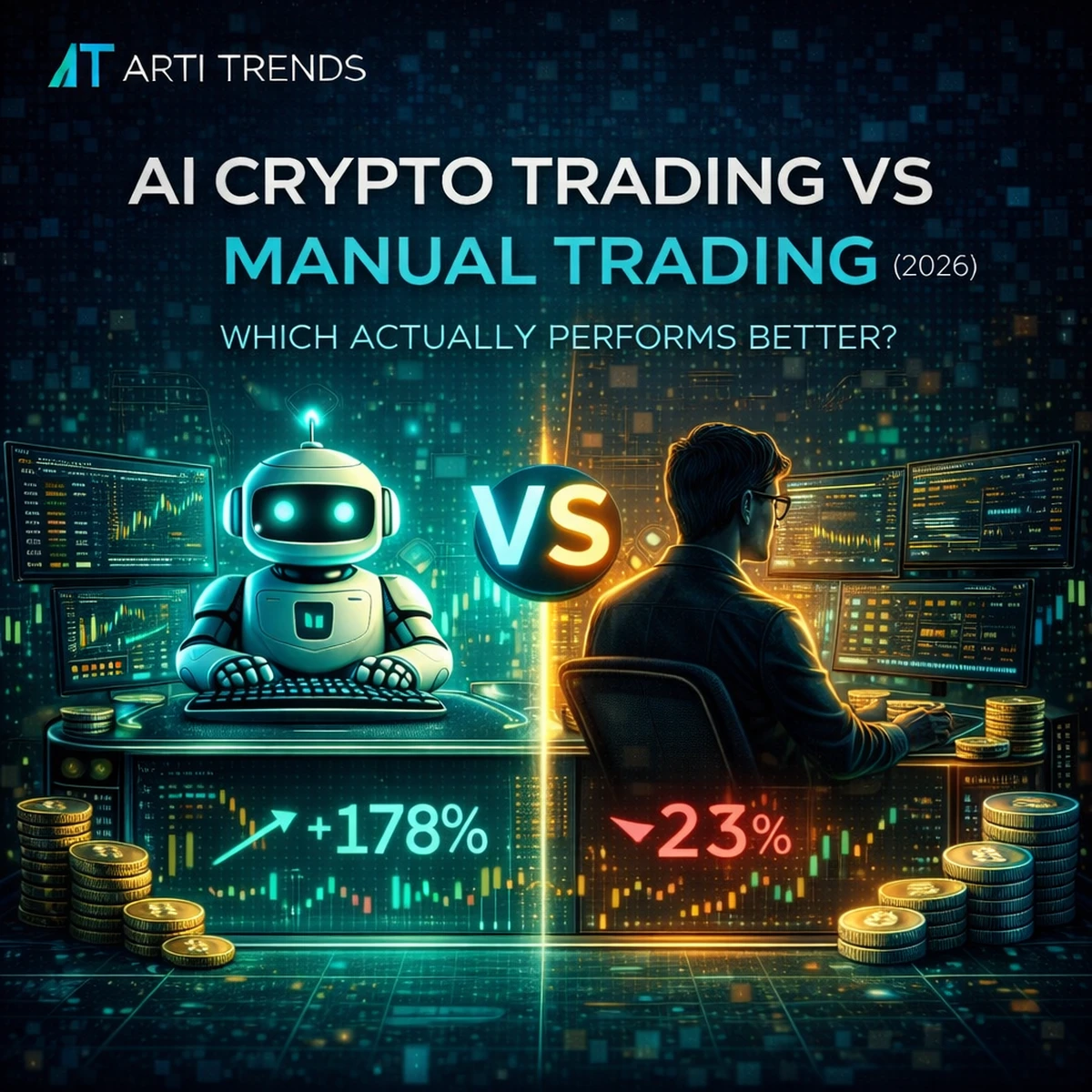
Introduction — Why This Comparison Matters
Almost every crypto trader starts the same way.
They believe that with enough:
- charts
- indicators
- news
- and experience
they can beat the market.
Some do — briefly.
But over time, most manual traders discover the same uncomfortable truth:
crypto trading is not a test of intelligence, it is a test of discipline, speed, and emotional control.
And humans are structurally bad at all three.
In 2026, crypto markets are no longer driven mainly by retail traders. They are dominated by:
- automated market makers
- algorithmic hedge funds
- AI-driven bots
- high-frequency systems
When you trade manually, you are not competing against other people — you are competing against machines that:
- react in milliseconds
- analyze thousands of signals
- and never hesitate
This is why comparing AI crypto trading with manual trading is no longer philosophical.
It is practical.
It determines:
- whether your strategy can survive
- whether your risk can be controlled
- and whether your time is being used effectively
This guide breaks down, without hype or bias, how humans and AI really perform in crypto markets — and why most serious traders now combine the two.
How Manual Crypto Trading Really Works
Manual crypto trading looks rational on the surface.
You:
- study charts
- follow the news
- wait for setups
- and click buy or sell
But under the hood, human trading is driven by a mix of limited information, emotional pressure, and slow execution.
Information Lag
By the time you see:
- a breakout
- a news headline
- or a whale move
it has already been processed by:
- algorithms
- market makers
- and AI-driven funds
Manual traders are always reacting — never leading.
Cognitive Bias
Humans are not wired for probabilistic decision-making.
We:
- chase recent winners
- hold losers too long
- fear missing out
- and avoid admitting mistakes
These biases quietly sabotage even good strategies.
Inconsistent Execution
Even disciplined traders break their own rules:
- after a losing streak
- during high volatility
- or when emotions spike
A strategy that works in theory fails in practice because humans do not execute it consistently.
Limited Scale
A person can only:
- watch a few charts
- trade a few markets
- and manage a few positions
Crypto markets run 24/7 across hundreds of assets.
Manual traders miss most of the opportunity space.
How AI Crypto Trading Actually Works
Professional AI crypto trading systems are not built as “a bot that trades.”
They are built as a three-layer trading architecture that separates strategy, intelligence, and market execution.
This structure is what allows AI systems to operate at scale while controlling risk.
Every professional-grade trading platform — from hedge-fund systems to retail AI bots — is built on this same foundation:
Strategy layer → AI decision layer → Exchange execution layer
The strategy layer defines what should be traded and under what rules.
The AI decision layer determines when and how aggressively trades should be executed.
The exchange execution layer determines whether those trades survive real-world fees, slippage, and liquidity.
When any one of these layers is weak, even a profitable strategy can collapse.
When all three are aligned, AI trading becomes a controlled, scalable financial system rather than a gambling machine.
Within this three-layer architecture, professional systems are supported by specialized data engines and independent risk engines that continuously feed and constrain the strategy.
Data & Signal Layer
AI systems continuously analyze:
- price
- volume
- volatility
- order books
- derivatives markets
- on-chain flows
Machine learning models detect patterns that indicate:
- momentum
- exhaustion
- accumulation
- distribution
Signals are only generated when multiple conditions align.
This eliminates much of the noise that overwhelms human traders.
Strategy Layer
Signals alone are meaningless without a framework.
AI applies those signals inside structured strategies such as:
- grid trading
- AI-driven DCA
- trend-following
- arbitrage
- market-making
These strategies determine:
- when to enter
- how much to risk
- when to exit
This is why AI Crypto Trading Strategies matter more than the bot itself.
Execution Layer
Once a trade is approved, AI executes:
- instantly
- at optimal prices
- with slippage and fees minimized
Humans cannot compete with this speed or precision.
Risk Layer
AI systems enforce:
- stop-losses
- position sizing
- exposure limits
- drawdown controls
These rules are never ignored.
This is one of the biggest structural advantages over manual trading.
Performance: Humans vs Algorithms
Over a single trade, a human can get lucky.
Over a thousand trades, luck disappears.
What remains is:
- consistency
- discipline
- and statistical edge
This is where AI systems dominate.
Trade Frequency
Humans can execute:
- a few trades per day
- with limited attention
AI systems execute:
- hundreds or thousands
- across multiple markets
- 24/7
This allows AI to capture many small edges that humans simply cannot access.
Reaction Speed
Markets move in milliseconds.
AI reacts in milliseconds.
Humans react in seconds.
In crypto, that difference often determines whether a trade is profitable or not.
Error Rate
Humans make mistakes:
- misclicks
- missed stops
- late entries
- emotional exits
AI does not.
It executes exactly what the strategy dictates — every time.
Compounding
Because AI trades more often, more consistently, and with tighter risk control, its small advantages compound faster.
This is why algorithmic systems dominate modern financial markets — not because they are smarter, but because they are reliable.
Risk Control Comparison
Most trading strategies fail not because they are wrong — but because risk is mismanaged.
This is where AI and humans diverge most dramatically.
Stop-Loss Discipline
Humans move stop-losses:
- when they feel uncomfortable
- when they hope price will come back
AI never does.
Once a stop is set, it is executed without hesitation.
Position Sizing
Manual traders often:
- bet too big after a win
- overtrade after a loss
AI calculates position size based on:
- volatility
- account equity
- and predefined risk limits
This prevents emotional blowups.
Drawdown Control
Humans keep trading when they should stop.
AI systems enforce:
- max drawdown rules
- auto-deleveraging
- and capital preservation modes
This is how professional systems survive market chaos.
These risk controls are exactly what we break down in AI Crypto Trading Risks & Regulation, where we show how safe platforms protect users from catastrophic losses.
Time, Effort & Scalability
Manual crypto trading is a full-time job.
AI crypto trading is a system.
That difference changes everything.
Time Investment
Manual traders must:
- watch charts
- track news
- manage positions
- and react constantly
AI systems do this automatically.
Once configured, they trade:
- 24/7
- across all markets
- without human presence
This frees up time — and removes fatigue from decision-making.
Opportunity Coverage
A human can follow:
- a handful of coins
- on one or two exchanges
AI can scan:
- hundreds of markets
- across multiple platforms
- simultaneously
This massively increases the number of profitable opportunities.
Scaling Capital
As capital grows, manual trading becomes harder.
AI scales effortlessly:
- larger positions
- more markets
- more strategies
without increasing workload.
This is why AI turns trading into an economic engine, not a stressful hobby.
When Humans Still Beat AI
AI is powerful, but it is not omniscient.
There are areas where human judgment still matters — especially in crypto.
Macro & Narrative Shifts
AI trades data.
Humans understand:
- politics
- regulation
- narratives
- technological breakthroughs
When:
- a government announces a ban
- a protocol launches a major upgrade
- or a black swan event hits
human interpretation can move faster than historical models.
Long-Term Conviction
AI optimizes for:
- probabilities
- short- to medium-term signals
Humans can hold:
- multi-year theses
- fundamental beliefs
- conviction trades
This is why some of the biggest crypto fortunes were built by people who ignored short-term noise.
Ethics, Risk & When to Stop
AI does not know when you:
- have made enough
- should reduce exposure
- or need to protect capital
Humans decide goals.
AI only executes.
Why Hybrid AI Trading Systems Win
The most successful crypto traders in 2026 are not manual traders.
They are not fully autonomous bots either.
They operate hybrid AI trading systems — where:
• Humans design the strategy
• AI executes it
• Risk systems protect it
• Exchanges provide liquidity
This structure mirrors how professional trading desks and crypto hedge funds operate.
A human decides:
which markets to trade
which strategies to run
how much risk the portfolio can take
when to shift between offense and defense
The AI then:
monitors hundreds of signals
executes thousands of orders
optimizes entry and exit timing
enforces position sizing and drawdown limits
This separation is critical.
Humans are good at:
macro thinking
narratives
regulation
long-term conviction
AI is good at:
speed
precision
consistency
emotionless execution
Together they form something neither can achieve alone:
Strategic intelligence executed with machine-level discipline
This is why modern crypto trading is no longer about “picking coins.”
It is about building a stack of strategy, automation, and execution that compounds over time.
If you want to see how these stacks are built in practice, the AI Trading Bots Hub maps the platforms and infrastructure behind professional-grade automation.
If you want to understand how strategies, risk, and execution fit together at a system level, AI Crypto Trading Bots: Complete Guide (2026) explains the full architecture.
And when you are ready to compare real platforms — including Cryptohopper, Bitsgap, 3Commas, and execution engines like Hummingbot — Best AI Crypto Trading Bots of 2026 shows which tools actually implement this hybrid model correctly.
This is the difference between trading crypto…
and operating an AI-powered trading business.
Conclusion — Why Smart Traders Use AI
Manual trading is no longer competitive in algorithm-driven crypto markets.
But blind automation is just as dangerous.
The traders who win in 2026 are not the ones who guess better —
they are the ones who operate better systems.
Modern crypto markets are shaped by:
algorithmic market makers
AI-driven liquidity engines
high-frequency execution
and automated risk controls
Trying to trade this environment manually is like racing a supercomputer with a stopwatch.
But handing money to a black-box bot is just as risky.
The winning model is hybrid:
Humans design strategy
AI executes it
Risk systems contain failure
Exchanges provide liquidity
This is how professional trading desks and crypto hedge funds operate —
and it is now accessible to individual traders through modern AI platforms.
If you are just starting, AI Crypto Trading for Beginners helps you build the right mental model before risking real capital.
To understand how strategies, execution engines, and exchanges work together as a system, AI Crypto Trading Bots: Complete Guide (2026) explains the full stack behind professional automation.
If you want to see how these systems fit into a broader automated trading ecosystem — from bots and exchanges to execution infrastructure — the AI Trading Bots Hub connects everything in one place.
And when you are ready to choose tools, compare performance, and evaluate safety, Best AI Crypto Trading Bots of 2026 shows which platforms actually implement these systems correctly — based on real execution, fees, and risk controls.
In modern crypto markets,
profit is created by strategy —
but it is protected by automation.
And the traders who survive long enough to compound…
are the ones who understand both.
Related Reading — AI Crypto Trading Ecosystem
Build Your Foundation
AI Crypto Trading for Beginners
Learn how automated crypto trading works, how risk is managed, and how to start safely with AI-powered systems.
AI Crypto Trading Strategies (2026)
Understand how grid, arbitrage, DCA, and trend-following bots actually perform in real market conditions.
AI Crypto Trading Risks & Regulation
Legal, financial, and operational risks every serious AI crypto trader must understand before scaling.
Execution & Platforms
Best AI Crypto Trading Bots of 2026
Compare Cryptohopper, Bitsgap, 3Commas, and professional execution engines based on real performance and risk controls.
Best Crypto Exchanges for AI Trading
Where AI bots actually execute trades with deep liquidity, low fees, and reliable APIs.
AI Trading Bots on HTX
How low-fee execution and high liquidity improve automated trading results.
Advanced AI Trading Systems
AI Crypto Arbitrage Bots
How AI systems exploit price differences across exchanges in real time.
AI Futures Trading Bots
Using AI to trade leverage, trends, and perpetual contracts safely.
AI Portfolio Trading Bots
Long-term, automated crypto portfolio construction and risk-balanced asset allocation.