
Disclosure:
We may earn a commission if you sign up through links on this page, at no extra cost to you. All opinions are independent and based on our editorial evaluation framework.
Introduction — Why HTX Is One of the Most Bot-Friendly Crypto Exchanges
Most AI trading bots live or die by one thing: how cheaply and how reliably they can trade.
That is exactly where HTX (formerly Huobi) stands out.
While many exchanges focus on flashy interfaces and retail features, HTX has quietly become one of the preferred venues for algorithmic traders, arbitrage bots, futures systems, and high-frequency AI strategies.
The reason is not hype.
It is infrastructure.
HTX offers some of the lowest trading fees in the industry, deep liquidity across spot and futures markets, and fast, stable APIs built for automation.
For AI bots that may execute hundreds or thousands of trades per week, these three factors determine whether a strategy is profitable or slowly bled to death by fees and slippage.
This is why many professional bot operators route a significant part of their trading volume through HTX — even when they use other exchanges for backup or diversification.
If you want to explore HTX as a bot-friendly trading venue, you can create an HTX account here.
In this guide, you will learn why HTX is particularly attractive for AI trading bots, which bots work best on HTX, how fees and liquidity affect bot performance, and how to connect your own AI trading system safely.
Whether you are running a grid bot, a futures strategy, or an arbitrage engine, understanding how HTX fits into the AI trading ecosystem can materially improve your results.
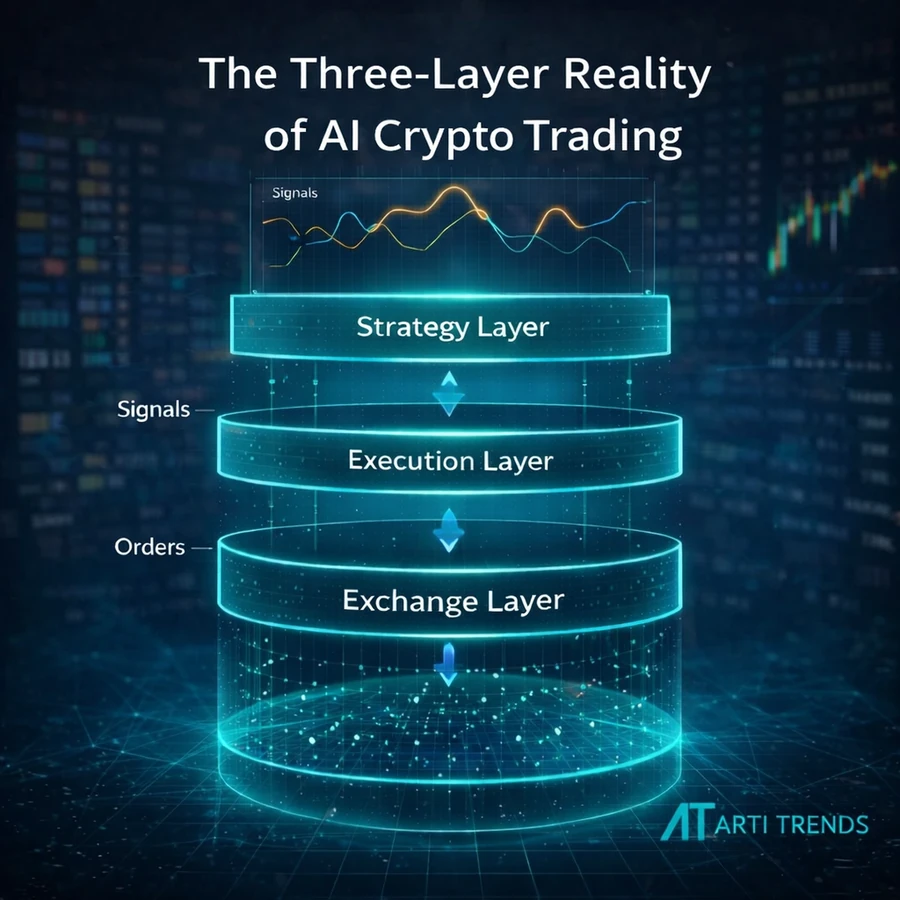
The Three-Layer Reality of AI Crypto Trading
Most retail traders think AI trading bots are about strategy alone.
Professional traders know this is false.
Every AI crypto trading system operates across three distinct layers:
Strategy Layer — where trading logic, signals, and risk rules are defined.
Execution Layer — where orders are routed, optimized, and filled in real markets.
Exchange Layer — where liquidity, fees, APIs, and market structure ultimately decide performance.
HTX excels specifically at the exchange and execution layers, which is why it has become a preferred venue for professional-grade AI trading bots.
Understanding this layered reality explains why the same bot can be profitable on one exchange — and fail on another.
What Makes HTX Ideal for AI Trading Bots
HTX was not designed for casual traders.
It was built for volume.
And volume is exactly what AI trading bots produce.
These are the four structural reasons why HTX has become one of the most bot-friendly exchanges in the crypto market.
Ultra-Low Trading Fees
AI bots trade frequently.
Some strategies execute dozens or even hundreds of trades per day.
HTX offers:
- extremely competitive maker and taker fees
- volume-based discounts
- futures fee tiers that reward high-frequency trading
For grid bots, arbitrage systems, and futures strategies, this means:
more of every small edge stays in your account instead of being paid to the exchange.
Over thousands of trades, this fee advantage alone can be the difference between profit and loss.
If you plan to run high-frequency bots, you can open an HTX account with low trading fees here.
Deep Liquidity Across Spot & Futures
HTX maintains large order books in:
- major crypto pairs
- stablecoins
- and derivatives markets
This allows AI bots to:
- enter and exit positions cleanly
- avoid excessive slippage
- and scale positions without disturbing the market
Liquidity is especially important for:
- arbitrage
- futures bots
- and market-making strategies
Fast and Reliable APIs
AI trading bots interact with HTX through its APIs.
HTX provides:
- high rate limits
- low latency
- and stable data feeds
This allows bots to:
- react quickly to market changes
- place and cancel orders efficiently
- and manage risk in real time
Slow APIs break strategies.
HTX’s infrastructure supports them.
High Tolerance for Automated Trading
Some exchanges quietly restrict or throttle bot activity.
HTX does not.
It is designed to support:
- algorithmic traders
- automated strategies
- and high-volume systems
This makes it a natural home for professional-grade AI trading bots.
Which AI Trading Bots Work Best on HTX
HTX is powerful — but it only becomes a real money-making machine when paired with the right trading bot.
Not every platform is designed for:
- low-fee, high-volume environments
- futures trading
- or deep order-book strategies
These AI trading platforms are particularly well-suited for HTX.
Cryptohopper
Cryptohopper is one of the most widely used AI trading platforms in the crypto market.
On HTX it performs especially well because it supports both futures and spot trading, integrates cleanly with HTX’s API, and offers advanced signal-based and strategy-driven automation.
It is especially effective for:
- trend-following strategies
- portfolio rebalancing bots
- and semi-automated AI trading
For a full breakdown of features, performance, and pricing, see Cryptohopper Review (2026).
If you want to use Cryptohopper with HTX, you can connect Cryptohopper to HTX here.
Bitsgap
Bitsgap is known for its powerful grid trading engine, built-in arbitrage tools, and multi-exchange routing.
HTX’s low fees and deep liquidity make it an ideal environment for Bitsgap’s high-frequency grid and arbitrage strategies, where small price movements can be turned into consistent cash-flow.
This combination is popular among:
- traders who want steady income from volatility
- and AI-driven range-trading systems
More details are covered in Bitsgap Review (2026).
You can run Bitsgap bots on HTX here.
3Commas
3Commas is widely used for futures bots, smart DCA strategies, and risk-managed automation.
HTX’s futures infrastructure allows 3Commas bots to:
- scale positions
- hedge exposure
- and execute quickly during volatile markets
This makes it a strong match for more aggressive AI traders who use leverage and dynamic position sizing.
See 3Commas Review (2026) for a full comparison.
You can connect 3Commas to HTX here.
Hummingbot
Hummingbot is a professional-grade, open-source trading bot used for market-making, arbitrage, and liquidity provision.
HTX’s fast APIs and favorable fee structure make it one of the best exchanges for running Hummingbot strategies at scale, especially for traders who want full control over their algorithms.
See Hummingbot Review (2026) for advanced setups.
You can deploy Hummingbot on HTX here.
HTX Trading Fees Explained
For AI trading bots, fees are not a detail.
They are a core performance variable.
Because bots trade so frequently, even small differences in fees compound into large differences in profit over time.
Maker vs Taker Fees
HTX charges different fees depending on how your orders interact with the market.
- Maker orders add liquidity to the order book
- Taker orders remove liquidity
Grid bots, market-making bots, and many AI strategies place mostly maker orders — which means they often pay significantly lower fees.
This is one of the main reasons why professional traders choose HTX.
Volume-Based Fee Tiers
HTX rewards high-volume traders.
As your AI bot generates more trades:
- your fee tier improves
- your maker and taker fees drop
- your net returns increase
This creates a powerful feedback loop:
more volume → lower fees → higher profit → more volume
If you plan to run high-frequency bots, you can open an HTX account with low trading fees here.
Futures Fees & Funding
For futures trading, HTX offers:
- competitive trading fees
- transparent funding rates
- and stable liquidation mechanics
This makes it particularly suitable for:
- trend-following bots
- hedging systems
- and leveraged AI strategies
Why Fees Decide Whether a Bot Wins or Loses
A grid bot that earns 0.2% per cycle will fail if it pays 0.1% in fees.
On HTX, that same strategy can remain profitable because of its low-cost execution.
To see how HTX compares to other platforms, the AI Trading Bot Fees Comparison page breaks this down in detail.
HTX for Futures, Grid & Arbitrage Bots
HTX is not a generic crypto exchange.
Its fee structure, liquidity, and API performance make it especially strong for active AI trading strategies — the kind that rely on speed, frequent execution, and low transaction costs.
Because these strategies depend so heavily on execution quality, most traders running them choose HTX as their primary venue. You can start trading these strategies on HTX here.
Grid Trading
Grid bots depend on:
- many small limit orders
- tight spreads
- and low maker fees
HTX provides all three.
Its deep spot liquidity and competitive maker pricing allow grid bots to continuously buy low and sell high without losing their edge to transaction costs. This is why HTX is one of the most popular venues for AI-driven grid trading.
Learn how these systems work in AI Crypto Trading Strategies.
Futures & Trend-Following Bots
HTX offers liquid perpetual futures, stable funding rates, and fast execution during volatile markets.
This makes it well suited for:
- momentum-based AI systems
- breakout strategies
- and risk-managed leverage
Trend-following bots benefit from HTX’s ability to handle fast price movements without choking on execution. The mechanics behind these systems are explained in AI Crypto Trading Strategies.
Arbitrage & Market-Making
Arbitrage and market-making bots live on tiny price differences.
HTX’s:
- multi-market liquidity
- fast APIs
- and low fees
allow these strategies to operate profitably even when margins are thin. This is why many professional arbitrage bots include HTX as a core exchange in their routing.
Advanced setups are covered in AI Crypto Arbitrage Bots.
Risks, Regulation & Availability
HTX is a global crypto exchange — and that brings both opportunity and responsibility.
While it is widely used by professional traders and AI bot operators, availability and regulation vary by region.
Understanding this is essential before connecting any automated system.
Global Availability
HTX operates through international entities and serves users in many countries.
However:
- some regions restrict derivatives
- some limit automated trading
- and some require additional verification
Always verify what products are available in your jurisdiction.
European Users
For traders in the European Union:
- futures and leveraged products may be restricted
- certain features may not be officially offered
- access may require using international entities
This does not make HTX illegal — but it does mean users are responsible for local compliance.
Many European traders use HTX for:
- spot trading
- API-based bots
- or through compliant structures
Risk Management Matters More on Global Exchanges
When trading on offshore exchanges:
- counterparty risk
- regulatory risk
- and platform risk
become more important.
This is why professional traders:
- limit exposure per exchange
- withdraw profits regularly
- and use strict API permissions
For a deeper breakdown, see AI Crypto Trading Risks & Regulation.
How to Connect a Trading Bot to HTX
Connecting an AI trading bot to HTX is straightforward — but doing it securely is critical.
A correct setup ensures:
- your bot can trade
- your funds remain safe
- and you stay in control
Here is the professional way to do it.
Step 1 — Create and Secure Your HTX Account
First, create your HTX account here.
Before connecting any bot:
- enable two-factor authentication
- complete identity verification if required
- and secure your login
Never connect automation to an unsecured account.
Step 2 — Generate API Keys
Inside your HTX account:
- create a new API key
- enable trading permissions only
- disable withdrawals
- and use IP whitelisting if available
This ensures that even if a bot or platform is compromised, your funds cannot be withdrawn.
Step 3 — Connect to Your Trading Bot
Enter the API key into:
- Cryptohopper
- Bitsgap
- 3Commas
- or Hummingbot
Make sure:
- the correct market (spot or futures) is selected
- and permissions are verified
Step 4 — Choose Strategy & Risk Limits
Before going live:
- select your strategy
- set position size limits
- configure stop-loss rules
- and define maximum drawdown
Never let a bot trade without hard risk controls.
Step 5 — Start Small and Monitor
Run the bot with:
- small capital
- real trades
- and close monitoring
Once performance and stability are confirmed, you can scale up.
Why This Matters
Most bot failures come not from bad strategies — but from:
- bad API setup
- missing risk limits
- or poor exchange configuration
Doing this correctly is what turns HTX into a safe and powerful AI trading platform.
Conclusion — Why HTX Is One of the Best Exchanges for AI Trading Bots
HTX’s position among professional AI traders is not accidental.
In automated crypto markets, performance is determined long before a strategy ever places its first trade. It depends on how efficiently signals are executed, how reliably orders are filled, and how much friction is introduced by fees, liquidity, and infrastructure.
HTX consistently performs well across these critical dimensions.
Its low and predictable fee structure allows high-frequency strategies to operate without being eroded by transaction costs. Deep spot and futures liquidity supports clean entries, exits, and position scaling. Fast and stable APIs enable execution systems to react to market changes without delay or instability. Combined, these factors create an environment where automated strategies can function as intended in real market conditions.
For grid bots, futures strategies, arbitrage engines, and market-making systems, this execution quality is what allows small statistical edges to compound over time instead of being lost to slippage, latency, or fees.
For global traders, HTX remains one of the most cost-efficient venues for running high-volume AI trading systems. For European traders, HTX can still be used effectively for spot trading and API-based automation, provided that local regulatory requirements are respected and strict risk controls are applied.
If you are ready to run AI trading bots on an exchange where execution quality and infrastructure are treated as core performance variables, you can start trading on HTX here.
To see which platforms are best suited to take advantage of this environment, the Best AI Crypto Trading Bots of 2026 guide compares the tools that can fully exploit HTX’s fee structure and execution performance.
And to understand how HTX fits into the broader landscape of automated crypto trading, the AI Trading Bots Hub maps the exchanges, bots, and strategies that power modern AI-driven markets.
In algorithmic trading, strategy is only the starting point.
Execution and infrastructure are what turn code into profit.
Related reading
If you want to explore how AI trading bots, strategies, and exchanges work together in real market conditions, these guides place HTX within the broader AI crypto trading ecosystem:
- AI Crypto Trading Bots: Complete Guide — How AI trading bots are designed, how they execute strategies, and why exchange infrastructure plays a decisive role.
- AI Crypto Trading Strategies — How grid trading, arbitrage, trend-following, and market-making strategies depend on execution quality and fees.
- Best AI Crypto Trading Bots of 2026 — Which AI trading platforms are best suited for low-fee, high-liquidity exchanges like HTX.
- Best Crypto Exchanges for AI Trading — How exchanges compare in terms of fees, liquidity, APIs, and automation support.
- AI Crypto Trading Risks & Regulation — The operational, regulatory, and counterparty risks to consider when running AI trading bots on global exchanges.