
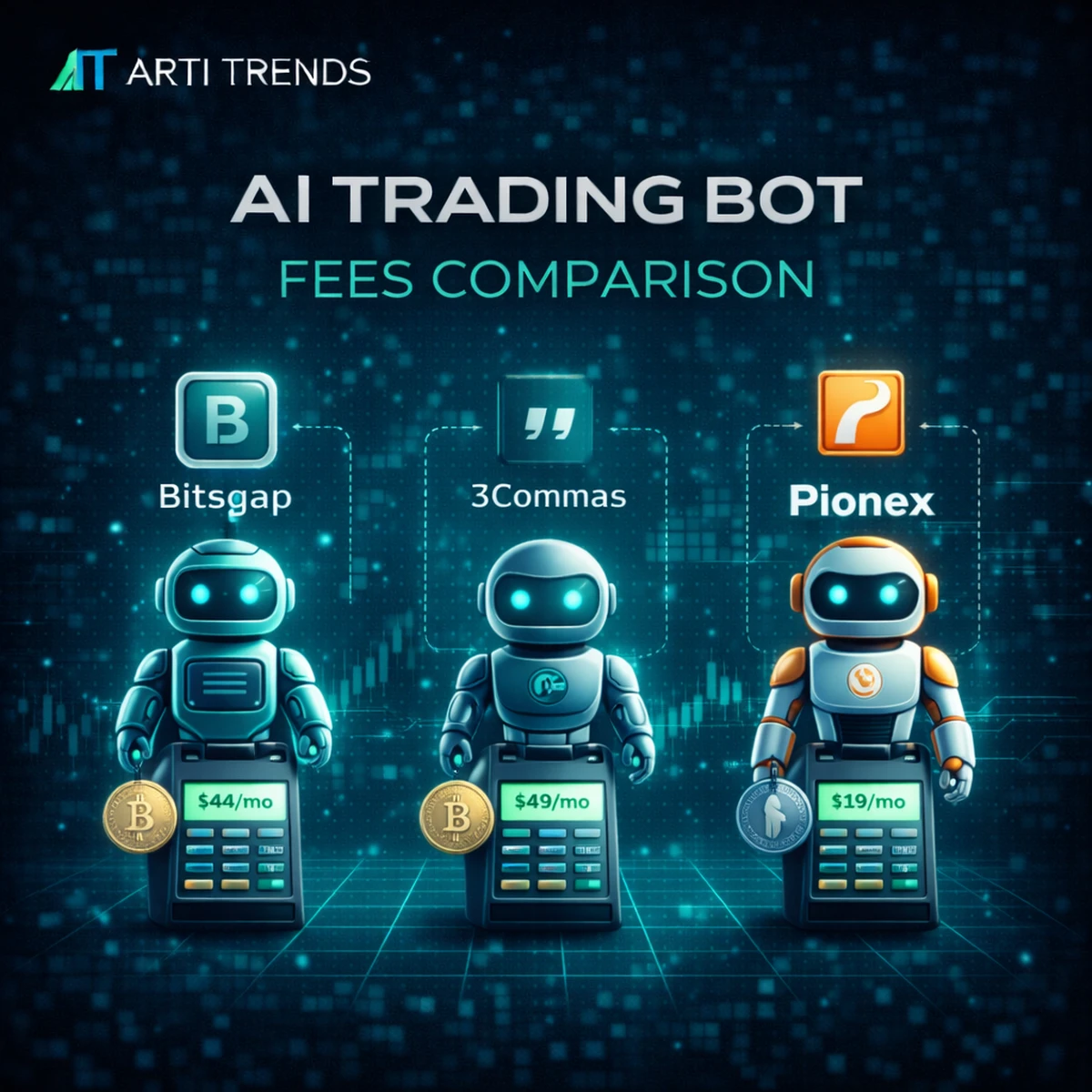
Introduction — Why Fees Decide Who Wins in AI Trading
Most people think AI trading is about finding the best algorithm.
It isn’t.
In modern crypto markets, the difference between profitable and unprofitable AI trading systems is almost never prediction accuracy. It is cost structure.
Every AI trading bot — whether it runs arbitrage, market making, trend following, or portfolio rebalancing — operates inside a dense network of fees. Exchange trading costs, platform subscriptions, execution slippage, funding rates, and infrastructure expenses quietly compound in the background of every trade.
Individually, these costs look insignificant.
At scale, they decide everything.
A strategy that generates a consistent edge of 0.2% per trade will fail if total fees consume 0.15%. The same strategy becomes profitable if costs are reduced by just a few basis points. This is why professional traders do not compete on signal quality alone. They compete on efficiency.
Most “AI trading bot fee comparisons” focus on monthly subscription prices or headline commission rates. That approach is fundamentally flawed. Fees are not a static number — they are a system. And that system behaves very differently depending on strategy type, trade frequency, exchange selection, and execution quality.
This is not a pricing table. It is a framework to evaluate what you actually pay
In 2026, crypto markets are dominated by automated trading systems executing thousands of orders per day across fragmented exchanges. In this environment, small inefficiencies are amplified. Bots that appear profitable on paper fail in real markets because their fee structure silently erodes every edge.
This article breaks down AI trading bot fees the way professionals actually analyze them — not as a price list, but as a performance variable. You will learn where costs really originate, which fees matter for different strategies, and why the cheapest bot is often the most expensive choice in the long run.
Fees are not a side detail of AI trading.
They are the foundation on which every profitable system is built.
The 4 Fee Layers Every AI Trading Bot Has
This analysis focuses on structural costs and execution dynamics rather than short-term performance claims or promotional pricing comparisons.
When traders talk about “bot fees,” they usually refer to a single number: a monthly subscription or a small percentage per trade.
That number is almost never the full picture.
In reality, every AI trading bot operates across four distinct fee layers that interact with each other. Ignoring even one of them leads to distorted profitability expectations.
1. Bot Platform Fees
This is the most visible cost layer — and the one most comparisons stop at.
Typical platform-related fees include:
- monthly or annual subscriptions
- tiered pricing based on features or bot count
- performance or profit-sharing fees
- paid strategy marketplaces or signal access
These costs are easy to compare, which is why marketing pages emphasize them. But visibility does not equal importance. Platform fees are often fixed, while trading-related costs scale with activity.
For low-frequency strategies, platform fees may dominate.
For high-frequency systems, they become almost irrelevant.
2. Exchange Trading Fees
Every order an AI bot places interacts directly with an exchange’s fee structure.
This includes:
- maker vs. taker fees
- volume-based fee tiers
- VIP or rebate programs
- fee differences across trading pairs
These costs compound rapidly. A bot executing hundreds or thousands of trades per day will feel even small differences in basis points. A strategy that looks profitable under standard fee assumptions can collapse when real exchange fees are applied.
Exchange fees are not a constant — they are a variable tied to behavior.
3. Execution & Slippage Costs
This is where most fee comparisons completely fail.
Execution costs are not listed on pricing pages, but they directly affect outcomes:
- latency between signal and order placement
- partial fills and order book depth
- market impact from order size
- inefficient order routing
Two bots paying the same exchange fees can produce very different results if one executes more efficiently than the other. Slippage silently taxes every trade, especially in volatile or thin markets.
These costs do not appear as a line item — they appear as underperformance.
4. Hidden Infrastructure Costs
Finally, there are costs that sit outside both the bot platform and the exchange.
Examples include:
- API rate limits that force suboptimal execution
- cloud hosting or server infrastructure
- withdrawal, funding, and settlement fees
- operational overhead from multi-exchange setups
Individually, these expenses seem minor. Together, they determine whether a strategy can scale beyond small account sizes.
How These Fees Map to the AI Trading System Stack
To understand why fee optimization is so often misunderstood, it helps to look at where costs actually emerge inside an AI trading system.
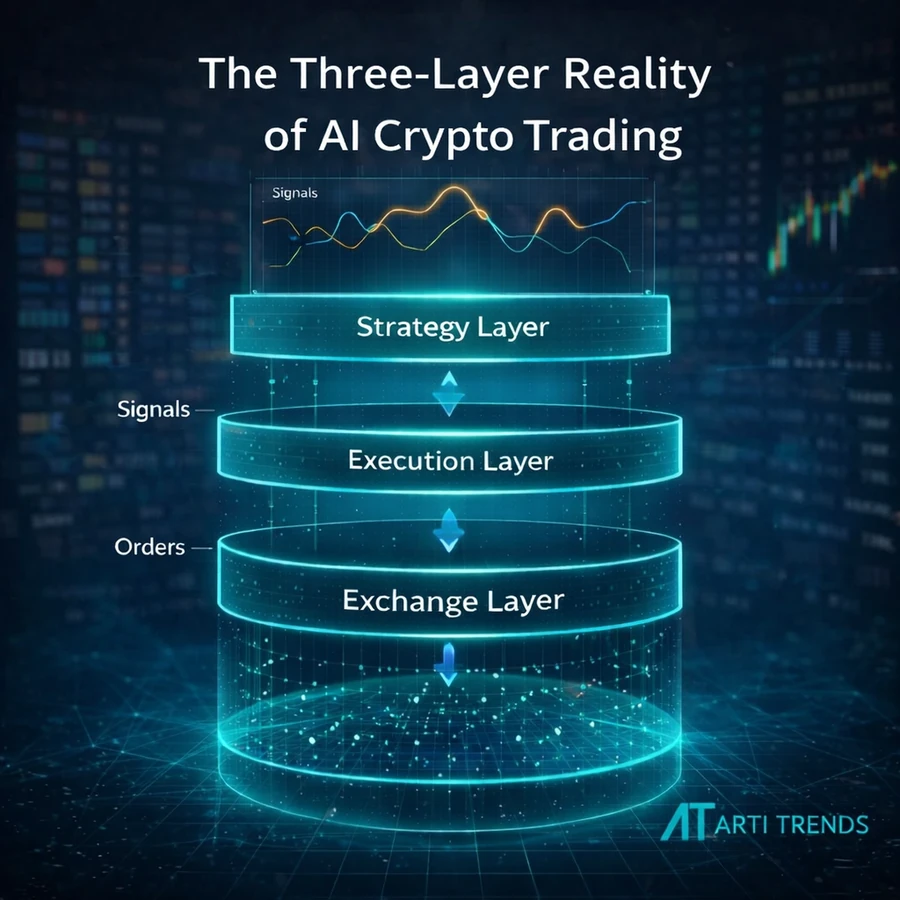
The Strategy Layer
This is where most retail traders focus their attention.
- platform subscriptions
- strategy or signal fees
- bot configuration limits
These costs are predictable and easy to control — but they are rarely decisive for performance.
The Execution Layer
This is where profitability is won or lost.
- exchange trading fees
- slippage and spread capture
- latency and order routing efficiency
Small inefficiencies here compound rapidly, especially for automated systems.
The Exchange Layer
This layer defines the economic environment.
- fee tiers and rebates
- funding rates and financing costs
- withdrawal and settlement friction
These factors determine whether a strategy remains viable as volume increases.
Most traders optimize only the strategy layer because it is visible and familiar.
Professional traders design systems that account for all three layers simultaneously.
This difference explains why two bots running the same strategy can produce dramatically different results — and why fee comparisons that ignore system structure consistently mislead.
Traders who want to understand how these fee layers fit into the full architecture of modern AI trading systems can explore the AI Crypto Trading Bots: Complete Guide (2026), which breaks down strategy design, execution infrastructure, and exchange mechanics in detail.
For the full system map across strategy, execution, and exchange layers, see the AI Trading Bots Hub.
Strategy-Dependent Fee Impact: Why the Same Fees Mean Different Outcomes
Not all AI trading strategies interact with fees in the same way.
This is where most traders — and most comparison sites — go wrong. They assume that a “low-fee bot” is universally better. In reality, the importance of each fee layer depends entirely on the strategy being deployed.
A fee structure that works well for one strategy can quietly destroy another.
Arbitrage Bots: Fees Are the Strategy
Arbitrage strategies operate on extremely small price differences across exchanges or trading pairs.
Typical characteristics:
- very high trade frequency
- thin profit margins per trade
- reliance on speed and execution precision
In this context, fees are not a secondary consideration — they are the strategy.
Even a small increase in:
- taker fees
- slippage
- latency
can eliminate the entire arbitrage window. Platform subscription costs are usually irrelevant compared to execution and exchange-layer costs.
For arbitrage systems, the critical fee layers are:
- Execution Layer
- Exchange Layer
A bot with perfect logic but inefficient execution will fail regardless of how “cheap” the platform appears.
Market Making Bots: Rebates Decide Survivability
Market making strategies aim to profit from the bid-ask spread rather than directional price moves.
Key characteristics:
- continuous order placement
- exposure to inventory risk
- sensitivity to spread width and fill quality
Here, the fee structure becomes asymmetric. Maker rebates, fee tiers, and exchange incentives play a central role. A market maker that pays taker fees will almost never be profitable at scale.
For market making systems, the most important cost drivers are:
- maker vs. taker fee differences
- rebate programs
- execution efficiency under partial fills
Platform fees matter, but only after the exchange-level economics are favorable.
Trend & Signal Bots: Platform Fees Matter More
Trend-following and signal-based bots typically trade less frequently.
Common traits:
- lower trade count
- larger average position sizes
- longer holding periods
Because trading activity is limited, exchange fees and slippage have a smaller cumulative impact. In this scenario, platform pricing and subscription models become more relevant.
For these strategies:
- fixed platform costs weigh heavier
- performance fees can significantly reduce net returns
- execution inefficiencies are less frequent but still relevant during volatile periods
A bot that looks inexpensive per trade can still be costly if it charges aggressive profit sharing.
Portfolio & Rebalancing Bots: Frequency Is the Hidden Cost
Portfolio automation strategies rebalance positions based on predefined rules.
Key risks:
- over-frequent rebalancing
- unnecessary trades during low volatility
- fee accumulation through churn
Here, the danger is not a single large fee, but constant small ones. Systems that rebalance too often slowly bleed capital through repeated trading costs.
For these bots, traders must evaluate:
- rebalancing thresholds
- fee sensitivity per rebalance
- exchange fee tiers relative to portfolio size
The impact of fees becomes even clearer when viewed through specific trading approaches, which is explored further in AI Crypto Trading Strategies (2026), covering how different algorithms interact with market structure and cost dynamics.
Why “Cheapest Bot” Is the Wrong Question
Once fees are evaluated through a strategy lens, a critical insight emerges:
There is no universally cheapest AI trading bot.
There are only:
- fee structures aligned with specific strategies
- fee structures that quietly undermine them
Any comparison that does not account for strategy behavior will produce misleading conclusions — even if the numbers appear precise.
Traders new to automated crypto markets may benefit from starting with AI Crypto Trading for Beginners, which introduces the core concepts before diving into advanced cost and execution analysis.
Real-World Fee Comparison: Fees in Context, Not on a Price List
Looking at fees in isolation creates false certainty.
What actually matters is how fees behave inside a real trading scenario. The same bot, running the same strategy, can produce very different results depending on how its fee structure interacts with trading frequency, execution quality, and exchange selection.
Below are scenario-based comparisons that reflect how AI trading systems operate in practice.
Scenario 1: High-Frequency Arbitrage System
Profile
- hundreds to thousands of trades per day
- thin spreads
- multiple exchanges
Primary cost drivers
- taker fees
- latency-induced slippage
- withdrawal and settlement costs
What matters most
- execution efficiency
- exchange fee tiers
- order routing precision
In this scenario, a higher monthly platform fee is irrelevant if the system reduces execution costs by a few basis points. Conversely, a “free” bot with poor execution can be unprofitable even when arbitrage opportunities exist.
Scenario 2: Market Making on a Single Exchange
Profile
- continuous limit orders
- inventory management
- spread capture
Primary cost drivers
- maker rebates
- partial fill efficiency
- inventory rebalancing costs
What matters most
- exchange incentive structure
- maker-only execution
- fee tier progression
Here, the exchange layer dominates. Bots that fail to optimize maker fees or accidentally cross the spread will consistently lose, regardless of how advanced their strategy logic appears.
Scenario 3: Trend-Following or Signal-Based Trading
Profile
- lower trade frequency
- directional exposure
- longer holding periods
Primary cost drivers
- platform subscriptions
- performance fees
- occasional slippage during volatility
What matters most
- pricing transparency
- profit-sharing structures
- capital efficiency
In this setup, fixed costs matter more than execution micro-optimizations. A bot with low trading fees but aggressive performance cuts can underperform a slightly more expensive platform with cleaner pricing.
Scenario 4: Portfolio Rebalancing Automation
Profile
- periodic rebalancing
- multi-asset exposure
- long-term orientation
Primary cost drivers
- cumulative exchange fees
- rebalancing frequency
- unnecessary churn
What matters most
- configurable thresholds
- trade suppression logic
- exchange fee scaling
The risk here is not dramatic loss — it is slow, persistent capital erosion. Systems that rebalance too aggressively generate fees without adding return.
The Professional Takeaway
When professionals compare AI trading bot fees, they do not ask:
“Which bot is cheapest?”
They ask:
- Where do fees compound in this strategy?
- Which layer dominates cost at scale?
- Which costs grow with volume — and which remain fixed?
Without this context, fee comparisons become marketing tables rather than decision tools.
Fee Optimization: How Professionals Reduce Costs
Professional traders treat fee reduction as a continuous process, not a one-time comparison.
Common optimization techniques include:
- prioritizing maker-only execution where possible
- selecting exchanges with favorable fee tier progression
- reducing unnecessary trade frequency
- aligning infrastructure with latency requirements
- avoiding opaque performance-fee models
The goal is not to eliminate fees — that is impossible.
The goal is to ensure fees remain structurally smaller than the strategy’s edge.
Actual costs vary by exchange fee tier, liquidity conditions, order size, and market volatility, which is why fee optimization must be evaluated under live trading conditions.
Many fee-related failures only become visible under real market conditions, a dynamic discussed further in AI Crypto Trading Risks, where execution, liquidity, and operational risks are analyzed in depth.
What to Look for When Comparing AI Trading Bot Fees
Comparing AI trading bot fees effectively requires more than checking a pricing page.
A meaningful evaluation focuses on structure, alignment, and scalability. The following criteria reflect how professional traders assess cost efficiency before deploying capital.
Fee Transparency
A serious platform clearly separates:
- platform fees
- exchange trading costs
- performance or profit-sharing models
If total costs are difficult to reconstruct before trading begins, risk is being transferred to the user.
Strategy Alignment
Fees should scale logically with strategy behavior.
- high-frequency systems require ultra-low execution costs
- low-frequency strategies must justify fixed platform fees
- portfolio bots should minimize unnecessary churn
A misaligned pricing model can quietly erase an otherwise sound strategy.
Execution Control
Fee efficiency is inseparable from execution quality.
Look for:
- maker/taker control
- order type flexibility
- latency awareness
- safeguards against overtrading
Without execution control, theoretical fee advantages disappear in live markets.
Exchange Flexibility
Costs are dictated as much by the exchange as by the bot.
Evaluate:
- supported exchanges and fee tiers
- rebate and incentive structures
- withdrawal and funding friction
Platforms locked into unfavorable exchanges impose structural disadvantages.
Scalability Behavior
A fee structure that works at small size must still work at scale.
Ask:
- do fees improve with volume?
- do infrastructure limits appear as capital grows?
- does performance degrade as order size increases?
Scalability is where many retail-optimized bots fail.
Conclusion — Fees Are the Strategy Beneath the Strategy
AI trading bots rarely fail because their algorithms are wrong.
They fail because their cost structure is misaligned with the system they operate in.
In automated crypto markets, every strategy competes inside a layered environment shaped by fees, execution quality, and exchange economics. When those layers are not understood — or when costs are evaluated in isolation — even mathematically sound strategies collapse under real-world conditions. What looks profitable in theory erodes silently through slippage, fee compounding, and structural inefficiencies.
This is why professional traders treat fee analysis as a core part of strategy design, not as a pricing detail. They analyze where costs originate, how they compound across the trading stack, and which layer ultimately determines survivability at scale. Optimizing only the strategy layer is never enough.
This perspective sits at the heart of the broader AI Trading Bots Hub, where automated trading is examined as a complete system — connecting strategy design, execution infrastructure, exchange mechanics, and risk management into one coherent framework. Within that context, fees are not an isolated variable, but a structural force that shapes every outcome.
Traders who want to explore this system-level approach in depth can continue with AI Crypto Trading Bots: Complete Guide (2026), which maps how fees interact with execution and exchange layers in real trading environments. Those still building foundational understanding may want to start with AI Crypto Trading for Beginners before deploying capital.
The most important question is not whether an AI trading bot is cheap.
It is whether its fee structure allows your strategy to retain its edge once it meets real markets.
For traders ready to apply this lens to platform selection, the Best AI Crypto Trading Bots (2026) analysis compares systems based on how they handle fees, execution quality, and scalability — not surface-level pricing.
Fees are not a side detail of AI trading.
They are the strategy beneath the strategy.
Frequently Asked Questions
Are AI trading bot fees more important than strategy?
Strategy determines whether an edge exists. Fees determine whether that edge survives in live markets. Even strong strategies fail when costs compound faster than returns, especially in automated and high-frequency environments.
What are the most overlooked fees in AI crypto trading?
Execution-related costs are the most underestimated. Slippage, latency, partial fills, and exchange-specific incentives often have a larger impact on performance than visible platform or subscription fees.
Do beginners need to worry about trading bot fees this much?
Yes — not to optimize every basis point, but to avoid structural mistakes. Beginners often choose platforms based on low headline prices while overlooking execution quality and exchange constraints that later limit scalability.
Why do “cheap” AI trading bots often underperform?
Because low platform fees say nothing about execution efficiency or exchange-level costs. A bot can be inexpensive to access but expensive to operate once real trading conditions are applied.
Do fees matter equally for all AI trading strategies?
No. High-frequency strategies such as arbitrage are extremely sensitive to execution and exchange fees, while lower-frequency strategies are more affected by fixed platform and performance-based costs.
Related Reading
To explore how fees, execution, and strategy interact within professional AI-driven trading systems, the following resources provide deeper context:
- AI Trading Bots Hub — A system-level overview of automated trading, covering strategy design, execution infrastructure, exchange mechanics, and risk management across crypto markets.
- AI Crypto Trading Bots: Complete Guide (2026) — A comprehensive breakdown of how modern AI trading systems are built, from strategy logic to execution and exchange-layer optimization.
- AI Crypto Trading Strategies (2026) — An in-depth look at how different algorithmic strategies behave in live markets, and why cost structures affect each strategy differently.
- AI Crypto Trading Risks — A detailed analysis of execution risk, liquidity risk, operational failures, and why many bots fail despite appearing profitable on paper.
- Best AI Crypto Trading Bots (2026) — A practical comparison of platforms evaluated through execution quality, fee structure, and scalability rather than surface-level pricing.