
Introduction — From Understanding AI Trading to Actually Using It
You’ve read about AI crypto trading bots.
You understand what they are, how strategies work, and why automation can outperform emotional decision-making in volatile markets.
Yet for many people, progress stops right there.
Not because the concepts are unclear — but because the transition from understanding to using feels risky, fragmented, and poorly defined. One guide explains strategies. Another compares tools. A third warns about risks. But none clearly answer the question that matters most at this stage:
How do I actually start — safely, deliberately, and without avoidable mistakes?
This is where most beginners struggle.
AI crypto trading does not fail because the technology is unreliable.
It fails because people jump straight to execution without building a structured setup around risk, capital allocation, and control.
At Arti-Trends, we approach AI trading differently.
Automation is not a shortcut to profit.
It is a system that amplifies whatever structure — or lack of structure — you put in place.
This guide exists to bridge that gap.
It does not recommend specific platforms, promise returns, or encourage aggressive trading. Instead, it provides a clear, step-by-step framework for setting up AI crypto trading responsibly — from preparing your exchange account and defining risk boundaries to choosing an appropriate setup path and going live with intention.
If you’ve already explored how AI trading bots work, the strategies they use, and the risks involved, this guide helps you move forward with confidence — not guesswork.
By the end, you’ll understand:
- what “setting up” AI crypto trading really means,
- how to avoid the most common early mistakes,
- and how to take your first automated steps without surrendering control.
AI trading only works when it is understood before it is automated.
This guide is where understanding turns into deliberate action.
If you already understand how AI crypto trading bots work, this guide helps you move from theory to a controlled, real-world setup.
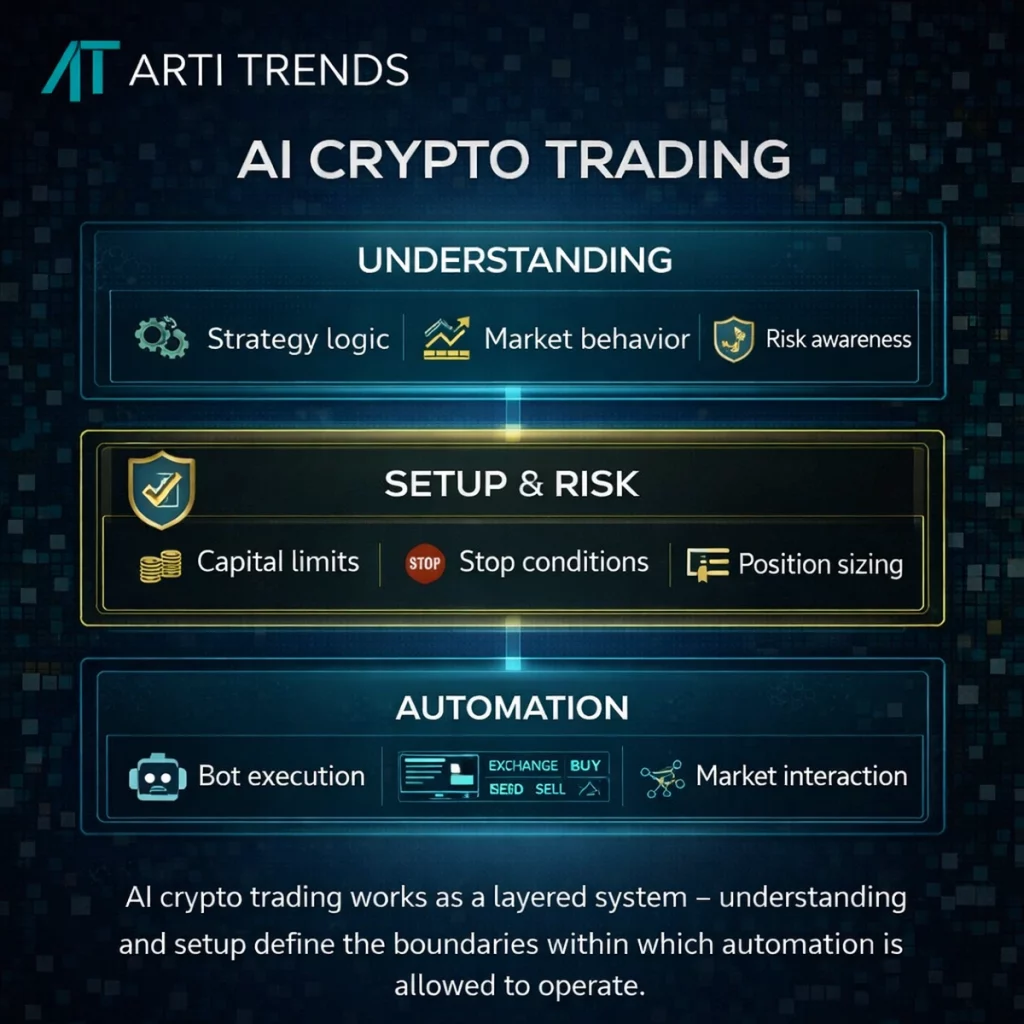
AI crypto trading setup is the process of defining risk limits, capital boundaries, and execution rules before automation is allowed to trade. It does not create profitability — it determines whether automation operates safely and predictably.
What You Need in Place Before Using Any AI Trading Bot
Before automation can add value, the foundation beneath it has to be stable.
Most problems in AI crypto trading do not originate from strategy logic or software limitations. They arise earlier — at the moment where users connect capital to systems without clearly defined constraints. This section exists to prevent that.
These are the elements that should be in place before you activate any AI trading bot.
If these concepts feel unfamiliar, it’s worth revisiting our guide on AI crypto trading risks and regulation before continuing.
Most failures in AI crypto trading are not caused by strategy selection or software quality, but by incomplete setup decisions that allow automation to operate without clearly defined limits.
Exchange readiness comes first
An AI trading bot does not operate in isolation. It executes trades inside an exchange environment, under the rules, liquidity conditions, and risk mechanics of that platform.
Before considering automation, your exchange setup should already be complete and understood:
- You should know whether you are trading spot markets or derivatives.
- Account security must be properly configured, including two-factor authentication and withdrawal protections.
- You should be comfortable navigating order history, balances, and open positions manually.
Automation should never be the first interaction you have with an exchange.
It should only accelerate processes you already understand.
Capital allocation is a decision, not a default
One of the most common early mistakes is treating “available balance” as “deployable capital.”
A proper setup separates:
- capital you are willing to test with,
- capital you are willing to expose to volatility,
- and capital that should not be touched by automated systems at all.
AI trading works best when capital exposure is intentionally constrained. Smaller, well-defined allocations allow you to observe system behavior without emotional pressure — and without forcing decisions during drawdowns.
Automation amplifies discipline only when discipline already exists. These risks are often compounded by overlooked AI trading bot fees, which quietly erode performance over time.
Risk boundaries must be defined before strategy
Many traders think in terms of entries and exits.
Professional systems think in terms of failure modes.
Before a bot places its first trade, you should already know:
- how much drawdown is acceptable,
- how many positions can be open simultaneously,
- and under which conditions automation should pause or stop entirely.
These boundaries matter more than the strategy itself.
Without them, even a statistically sound approach can become dangerous under unfavorable market conditions.
A minimum knowledge checkpoint
You do not need to be an expert to use AI trading bots.
But you do need a baseline level of understanding.
At a minimum, you should be comfortable with:
- the difference between spot and leveraged trading,
- how position sizing affects risk,
- why volatility matters more than prediction accuracy,
- and how automation behaves during rapid market moves.
If any of these concepts still feel unclear, it is worth revisiting foundational material before continuing. Automation should simplify execution — not introduce new uncertainty.
Three Proven AI Crypto Trading Setup Paths
Not every AI crypto trading setup should look the same.
One of the biggest mistakes beginners make is copying configurations designed for completely different goals, risk tolerances, or experience levels. A setup that works for an active trader can be inappropriate — or outright dangerous — for someone just starting out.
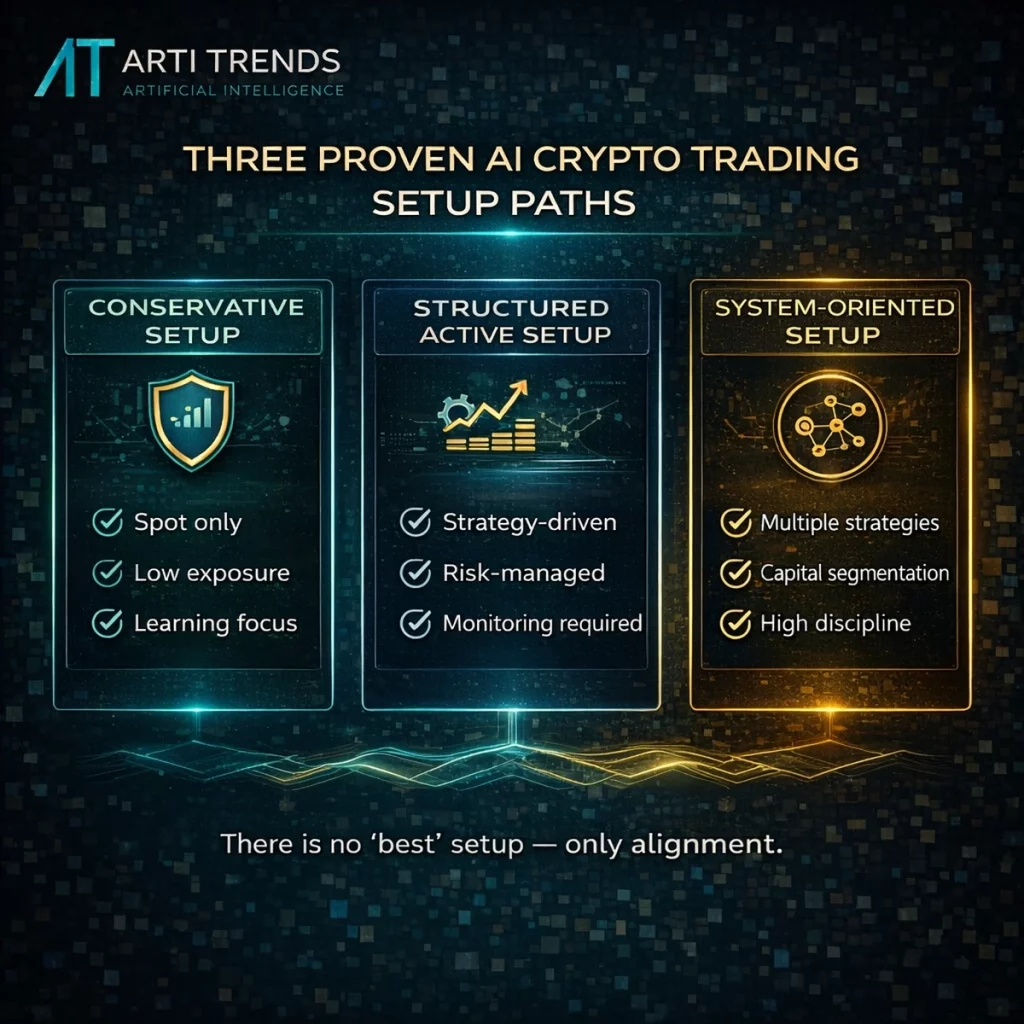
Instead of thinking in terms of “best bots” or “best platforms,” it’s far more useful to start with setup paths. Each path reflects a different relationship with risk, time commitment, and decision-making responsibility.
There is no universally correct choice. The right setup is the one that matches how you actually operate.
A conservative setup focused on learning and control
This path is designed for users who want to understand how automated trading behaves in real market conditions — without exposing themselves to unnecessary risk.
Typical characteristics:
- Spot trading only
- Simple, rules-based bot logic
- Limited number of trading pairs
- Strict capital caps per bot
The primary goal here is not optimization or performance.
It is observability.
By keeping exposure small and logic simple, you gain insight into how automation executes trades, responds to volatility, and behaves during drawdowns. This setup builds intuition without pressure — and creates a stable base for future expansion.
For most first-time users, this is the most sustainable starting point.
An active trading setup with structured risk
This path suits users who already understand market dynamics and want automation to support — not replace — active decision-making.
Common traits include:
- Strategy-driven bots aligned with market conditions
- Limited use of derivatives, if any
- Explicit risk rules per position
- Ongoing monitoring and adjustment
Here, automation acts as an execution assistant.
It enforces consistency, removes hesitation, and applies predefined rules without emotional drift.
However, this setup demands more engagement. You are still responsible for:
- validating strategies,
- monitoring exposure,
- and intervening when conditions change.
Automation increases efficiency — not immunity.
A system-oriented setup for experienced users
This path is for traders who think in systems rather than individual trades.
Instead of focusing on single bots, the setup is designed around:
- multiple strategies running in parallel,
- capital segmentation across approaches,
- and separation between strategy design and execution.
These setups often prioritize robustness over short-term performance. The goal is not to maximize returns in any single market phase, but to maintain controlled exposure across different conditions.
This approach requires:
- strong risk discipline,
- deep understanding of automation behavior,
- and a willingness to iterate slowly.
It is powerful — but only when built deliberately.
Choosing the right path
If you are unsure which path fits you best, that uncertainty is already a signal. Each of these paths maps closely to different AI crypto trading strategies, which we explore in more detail separately.
Starting with a conservative or structured setup is rarely a mistake. Scaling complexity is far easier than recovering from early losses caused by overexposure or misaligned expectations.
Automation rewards patience far more consistently than ambition.
From Zero to Your First Live AI Trading Bot
Once you’ve chosen a setup path, the next step is not speed — it is sequencing. If you are still early in the learning process, our AI crypto trading for beginners guide provides additional foundational context.
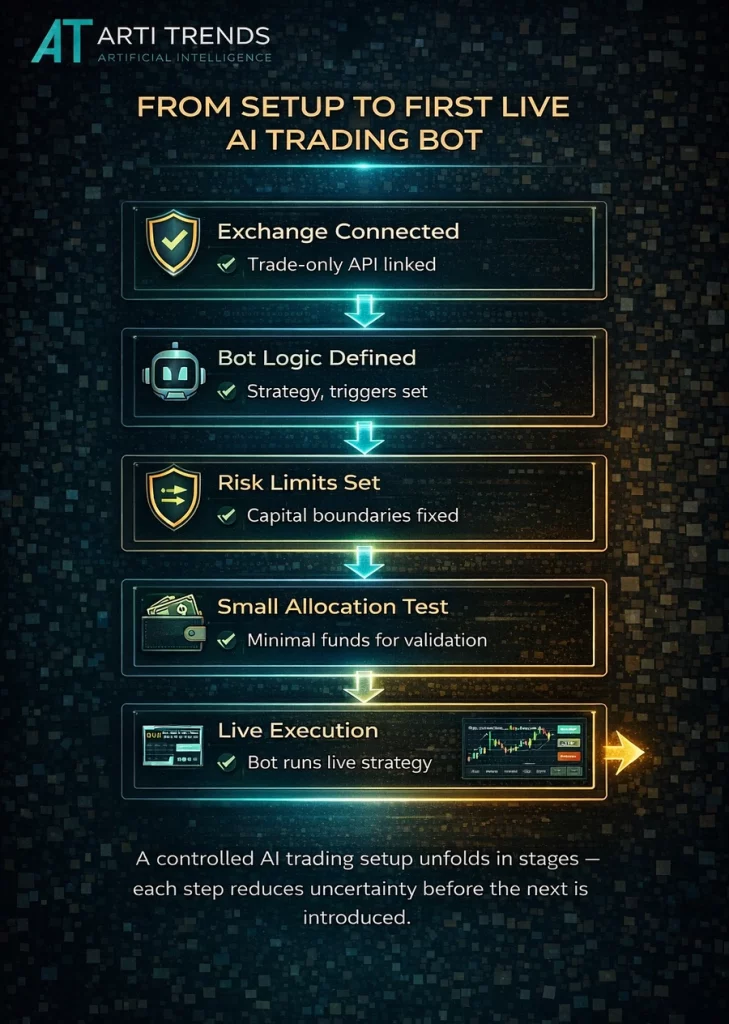
Most problems arise when users compress too many decisions into a single moment: choosing a platform, activating bots, allocating capital, and going live all at once. A sustainable setup unfolds in stages. Each stage reduces uncertainty before the next is introduced.
Connecting your exchange the right way
Every AI trading setup starts with an exchange connection. This step is often treated as a formality, but it is one of the most important control points in the entire system.
A proper connection:
- limits permissions to trading only,
- excludes withdrawal access entirely,
- and allows you to revoke access instantly if needed.
Think of this connection as a circuit breaker.
Automation should always be easy to stop.
Before moving on, confirm that:
- orders placed by automation are clearly visible,
- balances update correctly,
- and you understand exactly what the system can and cannot do.
If anything about this feels unclear, pause here. There is no advantage in rushing past uncertainty.
Choosing bot logic before choosing tools
A common mistake is selecting a platform first and adapting your strategy to whatever it offers.
A more resilient approach works the other way around.
Before activating anything, be explicit about:
- what market behavior the bot is meant to respond to,
- whether it operates continuously or conditionally,
- and how it behaves when markets move against you.
This keeps decision-making in your hands.
Tools should implement logic — not define it.
Defining exposure and limits
Automation becomes dangerous when exposure is implicit instead of explicit.
Before going live, you should already know:
- how much capital this setup can access,
- how much can be allocated per position,
- and how many positions can exist simultaneously.
These limits are not about pessimism.
They are about survivability.
Well-defined exposure rules allow you to observe performance without emotional pressure — and without being forced into reactive decisions during volatility spikes.
Testing behavior, not performance
Early testing is often misunderstood.
The purpose of testing is not to “see if it makes money.”
It is to observe whether the system behaves as expected.
During this phase, focus on:
- whether trades are executed correctly,
- whether position sizing matches your intent,
- and how the system behaves during unfavorable moves.
Small allocations are an advantage here. They allow learning without consequence.
If behavior matches expectations, performance can be evaluated later.
Going live with intention
Going live should feel almost anticlimactic.
If the setup process has been deliberate, there is no dramatic switch — only a controlled transition from observation to execution.
At this point:
- you are not proving the strategy,
- you are validating the system,
- and you are gathering data for future decisions.
Automation should feel boring at first.
That is usually a sign that it is working as intended.
Common Setup Mistakes That Quietly Destroy Accounts
Most AI trading accounts do not fail because markets are unpredictable or strategies stop working.
They fail because small setup decisions compound in the wrong direction — quietly, consistently, and often unnoticed until damage is already done.
These mistakes are common not because users are careless, but because automation creates a false sense of safety. When trades execute without hesitation, it is easy to assume risk is under control — even when it is not.
Scaling complexity too early
Running multiple bots, strategies, or trading pairs may feel like diversification. In practice, it often increases correlated exposure.
When markets move sharply, multiple automated systems can amplify the same risk at the same time. What looks like distribution becomes concentration under stress.
A single, well-understood setup is far more resilient than several loosely monitored ones.
Treating available balance as deployable capital
Many platforms make it easy to allocate “unused” balance to new bots.
This convenience hides a critical risk: exposure grows by default, not by decision. Over time, automation can quietly consume more capital than originally intended — especially when multiple bots operate in parallel.
Capital should always be assigned deliberately.
If you did not actively decide to expose it, it should not be exposed at all.
Ignoring failure conditions
Every automated system should have a clear answer to one question:
What happens if this stops working?
Without predefined stop conditions, bots can continue operating under unfavorable market regimes long after their assumptions no longer apply. Automation does not know when it is wrong — it only knows when it is allowed to continue.
Failing to define failure is one of the fastest ways to turn a controlled setup into an uncontrolled one.
Copying configurations without context
Copy trading and shared bot templates are attractive because they promise shortcuts.
What they rarely communicate is context:
- the original risk tolerance,
- capital size,
- monitoring discipline,
- and market conditions under which the setup was designed.
A configuration that works well for one trader can be completely inappropriate for another. Automation magnifies these mismatches.
Monitoring results instead of behavior
Early in the process, many users focus on profit and loss while overlooking execution quality.
But PnL alone does not tell you whether a system is healthy.
What matters first is:
- consistency of position sizing,
- adherence to defined limits,
- and predictable responses to volatility.
If behavior is unstable, performance is irrelevant.
The First Week Live: What to Watch — and What to Ignore
The moment your AI trading setup goes live, the psychological challenge changes.
Before activation, uncertainty is technical.
After activation, uncertainty becomes emotional.
Many users sabotage otherwise sound setups during the first few days — not because something is wrong, but because they misinterpret normal system behavior. This phase is about observation, not intervention.
What deserves your attention
During the first week, your primary focus should be system behavior, not results.
Pay attention to:
- whether trades are executed exactly as configured,
- whether position sizes align with your defined limits,
- and whether the system behaves predictably during unfavorable price moves.
This is also the time to watch for operational issues:
- delayed execution,
- unexpected order types,
- or discrepancies between intended and actual exposure.
These signals matter far more than short-term performance.
What you should deliberately ignore
Short-term profit and loss is a poor signal early on.
Markets fluctuate. Drawdowns occur. Even well-designed systems can start with losses. Reacting to every outcome during the first days often introduces more risk than it removes.
Avoid:
- stopping bots after a small loss,
- increasing allocation after a small gain,
- or adjusting parameters without understanding why.
Early overreaction turns structured automation back into emotional trading — the very behavior automation is meant to prevent.
Establishing a review rhythm
Rather than constant monitoring, define a simple review cadence.
For example:
- check execution quality daily,
- review exposure and limits weekly,
- evaluate performance only after a meaningful sample size.
This creates distance between observation and action — and helps preserve the integrity of your setup.
Automation is most effective when it reduces decision frequency, not increases it.
What Comes After Setup: From Activation to Optimization
A working AI crypto trading setup is not an endpoint.
It is a starting position.
Once automation is running predictably and within defined limits, the nature of decision-making changes again. The question is no longer “Did I set this up correctly?” but “What does the system tell me over time?”
Optimization should always follow observation — never replace it.
When to start evaluating performance
Meaningful evaluation requires context.
Short timeframes distort results, especially in volatile markets. A strategy that performs poorly over a few days may behave exactly as intended across different conditions. Conversely, early gains often say more about market regime than system quality.
Performance analysis only becomes useful when:
- execution has been consistent,
- exposure has remained within limits,
- and the system has experienced both favorable and unfavorable conditions.
Until then, optimization is guesswork.
Improving structure before increasing exposure
The safest improvements are structural, not aggressive.
Before allocating more capital, consider:
- simplifying underperforming configurations,
- reducing overlapping strategies,
- or refining risk rules rather than entries.
These adjustments strengthen resilience without increasing downside.
Scaling capital should always be the final step — not the first.
Choosing tools with context, not urgency
Only after your setup framework is clear does platform choice truly matter.
At that point, tools become interchangeable components rather than defining factors. You are no longer asking “What can this platform do?” but “Does this platform support how I already trade?”
This is the right moment to explore:
- comparative platform reviews,
- execution differences,
- cost structures,
- and operational trade-offs.
Tools should fit your system — not shape it.
Where to go next
If you are ready to continue building deliberately, the next steps within this cluster provide deeper guidance:
- platform comparisons and independent reviews,
- performance tracking and backtesting frameworks,
- security, custody, and operational risk considerations.
Each of these builds on the same principle that guided this setup guide:
automation only creates value when it operates inside clearly defined boundaries.
AI crypto trading is not about removing decision-making.
It is about relocating it — from moments of pressure to moments of clarity.
That shift is where durable systems are built.
Automation only creates value when it operates inside clearly defined boundaries.
Once your setup framework is clear, comparing platforms becomes meaningful. Our overview of the Best AI crypto trading bots of 2026 and our independent AI trading bot reviews help you evaluate tools based on fit — not hype.