AI crypto trading in 2026 is no longer about finding the “best bot.” It is about understanding how automated trading systems function as infrastructure within modern crypto markets.
What began as a fragmented landscape of retail bots, scripts, and experimental automation has evolved into a structured execution layer used by professional traders, quantitative teams, and increasingly institutional participants. Artificial intelligence is no longer positioned as a shortcut to profits, but as a tool for consistency, discipline, and operational control.
In practical terms, AI crypto trading is not primarily about prediction. It is about execution. As markets have matured, liquidity has deepened and volatility has become a persistent feature rather than an occasional anomaly. Under these conditions, human decision-making struggles to keep pace. Continuous exposure, complex portfolios, and emotional pressure introduce inconsistency — not because traders lack insight, but because execution breaks down under stress.
AI systems address a different problem. They do not remove uncertainty, eliminate risk, or guarantee outcomes. Instead, they translate predefined rules, risk constraints, and portfolio objectives into repeatable actions. Their value lies in reducing operational noise, enforcing discipline, and maintaining consistency over time.
Understanding how AI crypto trading bots are structured across strategy, execution, and exchange infrastructure helps clarify why these systems behave differently in practice.
AI crypto trading in 2026 can be defined as the use of automated systems that execute trading strategies based on predefined rules, real-time data inputs, and clearly defined risk constraints. These systems focus on execution consistency, portfolio management, and risk control rather than predicting market movements. For readers who are new to this space, AI crypto trading for beginners provides a practical foundation for understanding how these systems work and what to expect.
In today’s market, AI crypto trading is best understood as infrastructure. It sits between strategy and the market, acting as a translation layer between intent and execution. These systems do not decide what to trade or why — they ensure that decisions are applied consistently, without hesitation or emotional drift. The effectiveness of this process depends heavily on how different AI crypto trading strategies are designed and applied under real market conditions.
This article takes a state-of-the-market view of AI crypto trading in 2026. It does not focus on tools, rankings, or performance claims. Instead, it examines how the market is structured, who participates in it, what constraints shape it, and where artificial intelligence meaningfully contributes — and where it does not. The broader AI trading bots ecosystem provides additional context on how crypto trading fits within AI-driven automation across markets.
Understanding this context is essential. Because the difference between disciplined AI crypto trading and costly experimentation is no longer about finding a better bot. It is about understanding how this market actually functions — and how AI fits into a broader, long-term approach to investing and risk management.
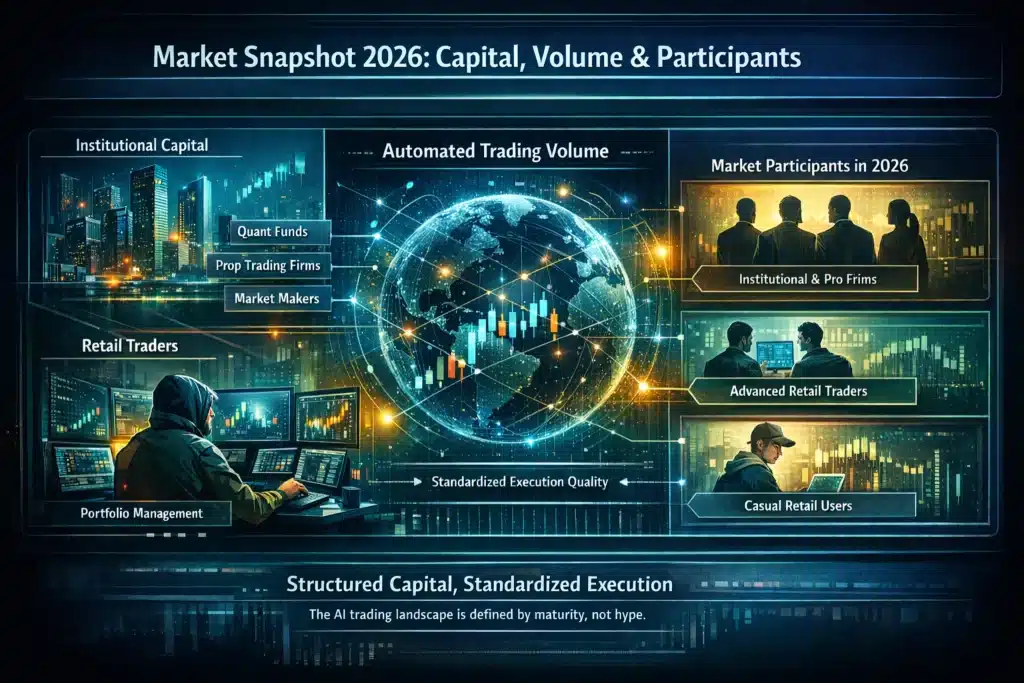
Market Snapshot 2026: Capital, Volume & Participants
By 2026, AI crypto trading has become a meaningful part of overall crypto market activity — not because it dominates headlines, but because it quietly underpins a growing share of daily execution.
The most important shift is not technological, but structural. Capital has consolidated. Trading volume has professionalized. And participation has become more segmented than in earlier market cycles.
Where the Capital Is Concentrated
Despite the visibility of retail trading bots, the majority of AI-driven trading volume is now generated by a relatively small group of professional participants. These include proprietary trading firms, quantitative funds, market makers, and specialized crypto desks operating across multiple exchanges and venues. What matters here is not automation itself, but how it is embedded within institutional-grade execution systems designed to operate at scale.
Retail participation still exists, but its role has shifted. Instead of driving volume, retail traders increasingly operate at the edges of liquidity — using automation to manage positions, rebalance portfolios, or reduce manual decision pressure. In this context, AI crypto trading bots function less as speculative engines and more as tools for enforcing discipline and operational consistency within defined constraints.
For investors trying to assess the relevance of AI crypto trading, this distinction helps separate perception from reality. Visibility does not equal impact. The market is shaped less by the sheer number of bots deployed and more by how capital is structured, governed, and executed through them — a dynamic also reflected in the broader Best AI crypto trading bots in 2026 comparison.
Trading Volume vs Execution Quality
Headline volume figures can be misleading. While overall crypto trading volume fluctuates with market cycles, the share executed through automated systems continues to rise steadily. This does not mean markets are becoming more “efficient” in a classical sense. It means execution is becoming more standardized.
AI-driven systems increasingly handle:
- order slicing and timing
- cross-exchange routing
- exposure balancing across strategies
- continuous position management
These functions rarely attract attention, but they materially affect market behavior. Price discovery becomes smoother, spreads tighten during normal conditions, and volatility clusters more predictably during stress events. In this environment, execution quality matters more than raw trade frequency.
This is also where costs become visible. Fees, slippage, infrastructure overhead, and latency constraints define long-term outcomes far more than isolated winning trades — something that becomes clear when analyzing AI trading bot fees and cost structures.
Who Participates in the Market Today
The AI crypto trading market in 2026 can broadly be divided into three participant groups:
- Institutional and professional firms, using AI as part of larger trading and risk systems
- Advanced retail traders, deploying automation to enforce discipline and manage complexity
- Casual retail users, often drawn by simplified interfaces and marketing promises
Each group operates under different constraints, expectations, and risk tolerances. Confusion arises when tools designed for one group are evaluated through the lens of another. Many frustrations around AI trading originate not from technical failure, but from mismatched use cases.
Understanding who a system is built for — and who it is not — is therefore a prerequisite for evaluating its relevance. This becomes especially important for readers exploring AI crypto trading for beginners, where expectations often diverge from how the market actually operates.
Why This Market Snapshot Matters
Looking at capital flows, execution behavior, and participant structure clarifies one central point: AI crypto trading is no longer defined by experimentation. It is defined by operational maturity.
This does not make the market safer or easier. It makes it more demanding. Poorly designed systems are exposed faster. Weak risk frameworks fail more visibly. And superficial automation offers diminishing returns.
Against this backdrop, the next question is no longer who is using AI to trade crypto, but how those systems are actually structured — and what that structure reveals about where real value is created. This becomes even clearer when placed within the broader AI crypto trading market evolution.
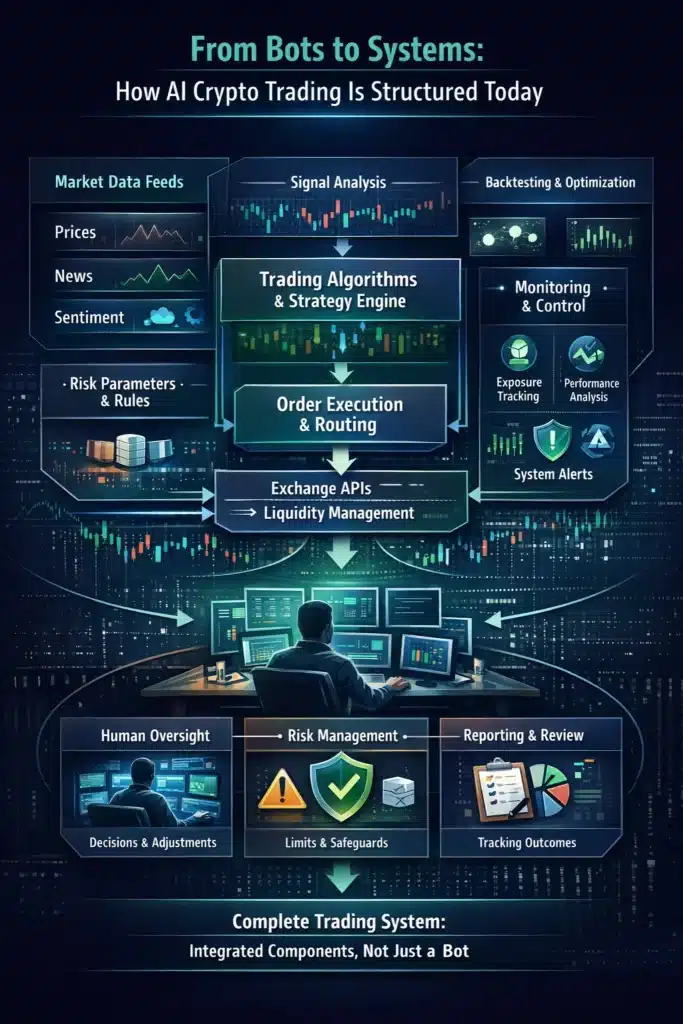
From Bots to Systems: How AI Crypto Trading Is Structured Today
One of the most persistent misconceptions in AI crypto trading is the belief that performance is driven by a single “smart bot.”
In reality, no serious trading operation — retail or institutional — relies on isolated automation. What users see as a bot is usually just the visible interface of a broader trading system. That system determines how market data is interpreted, how strategies are translated into execution, how risk is constrained, and how outcomes are monitored over time.
Understanding this distinction is essential. Many failures in AI crypto trading do not originate from flawed algorithms, but from incomplete system design.
Why the “Bot” Mental Model Breaks Down
A standalone bot implies autonomy: software that observes the market, makes decisions, and produces results on its own. That framing is misleading.
In practice, AI crypto trading systems are shaped by decisions made outside the algorithm itself. Humans still define the boundaries within which automation operates: which markets are traded, how much capital is allocated, which risks are acceptable, and when systems should be paused, adjusted, or shut down.
AI does not define these parameters. Humans do.
This is why evaluating automation purely through signals, predictions, or win rates often leads to poor conclusions. Traders who focus only on perceived intelligence tend to overlook the structural factors that actually determine long-term outcomes. Execution consistency, exposure control, and failure handling matter far more than momentary insight — especially when compared with the realities of AI vs manual crypto trading.
Trading as an Interconnected System
In 2026, AI crypto trading is better understood as a coordinated system with multiple responsibilities rather than as a single decision-making entity.
At a high level, these systems must continuously:
- ingest and normalize market data
- translate strategy rules into executable logic
- manage orders across exchanges and liquidity conditions
- monitor exposure, drawdowns, and operational risk
Each component may function well in isolation and still fail at the system level if the integration between them is weak. This is one of the main reasons why comparing platforms based only on surface-level features rarely produces meaningful insight.
From a market perspective, this also explains why professional participants invest more effort into infrastructure, monitoring, and governance than into chasing marginal predictive advantages. That broader context becomes clearer when viewed through the AI trading bots hub, where different platforms solve different layers of the automation stack.
Structure Determines Outcomes More Than Intelligence
As AI crypto trading matures, the source of advantage has shifted. Early adopters benefited from novelty, fragmented markets, and temporary inefficiencies. In 2026, those edges have largely compressed.
What remains is structure.
Well-designed systems tend to:
- enforce consistent execution
- constrain risk before it becomes visible
- scale exposure deliberately rather than opportunistically
- fail predictably instead of catastrophically
Poorly designed systems do the opposite — regardless of how sophisticated their models appear on the surface.
This helps explain why some traders experience stable, incremental performance while others encounter rapid losses using tools that seem similar at first glance. The difference often lies less in the intelligence of the algorithm and more in the quality of the surrounding system — including setup, monitoring, and risk controls. For readers exploring practical implementation, this is also why a strong AI crypto trading setup matters more than most marketing claims suggest.
Setting the Stage for the Trading Stack
Once trading is viewed as a system rather than a standalone bot, the market becomes significantly easier to analyze. Patterns begin to emerge. Constraints become visible. And the role of AI can be assessed in a more realistic and grounded way.
This shift in perspective is especially important for readers exploring different approaches such as AI futures trading bots, AI crypto arbitrage bots, or AI portfolio trading bots. While these categories may appear distinct on the surface, they all depend on the same underlying structure: data quality, execution logic, and risk management working together as a coherent system.
What changes is not the foundation, but the context in which that system operates.
In the next section, we break this structure down into a simplified market-level model — not to introduce unnecessary complexity, but to clarify where value is actually created, where risk accumulates, and where automation provides meaningful leverage within the broader AI trading bots ecosystem.
The AI Crypto Trading Stack (Market-Level View)
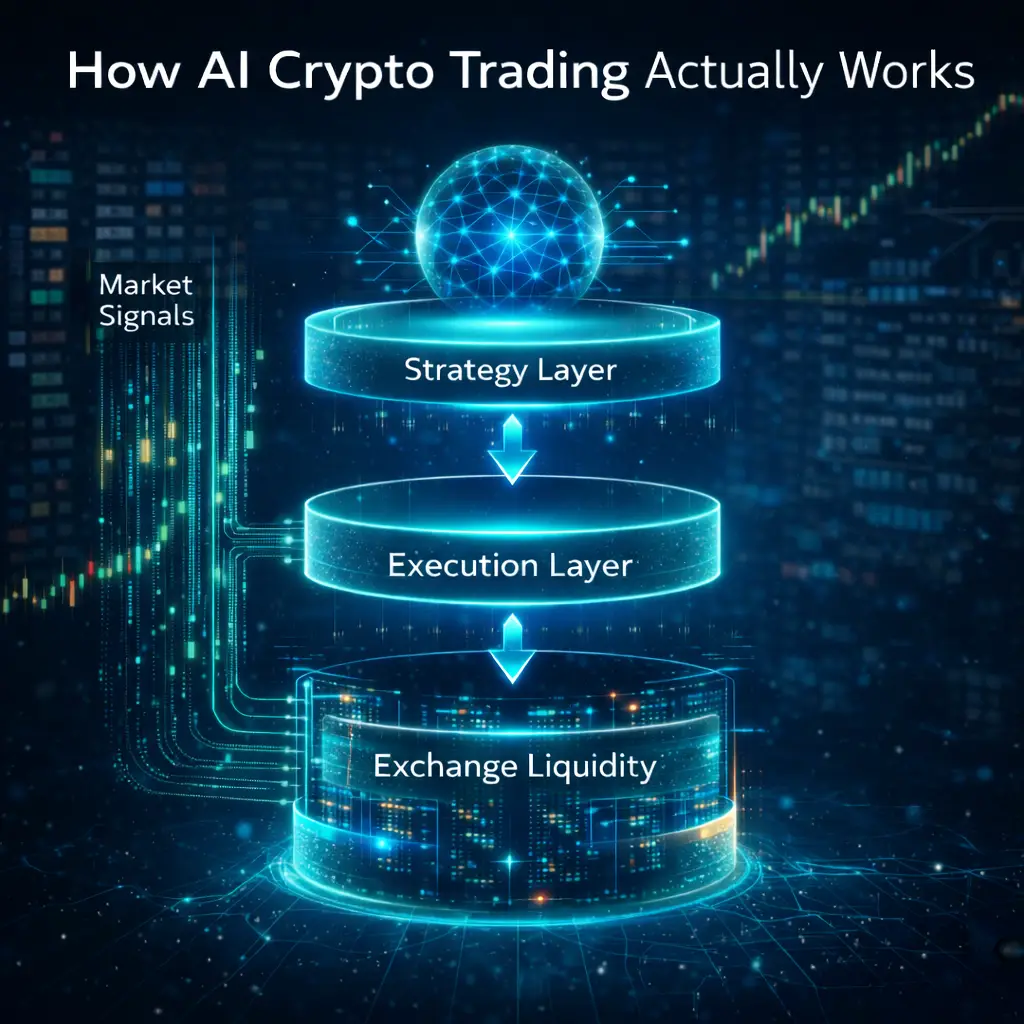
Once AI crypto trading is understood as a system rather than a single bot, its structure becomes easier to reason about. Across the market, most serious AI trading operations — regardless of size — follow a similar high-level architecture.
This architecture can be simplified into three functional layers. Each layer serves a distinct purpose, and confusion between them is a common source of poor expectations and weak outcomes.
Layer 1: Data & Market Access
At the base of the stack lies data.
Crypto markets are fragmented across exchanges, trading pairs, and venues. Prices, liquidity, and order book dynamics are never perfectly synchronized. AI trading systems depend on reliable access to this constantly shifting information — not just price data, but depth, volume, spreads, and execution conditions.
This layer determines:
- which markets can be accessed
- how quickly information is received
- how accurately market conditions are represented
Weaknesses here propagate upward. Poor data quality or limited market access cannot be “fixed” by smarter execution logic later in the stack — a reality that explains why AI crypto arbitrage bots are fundamentally dependent on high-quality, low-latency market data.
Layer 2: Execution & Strategy Automation
The middle layer is where most users focus their attention — and where most misunderstandings arise.
This layer translates predefined strategies into executable actions. It decides how trades are placed, adjusted, and closed under varying market conditions. Importantly, it does not decide what the strategy should be or why it exists. Those decisions belong outside the system.
Execution and automation logic typically handles:
- order placement and timing
- position sizing and scaling
- strategy-specific rules (e.g. grids, trends, arbitrage)
- response to changing volatility or liquidity
When evaluated responsibly, this layer is about consistency, not creativity. Its purpose is to apply rules reliably across thousands of micro-decisions that would overwhelm manual execution — whether applied through AI futures trading bots or AI crypto arbitrage bots operating under different market constraints.
Layer 3: Risk, Portfolio & Governance
The top layer is the most underestimated — and the most decisive over time.
Here, AI trading systems are constrained, monitored, and evaluated. This layer governs how much capital is exposed, how losses are handled, and how performance is interpreted within a broader portfolio context.
Key responsibilities include:
- risk limits and drawdown controls
- portfolio-level exposure management
- capital allocation across strategies
- monitoring, alerts, and intervention rules
Without this layer, automation amplifies errors instead of controlling them. With it, AI trading becomes a tool for enforcing discipline rather than accelerating mistakes.
This is also where AI crypto trading intersects most clearly with long-term investing principles. Systems are no longer judged by individual trades, but by how they contribute to portfolio stability and risk-adjusted outcomes — a distinction that sits at the core of AI portfolio trading bots.
Why This Stack Matters
Viewing AI crypto trading through this three-layer model clarifies several persistent misconceptions.
First, no single layer creates success on its own. Strong execution cannot compensate for weak risk governance. Sophisticated strategies cannot overcome unreliable data. And robust controls cannot rescue poorly defined objectives.
Second, it explains why tools that appear similar on the surface produce radically different outcomes in practice. The visible interface reveals very little about the underlying structure.
Finally, it reinforces a core principle of mature AI trading: value is created by integration, not intelligence alone. The most durable systems are not those that claim superior prediction, but those that align data, execution, and risk into a coherent whole.
With this structure in mind, the next distinction becomes unavoidable — the difference between how retail participants and institutional players operate within the same market.
Retail vs Institutional AI Crypto Trading
At first glance, retail and institutional AI crypto trading appear to use similar technology. Both rely on automated execution, data-driven decision rules, and algorithmic risk controls. This surface similarity often leads to unrealistic comparisons — and misplaced expectations.
In reality, retail and institutional participants operate under fundamentally different constraints.
Same Technology, Different Objectives
Institutional trading firms do not use AI to “find better trades.” Their primary objective is execution efficiency at scale. AI systems are designed to manage liquidity impact, minimize transaction costs, maintain exposure neutrality, and operate within strict risk and compliance boundaries.
Retail traders, by contrast, often approach AI trading as a way to improve decision quality or reduce emotional stress. Automation is used to enforce rules, maintain consistency, or manage complexity that would otherwise overwhelm manual execution.
Neither approach is inherently superior. They serve different goals. Problems arise when tools built for one context are evaluated through the lens of the other.
Capital, Risk, and Time Horizon
Institutional systems are capital-heavy and margin-sensitive. A small inefficiency, when applied across large volumes, quickly becomes material. As a result, institutions prioritize:
- predictable execution
- tight risk constraints
- continuous monitoring
- rapid intervention when assumptions break
Retail traders operate with smaller capital bases but often accept higher relative risk. Time horizons are shorter, drawdown tolerance varies widely, and system intervention is more discretionary. Automation helps, but it cannot replace disciplined capital management.
This difference explains why institutional systems emphasize portfolio balance and exposure control, while retail tools often emphasize strategy selection or signal logic.
Infrastructure and Governance
Perhaps the most important distinction lies in governance.
Institutional AI trading systems are embedded within formal processes: compliance checks, model validation, performance attribution, and documented intervention rules. Automation exists within a clearly defined framework of accountability.
Retail traders rarely operate with this level of structure. Decisions around capital allocation, system shutdowns, or risk escalation are often made ad hoc — sometimes under stress. AI tools can assist, but they cannot substitute for governance that has not been defined.
This gap does not imply inferiority. It highlights why copying institutional tactics without institutional discipline rarely produces the intended results.
What Retail Can Learn — Without Imitation
The most valuable lessons retail participants can draw from institutional practice are not technical. They are structural.
Institutions succeed not by predicting markets, but by:
- enforcing consistent execution
- defining failure conditions in advance
- managing risk at the portfolio level
- accepting modest edges applied systematically
Retail traders who adopt these principles — within their own constraints — tend to experience more stable outcomes than those chasing sophistication for its own sake.
Understanding these differences reframes AI crypto trading as a question of fit, not capability. The market rewards alignment between tools, objectives, and constraints. It penalizes mismatch.
With this distinction clarified, the next layer shaping AI crypto trading in 2026 becomes visible: regulation, risk, and the structural limits within which all participants must operate.
Regulation, Risk & Market Constraints in 2026
By 2026, regulation and risk management are no longer peripheral concerns in AI crypto trading. They have become structural forces that shape how the market operates — determining which systems can scale, which participants endure, and which approaches quietly disappear.
Importantly, regulation has not slowed AI crypto trading. It has filtered it.
Regulation as a Market Filter
Early crypto markets thrived in regulatory ambiguity. That environment favored speed, experimentation, and often excess. As oversight increased, many fragile or poorly governed trading operations struggled to adapt. What remains in 2026 is a market that increasingly rewards transparency, process discipline, and operational resilience.
For AI crypto trading systems, this means:
- clearer requirements around exchange access and API usage
- stricter standards for custody and fund segregation
- greater scrutiny of leverage and risk disclosure
These constraints limit certain behaviors, but they also reduce systemic fragility. Markets become harder to exploit casually, but easier to operate professionally.
Risk Is Structural, Not Accidental
AI does not remove risk from crypto trading. It reshapes where risk appears.
Model assumptions can fail. Data feeds can degrade. Liquidity can vanish during stress events. Automation amplifies both discipline and error. When systems operate continuously, small flaws compound faster than in manual trading.
In 2026, the most common failure modes are no longer technical bugs, but structural weaknesses:
- strategies deployed outside their intended market regime
- excessive leverage applied systematically
- delayed human intervention during drawdowns
- overreliance on historical performance metrics
Recognizing these risks is not a reason to avoid AI trading. It is a prerequisite for using it responsibly.
Exchanges, APIs, and Custody Constraints
AI crypto trading systems are tightly coupled to exchange infrastructure. API stability, rate limits, order execution rules, and custody arrangements impose practical boundaries on what automation can achieve.
These constraints shape outcomes in subtle ways:
- execution logic must adapt to exchange-specific behaviors
- system downtime becomes a risk factor
- custody decisions affect both security and operational flexibility
Ignoring these dependencies leads to unrealistic expectations. Designing around them leads to resilience — a reality addressed in AI Crypto Trading Risks & Regulation and reinforced by practical considerations around AI Crypto Trading Security & Custody.
Why Risk Awareness Strengthens, Not Weakens, AI Trading
There is a persistent misconception that acknowledging risk undermines confidence in AI-driven trading. In practice, the opposite is true.
The most durable AI trading systems are built by participants who assume failure will occur — and plan accordingly. They define limits, monitor continuously, and intervene early. Automation becomes a stabilizing force precisely because it operates within known constraints.
In a maturing market, trust is earned not through promises, but through restraint. Regulation and risk management do not eliminate opportunity. They define the boundaries within which opportunity can be pursued sustainably.
With these constraints in view, attention naturally shifts toward outcomes: what approaches perform reliably in this environment, and which consistently fall short.
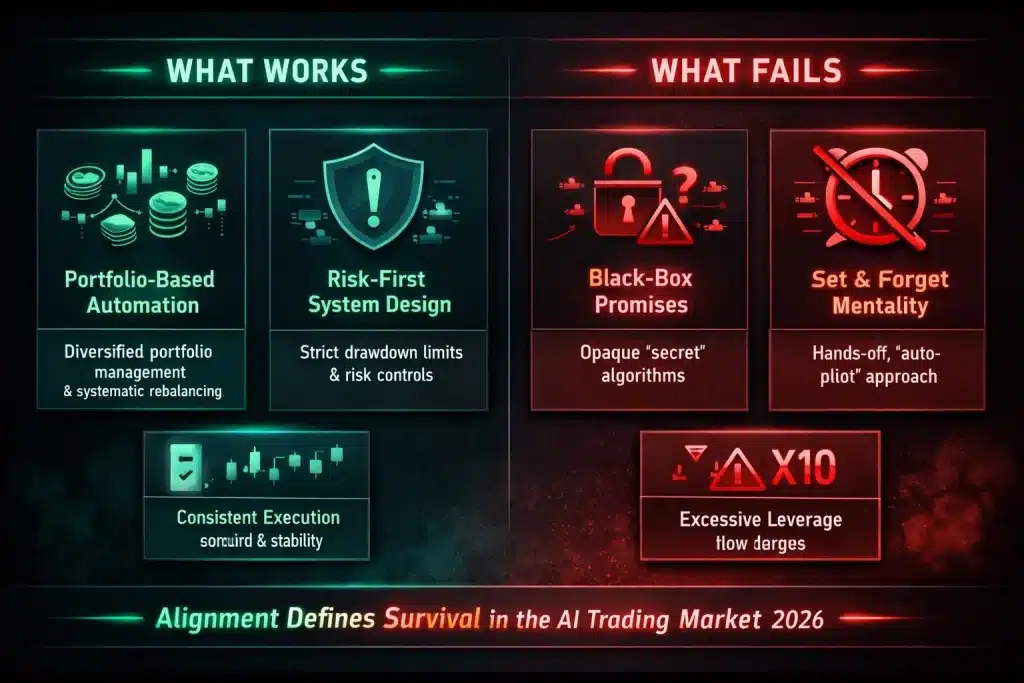
What Works in the Current Market — And What Doesn’t
As AI crypto trading has matured, the sources of sustainable performance have become clearer. Many early advantages have eroded, and superficial sophistication no longer compensates for weak structure or unrealistic assumptions.
In 2026, the dividing line between approaches that endure and those that fail is not intelligence, but alignment.
What Tends to Work
1. Portfolio-Based Automation
Systems that manage exposure at the portfolio level consistently outperform those focused on isolated strategies. Diversification across assets, strategies, and timeframes reduces dependence on any single market condition.
Automation adds value here by enforcing allocation rules, rebalancing systematically, and preventing emotional concentration during volatile periods.
(Internal link: AI Portfolio Trading Bots)
2. Risk-First System Design
Effective AI trading systems are designed around risk constraints, not return targets. Drawdown limits, position caps, and predefined shutdown conditions are treated as core features, not safeguards of last resort.
This approach sacrifices occasional upside, but it preserves capital — which remains the primary requirement for long-term participation, a principle examined through AI Crypto Trading Performance & Backtesting.
3. Consistent Execution Over Prediction
Markets punish inconsistency more reliably than they reward clever insight. Systems that execute simple rules reliably often outperform those attempting complex forecasts.
Automation excels at repetition. When strategies are robust but unremarkable, AI ensures they are applied without drift, hesitation, or selective memory.
What Consistently Falls Short
1. Black-Box Promises
Systems that claim proprietary intelligence without transparent structure tend to fail under stress. When performance degrades, users lack the insight required to adjust or intervene responsibly.
Opacity does not create an edge. It creates dependency.
2. Excessive Leverage Applied Systematically
Leverage magnifies both discipline and error. In automated systems, losses compound faster because exposure is applied consistently. Without tight controls, drawdowns escalate rapidly and recovery becomes mathematically unlikely.
3. Passive Expectations in Active Markets
AI crypto trading is often marketed as “set and forget.” In practice, the most stable outcomes are achieved by participants who monitor, evaluate, and periodically recalibrate their systems.
Automation reduces workload. It does not eliminate responsibility.
Why This Distinction Matters
These patterns are not theoretical. They emerge repeatedly across market cycles, platforms, and participant groups. Systems that respect constraints survive long enough for small edges to compound. Systems built on expectation rather than structure tend to fail quickly and visibly.
Understanding what works — and why — reframes AI crypto trading as a discipline rather than a shortcut. It prepares participants to evaluate tools, strategies, and claims with clarity rather than optimism.
With these lessons in mind, one final element remains central to the market in 2026: the ongoing role of human judgment.
The Human Role in an AI-Driven Crypto Market
As AI systems take on a larger share of execution in crypto markets, it is tempting to frame the human role as diminishing. In practice, the opposite is true.
Automation does not remove judgment from trading. It concentrates it.
Every AI crypto trading system reflects a series of human decisions: how risk is defined, which markets are traded, when automation should pause, and how failure is handled. AI executes these decisions consistently, but it does not question their validity. That responsibility remains human.
Judgment Over Prediction
In mature markets, advantage rarely comes from predicting price movements. It comes from designing systems that behave predictably under uncertainty.
Human judgment plays its most important role before execution begins:
- defining objectives and constraints
- selecting appropriate strategies for specific market conditions
- determining acceptable failure modes
- deciding when not to trade
These decisions cannot be automated responsibly, because they involve trade-offs that extend beyond data.
Automation as an Amplifier
AI acts as an amplifier. It reinforces both discipline and error.
When human decisions are coherent and well-defined, automation enhances their impact. When assumptions are weak or inconsistent, AI accelerates their consequences. This dynamic explains why similar tools produce vastly different outcomes across users.
Understanding this amplification effect reframes the role of AI crypto trading. The system is not an autonomous actor. It is an extension of human intent.
Responsibility Does Not Disappear
One of the most persistent misconceptions around AI trading is the idea that responsibility shifts from the user to the system. In reality, responsibility becomes more concentrated.
Automated execution increases scale, speed, and consistency — which raises the stakes of design choices. Ethical use, risk awareness, and ongoing oversight remain essential, regardless of how sophisticated the technology becomes.
This perspective aligns with how professional participants approach AI trading. Automation is embraced precisely because it operates within clear boundaries, not because it replaces accountability.
Why This Matters Going Forward
As AI crypto trading becomes more embedded in market infrastructure, the human role becomes less visible but more decisive. The quality of judgment embedded in systems will increasingly determine outcomes — not the novelty of the technology itself.
Recognizing this role is not a constraint on progress. It is what allows AI-driven trading to scale responsibly.
With this understanding in place, the final question becomes forward-looking: where is this market heading next, and how will these dynamics shape its future?
Market Outlook: Where AI Crypto Trading Is Headed
Looking beyond 2026, the trajectory of AI crypto trading is becoming clearer — not because the market has stabilized, but because its underlying forces are better understood.
The next phase of development is less about technological breakthroughs and more about institutionalization.
From Innovation to Standardization
In earlier cycles, advantage often came from early adoption. Novel strategies, new tools, or faster execution provided temporary edges. As markets mature, those edges compress.
Between 2026 and 2028, AI crypto trading is likely to follow the same path as other algorithmic markets:
- execution practices become standardized
- infrastructure becomes more modular
- risk controls become more formalized
This does not eliminate opportunity. It shifts it. Performance increasingly depends on system design, integration, and discipline rather than isolated innovation.
AI as Portfolio Intelligence, Not Trade Prediction
One of the most significant shifts underway is the movement of AI upward in the decision stack.
Rather than focusing solely on trade-level execution, AI systems are increasingly applied to:
- portfolio exposure management
- strategy allocation across regimes
- volatility-aware rebalancing
- scenario analysis and stress testing
This evolution aligns AI crypto trading more closely with long-term investing principles. Automation supports capital preservation and adaptive allocation rather than continuous speculation.
Convergence With Broader AI Investing Trends
AI crypto trading does not evolve in isolation. Its development mirrors trends across AI-driven investing more broadly: greater emphasis on governance, transparency, and risk-adjusted performance.
As regulatory frameworks mature and institutional participation increases, AI trading becomes less visible but more foundational. It fades from headlines while embedding itself deeper into market operations — a trajectory explored in Future of AI Investing: The Trends Shaping Markets to 2030 (2026).
What This Means for Market Participants
For participants, the implications are straightforward but demanding.
Sustainable engagement with AI crypto trading will require:
- realistic expectations
- clearly defined objectives
- systems designed for failure as well as success
- ongoing learning rather than static deployment
Those who treat AI as infrastructure — rather than as a promise — are better positioned to adapt as markets continue to evolve.
With this forward-looking context established, the final step is to connect this market view back to the broader Arti-Trends framework — and guide readers toward the next layer of understanding.
How This Market View Fits Into the Arti-Trends AI Trading Framework
This market overview is not intended to stand on its own. It forms part of a broader framework for understanding how artificial intelligence is reshaping trading and investing — across assets, strategies, and time horizons.
Throughout this article, one principle has remained consistent: AI crypto trading delivers value when it is treated as infrastructure rather than as opportunity. That perspective underpins how the Arti-Trends AI Trading framework is structured.
From Market Context to Practical Understanding
At its core, this page provides context. It explains where AI crypto trading fits within the wider AI investing landscape, how the market has matured, and which structural forces define its current state.
From here, the framework expands into more focused layers:
- foundational understanding of how AI trading systems operate in practice
- strategy-level analysis of different trading approaches and use cases
- risk and governance insights that clarify limitations and failure modes
- independent platform evaluations for readers exploring implementation
Each layer builds on the one above it. None is designed to replace the others.
Navigating the Framework
If this article clarified why AI crypto trading looks the way it does in 2026, the next step depends on what you want to understand more deeply:
For a comprehensive breakdown of how systems are structured, the AI crypto trading bots guide (2026) explains how strategy, execution, and infrastructure interact in practice.
For readers new to the space, AI crypto trading for beginners introduces the core concepts, risks, and realistic expectations without assuming prior experience.
Those interested in practical application can explore AI crypto trading strategies (2026), where different approaches are analyzed in real market conditions.
For a broader perspective across platforms and categories, the the AI Trading Bots hub connects crypto automation to the wider landscape of AI-driven trading systems.
These paths are designed to support understanding — not to push decisions.
A Consistent Editorial Standard
All content within the Arti-Trends AI Trading framework follows the same principles reflected throughout this article: clarity over complexity, structure over speculation, and long-term understanding over short-term excitement.
AI-driven trading will continue to evolve. Tools will change. Markets will adapt. The purpose of this framework is not to track every development, but to provide durable mental models that remain relevant as conditions shift.
Viewed through that lens, AI crypto trading is neither a shortcut nor a threat. It is a discipline — one that rewards those who understand its structure, respect its constraints, and approach it with patience rather than urgency.
Frequently Asked Questions
These questions focus on the market structure, system design, and strategic role of AI crypto trading in 2026 — rather than on individual tools or platform selection.
Why is AI crypto trading described as infrastructure rather than a tool?
AI crypto trading is best described as infrastructure because it operates as a system layer between strategy and market execution. It does not define investment goals or create edge on its own. Instead, it ensures that predefined decisions are executed consistently, within risk constraints, and without emotional drift.
What has changed in AI crypto trading between earlier market cycles and 2026?
The biggest shift is structural rather than technological. Earlier market cycles were dominated by fragmented retail experimentation, while in 2026 trading volume has become more professionalized, capital has consolidated, and automation is increasingly embedded in broader execution systems. This market evolution is explored further in AI crypto trading market 2026.
Why does execution matter more than prediction in modern AI crypto trading?
In mature crypto markets, small inefficiencies in execution often matter more than isolated moments of predictive accuracy. Order timing, routing, slippage, exposure balance, and risk control have a greater long-term impact than occasional correct forecasts. That is why modern AI trading systems are increasingly valued for consistent execution rather than for trying to predict every market move.
Why is the idea of a single “smart trading bot” misleading?
The idea is misleading because what appears to users as a bot is usually only the visible interface of a larger system. Real performance depends on how data is processed, how trades are executed, how capital is allocated, and how risk is monitored. In practice, the surrounding system matters more than the perceived intelligence of the bot itself.
What are the core layers of an AI crypto trading system?
Most mature AI crypto trading systems can be understood through three functional layers: data and market access, execution and strategy automation, and risk, portfolio management, and governance. The key point is that no single layer can compensate for weakness in another. Reliable execution cannot rescue poor data, and strong strategies cannot overcome weak risk controls.
Why do similar AI trading bots produce very different results?
Similar-looking bots can produce very different outcomes because results depend on the entire system around them. Setup quality, risk controls, exchange conditions, capital allocation, monitoring discipline, and user behavior often influence performance more than the automation interface itself. This is also why a strong AI crypto trading setup matters more than most marketing claims suggest.
How do retail and institutional AI crypto trading approaches differ?
Retail and institutional participants may use similar automation tools, but they operate under very different constraints. Institutions focus on execution efficiency, governance, and portfolio-level risk control at scale, while retail traders more often use automation to reduce emotional decision-making and manage complexity. The difference lies less in the technology and more in objectives, capital structure, and process discipline.
Why is system design more important than algorithm complexity?
As crypto markets mature, advantages from complexity alone tend to compress. What remains is the ability to operate consistently under real conditions. Systems that align data, execution, and risk management in a coherent structure generally prove more durable than complex models built on weak foundations.
What role does human decision-making still play in AI crypto trading?
Human judgment remains central. People still define objectives, capital limits, acceptable risk, intervention rules, and the conditions under which automation should pause or adapt. AI executes within those boundaries, but it does not validate whether those boundaries are appropriate. Responsibility therefore becomes more concentrated, not less.
How is regulation shaping AI crypto trading in 2026?
Regulation is acting less as a barrier and more as a market filter. It increasingly removes fragile or poorly governed systems while rewarding participants that operate with stronger process discipline, transparency, and operational resilience. A deeper breakdown is available in AI crypto trading risks.
What separates sustainable AI trading systems from failing ones?
Sustainable systems usually prioritize risk control, execution consistency, portfolio-level thinking, and predefined failure conditions. Failing systems, by contrast, often rely on opaque logic, excessive leverage, weak intervention rules, or unrealistic expectations about what automation can achieve.
What is the long-term direction of AI crypto trading?
AI crypto trading is moving toward greater standardization, institutionalization, and deeper integration into broader portfolio management. The emphasis is shifting away from individual “smart bots” and toward system-level performance, risk-adjusted outcomes, and disciplined execution within a more mature market structure.