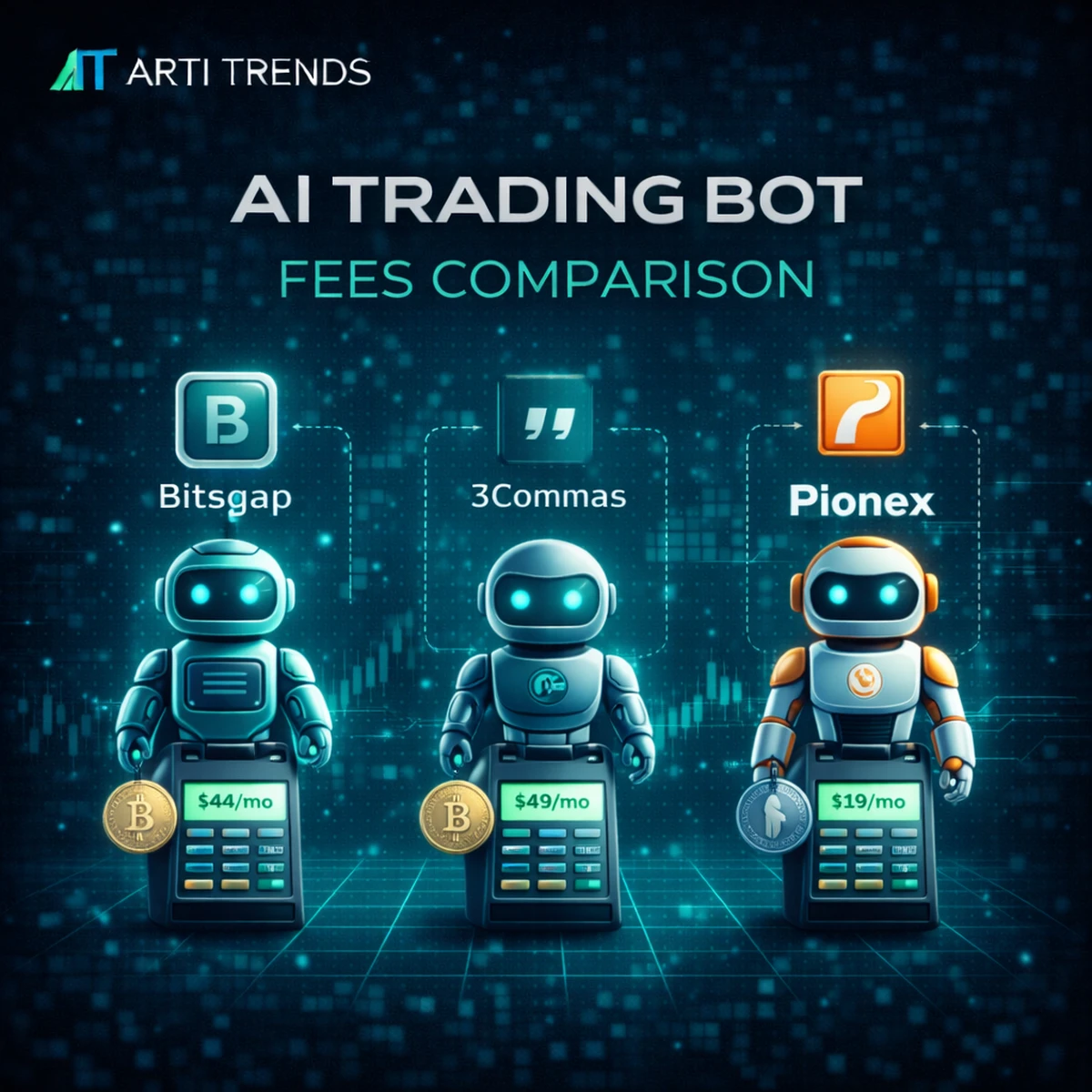
AI trading is often framed as a prediction problem. It isn’t. In modern crypto markets, the difference between profitable and unprofitable AI trading systems is rarely signal accuracy. It is cost structure. Fees, slippage, execution quality, and exchange mechanics determine whether a strategy survives once it leaves the backtest environment and enters live markets. This is where most traders — and most “AI trading bot comparisons” — get it wrong. They focus on algorithms, while professionals focus on efficiency.
Understanding how fees shape performance requires a broader view of how AI trading systems are structured. Costs are not a static number attached to a platform, but a dynamic system that interacts with strategy design, execution behavior, and exchange conditions. A strategy that appears profitable on paper can fail entirely once real-world costs are applied.
This article analyzes AI trading bot fees as a structural performance variable rather than a pricing detail. It explains where costs originate, how they compound across the trading stack, and why fee efficiency — not algorithm complexity — ultimately determines long-term profitability. Traders who want to understand how these cost layers fit into the full architecture of modern systems can explore the AI Crypto Trading Bots Guide (2026), while those new to the space may benefit from starting with AI Crypto Trading for Beginners before applying these concepts in practice.
Key Takeaways
- AI trading performance is primarily determined by cost structure, not prediction accuracy
- Fees operate across multiple layers: platform, exchange, execution, and infrastructure
- Execution costs such as slippage and latency often have a greater impact than visible fees
- The impact of fees varies significantly by strategy, especially between high-frequency and low-frequency systems
- The “cheapest” AI trading bot is often the most expensive when total cost is considered
- Sustainable profitability depends on aligning fee structure with strategy behavior and execution efficiency
The 4 Fee Layers Every AI Trading Bot Has
This analysis focuses on structural costs and execution dynamics rather than short-term performance claims or promotional pricing comparisons. When traders refer to “bot fees,” they typically point to a single number — a subscription or a commission per trade. That number is almost never the full picture.
In practice, every AI trading bot operates across four distinct fee layers that interact with each other. These layers do not function independently. They compound. Ignoring even one of them leads to distorted expectations about profitability.
1. Bot Platform Fees
This is the most visible cost layer — and the one where most comparisons stop.
Typical platform-related costs include:
- monthly or annual subscriptions
- tiered pricing based on features or bot usage
- performance or profit-sharing fees
- paid strategy marketplaces or signal access
These costs are easy to compare, which is why they dominate marketing pages. However, visibility does not equal importance. Platform fees are typically fixed, while trading-related costs scale with activity.
For low-frequency strategies, platform fees can represent a significant portion of total cost. For high-frequency systems, they quickly become negligible relative to execution and exchange-related expenses.
2. Exchange Trading Fees
Every order placed by an AI trading bot is executed within an exchange fee structure.
This includes:
- maker vs. taker fees
- volume-based fee tiers
- VIP or rebate programs
- differences across trading pairs
These costs compound rapidly. A system executing hundreds or thousands of trades per day will be highly sensitive to even small differences in basis points. Strategies that appear profitable under standard assumptions can collapse once real exchange fees are applied.
Exchange fees are not static. They are directly tied to behavior — frequency, volume, and execution style.
3. Execution & Slippage Costs
This is the layer most frequently overlooked — and often the most impactful.
Execution costs are not listed on pricing pages, but they directly influence outcomes:
- latency between signal generation and order placement
- partial fills due to limited order book depth
- market impact from order size
- inefficient order routing
Two systems paying identical exchange fees can produce very different results if execution quality differs. Slippage acts as a hidden tax on every trade, particularly in volatile or low-liquidity markets.
These costs rarely appear as explicit fees. Instead, they manifest as consistent underperformance relative to expectations.
4. Hidden Infrastructure Costs
The final layer sits outside both the platform and the exchange, but becomes increasingly important as systems scale.
Examples include:
- API rate limits that constrain execution efficiency
- cloud hosting or server infrastructure
- withdrawal, funding, and settlement fees
- operational complexity in multi-exchange setups
Individually, these costs appear minor. In aggregate, they determine whether a system can scale efficiently beyond small account sizes.
The 4 Fee Layers Every AI Trading Bot Has
Most traders focus on one visible cost, such as a subscription or trading fee. In reality, every AI trading bot operates across four fee layers that interact with each other. Use the tabs below to see where costs originate, how they compound, and why total profitability depends on more than platform pricing.
1. Bot Platform Fees
This is the most visible layer and the one most comparisons focus on. These costs are easy to compare, but their real importance depends on how often the system trades.
Typical Costs
- Monthly or annual subscriptions
- Tiered pricing by features or bot count
- Performance or profit-sharing fees
- Paid strategy marketplaces or signals
Why It Matters
- More important for low-frequency strategies
- Less important for high-frequency systems
- Easy to compare, easy to overvalue
- Often overemphasized in marketing
2. Exchange Trading Fees
Every order interacts with an exchange fee model. These costs scale with trading behavior and often determine whether a strategy remains viable in live markets.
Typical Costs
- Maker vs. taker fees
- Volume-based fee tiers
- VIP discounts and rebates
- Pair-specific fee differences
Why It Matters
- Compounds fast as frequency increases
- Critical for arbitrage and market making
- Can erase thin profit margins
- Depends on volume and order behavior
3. Execution & Slippage Costs
This is the most overlooked layer and often the most damaging. These costs rarely appear on pricing pages, but they directly reduce real-world performance.
Typical Costs
- Latency from signal to execution
- Partial fills and shallow liquidity
- Market impact from order size
- Inefficient order routing
Why It Matters
- Creates underperformance without visibility
- Critical in volatile or thin markets
- Can outweigh visible platform costs
- Separates similar bots in live trading
4. Hidden Infrastructure Costs
This final layer sits outside the platform and the exchange. It looks small at first, but becomes increasingly important as strategy complexity and capital scale.
Typical Costs
- API rate limits and connection constraints
- Cloud hosting or server infrastructure
- Withdrawal, funding, and settlement costs
- Operational overhead in multi-exchange setups
Why It Matters
- Usually underestimated at small scale
- Grows with complexity and automation depth
- Can limit efficiency before capital does
- Determines operational scalability
How These Fees Map to the AI Trading System Stack
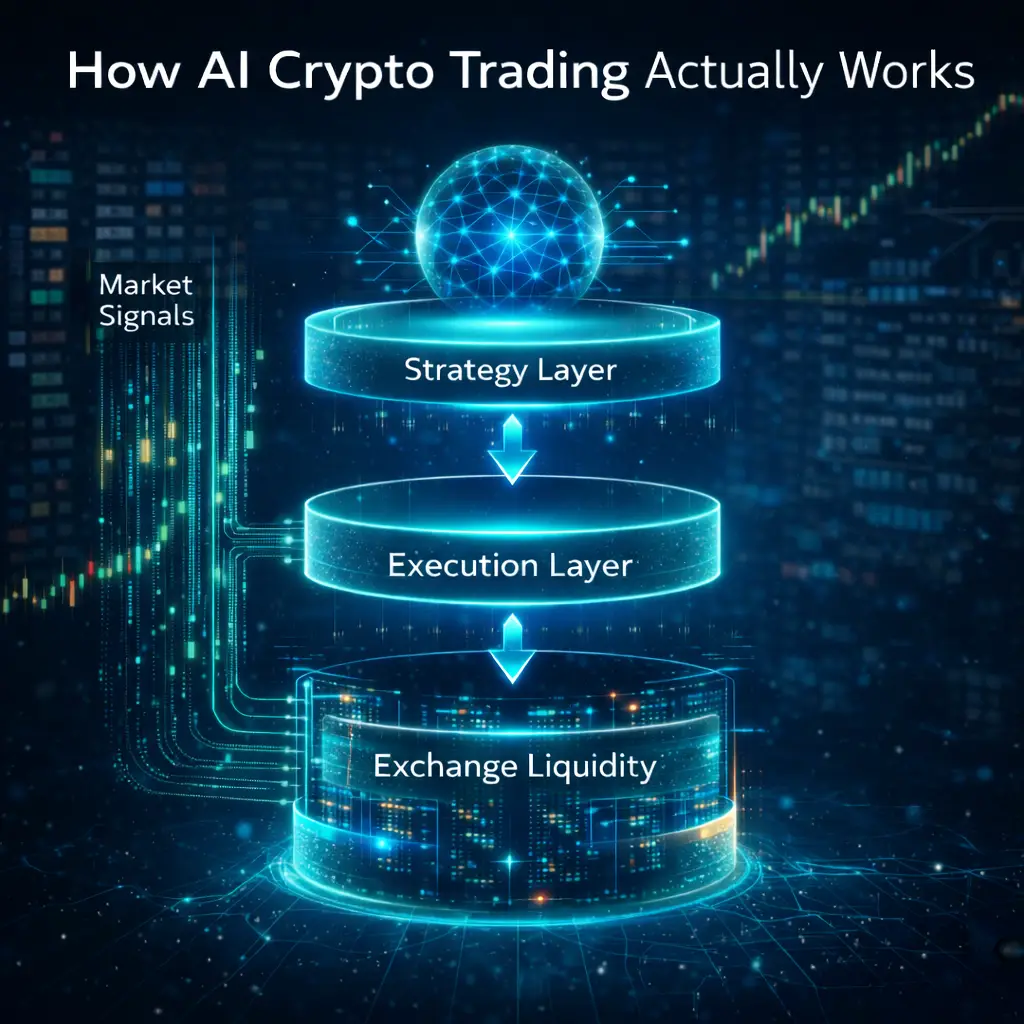
To understand why fee optimization is so often misunderstood, it is necessary to examine where costs actually emerge within an AI trading system. Fees are not isolated variables — they are embedded across different layers of the trading stack, each with its own dynamics and impact on performance.
The Strategy Layer
This is where most retail traders focus their attention.
- platform subscriptions
- strategy or signal fees
- bot configuration limits
These costs are visible, predictable, and relatively easy to control. However, they are rarely decisive for performance. Optimizing this layer alone creates a false sense of efficiency.
The Execution Layer
This is where profitability is won or lost.
- exchange trading fees
- slippage and spread capture
- latency and order routing efficiency
Small inefficiencies at this layer compound rapidly, especially in automated environments where systems operate at high frequency. Even marginal differences in execution quality can determine whether a strategy remains profitable.
The Exchange Layer
This layer defines the economic environment in which the system operates.
- fee tiers and rebate structures
- funding rates and financing costs
- withdrawal and settlement friction
These factors determine whether a strategy remains viable as volume scales. A system that performs well under basic assumptions can become unprofitable once real exchange conditions are applied.
Most traders optimize only the strategy layer because it is visible and familiar. Professional traders design systems that account for all three layers simultaneously. This distinction explains why two bots running the same strategy can produce materially different results — and why fee comparisons that ignore system structure consistently mislead.
Traders who want to understand how these layers integrate into a complete system can explore the AI Crypto Trading Bots Guide (2026), which breaks down strategy design, execution infrastructure, and exchange mechanics in detail. For a broader system-level overview, the AI Trading Bots Hub connects these layers across real-world platforms, strategies, and risk models.
Strategy-Dependent Fee Impact: Why the Same Fees Mean Different Outcomes
Not all AI trading strategies interact with fees in the same way. This is where most traders — and most comparison sites — go wrong. They assume that a “low-fee bot” is universally better. In reality, the importance of each fee layer depends entirely on the strategy being deployed.
A fee structure that supports one strategy can quietly undermine another. Without understanding this relationship, fee comparisons become misleading by design.
Arbitrage Bots: Fees Are the Strategy
Arbitrage strategies operate on extremely small price differences across exchanges or trading pairs.
Typical characteristics:
- very high trade frequency
- thin profit margins per trade
- reliance on speed and execution precision
In this context, fees are not a secondary consideration — they are the strategy.
Even small increases in:
- taker fees
- slippage
- latency
can eliminate the entire arbitrage window. Platform subscription costs are largely irrelevant compared to execution and exchange-layer costs.
For arbitrage systems, the dominant cost layers are:
- Execution Layer
- Exchange Layer
A system with strong logic but inefficient execution will fail regardless of how “cheap” the platform appears.
For a deeper breakdown of arbitrage dynamics, see AI Crypto Arbitrage Bots.
Market Making Bots: Rebates Decide Survivability
Market making strategies generate returns from the bid-ask spread rather than directional price movements.
Key characteristics:
- continuous order placement
- exposure to inventory risk
- sensitivity to spread width and fill quality
Here, the fee structure becomes asymmetric. Maker rebates, fee tiers, and exchange incentives play a central role. A market maker consistently paying taker fees will struggle to remain profitable at scale.
Key cost drivers include:
- maker vs. taker fee differentials
- rebate programs and incentives
- execution efficiency under partial fills
Platform fees matter only after the exchange-level economics are structurally favorable.
Trend & Signal Bots: Platform Fees Matter More
Trend-following and signal-based strategies typically operate at lower frequency.
Common characteristics:
- lower trade count
- larger position sizes
- longer holding periods
Because trading activity is limited, exchange fees and slippage have a smaller cumulative impact. In this context, platform pricing and subscription models become more significant.
For these strategies:
- fixed platform costs carry more weight
- performance fees can materially reduce net returns
- execution inefficiencies are less frequent, but still relevant during volatility
A system that appears inexpensive per trade can still be costly if it relies on aggressive profit-sharing models.
Portfolio & Rebalancing Bots: Frequency Is the Hidden Cost
Portfolio automation strategies rebalance positions based on predefined rules.
Key risks include:
- excessive rebalancing frequency
- unnecessary trades in low-volatility conditions
- cumulative fee impact through repeated execution
In this case, the primary risk is not a single large cost, but continuous small costs that erode capital over time.
Critical evaluation factors include:
- rebalancing thresholds
- fee sensitivity per rebalance
- exchange fee tiers relative to portfolio size
For a deeper analysis of portfolio-level automation, see AI Portfolio Trading Bots.
Futures & Leveraged Bots: Fees Compound with Risk
Futures trading introduces an additional layer of cost through leverage and funding mechanisms.
Key characteristics:
- exposure to funding rates
- higher sensitivity to liquidation thresholds
- amplified impact of fees under leverage
In these environments, fees compound faster due to position size and financing costs. A strategy that appears viable under spot conditions can become structurally unprofitable when applied to leveraged markets.
For more detail, see AI Futures Trading Bots.
The interaction between strategy design and cost structure is central to understanding real-world performance. Traders who want a broader view of how different strategies behave under live market conditions can explore AI Crypto Trading Strategies (2026), where execution dynamics, market structure, and cost sensitivity are analyzed in depth.
Why “Cheapest Bot” Is the Wrong Question
Once fees are evaluated through a strategy lens, a critical insight emerges:
There is no universally cheapest AI trading bot.
There are only:
- fee structures aligned with specific strategies
- fee structures that quietly undermine them
A pricing model cannot be evaluated in isolation. Its impact depends entirely on how a system trades — frequency, execution style, and exchange interaction all determine whether costs remain manageable or compound into structural drag.
Any comparison that ignores strategy behavior will produce misleading conclusions, even when the numbers appear precise.
Traders new to automated crypto markets may benefit from starting with AI Crypto Trading for Beginners, which introduces the core concepts before moving into cost structure and execution dynamics.
Real-World Fee Comparison: Fees in Context, Not on a Price List
Evaluating fees in isolation creates false certainty. What matters is not the fee itself, but how it behaves within a real trading environment. The same bot, running the same strategy, can produce materially different results depending on how its cost structure interacts with trading frequency, execution quality, and exchange conditions.
The following scenarios illustrate how fees function in practice.
Scenario 1: High-Frequency Arbitrage System
Profile
- hundreds to thousands of trades per day
- thin spreads
- multi-exchange execution
Primary cost drivers
- taker fees
- latency-induced slippage
- withdrawal and settlement costs
What matters most
- execution efficiency
- exchange fee tiers
- order routing precision
In this environment, platform pricing becomes irrelevant relative to execution performance. A system that reduces slippage by a few basis points can outperform a “cheaper” alternative by a wide margin. Conversely, a low-cost or free bot with inefficient execution can remain unprofitable even when arbitrage opportunities exist.
Scenario 2: Market Making on a Single Exchange
Profile
- continuous limit order placement
- inventory management
- spread capture
Primary cost drivers
- maker rebates
- partial fill efficiency
- inventory rebalancing costs
What matters most
- exchange incentive structures
- maker-only execution
- fee tier progression
Here, the exchange layer dominates. Systems that fail to optimize maker fees — or unintentionally cross the spread — will consistently underperform, regardless of strategy sophistication.
Scenario 3: Trend-Following or Signal-Based Trading
Profile
- lower trade frequency
- directional exposure
- longer holding periods
Primary cost drivers
- platform subscriptions
- performance fees
- episodic slippage during volatility
What matters most
- pricing transparency
- profit-sharing structures
- capital efficiency
In this setup, fixed costs carry more weight than execution micro-optimizations. A system with low trading fees but aggressive performance cuts can underperform a slightly more expensive platform with a cleaner and more predictable pricing model.
Scenario 4: Portfolio Rebalancing Automation
Profile
- periodic rebalancing
- multi-asset exposure
- long-term orientation
Primary cost drivers
- cumulative exchange fees
- rebalancing frequency
- unnecessary trade execution
What matters most
- configurable thresholds
- trade suppression logic
- exchange fee scaling
The primary risk is not sudden loss, but gradual capital erosion. Systems that rebalance too frequently generate consistent fees without generating proportional returns.
Across all scenarios, a consistent pattern emerges: fees cannot be evaluated independently of system behavior. The same pricing structure can be efficient or destructive depending on how it interacts with execution, frequency, and exchange conditions. This is why professional evaluation focuses on cost dynamics within real trading environments — not static price comparisons.
How Professionals Actually Evaluate AI Trading Bot Fees
Where do fees compound within this strategy?
Which layer dominates cost as the system scales?
Which costs grow with volume — and which remain fixed?
Fee Optimization: How Professionals Reduce Costs
Professional traders treat fee optimization as a continuous process, not a one-time comparison.
Common techniques include:
- prioritizing maker-only execution where possible
- selecting exchanges with favorable fee tier progression
- reducing unnecessary trade frequency
- aligning infrastructure with latency requirements
- avoiding opaque performance-fee models
The objective is not to eliminate fees — that is impossible. The objective is to ensure that total cost remains structurally smaller than the strategy’s edge.
Actual costs vary depending on exchange fee tiers, liquidity conditions, order size, and market volatility. As a result, fee optimization must be evaluated under live trading conditions rather than theoretical assumptions.
Many fee-related failures only become visible in real markets. These dynamics are explored further in AI Crypto Trading Risks, where execution, liquidity, and operational risks are analyzed in depth.
What to Look for When Comparing AI Trading Bot Fees
Comparing AI trading bot fees effectively requires more than reviewing a pricing page. A meaningful evaluation focuses on structure, alignment, and scalability.
Fee Transparency
A reliable platform clearly separates:
- platform fees
- exchange trading costs
- performance or profit-sharing models
If total costs cannot be reconstructed before trading begins, risk is being transferred to the user.
Strategy Alignment
Fee structures must align with strategy behavior:
- high-frequency systems require ultra-low execution costs
- low-frequency strategies must justify fixed platform fees
- portfolio strategies should minimize unnecessary trading
Misalignment between pricing and behavior can quietly erode an otherwise sound strategy.
Execution Control
Fee efficiency is inseparable from execution quality.
Look for:
- maker/taker control
- order type flexibility
- latency awareness
- safeguards against overtrading
Without execution control, theoretical cost advantages rarely translate into real performance.
Exchange Flexibility
Costs are dictated as much by the exchange as by the bot.
Evaluate:
- supported exchanges and fee tiers
- rebate and incentive structures
- withdrawal and funding friction
Platforms restricted to unfavorable exchange conditions impose structural disadvantages.
Scalability Behavior
A fee structure that works at small scale must remain effective as capital increases.
Key questions include:
- do fees improve with volume?
- do infrastructure limits emerge as usage grows?
- does execution quality degrade with larger order sizes?
Scalability is where many retail-focused systems fail.
Conclusion — Fees Are the Strategy Beneath the Strategy
AI trading bots rarely fail because their algorithms are wrong.
They fail because their cost structure is misaligned with the system they operate in.
In automated crypto markets, every strategy competes inside a layered environment shaped by fees, execution quality, and exchange economics. When those layers are not understood — or when costs are evaluated in isolation — even mathematically sound strategies collapse under real-world conditions. What looks profitable in theory erodes silently through slippage, fee compounding, and structural inefficiencies.
This is why professional traders treat fee analysis as a core part of strategy design, not as a pricing detail. They analyze where costs originate, how they compound across the trading stack, and which layer ultimately determines survivability at scale. Optimizing only the strategy layer is never enough.
This perspective sits at the heart of the broader AI Trading Bots Hub, where automated trading is examined as a complete system — connecting strategy design, execution infrastructure, exchange mechanics, and risk management into one coherent framework. Within that context, fees are not an isolated variable, but a structural force that shapes every outcome.
Traders who want to explore this system-level approach in depth can continue with AI Crypto Trading Bots: Complete Guide (2026), which maps how fees interact with execution and exchange layers in real trading environments. Those still building foundational understanding may want to start with AI Crypto Trading for Beginners before deploying capital.
The most important question is not whether an AI trading bot is cheap.
It is whether its fee structure allows your strategy to retain its edge once it meets real markets.
For traders ready to apply this lens to platform selection, the Best AI Crypto Trading Bots (2026) analysis compares systems based on how they handle fees, execution quality, and scalability — not surface-level pricing.
Fees are not a side detail of AI trading.
They are the strategy beneath the strategy.
Frequently Asked Questions
These answers address the most common questions readers have when comparing AI trading bot fees, execution costs, and the hidden factors that affect real crypto trading performance.
What are AI trading bot fees?
AI trading bot fees include all costs involved in running an automated trading system. This can include platform subscriptions, exchange trading fees, execution-related costs such as slippage, and infrastructure expenses. In practice, total cost is not a single number, but a combination of multiple layers that interact with each other.
Which AI trading bot fees have the biggest impact on performance?
Execution-related costs often have the greatest impact on real-world performance. Slippage, latency, and order-routing quality can reduce profitability more than visible platform pricing, especially in high-frequency strategies where small inefficiencies compound rapidly.
Why do cheap AI trading bots often underperform?
Low platform fees do not guarantee low total cost. A bot may look inexpensive on a pricing page but still generate poor results due to slippage, weak execution, or unfavorable exchange conditions. In live markets, a “cheap” bot can become expensive to operate.
Do fees matter more for high-frequency trading strategies?
Yes. High-frequency strategies such as arbitrage and market making are extremely sensitive to fees because profit margins per trade are small. Even minor increases in taker fees, latency, or slippage can eliminate the entire edge. For broader context, see AI crypto trading strategies (2026).
What is the difference between maker and taker fees?
Maker fees apply when you add liquidity to the order book, usually through limit orders. Taker fees apply when you remove liquidity, typically through market orders or instantly matched trades. Maker fees are often lower and may include rebates, while taker fees are usually higher and more damaging for active automated systems.
How does slippage affect AI trading bot performance?
Slippage occurs when a trade is executed at a different price than expected. It acts as a hidden cost that can quietly reduce profitability over time, especially in volatile or low-liquidity markets. For many strategies, slippage is more important than the visible platform fee.
How can traders reduce AI trading bot fees?
Traders can reduce costs by prioritizing maker execution where possible, choosing exchanges with favorable fee tiers, reducing unnecessary trading frequency, and avoiding platforms with unclear pricing or aggressive performance fees. Effective fee reduction depends on strategy design as much as on platform choice.
Are AI trading bot fees different across exchanges?
Yes. Exchanges differ in maker and taker rates, fee-tier structures, rebate programs, withdrawal costs, and funding mechanics. The same strategy can produce different results depending on the exchange used, even when the bot remains unchanged. A deeper exchange-focused perspective will also matter when comparing execution environments.
Do fees affect backtesting results?
Yes. Backtests often underestimate real costs because they assume ideal execution. In live trading, slippage, latency, spread friction, and actual liquidity conditions raise effective costs. This is one reason why backtested profitability often looks better than real market performance.
How do I know if an AI trading bot’s fee structure is fair?
A fair fee structure is transparent, predictable, and aligned with your trading strategy. You should be able to reconstruct total costs before trading begins, including platform pricing, exchange fees, and any profit-sharing model. If total cost remains unclear, risk is being transferred to the user. Traders new to the space may also benefit from starting with AI crypto trading for beginners.
Related Reading
To explore how fees, execution, and strategy interact within professional AI-driven trading systems, the following resources provide deeper context:
- AI Trading Bots Hub — A system-level overview of automated trading, covering strategy design, execution infrastructure, exchange mechanics, and risk management across crypto markets.
- AI Crypto Trading Bots: Complete Guide (2026) — A comprehensive breakdown of how modern AI trading systems are built, from strategy logic to execution and exchange-layer optimization.
- AI Crypto Trading Strategies (2026) — An in-depth look at how different algorithmic strategies behave in live markets, and why cost structures affect each strategy differently.
- AI Crypto Trading Risks — A detailed analysis of execution risk, liquidity risk, operational failures, and why many bots fail despite appearing profitable on paper.
- Best AI Crypto Trading Bots (2026) — A practical comparison of platforms evaluated through execution quality, fee structure, and scalability rather than surface-level pricing.