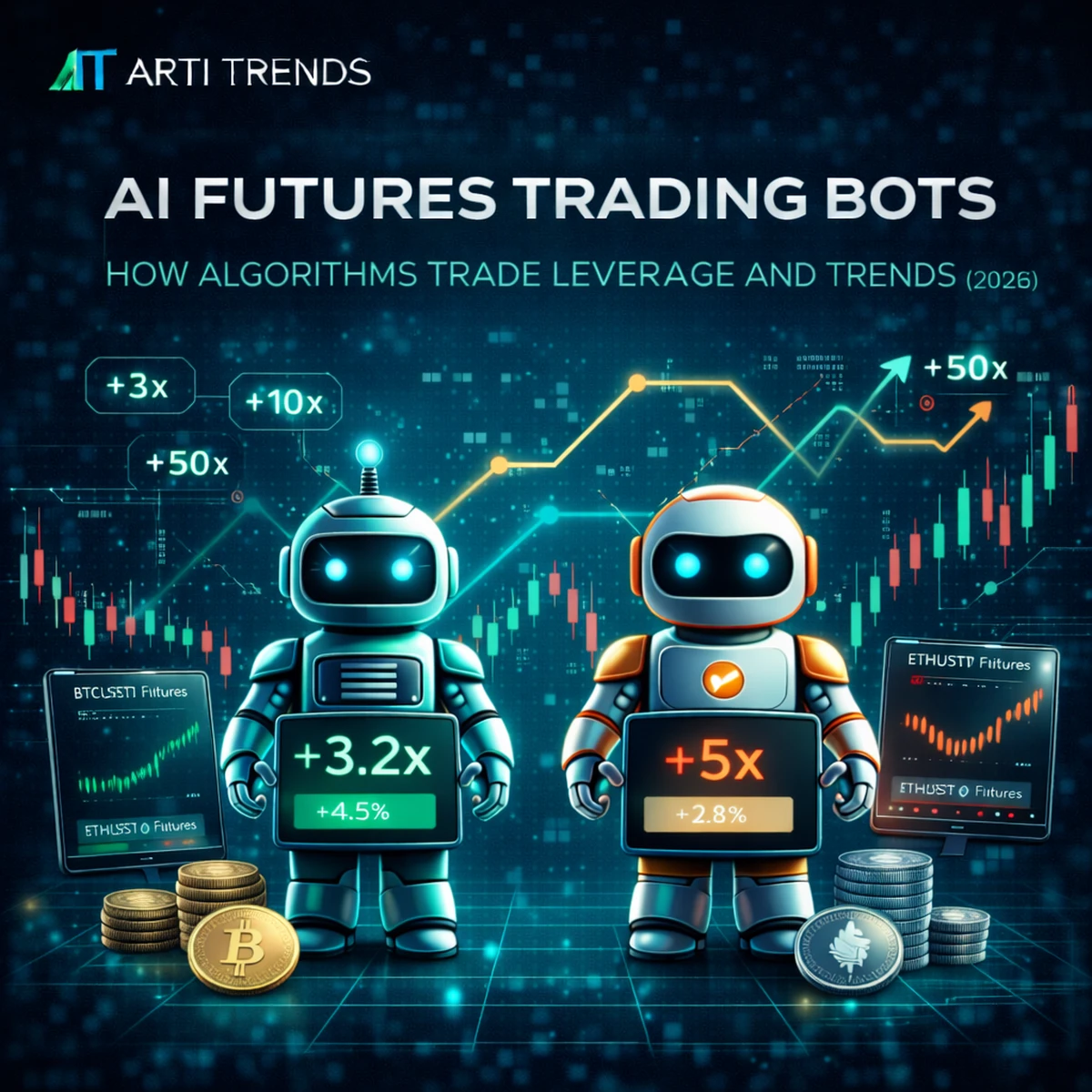
This guide explains how AI futures trading bots operate as execution systems — managing leverage, trends, and risk in modern crypto markets.
Introduction — Why Futures Trading Is an Execution Discipline, Not a Leverage Gamble
Crypto futures trading is often framed as a high-risk shortcut to fast profits.
Leverage gets the attention, liquidations make the headlines, and futures markets are frequently portrayed as a place where traders either win big or blow up quickly.
That framing misses the point.
Futures markets were not designed for gambling. They exist to manage exposure, express directional views efficiently, and control risk in volatile environments. What makes futures dangerous for most retail traders is not leverage itself, but the combination of emotional decision-making, delayed reactions, and inconsistent execution under pressure.
This is where AI futures trading bots change the equation — not by predicting markets, but by enforcing execution discipline.
In 2026, the most effective AI futures trading bots are not prediction engines trying to outguess price movements. They are execution systems, designed to operate between strategy decisions and exchange-enforced risk. Their value lies in consistency: adjusting position size dynamically, managing leverage relative to volatility, reacting instantly to changing market regimes, and executing predefined rules without hesitation or fatigue.
Used correctly, futures bots do not increase risk blindly — they structure risk.
Used incorrectly, they amplify mistakes faster than any human ever could.
This article explains how AI futures trading bots actually work, how algorithms trade leverage and trends in practice, and why futures automation belongs in the execution layer of a professional AI trading stack — not as a shortcut to easy profits, but as a tool for disciplined, systematic exposure in fast-moving crypto markets.
What Makes Futures Markets Different From Spot Markets
Margin, Liquidation, and Time-Based Risk
To understand why AI futures trading bots exist, it is essential to understand how futures markets fundamentally differ from spot markets.
In spot trading, you buy or sell an asset and own it outright. Risk is linear: the price moves up or down, and your position reflects that movement directly. There is no forced exit mechanism built into the market structure itself.
Futures markets work differently.
Futures allow traders to control positions larger than their actual capital by using margin. This introduces leverage, which magnifies both gains and losses. But leverage is only the most visible difference. The deeper distinction lies in how risk is enforced over time.
In futures trading, every position is continuously evaluated against maintenance margin requirements. If losses push the position below that threshold, the exchange will automatically close it through liquidation. Futures trading is therefore not just about being right eventually — it is about surviving volatility along the way.
Another defining feature is the dominance of perpetual contracts and funding rates. Unlike traditional futures with fixed expiration dates, most crypto futures are perpetual. They rely on periodic funding payments to keep prices aligned with the spot market. These funding rates introduce a time-based cost or reward for holding positions, making futures exposure inherently dynamic rather than static.
As a result, futures markets introduce three forms of risk that do not exist in spot trading:
- Price risk, amplified by leverage
- Volatility risk, where sudden price spikes can trigger forced exits even if the longer-term direction is correct
- Time-based risk, where funding payments and margin requirements penalize poor positioning over time
For human traders, managing all three simultaneously is difficult. Emotions interfere, reactions lag, and risk rules are often adjusted in the heat of the moment. Even experienced traders often underestimate how quickly these risks interact during periods of market stress.
For algorithmic systems, this environment is precisely where automation thrives.
AI futures trading bots are designed to operate inside this structure — not to fight it. They monitor margin usage continuously, adjust exposure as volatility changes, account for funding dynamics, and react instantly when predefined risk thresholds are reached.
Understanding these structural differences is essential. Futures bots are not simply “spot bots with leverage.” They are execution systems built specifically for markets where risk is enforced by design — and where discipline matters more than conviction.
Leverage as a Dynamic Variable
How Professional Bots Adjust Exposure in Real Time
Most retail traders treat leverage as a fixed setting.
They choose 5×, 10×, or 20× at entry and leave it unchanged, regardless of what the market does next. In calm conditions this may appear manageable. In volatile markets, it is usually what leads to liquidation.
Professional AI futures trading systems approach leverage very differently — and if you want to see where futures fits inside the full stack, start with AI Crypto Trading Bots: Complete Guide (2026).
Leverage is not a preference. It is a dynamic variable that must adapt continuously to market conditions, account equity, and risk constraints — a principle that sits at the core of systematic approaches outlined in AI Crypto Trading Strategies (2026). The question is never “How much leverage do I want?” but “How much exposure can the system safely support right now?”
This distinction is critical.
In practice, AI futures trading bots adjust effective leverage indirectly through position sizing. When volatility increases, position sizes are reduced. When volatility contracts, exposure can be increased without raising liquidation risk. The leverage number shown in the interface becomes secondary; what matters is the relationship between position size, margin usage, and expected price movement.
This is why professional systems focus on risk-normalized exposure rather than raw leverage — especially once funding costs, liquidation risk, and execution fees are taken into account, as explored in AI Trading Bot Fees Comparison. A 3× leveraged position during extreme volatility can be more dangerous than a 10× position in a stable market. Bots account for this by continuously recalculating exposure based on real-time volatility measures and predefined drawdown limits.
Another advantage of automation is consistency under stress.
When markets move rapidly, human traders tend to freeze, override rules, or “give a trade more room” by increasing leverage or removing stops. AI futures trading bots do the opposite. As volatility rises, they automatically reduce exposure, widen safety buffers, or exit positions entirely if risk thresholds are breached.
This behavior often feels counterintuitive to discretionary traders. Reducing leverage during high opportunity moments can look like missed upside. In reality, it is what allows systems to survive long enough to capture trends when conditions stabilize.
Dynamic leverage control also enables portfolio-level risk management. Instead of evaluating positions in isolation, AI systems assess total account exposure across multiple futures positions. If correlated trades begin moving against the portfolio simultaneously, exposure is reduced globally rather than trade by trade.
This is the point where futures automation moves beyond convenience and becomes infrastructure.
Leverage stops being a blunt instrument and becomes a controlled parameter within a broader execution and risk framework. AI futures trading bots do not make leverage safer by promising better predictions. They make it safer by removing discretion at the moment discretion is most dangerous.
That is why leverage, in professional AI trading systems, is never a static choice. It is a variable that is constantly earned, adjusted, and defended through disciplined execution.
Trend Following in Futures Markets
How Algorithms Trade Direction Without Prediction
Trend following is often misunderstood as a form of prediction.
In reality, it is the opposite.
AI futures trading bots do not attempt to forecast where the market will go. They focus on identifying where the market is already going, and on staying aligned with that direction for as long as conditions remain favorable.
This distinction matters, especially in leveraged markets.
In futures trading, being early but wrong is often worse than being late but disciplined. A premature position can be wiped out by volatility long before a trend actually develops. Trend-following systems are designed to avoid this trap by requiring confirmation, not conviction — a defining principle of systematic approaches explained in AI Crypto Trading Strategies (2026).
Algorithmic trend detection typically relies on a combination of price structure, momentum persistence, and volatility filters. Rather than reacting to single candles or short-term signals, bots evaluate whether directional movement is sustained across multiple timeframes and whether that movement occurs within acceptable risk boundaries.
Just as important is knowing when not to trade.
AI futures trading bots operate with regime awareness. When markets are choppy, range-bound, or dominated by noise, trend-following systems reduce exposure or step aside entirely. This behavior is critical in futures markets, where leverage amplifies losses during false breakouts and whipsaws.
Volatility plays a dual role here. Rising volatility can signal the start of a trend, but it can also indicate instability. Professional systems distinguish between constructive volatility, which supports trend continuation, and destructive volatility, which increases liquidation risk without directional clarity.
This is another area where automation outperforms human discretion.
Human traders tend to increase risk when markets feel exciting and reduce risk when conditions appear calm. AI systems do the opposite. They increase exposure only when trends are confirmed and volatility is contained, and they reduce or exit positions when market behavior becomes erratic — even if price continues moving in the same direction.
Crucially, trend-following futures bots are designed to exit early and often. Small losses are treated as part of the system, not as failures. The objective is not to win every trade, but to remain positioned for the relatively small number of sustained trends that drive the majority of long-term returns.
In this sense, trend following is not about confidence. It is about alignment.
AI futures trading bots do not predict tops or bottoms. They follow trends while risk allows, and they disengage the moment market structure no longer supports disciplined exposure. This ability to participate without attachment is what makes trend-following viable in leveraged crypto markets.
Risk Management in AI Futures Trading
How Bots Survive What Humans Can’t
Risk management is not a feature layered on top of futures trading.
In leveraged markets, it is the system.
Where discretionary traders often think in terms of individual trades, AI futures trading bots operate at the level of continuous exposure control. Every open position is evaluated in relation to margin usage, liquidation distance, volatility, and overall portfolio risk — not in isolation, but as part of a living system.
One of the most critical mechanisms is the management of liquidation buffers. Rather than allowing positions to drift dangerously close to forced closure, bots maintain predefined safety margins. As markets move against a position, exposure is reduced incrementally long before liquidation thresholds are reached. This creates space for volatility without surrendering control.
Stop-loss logic in professional futures systems is also fundamentally different from manual trading. Instead of relying on static price levels, AI bots often use conditional exits tied to volatility, time-in-trade, or structural breakdowns in market behavior. This allows the system to exit positions that no longer meet risk criteria, even if price has not yet hit a traditional stop level.
Portfolio-level risk management is where automation becomes indispensable.
In fast-moving markets, multiple futures positions can become correlated without warning. A sudden macro move can cause several trades to move against the account simultaneously. Human traders tend to address these situations one trade at a time, often too late. AI futures trading bots monitor aggregate exposure continuously. When overall risk exceeds predefined limits, exposure is reduced across the portfolio, not just in the most visible losing position.
Another often overlooked factor is time-based risk. The longer a leveraged position remains open, the more it is exposed to funding costs, volatility shifts, and regime changes. Professional systems account for this by limiting maximum holding times or reducing exposure as trades age without delivering expected results.
This systematic approach changes the role of losses.
Small, controlled losses are not signals of failure. They are the cost of staying aligned with market reality — a perspective that aligns with the broader risk and responsibility framework outlined in AI Crypto Trading Risks & Regulation. What matters is not avoiding losses altogether, but preventing the kind of uncontrolled drawdowns that end trading careers.
AI futures trading bots excel here not because they are smarter than humans, but because they are uncompromising. They do not rationalize losing positions, ignore risk thresholds, or postpone difficult decisions. When risk rules are breached, action is taken automatically.
In leveraged markets, survival is the edge.
Risk management is what allows AI futures trading bots to remain active through periods of extreme volatility, adapt to changing conditions, and continue operating when discretionary traders are forced out. This is the layer where automation proves its true value — not by increasing returns, but by protecting capital when discipline matters most.
When AI Futures Trading Bots Make Sense
Who This Execution Layer Is Actually For
AI futures trading bots are powerful tools — but they are not universal solutions.
Their effectiveness depends less on the software itself and more on who is using it, and for what purpose.
Futures automation makes sense primarily for traders who already think in systems rather than individual trades.
This includes systematic traders who work with predefined strategies and understand that consistency matters more than intuition. For them, AI futures bots act as execution infrastructure, ensuring that strategy logic is applied the same way in calm markets and in periods of stress.
It also includes portfolio-level traders and investors who use futures to manage exposure rather than to speculate aggressively. Futures bots can be used to hedge downside risk, adjust directional exposure dynamically, or complement spot holdings with capital-efficient positions. In these cases, leverage is a tool for efficiency, not amplification.
Another group that benefits from futures automation is active risk-managed traders operating across multiple markets or timeframes. When several positions are open simultaneously, manual oversight becomes unreliable. Bots provide continuous monitoring, enforce portfolio-wide risk limits, and remove the need for constant intervention.
Where AI futures trading bots do not make sense is just as important.
They are poorly suited for beginners who are still learning basic market mechanics, position sizing, or emotional control — for those readers, AI Crypto Trading for Beginners provides a safer and more appropriate starting point. Automation does not compensate for a lack of understanding. In leveraged markets, it often accelerates losses.
They are also not designed for traders seeking constant action or short-term excitement. Futures bots will often stay inactive for extended periods, reduce exposure during volatile phases, or exit trades that still “feel right” to a human trader. This restraint is a feature, not a flaw — but it can be frustrating for those who equate activity with progress.
The common thread among successful users is intent.
AI futures trading bots work best when they are treated as execution layers within a broader trading system. They are tools for enforcing discipline, scaling consistency, and protecting capital — not substitutes for strategy, judgment, or responsibility.
Understanding whether you belong in that category is a critical step. Futures automation rewards preparation and patience. Without those, it offers no shortcuts — only faster feedback from the market.
The Real Risks of AI Futures Trading Bots
What Automation Cannot Protect You From
AI futures trading bots introduce structure, speed, and discipline into leveraged markets — but they do not eliminate risk, a distinction that becomes clearer when comparing automated systems with discretionary approaches in AI Crypto Trading vs Manual Trading. Understanding their limits is essential, especially in environments where losses can escalate quickly.
One of the most underestimated risks is exchange dependency. Futures bots rely entirely on exchange infrastructure: order matching, margin calculations, funding mechanisms, and API stability. When exchanges experience outages, delayed liquidations, or sudden rule changes, even perfectly configured bots can be exposed to unexpected outcomes. Automation cannot compensate for failures in the market infrastructure itself.
Another persistent risk is misconfiguration.
AI futures bots execute exactly what they are told to execute — nothing more, nothing less. Incorrect leverage caps, overly tight risk thresholds, unrealistic backtesting assumptions, or poorly defined exit logic can all turn a disciplined system into a fragile one. In leveraged trading, small configuration errors tend to surface quickly and decisively.
Over-optimization is a more subtle but equally dangerous threat.
Backtests that look flawless on historical data often fail in live markets. Futures markets evolve, liquidity conditions change, and volatility regimes shift. Systems optimized too closely to past behavior may struggle when market structure diverges. AI does not eliminate this risk; in some cases, it amplifies it by executing a flawed model with perfect consistency.
There is also correlation risk, especially in crypto markets. Futures positions that appear diversified can suddenly move in unison during macro events, regulatory news, or sharp liquidity shocks. While bots manage portfolio-level exposure more effectively than humans, they cannot prevent markets from becoming highly correlated under stress.
Finally, there are black swan events — extreme, unpredictable market moves that exceed historical norms. Sudden exchange failures, regulatory interventions, or cascading liquidations can overwhelm even conservative risk models. Automation helps systems respond faster, but it does not make them immune to structural breaks in the market.
Recognizing these risks is not a reason to avoid AI futures trading bots. It is a reason to use them responsibly.
Professional systems treat automation as a risk-management tool, not a guarantee. They assume that models can fail, exchanges can malfunction, and markets can behave irrationally. Capital allocation, leverage limits, and contingency planning are designed with those assumptions in mind.
In futures trading, confidence does not come from believing that a bot will always perform. It comes from understanding exactly where its protections end — and where human responsibility begins.
Futures Bots Inside a Professional AI Trading Stack
Where Execution Discipline Fits Into the Bigger System
AI futures trading bots do not operate in isolation — they form part of a broader execution framework within modern crypto markets, as outlined in AI Crypto Trading Bots: Complete Guide (2026). In professional environments, they function as part of a broader trading system in which different responsibilities are deliberately separated.
Strategy decisions — what to trade, when to enter, and how much risk to accept — are defined upstream. These decisions may come from quantitative models, discretionary frameworks translated into rules, or portfolio-level allocation logic. Futures bots do not question these inputs. They receive them.
Downstream, exchanges provide the market infrastructure itself. Liquidity, order books, funding mechanisms, margin rules, and liquidation processes are all enforced at the exchange level. No bot can override these constraints.
Futures trading bots sit in between.
Their role is to translate strategy intent into real positions under leverage while enforcing execution and risk discipline in real time. They determine how exposure is applied, how margin is consumed, how liquidation buffers are maintained, and how positions are adjusted or closed as conditions change.
This separation is critical.
Traders who treat futures bots as all-in-one solutions often blur the boundaries between strategy, execution, and market access. When results disappoint, it becomes unclear where the failure occurred — in the strategy logic, the execution rules, or the exchange environment itself. Professional systems avoid this by design.
By isolating execution responsibilities, AI futures trading bots make systems more transparent and more resilient. Strategies can be evaluated independently of execution quality. Exchanges can be chosen or replaced without rewriting trading logic. Risk rules can be tightened or relaxed without altering strategic intent.
This layered approach also explains why futures automation scales.
As systems grow more complex — across multiple markets, instruments, and timeframes — execution consistency becomes harder to maintain manually. Futures bots provide that consistency, not by making better predictions, but by ensuring that every decision is applied exactly as intended, even under stress.
In this context, futures bots are not shortcuts to performance. They are infrastructure components.
They exist to enforce discipline, preserve capital, and maintain system integrity in environments where leverage magnifies both opportunity and error. When used as part of a well-defined trading stack, they allow strategies to express themselves cleanly — and allow traders to understand precisely where responsibility lies when outcomes fall short.
Related Reading
The topics below expand on the concepts discussed in this guide, providing deeper context around strategy design, execution models, and cost structures within professional AI crypto trading systems.
- AI Crypto Trading Bots: Complete Guide (2026)
- AI Crypto Trading Strategies (2026)
- AI Crypto Arbitrage Bots
- AI Trading Bot Fees Comparison
FAQ — AI Futures Trading Bots
Do AI futures trading bots predict market direction?
No. Professional futures bots do not attempt to forecast prices. They execute predefined strategies and manage risk dynamically based on market conditions, volatility, and margin constraints.
Are AI futures trading bots safer than manual futures trading?
They can reduce execution errors and emotional mistakes, but they do not eliminate risk. Leverage, exchange failures, and market shocks remain. Bots improve discipline — they do not guarantee safety.
Can beginners use AI futures trading bots responsibly?
In most cases, no. Futures bots assume a solid understanding of leverage, margin, and risk management. Without that foundation, automation often accelerates losses rather than preventing them.
What happens if market conditions change suddenly?
Well-designed bots respond by reducing exposure, exiting positions, or pausing trading based on predefined risk rules. However, extreme events can still exceed model assumptions.
Do AI futures bots replace trading strategies?
No. They operate at the execution layer. Strategy design, risk tolerance, and capital allocation remain human responsibilities.
Is leverage required to use futures bots effectively?
Leverage is inherent to futures markets, but effective systems treat it as a dynamic variable, not a fixed multiplier. Lower effective leverage is often used during volatile conditions.
Conclusion — Futures Bots Don’t Create Edge, They Enforce It
AI futures trading bots are often misunderstood as tools that create advantage through superior intelligence or prediction. In reality, their value lies elsewhere.
They enforce discipline.
In leveraged markets, success is rarely determined by insight alone. It depends on consistent execution, controlled exposure, and the ability to reduce risk precisely when human judgment becomes unreliable. Futures bots excel not because they anticipate markets better than people, but because they apply rules without hesitation, fatigue, or emotional bias.
Throughout this guide, one theme remains constant:
futures trading is an execution problem before it is a strategy problem.
Leverage amplifies everything — good decisions and bad ones alike. AI futures trading bots make leverage usable by transforming it from a static choice into a managed variable, governed by volatility, margin constraints, and portfolio-wide risk limits. They allow traders to participate in trends without attachment, exit positions without regret, and survive conditions that force discretionary traders out of the market.
This does not make futures automation easy, safe, or suitable for everyone. Bots do not replace strategy design, market understanding, or responsibility. They expose weaknesses faster than manual trading ever could. Used without preparation, they magnify mistakes. Used correctly, they create the structure required to operate systematically in fast-moving, leveraged environments.
That is the real role of AI futures trading bots in 2026.
They are not shortcuts.
They are not guarantees.
They are execution infrastructure — one component within a broader AI crypto trading system. For readers looking to understand how futures automation fits alongside other strategies and platforms, this guide connects directly to our in-depth overview in AI Crypto Trading Bots: Complete Guide (2026) and the broader AI Trading Bots Hub.