Published January 12, 2026 · Updated January 26, 2026
Introduction: What AI Crypto Trading Really Means
AI crypto trading does not mean letting a robot gamble with your money.
In 2026, it means using intelligent software systems that analyze market data, manage risk, and execute trades automatically — based on predefined rules and continuously updated models — while you remain in control of the capital.
A modern AI crypto trading bot does three things at the same time:
- It watches the market
It monitors price movements, order books, volume, funding rates, and sometimes on-chain data across multiple exchanges — far more than any human could track manually. - It makes decisions based on data
Instead of reacting emotionally to sudden price moves, the AI evaluates probabilities: trend strength, volatility, momentum, and risk exposure. When certain conditions are met, it decides whether to buy, sell, or wait. - It executes trades automatically
Once a decision is made, the bot sends orders directly to the exchange through a secure API connection. This allows it to act instantly, without hesitation or fatigue.
For beginners, this changes everything.
In 2026, AI crypto trading is no longer experimental — it is becoming the execution layer of digital asset markets.
Traditional crypto trading requires constant attention, technical analysis skills, and emotional discipline — three things most new traders struggle with. AI trading bots remove much of that burden by turning trading into a structured, rules-based process rather than a series of gut-driven decisions.
That does not mean AI eliminates risk. Crypto markets are still volatile and unpredictable. But it does mean that your strategy is applied consistently, even when the market becomes chaotic.
If you want a deeper look at how these systems actually work — including strategy types, risk controls, and professional-grade automation — see our AI Crypto Trading Bots: Complete Guide (2026), which serves as the cornerstone of Arti-Trends’ AI crypto investing coverage.
In the sections that follow, we’ll break this down even further, starting with how AI trading bots actually interact with exchanges and your capital — in plain, beginner-friendly terms.
This beginner guide is part of the AI Crypto Trading Hub on Arti-Trends, where we connect AI trading bots, exchanges, strategies, and risk frameworks into one professional investing system.
- How AI Crypto Trading Bots Work (In Plain English)
- Is AI Crypto Trading Safe for Beginners?
- What You Need Before You Start
- Types of AI Crypto Trading Bots (Beginner Version)
- How Much Money Do You Need to Start?
- How AI Crypto Trading Bots Make Money
- Common Mistakes Beginners Make
- Regulation, Taxes, and What Beginners Need to Know
- Your First Steps Into AI Crypto Trading
- Conclusion — How Beginners Should Approach AI Crypto Trading
- Related Reading
How AI Crypto Trading Bots Work (In Plain English)
To understand AI crypto trading, it helps to stop thinking in terms of “a bot that trades” and start thinking in terms of a connected system.
Every AI crypto trading setup is built around three core components:
You → The AI trading system → The Crypto exchange
You provide the capital and define the risk.
The AI system provides the strategy, decision-making, and automation.
The exchange is where trades are actually executed and liquidity is accessed.
Nothing happens outside this loop.
Every profit and every loss flows through these three parts.
Here is how that system works in practice.
The Three-Layer Model (How Professionals Think About AI Trading)
Most beginners see AI crypto trading as a simple setup: connect a bot to an exchange and let it trade.
Professionals see something very different.
They break every AI-driven trading system into three layers that must work together for any strategy to succeed.
1. Strategy layer
This is the trading logic. It defines what to trade, when to trade, and how much risk to take.
Examples include dollar-cost averaging, grid trading, trend-following, arbitrage, and portfolio rebalancing.
Without a real strategy, AI does not create an edge — it only automates randomness.
2. AI decision & execution layer
This is where artificial intelligence actually operates.
The system processes live data such as price action, volume, volatility, and sometimes on-chain or derivatives data to decide:
• when to enter or exit
• how large a position should be
• when to reduce or increase risk
Two bots can use the same strategy, but the one with better signal filtering, risk control, and regime detection will perform far better.
3. Exchange infrastructure layer
This is where trades are filled in the real market.
Fees, liquidity, slippage, API reliability, and order execution quality determine whether theoretical profits survive reality.
A strategy that looks great on paper can fail simply because execution is too slow or too expensive.
Most retail traders only focus on the first layer — the bot’s features.
Professional traders optimize all three.
If you understand this model, you will avoid many of the mistakes that cause beginners to lose money even when they use advanced AI tools.
Step 1: You connect the bot to an exchange
First, you open an account on a crypto exchange such as HTX, OKX, or another platform that supports automated trading. You then connect your AI bot to that exchange using an API key.
This connection allows the bot to:
- read market data
- check your balances
- place trades on your behalf
Importantly, it cannot withdraw your funds. It only has permission to trade within the rules you set.
Step 2: The bot watches the market
Once connected, the AI bot starts collecting data in real time:
- price movements
- trading volume
- order book activity
- volatility
- sometimes even sentiment or on-chain signals
This data flows continuously into the model that decides how and when to trade.
Step 3: The AI evaluates what to do
Instead of following a fixed rule like “buy when price drops 5%,” modern bots evaluate patterns and probabilities.
They ask questions like:
- Is this move part of a trend or just noise?
- Is volatility increasing or fading?
- How much risk is the portfolio currently taking?
Based on those inputs, the AI adjusts position size, entry timing, and exit logic dynamically.
Step 4: The bot places the trade
When conditions match the strategy, the bot sends an order to the exchange. This might be:
- a market buy
- a limit sell
- a trailing stop
- or a more complex combination
The exchange executes the order, and the result flows back into the bot’s model, which updates its view of the market.
Step 5: The system repeats — continuously
This loop runs 24/7:
observe → decide → execute → learn → repeat
That is the real advantage of AI crypto trading:
it applies a strategy without fatigue, emotion, or distraction, even when markets are moving fast.
For beginners, this is powerful because it removes the two biggest enemies of good trading: panic and overconfidence.
Is AI Crypto Trading Safe for Beginners?
The honest answer is:
AI crypto trading can be safer than manual trading — but only when used correctly.
What makes crypto risky is not just price volatility. It is the way humans react to it. New traders often buy too late, sell too early, and take too much risk when emotions run high. AI trading bots were created to remove that emotional layer and replace it with rules, probabilities, and consistency.
That alone already reduces many beginner mistakes.
But safety in AI crypto trading comes from three specific factors.
1. Risk controls built into the bot
Good AI trading platforms allow you to define:
- maximum position size
- stop-loss limits
- exposure per coin
- how much of your capital is used at any time
These controls prevent a single bad trade or sudden market move from wiping out your account. Without them, even a sophisticated AI model can become dangerous.
2. The quality of the exchange
Your bot does not trade in isolation. It trades through a crypto exchange. If that exchange has poor liquidity, unstable APIs, or regulatory issues, even the best bot can suffer.
That is why choosing a reliable, well-supported platform is just as important as choosing a good AI bot — something we cover in detail in Best Crypto Exchanges for AI Trading.
3. Realistic expectations
AI trading bots are not profit guarantees. They are tools that apply strategies with discipline. When markets are favorable, they can perform well. When markets are chaotic, they can still lose money — just often in a more controlled way than a human trader would.
This is why understanding the risks matters. Sudden news events, exchange outages, and extreme volatility can still affect performance. We explain these dangers in more depth in AI Crypto Trading Risks & Regulation.
Used properly, AI bots help beginners avoid emotional mistakes, stick to a plan, and manage risk more consistently. Used recklessly, they can simply automate bad decisions.
What You Need Before You Start
Getting started with AI crypto trading does not require advanced technical skills — but it does require a few essential building blocks. Having these in place before you begin will save you from most beginner mistakes.
A crypto exchange account
AI trading bots do not hold your money. Your funds stay on a crypto exchange. That means you first need an account on a platform that supports automated trading through APIs.
When choosing an exchange, look for:
- strong liquidity
- reliable uptime
- support for API-based trading
- availability in your country
Some exchanges are better suited for AI trading than others, which is why we maintain a curated list of the Best Crypto Exchanges for AI Trading.
A small amount of trading capital
You do not need thousands of dollars to start. Many bots work with a few hundred dollars. However, having a little more capital makes it easier to diversify and manage risk.
What matters most is not the size of your account, but how much of it you are willing to risk on automation. Start with money you can afford to test and learn with.
Basic risk awareness
Before activating a bot, you should understand:
- that losses are possible
- how much drawdown you can tolerate
- whether you prefer slow growth or active trading
You do not need to be a professional trader — but you do need to know your own comfort level with risk.
A compatible AI trading platform
Finally, you need a bot platform that connects to your exchange and supports the type of strategy you want to run. Some platforms are built for beginners with simple interfaces, while others are designed for advanced users who want full control.
In a later section, we’ll show you how to choose the right one. For now, just know that your exchange and your bot must work well together.
Types of AI Crypto Trading Bots (Beginner Version)
Not all AI crypto trading bots do the same thing. In fact, most confusion — and many losses — come from using the wrong type of bot for the wrong goal.
Here are the main categories you will encounter in 2026.
AI DCA and Accumulation Bots
These bots are designed for people who want to build a crypto position slowly over time. Instead of trying to time the market, they buy in small amounts, more aggressively when prices fall and more cautiously when prices rise.
AI improves this approach by adjusting how much and how often it buys based on volatility and trend strength. This makes it more efficient than manual dollar-cost averaging.
These bots are popular with long-term investors who want exposure to crypto without constant trading.
If you want to see how AI-driven accumulation and long-term strategies work in practice, our AI Crypto Trading Strategies (2026) guide explains how these systems are designed and combined.
AI Grid and Range Bots
Grid bots place buy and sell orders within a price range. When the price moves up and down inside that range, the bot profits from the swings.
AI-enhanced grid bots automatically adjust their range and spacing based on market conditions. They work best in sideways or choppy markets, where prices move but do not trend strongly.
These momentum-driven systems are also known as trend-following strategies, which are covered in depth in AI Crypto Trading Strategies (2026).
AI Volatility and Momentum Bots
These bots are built for active trading. They look for strong price movements and try to enter when momentum builds and exit when it fades.
They trade more frequently and carry more risk, but they can capture profits in fast-moving markets that manual traders often miss.
These momentum-driven systems are also known as trend-following strategies, which are covered in depth in AI Crypto Trading Strategies (2026).
AI Portfolio and Rebalancing Bots
Portfolio bots treat your crypto holdings as a basket of assets. Instead of trading individual coins aggressively, they continuously adjust how much you hold of each asset to control risk and maintain diversification.
This approach is often used by people who want a more stable, long-term way to stay invested in crypto.
These systems are closely related to AI Portfolio Trading Bots, which focus on long-term asset allocation and risk-balanced crypto investing.
Custom and Open-Source AI Bots
Some platforms allow users to build their own strategies or even their own AI models. These tools offer maximum flexibility but also require more technical knowledge.
For most beginners, simpler preset bots are a better place to start.
Advanced users who want full control over execution often move beyond hosted platforms and use tools like Hummingbot, which we analyze in our Hummingbot Review (2026).
How Much Money Do You Need to Start?
One of the biggest myths about AI crypto trading is that you need a large account to make it work.
In reality, most modern AI trading bots can operate with surprisingly small amounts of capital.
For many platforms:
- $100–$300 is enough to test simple strategies
- $500–$1,000 gives more flexibility and smoother performance
- Larger accounts simply scale the same logic
What matters far more than the amount of money is how that money is deployed.
AI bots usually divide your capital into multiple smaller positions. This allows them to:
- enter trades gradually
- reduce risk per trade
- adapt to volatility
A bot running on $300 with good risk controls can be far safer than a bot running on $10,000 with aggressive settings.
The most important rule is to start with an amount you are comfortable learning with. AI trading is not something you switch on and forget forever. You will want to observe how the bot behaves, how it handles drawdowns, and whether its strategy fits your temperament.
Once you understand how it performs, you can always scale up.
How AI Crypto Trading Bots Make Money
AI crypto trading bots do not make money because they are “smart.”
They make money because they apply a trading strategy with discipline, speed, and consistency.
Every profitable bot is built around one or more of these basic ideas.
Buying low and selling high — repeatedly
Some bots focus on volatility. They buy when prices dip and sell when prices rise, capturing small profits over and over again.
AI improves this by:
- detecting when volatility is increasing
- adjusting order size based on risk
- avoiding overtrading when conditions are poor
This works best in choppy or sideways markets.
Following trends
Trend-following bots look for markets that are moving strongly up or down. When the AI detects momentum building, it enters a position and tries to stay in the move until the trend weakens.
This is how many professional traders operate — AI just executes it faster and without emotional hesitation.
Exploiting inefficiencies between exchanges
Arbitrage bots compare prices across different exchanges. When Bitcoin is cheaper on one exchange than another, the bot buys on the cheaper one and sells on the more expensive one.
These opportunities are small and short-lived, but AI can spot and execute them far faster than a human.
Managing risk while trading
A good bot does not just try to make money — it tries to not lose too much when it is wrong.
AI adjusts:
- position sizes
- stop-loss levels
- how much capital is active at any time
This is why some bots can survive long losing streaks without blowing up an account.
Common Mistakes Beginners Make
Most people do not lose money with AI crypto trading because the technology fails.
They lose money because they use it the wrong way.
Here are the mistakes that matter most.
Starting with too much money
Beginners often assume a bot that works with $200 will work even better with $10,000. That is not how trading works. Larger positions magnify both gains and losses.
Starting small gives you time to understand how the bot behaves before real risk is involved.
Choosing the wrong type of bot
A volatility bot is not suitable for a conservative investor. A long-term accumulation bot is not suitable for someone chasing quick trades.
Many losses come from using a strategy that does not match the trader’s goals or temperament.
Over-optimizing and constantly changing settings
Tweaking a bot every day based on short-term results usually makes performance worse. AI strategies need time to play out.
The goal is to let the system operate consistently, not to interfere whenever the market moves.
Ignoring risk controls
Stop-losses, maximum position sizes, and drawdown limits exist for a reason. Turning them off in pursuit of higher returns is one of the fastest ways to blow up an account.
Believing marketing instead of data
Some platforms advertise unrealistic returns. A good AI trading bot focuses on controlled growth and survival through bad markets — not flashy screenshots.
Regulation, Taxes, and What Beginners Need to Know
AI crypto trading does not exist outside the law.
Even though the trading is automated, you are still responsible for what happens to your money — including compliance, reporting, and taxes.
Here are the most important things beginners should understand.
Crypto trading is regulated differently by country
Some countries allow crypto exchanges to operate freely. Others require strict licensing, KYC checks, and reporting. Before you use any AI trading bot, make sure the exchange it connects to is legally accessible in your region.
Using an unlicensed platform can put your funds at risk — even if the AI strategy itself is sound.
You are responsible for taxes
AI bots do not pay taxes for you.
Every trade they execute may create:
- capital gains
- capital losses
- taxable income
In most jurisdictions, crypto trading profits must be reported, even if they were generated by an automated system. Many bot platforms allow you to export full trade histories for tax reporting.
Regulation is increasing, not decreasing
Governments around the world are paying more attention to crypto trading, AI, and financial automation. That means:
- better consumer protection
- but also more compliance requirements
Choosing reputable platforms now reduces the risk of future account freezes or legal issues.
AI trading is powerful — but it still operates inside the real financial system. Understanding that is part of using it responsibly.
In the next section, we’ll bring everything together and show you how to move forward safely as a beginner.
Your First Steps Into AI Crypto Trading
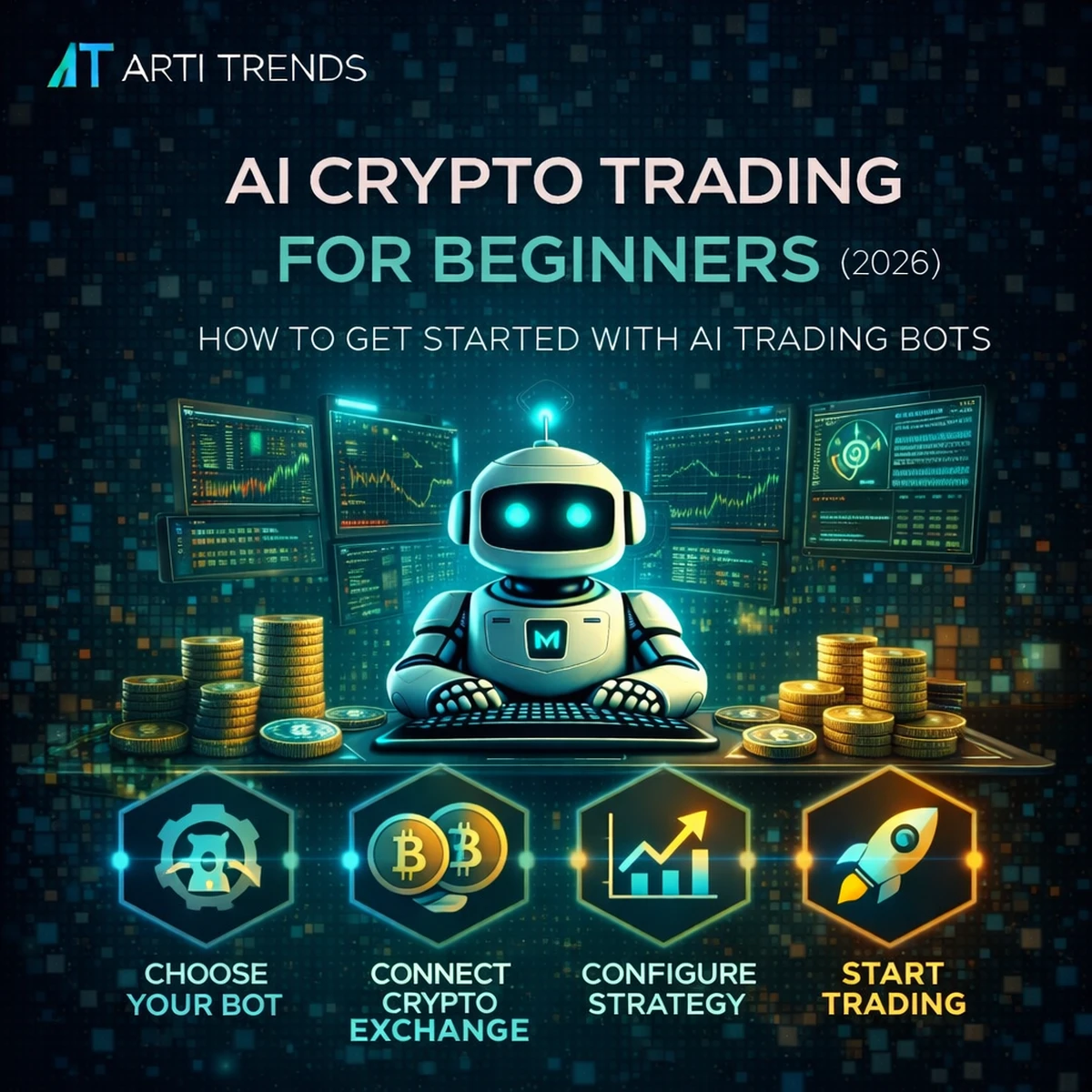
By now, you understand what AI crypto trading is, how it works, and what risks are involved. The next step is not to find “the most profitable bot” — it is to start in a way that lets you learn without unnecessary risk.
Here is a simple, safe path that works for most beginners.
1. Choose a reliable exchange
Start with a well-established crypto exchange that supports API-based trading and operates legally in your country. Liquidity, stability, and compliance matter far more than flashy features.
We maintain an updated list of the Best Crypto Exchanges for AI Trading to help you make that choice.
2. Pick a beginner-friendly AI bot
Look for a platform that offers:
- simple setup
- clear risk controls
- transparent performance tracking
You do not need advanced features at the start — you need stability and clarity.
Our Best AI Crypto Trading Bots of 2026 guide compares the platforms that are most suitable for beginners.
3. Start with conservative settings
Choose low leverage, small position sizes, and limited capital exposure. The goal of your first weeks is not maximum profit — it is to understand how the system behaves.
4. Observe, don’t interfere
Let the bot run. Watch how it reacts to market movements. Learn how drawdowns and recoveries work. This experience is far more valuable than short-term gains.
5. Scale only after you understand the risk
Once you are comfortable with how the AI trades and how it handles losses, you can gradually increase capital or try more advanced strategies.
This is how professional traders build automated systems: slowly, methodically, and with respect for risk.
Conclusion — How Beginners Should Approach AI Crypto Trading
AI crypto trading is not about finding a shortcut to profits.
It is about building a structured, disciplined way to participate in highly volatile digital markets using data, automation, and risk controls instead of emotion.
For beginners, this is powerful. It allows you to:
- stay invested without staring at charts
- follow a consistent strategy
- avoid many of the mistakes that ruin manual traders
The next step is not to guess — it is to choose the right tools for the way you trade.
If you want to understand the full mechanics of AI-driven crypto trading — from strategy design to portfolio automation — read our AI Crypto Trading Bots: Complete Guide (2026), which serves as the cornerstone of our AI trading coverage.
If you want to see how everything fits together — strategies, exchanges, risk management, and execution — the AI Crypto Trading Hub connects the full AI-driven investing system in one place.
If you are ready to explore actual platforms, compare features, and see which bots are best suited for beginners and experienced traders alike, visit our Best AI Crypto Trading Bots of 2026 — where we break down the leading AI trading systems in real-world terms.
And if you want to see how AI fits into a broader investing strategy across crypto, stocks, and ETFs, our AI Investing Hub connects the entire ecosystem.
You do not need to rush.
You need to start with clarity.
That is how AI becomes an advantage — not a risk.
Related Reading
AI Crypto Trading Ecosystem
- AI Crypto Trading Bots: Complete Guide (2026) – A complete breakdown of how AI bots, strategies, and exchanges fit together
- AI Crypto Trading Strategies (2026) – Learn how grid, arbitrage, and trend-following bots actually work
- AI Crypto Trading Risks & Regulation – Understand legal, financial, and operational risks before you scale
- AI Crypto Trading vs Manual Trading – See how automation compares to human decision-making
Platforms & Tools
- Best AI Crypto Trading Bots of 2026 – Compare Cryptohopper, Bitsgap, 3Commas, and more
- Best Crypto Exchanges for AI Trading – Where AI bots perform best in real markets
- AI Trading Bots on HTX – How low-fee execution improves bot profitability
Advanced Strategies
- AI Crypto Arbitrage Bots – How bots profit from price differences across exchanges
- AI Futures Trading Bots – Using AI for leveraged and trend-based crypto trading
- AI Portfolio Trading Bots – Long-term, automated crypto portfolio management