Capture
Input LayerIdeas, prompts, notes, documents, research, source material, and structured context enter here.

A practical framework for understanding how AI tools work together in real workflows. Instead of treating tools as isolated apps, Arti-Trends maps them by their role in how work flows.
AI Workflow Framework
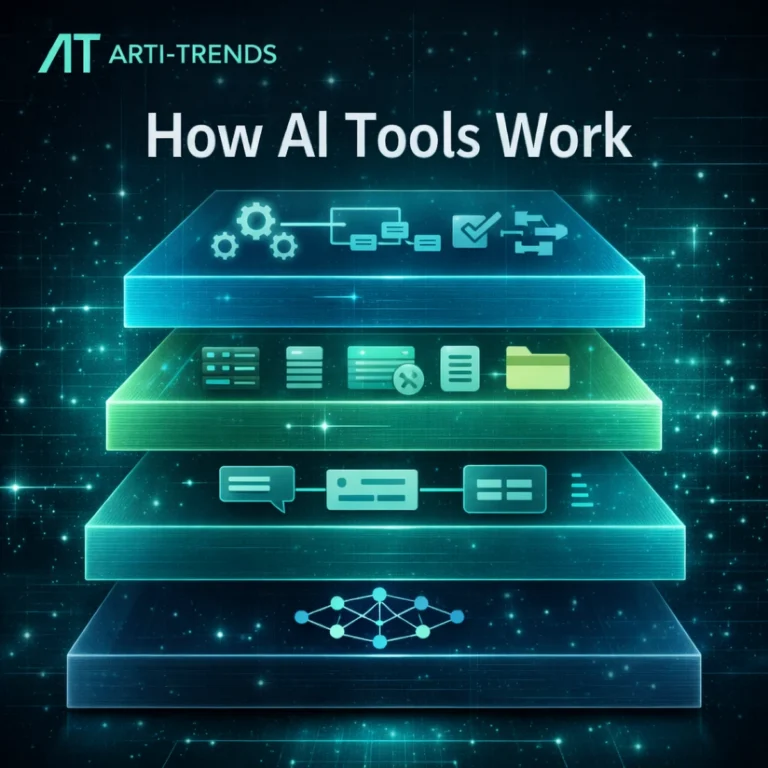
The Arti-Trends Workflow Stack™ helps explain how AI tools support real work by role, not just by feature. Instead of viewing tools as isolated apps, this framework maps where they add value across the workflow: capturing ideas, creating output, refining quality, executing tasks, and learning from results.
The Arti-Trends AI Workflow Method™ follows five connected stages. Each stage answers a different question in the workflow: what enters the system, what gets produced, how it is improved, how it becomes real-world value, and how outcomes feed back into the next cycle.
Ideas, prompts, notes, documents, research, source material, and structured context enter here.
AI transforms structured input into drafts, code, visuals, summaries, designs, and usable outputs.
Raw output is edited, optimized, reformatted, clarified, polished, and made stronger for real use.
Work is published, automated, integrated, routed, deployed, or executed in live operational systems.
Outcomes are measured, analyzed, monitored, and turned into insight that improves the next cycle.
Most AI failures do not happen inside a single tool. They happen between stages. Weak capture leads to poor creation, skipped refinement lowers quality, and output without execution never becomes real value. The Arti-Trends AI Workflow Method™ exists to reduce that friction.
Each stage plays a different role inside the system. Tools should be evaluated not only by features, but by where they fit in the workflow and how much friction they remove between capture, creation, refinement, execution, and learning.
What do I start with?
Ideas, prompts, notes, documents, research questions, source material, and structured context all enter here. This stage defines the quality ceiling for everything that follows.
What does AI produce?
First drafts, text, visuals, code, summaries, videos, design outputs, and structured responses are generated here from guided input and model capabilities.
How do I improve it?
Raw output gets edited, optimized, rewritten, reformatted, and polished into something stronger, clearer, more accurate, and more usable in real workflows.
How does it become real value?
Work is published, automated, integrated, routed, or deployed into systems that generate operational, financial, or strategic outcomes in the real world.
What do I improve next?
Outcomes are analyzed, monitored, evaluated, and turned into insight that improves the next workflow cycle. This is where workflows begin to compound.
Why this is not linear
Strong workflows do not stop after execution. Every result creates feedback. Every insight improves capture. That loop is where durable AI advantage is built.
Execution is where AI stops being output and becomes real-world value. On Arti-Trends, this typically happens in three directions. Choose the path that matches your workflow.
The framework stays the same, but the outcome depends on the workflow you are building. These three examples show how capture, creation, refinement, execution, and learning come together in real use cases.
A typical editorial workflow starts with research and prompts, moves through drafting and refinement, and ends with publication plus performance analysis.
In automation workflows, AI output is routed into integrations, task systems, and agents that reduce manual work and create repeatable operational processes.
In trading workflows, signals and structured strategy are refined into rule-based systems that execute in live markets and improve through performance feedback.
The Arti-Trends AI Workflow Method™ helps readers understand where tools fit, how they connect, and where value is actually created. It is the framework behind our tool reviews, trading bot evaluations, and practical AI infrastructure coverage.
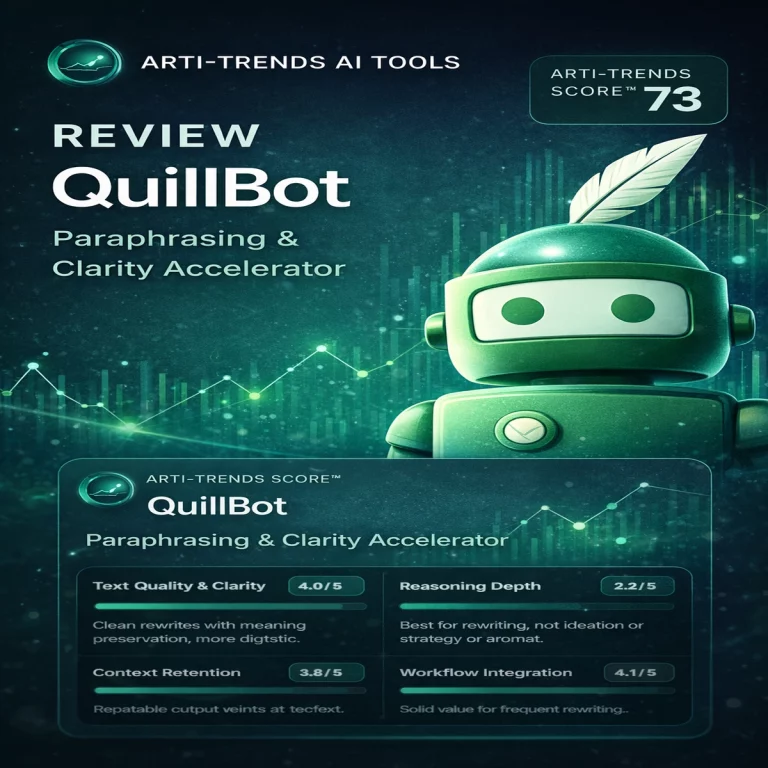
Best for fast rewriting and clarity upgrades in academic and content workflows — especially for students and non-native English writers who want low-friction paraphrasing.