
In 2024 there were only a few hundred widely used AI tools. Two years later the number has expanded dramatically. By early 2026 the ecosystem has grown to well over ten thousand tools across writing, design, software development, marketing, automation, research, and financial analysis. Artificial intelligence is rapidly becoming a new software layer on top of traditional applications. Instead of manually performing repetitive digital work, professionals increasingly rely on AI assistants that help generate content, analyze information, automate workflows, and accelerate decision-making.
The timeline below illustrates how these phases build on each other and where the greatest productivity gains are beginning to emerge.
Table of Contents
ToggleAI Tools Evolution Timeline
From generation to workflow coordination to autonomous execution, the AI tools landscape is moving through three increasingly advanced stages.
The first wave focused on producing text, images, code, and other outputs from prompts.
The second wave embeds AI into professional processes to reduce friction across multi-step workflows.
The next phase introduces systems that can complete increasingly autonomous multi-step digital tasks.
For many users the challenge is no longer discovering AI tools. The real challenge is understanding which tools genuinely improve real workflows and which ones primarily rely on marketing claims. The AI tools ecosystem has become large enough that navigation itself has become a problem. Platforms such as the AI Tools Hub on Arti-Trends attempt to address this by organizing tools by category and real-world use case rather than by hype or launch momentum.
Key Takeaway
The AI tools landscape is evolving rapidly from simple content generation toward integrated workflow automation and increasingly autonomous AI agents. While early generative AI platforms introduced millions of users to artificial intelligence, the real productivity gains are now emerging from tools that streamline entire workflows and coordinate tasks across multiple applications. As the ecosystem continues to expand, the most valuable skill will not be simply using AI tools, but understanding where they fit within real professional workflows and how they can meaningfully improve efficiency, decision-making, and output quality.
The Rapid Expansion of the AI Tools Ecosystem
The rapid growth of the AI tools landscape has been driven by advances in large language models, multimodal AI systems, and accessible cloud infrastructure. Developers no longer need to train their own artificial intelligence models from scratch. Instead they can build powerful software on top of existing AI infrastructure and focus on solving specific workflow problems. This shift has dramatically lowered the barrier to entry and accelerated innovation across the industry.
Thousands of tools have appeared across several major categories. Writing assistants help generate and edit text, image generation platforms create visual content, and video tools automate editing and production tasks. Coding assistants support developers by generating or refactoring code. Research tools summarize complex documents or extract insights from large datasets. Automation platforms connect different software systems and streamline repetitive tasks. Financial tools increasingly apply AI to trading strategies, portfolio analysis, and market monitoring.
This expansion resembles the early stages of the mobile app economy, when smartphones created an entirely new category of software. The difference today is that many of these applications are not simply tools but AI-powered assistants designed to automate professional tasks. Readers exploring this ecosystem often begin with curated directories such as the AI Tools Hub on Arti-Trends, where tools are categorized by function and industry rather than simply listed by popularity.
From Generative AI to Workflow AI
The first generation of AI tools focused primarily on generative capabilities. Users experimented with generating blog posts, images, and code snippets. These tools demonstrated the potential of artificial intelligence but they addressed only a limited portion of professional workflows.
The next phase of development is centered around workflow AI. Instead of producing isolated outputs, these tools integrate artificial intelligence directly into ongoing work processes. Marketing platforms can generate campaign structures, content calendars, and ad copy simultaneously. Coding assistants such as Cursor provide real-time support while developers write and debug software. Automation tools like Zapier AI connect multiple applications and trigger actions across entire digital workflows. Research assistants summarize reports and highlight key insights in seconds.
In this model artificial intelligence becomes less of a standalone tool and more of a collaborative layer embedded inside professional software environments. The real value of AI increasingly lies not in content generation but in reducing friction inside everyday workflows.
The Three Phases of the AI Tools Evolution
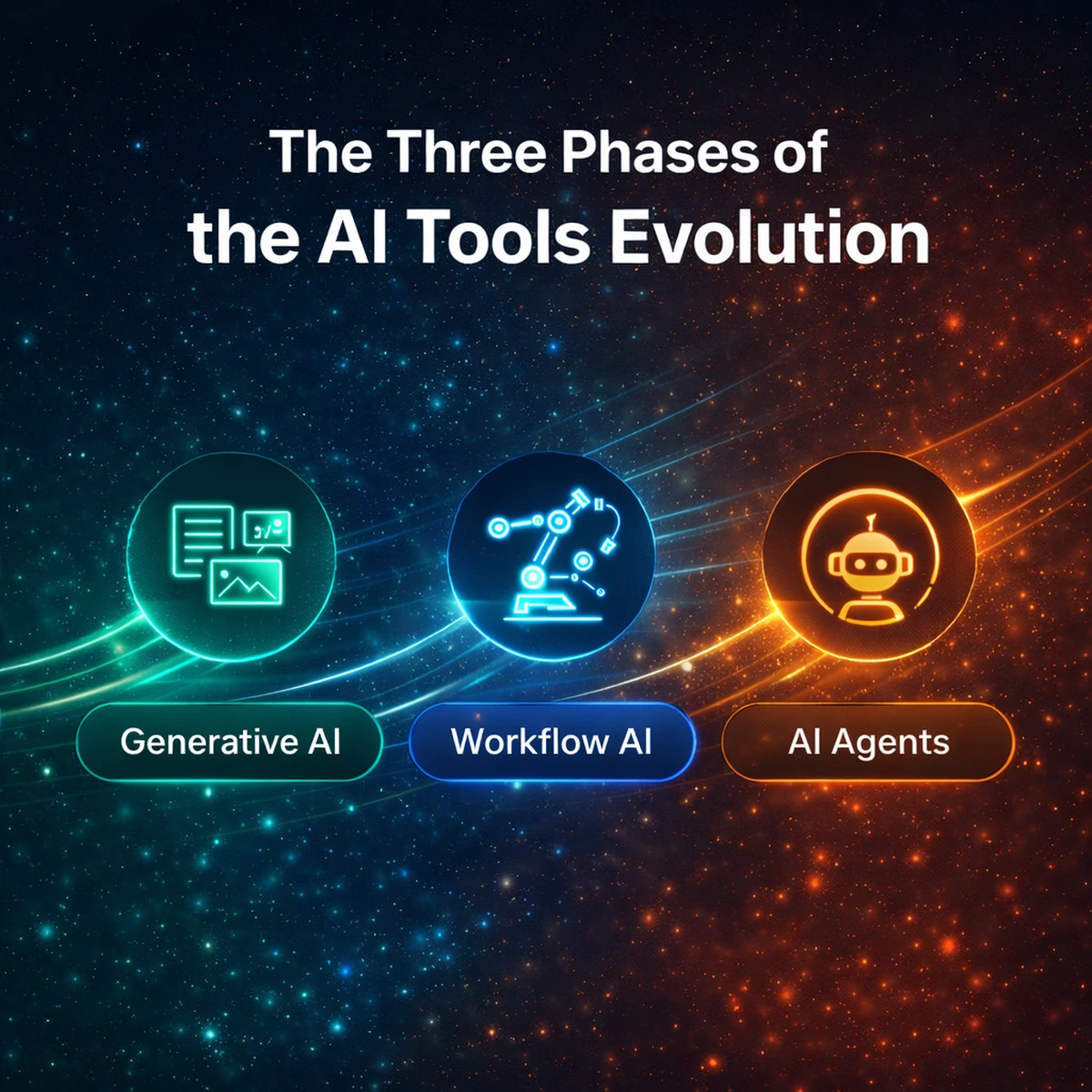
The development of AI tools can be roughly divided into three stages. The first stage focuses on generative AI systems that produce text, images, or code. Examples include platforms such as ChatGPT and Midjourney, which introduced millions of users to the capabilities of artificial intelligence. These tools are particularly useful for experimentation and creative tasks.
The second stage involves workflow AI systems that integrate artificial intelligence directly into professional processes. Tools such as Cursor for software development or Zapier AI for workflow automation fall into this category. These platforms do not simply generate content but help coordinate and automate complex tasks across multiple applications.
The third stage is the emergence of AI agents. These systems are designed to execute multi-step tasks with minimal human intervention. Early platforms such as MultiOn and Adept illustrate this direction, where AI systems may eventually research information, coordinate tasks across applications, and complete objectives autonomously.
While generative AI introduced the technology to a wide audience, workflow AI and autonomous agents are likely to drive the most significant productivity gains in the coming years.
The progression from generative tools to workflow automation and ultimately to autonomous AI agents can be summarized in three distinct phases. The table below provides a simplified overview of how these stages differ in terms of capabilities, typical tools, and primary use cases.
| AI Phase | Example Tools | Core Capability | Best For |
|---|---|---|---|
| Generative AI | ChatGPT, Midjourney | Generate text, images, and code outputs on demand. | Creators, experimentation, and fast content production. |
| Workflow AI | Cursor, Zapier AI | Automate multi-step processes across tools and workflows. | Professionals, operators, and teams looking to improve efficiency. |
| AI Agents | MultiOn, Adept | Execute increasingly autonomous multi-step digital tasks. | Emerging enterprise use cases and advanced automation scenarios. |
Big Tech Is Accelerating the AI Tools Race
Large technology companies are rapidly integrating artificial intelligence into their products. AI assistants are increasingly embedded inside productivity suites, browsers, software development tools, and creative applications. Instead of using separate AI platforms, users will increasingly interact with AI directly within the software they already use.
At the same time, independent startups continue to launch highly specialized AI tools focused on narrow but valuable problems. These niche platforms often outperform larger systems in specific workflows. For example, some tools focus exclusively on coding efficiency, while others specialize in marketing automation, data analysis, or financial trading strategies.
The coexistence of large platform ecosystems and specialized tools creates a highly dynamic market. For users, understanding the differences between these systems is becoming increasingly important. Independent analysis platforms such as the AI Tools Reviews section on Arti-Trends aim to clarify how different tools function and where they provide measurable value.
The Hidden Challenge: Too Many AI Tools
The explosive growth of the AI tools ecosystem has created an unexpected challenge. The market has become saturated with new platforms, each claiming to improve productivity or automate complex tasks. For professionals evaluating AI software the difficulty now lies in identifying which tools deliver genuine workflow improvements.
Many tools promise automation but provide limited integration with existing systems. Others offer impressive demonstrations but struggle to deliver consistent results in real-world environments. Without structured evaluation methods it becomes difficult to compare tools objectively or understand their long-term usefulness.
This growing complexity explains why curated directories and structured evaluation frameworks are becoming increasingly valuable. As the ecosystem expands, users need reliable ways to identify tools that genuinely improve productivity rather than simply adding another layer of software complexity.
How Arti-Trends Evaluates AI Tools
Arti-Trends evaluates AI tools as workflow infrastructure rather than novelty software. The goal is not to highlight the most impressive technology but to identify tools that create measurable improvements inside real professional environments.
Each tool is assessed within its functional category using a structured evaluation methodology. This framework examines workflow efficiency, usability, automation capabilities, integration with existing software ecosystems, and long-term reliability. Tools that perform well across these criteria are more likely to deliver consistent productivity gains.
By applying a consistent methodology across categories, Arti-Trends helps readers compare tools objectively and understand where each platform fits within the broader AI ecosystem. The complete directory of categorized tools is available through the AI Tools Hub on Arti-Trends.
A simple approach is to evaluate tools based on a small number of practical criteria. At Arti-Trends, we explore this topic in more depth in our guide on how to choose the right AI tools for your workflow, but the core principles remain straightforward.
Top Workflow AI Trends Emerging in 2026
Several trends are shaping the next generation of AI tools. One of the most significant developments is the integration of AI copilots directly into existing software platforms. Instead of switching between multiple applications, users increasingly interact with AI features inside the tools they already use.
Another major trend is cross-application automation. AI systems are beginning to coordinate tasks across multiple software platforms, enabling workflows that previously required manual coordination between different tools.
Multimodal capabilities are also expanding rapidly. New AI systems can work simultaneously with text, images, video, and code, allowing tools to handle more complex workflows.
Finally, the emergence of autonomous AI agents suggests that artificial intelligence may soon move beyond assistance toward partial task autonomy. These systems could eventually manage multi-step processes such as research, reporting, or workflow coordination with minimal human supervision.
Together these developments indicate that artificial intelligence is evolving into a coordination layer for digital work.
How to Choose the Right AI Tool in 2026
With thousands of tools available, selecting the right platform requires a focus on practical outcomes rather than novelty features. The most useful tools are those that reduce friction inside existing workflows rather than introducing additional complexity.
A simple approach is to evaluate tools based on three criteria. The first is whether the tool reduces time or effort in a specific workflow. The second is whether it integrates with the software systems already used by the organization or individual. The third is whether the tool delivers consistent results over time rather than producing unpredictable outputs.
Tools that perform well across these criteria are more likely to provide lasting productivity benefits.
Final Thoughts
The AI tools ecosystem is expanding faster than almost any other segment of the software industry. What began as a handful of generative AI platforms has evolved into a vast ecosystem of specialized tools designed to support nearly every professional task.
As this landscape continues to grow, the key challenge for users will not be accessing AI technology but understanding how different tools fit into real workflows. Artificial intelligence is increasingly becoming an infrastructure layer that connects and enhances existing software systems.
Platforms that provide structured analysis, independent evaluation, and curated directories will therefore play an increasingly important role in helping professionals navigate the rapidly evolving AI software landscape.
FAQ – AI Tools Evolution
What is the difference between generative AI and workflow AI?
Generative AI tools focus primarily on producing content such as text, images, or code from user prompts. Examples include systems that write articles, generate visuals, or produce programming snippets.
Workflow AI tools go a step further. Instead of generating isolated outputs, they integrate artificial intelligence directly into professional workflows. These systems can coordinate multiple steps, connect different applications, and automate repetitive processes across a workflow.
In practice, this means generative AI helps create individual outputs, while workflow AI helps manage and automate entire tasks or processes.
What are AI agents?
AI agents are systems designed to perform multi-step tasks with minimal human intervention. Unlike traditional AI tools that respond to individual prompts, AI agents can plan actions, interact with multiple applications, and execute tasks autonomously.
Examples of potential AI agent capabilities include researching information, summarizing documents, coordinating workflows across software tools, and executing complex digital tasks.
While the technology is still developing, AI agents are expected to become a major part of future digital workflows.
Why are AI tools evolving so quickly?
Several factors are driving the rapid growth of the AI tools ecosystem. Advances in large language models and multimodal AI systems have made it easier for developers to build powerful applications.
At the same time, cloud infrastructure and AI APIs allow startups to launch new tools without building their own models from scratch. This dramatically reduces development time and encourages rapid innovation.
As a result, thousands of AI tools have appeared across industries such as marketing, software development, research, design, and finance.
How do you choose the right AI tool?
Choosing the right AI tool depends on how well it fits into an existing workflow. The most effective tools are those that reduce friction in everyday tasks rather than adding additional complexity.
Three practical questions can help evaluate an AI tool:
Does the tool save time in a real workflow?
Does it integrate with existing software systems?
Does it produce consistent and reliable results?
Tools that meet these criteria are more likely to provide lasting productivity benefits.
Will AI agents replace traditional software?
AI agents are unlikely to replace traditional software completely. Instead, they are expected to operate as an additional layer that interacts with existing applications.
Rather than replacing software tools, AI agents will increasingly coordinate them. They may automate tasks across different platforms, assist with decision-making, and reduce the amount of manual interaction required to complete complex workflows.