
Introduction
For centuries, creativity was humanity’s most mysterious and defining gift — emotional, intuitive, unpredictable. Then came artificial intelligence.
Today, AI can write, paint, compose, design, and brainstorm. It doesn’t simply mimic creativity; it reshapes it. Rather than replacing imagination, AI expands its reach, giving creators new tools to explore ideas at a scale never seen before.
This article explores how AI and creativity are converging, why it matters for artists, businesses, and innovators, and how humans and machines are beginning to co-create the future. For a broader foundation, read What Is Artificial Intelligence? The Ultimate Guide — the cornerstone article that explains how AI actually works beneath the surface.
What Is Creative AI
Creative AI, also known as generative AI, refers to systems designed to produce original content such as text, images, music, or video by learning from existing examples. Unlike traditional programs that follow explicit instructions, creative AI models analyze millions of human creations to recognize patterns — then generate new outputs that blend novelty with familiarity.
The underlying technology includes neural networks and large language models capable of predicting and remixing creative elements like rhythm, structure, tone, and color. Research from PubMed Central (PMC) shows that generative AI can enhance perceived creativity when humans use it as inspiration. However, overreliance may reduce overall originality — proving that AI still needs human guidance to stay meaningful.
AI doesn’t diminish creativity; it democratizes it. What photography once did for painting, AI now does for imagination.
The Psychology of Creativity and AI
To understand how AI transforms creativity, we must look at the human mind. Creativity involves two types of thinking: divergent thinking — generating many ideas — and convergent thinking — selecting the best ones. AI excels at the first but lacks emotional judgment for the second.
Humans interpret meaning; machines multiply options. This makes AI a perfect partner for brainstorming and early exploration, while humans add emotion, ethics, and storytelling. Psychologists note that creativity thrives at the intersection of logic and chaos — exactly where AI operates best when guided by human curiosity.
How AI Enhances Human Creativity
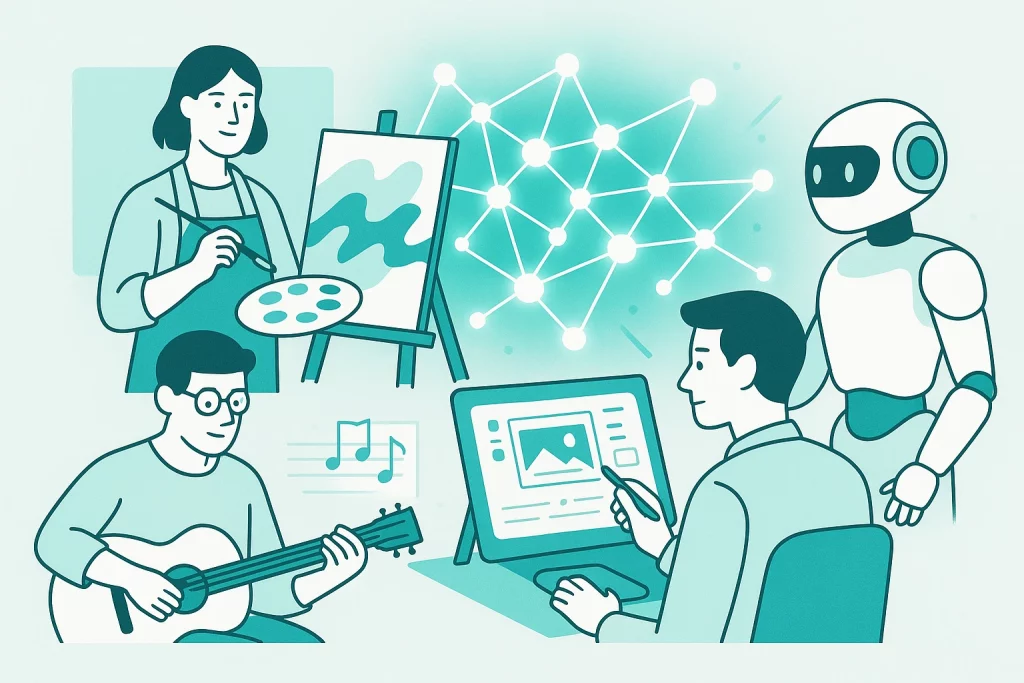
AI acts as an amplifier for human imagination across every creative field.
1. Acceleration
AI drastically reduces production time. Writers can turn an idea into a draft in minutes. Designers visualize brand concepts instantly. Musicians explore melodies or soundscapes without technical barriers.
2. Exploration
AI expands creative boundaries by suggesting unexpected combinations — color palettes that evoke emotion, narrative twists that surprise, design patterns inspired by nature or data.
3. Collaboration
A study by Carnegie Mellon University confirms that collaboration between humans and AI systems leads to outcomes superior to those achieved by either alone. When human intuition meets machine precision, innovation accelerates.
By automating repetition, AI lets creators focus on the parts that matter most: meaning, originality, and emotional impact.
Real-World Examples of AI in the Creative Industry
Art and Design
Tools such as Midjourney, DALL·E, and Adobe Firefly have transformed the creative process. Artists no longer start from a blank canvas; they start from infinite possibility. Architects use AI to optimize spatial design, while illustrators generate quick concept art to refine styles faster.
In branding and marketing, AI-generated visuals help businesses A/B-test creative assets before launch, improving engagement while saving time.
For deeper insights into these technologies, visit Generative AI on Arti-Trends.
Music and Sound
AI composers like AIVA and MusicLM produce melodies, harmonies, and even full arrangements that adapt to mood or genre. Film studios now use AI to score scenes dynamically, adjusting sound in real time. These tools don’t erase musicianship; they enhance it — allowing composers to experiment with structure while focusing on emotional storytelling.
Writing and Storytelling
Authors and copywriters use large language models such as ChatGPT and Sudowrite to brainstorm, outline, and refine content. Screenwriters co-develop scripts by feeding context and dialogue into AI systems that generate pacing suggestions or character arcs.
Creative AI helps writers explore style, not replace it. It becomes a collaborator that accelerates ideation while leaving vision and interpretation firmly in human hands.
For structured writing techniques and prompt engineering, explore our guide AI Prompts for Writers.
Film, Gaming, and Innovation
Studios like Pixar and independent creators alike experiment with AI-driven tools such as Runway and Synthesia for storyboarding and real-time animation.
In gaming, developers use AI to design immersive worlds and dynamic narratives that evolve with each player’s decisions.
AI also powers product design — from fashion forecasting to user-experience simulations — giving innovators access to instant feedback and inspiration.
Skills for the AI-Augmented Creator
The next generation of creatives will need new hybrid skills. To thrive in an AI-driven landscape, focus on:
- Prompt mastery: learning how to communicate ideas clearly to AI models for consistent creative results.
- Critical evaluation: distinguishing between genuine inspiration and algorithmic repetition.
- Cross-disciplinary thinking: combining data, storytelling, and design principles.
- Ethical awareness: understanding copyright, transparency, and consent in creative datasets.
At AI Academy, we explore how professionals can train these skills and integrate AI responsibly into their workflow.
The Human Element: Emotion, Context, and Meaning
AI can generate beauty but not purpose. It can simulate emotion but not feel it. Human creativity is more than pattern recognition — it’s empathy, story, and context.
A machine may paint a landscape, but it is the human who gives it soul. What makes creativity valuable is not the speed of creation but the depth of connection.
In this era, emotional intelligence becomes the new creative advantage. The more we understand ourselves, the better we can direct intelligent systems toward art that matters.
Ethical and Cultural Dimensions
The rise of creative AI raises new questions about ownership, originality, and diversity. Who owns AI-generated art? Should artists whose works train AI models receive credit or compensation? Can we ensure datasets are fair and culturally inclusive?
Studies published on PubMed Central (PMC) highlight that while generative AI boosts individual creativity, it can also homogenize collective expression if left unchecked.
Regulations are emerging worldwide to balance innovation with ethics, as explored in AI Law & Ethics: Navigating the New Frontier.
The future of creativity depends on how consciously we use these technologies — not just what they can produce.
The Future of Creativity: A Vision Beyond the Horizon
In twenty years, creativity won’t happen on screens — it will flow through them. AI will no longer be a tool; it will be a silent partner woven into every act of creation. Imagine a world where thought becomes form — where a whisper of imagination transforms instantly into light, music, or design.
In this future, creativity is not limited by skill or access. A child in Ghana, a designer in Amsterdam, and an engineer in Tokyo can all co-create a symphony of color and code in real time. AI translates, adapts, and harmonizes — making human imagination a global language.
Art will live, evolve, and breathe with us. Paintings will change with seasons, stories will adapt to the reader’s emotion, and music will rewrite itself based on your heartbeat. But one thing won’t change: the essence of creation — the why behind every act. That remains human.
We will not lose creativity to machines; we will rediscover it through them. The next Renaissance will not happen in galleries, but in the space between neurons and algorithms — a dance of curiosity, ethics, and wonder.
And as we stand at that threshold, one truth becomes clear: AI will not make us less human — it will remind us how extraordinary humanity can be.
Conclusion
Artificial intelligence is transforming creativity from a solitary act into a shared process. Humans bring meaning, emotion, and purpose. AI brings speed, structure, and scale. Together they redefine what imagination can achieve.
The creative professional of tomorrow will not just use AI tools — they will orchestrate them. Those who embrace this collaboration will shape the next great wave of innovation and art.
To understand how creativity fits into the wider evolution of artificial intelligence, read What Is Artificial Intelligence? The Ultimate Guide and explore how AI influences business, ethics, and the human mind.
FAQ
Can AI truly be creative?
AI can generate new combinations of data that appear creative, but true creativity still relies on human intention and emotional context.
Will AI replace artists and designers?
No. AI enhances workflows and speeds up ideation, but human originality, taste, and emotion remain irreplaceable.
What are the best AI tools for creativity?
Popular options include ChatGPT for writing, Midjourney for visual art, Runway for video editing, and AIVA for music composition.
Is AI-generated art considered plagiarism?
Not inherently. Ethical AI use requires transparency, respect for training data, and crediting original sources.