
In the rapidly expanding AI writing ecosystem, most tools attempt to do everything: generate articles, brainstorm ideas, summarize research, and act as conversational assistants. Within the broader AI writing tools landscape, platforms compete to combine generation, editing, and workflow automation into a single interface.
QuillBot takes a different approach. Rather than functioning as a full generative writing system, the platform focuses primarily on text transformation and rewriting. Its core functionality revolves around paraphrasing, summarization, grammar correction, and citation support. This positioning makes QuillBot less comparable to full AI writing assistants and more comparable to editing infrastructure inside a professional writing workflow. The central question of this review is therefore not whether QuillBot can replace generative AI systems such as ChatGPT. The real question is whether QuillBot materially improves editing and rewriting efficiency inside real writing workflows.
Table of Contents
ToggleReview Snapshot
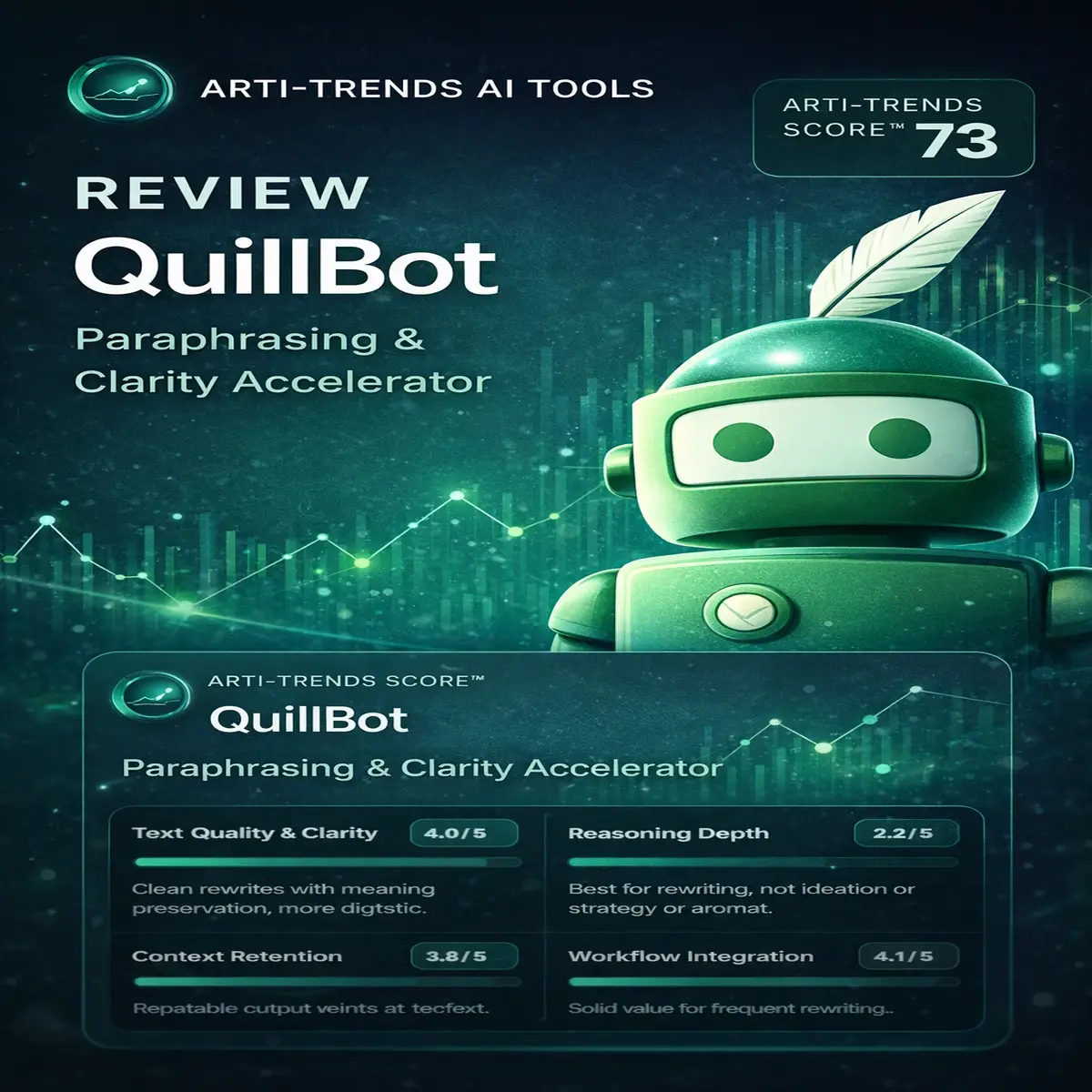
Arti-Trends Score™: 73 / 100
Category: AI Writing & Language Tools
AI Stack Role: Interface / Workflow Tool
Agent Compatibility: Limited
Positioning: Best Budget Paraphrasing Tool
Best for:
Students, bloggers, editors, and non-native English writers who want fast rewriting and clarity improvements.
Less suitable for:
Research synthesis, deep reasoning tasks, long-form document strategy, or users seeking a full AI writing assistant.
Methodology:
This review applies the Arti-Trends AI Writing Framework (6 weighted pillars) and evaluates QuillBot based on real workflow testing, paraphrasing accuracy, integration support, pricing structure, and output stability.
If you want to test QuillBot yourself, you can try the tool directly on the official website. The free version allows basic paraphrasing, while the premium plan unlocks additional writing modes and unlimited rewriting.
Platform Overview
QuillBot is an AI-powered writing assistant designed to help users rewrite, refine, and restructure text while preserving its meaning. The platform is widely used by students, researchers, academic writers, bloggers, and marketing teams who need to improve clarity or rephrase existing content without altering the underlying ideas.
The platform consists of several core modules. The paraphraser acts as the flagship feature, allowing users to rewrite sentences and paragraphs using multiple rewriting modes. The grammar checker identifies grammatical errors and punctuation issues, while the summarizer condenses longer passages into shorter, more digestible formats. Additional tools include a citation generator for academic referencing, a plagiarism checker available in premium plans, and a recently added translation feature that allows cross-language paraphrasing.
Rather than forcing users to switch platforms, QuillBot integrates directly into existing writing environments. The tool works inside Chrome, Google Docs, and Microsoft Word, allowing writers to edit and rewrite text without leaving their primary workspace. This integration strategy positions QuillBot as a writing layer rather than a standalone content generation tool.
Below is QuillBot’s framework breakdown across six weighted pillars using the Arti-Trends AI Tool evaluation framework.
QuillBot
QuillBot works best as a refinement layer inside real writing workflows. It does not replace thinking, research, or strategic content creation, but it can significantly reduce friction when rewriting drafts, improving readability, tightening phrasing, and adapting text for different audiences or clarity levels.
- Best for: Students, non-native English writers, marketers, and professionals improving existing drafts rather than generating deep original work.
- Strength: Fast rewriting and clarity improvement with very low setup friction and immediate time-to-value.
- Limitation: Not designed for advanced reasoning, strong original insight generation, or high-context long-form analysis.
QuillBot — Paraphrasing & Clarity Accelerator
Pillar Analysis
Text Quality & Clarity is one of QuillBot’s strongest areas. The paraphrasing engine consistently produces grammatically correct and readable outputs while preserving the meaning of the original text. Compared with many general AI writing systems, QuillBot shows lower hallucination risk because the system focuses on transformation rather than generation. The tool excels at sentence-level and paragraph-level rewriting, which makes it highly effective for editing workflows.
Reasoning Depth is intentionally limited. QuillBot is not designed to generate complex arguments or long analytical text. Unlike large language models such as ChatGPT and other large language models, it does not perform multi-step reasoning or research synthesis. Instead, the system focuses on rewriting existing content. The lower reasoning score reflects design scope rather than a technical weakness.
Context Retention is another strong area. During testing, QuillBot consistently preserved factual meaning and argument structure when paraphrasing content. This makes the tool particularly useful for academic rewriting and draft editing. Minor context degradation can occur when very long passages are paraphrased at once, but breaking text into smaller sections significantly improves stability.
Output Consistency is one of the platform’s key strengths. QuillBot offers multiple paraphrasing modes including Standard, Fluency, Formal, Creative, Expand, and Shorten. These modes reliably modify sentence structure while maintaining grammatical accuracy. Repeated paraphrasing cycles produce predictable variations without introducing factual drift, which is important for editing workflows.
Workflow Integration also scores highly. The Chrome extension and integrations with Google Docs and Microsoft Word allow writers to refine text directly inside their working environment. This reduces workflow friction and makes the tool particularly useful for content teams and academic writers who operate inside established writing software.
Pricing & Access remain relatively competitive. QuillBot offers a free version with basic paraphrasing capabilities and character limits. Premium subscriptions unlock additional writing modes, unlimited rewriting, plagiarism detection, and faster processing speeds. Compared to broader AI writing platforms, the cost-to-leverage ratio remains favorable for users focused primarily on editing and rewriting.
Agent & Stack Compatibility
Agent compatibility evaluates whether a tool can function inside automated AI workflows. QuillBot receives a Limited compatibility rating. The platform is primarily a user-interface driven tool and currently lacks widely accessible APIs or strong automation integrations. This means the system works best as a human-operated editing layer rather than as a fully automated component inside AI pipelines.
In agent-driven workflows, tools that expose APIs or structured outputs integrate more easily into automation systems. Because QuillBot relies heavily on its user interface, it is better suited for manual editing rather than automated orchestration.
AI Stack Position
Within the modern AI tools ecosystem, QuillBot functions as an Interface / Workflow Tool. It acts as a refinement layer positioned between draft generation and final publication. In practical workflows, the tool often appears after a generative AI system has produced the initial draft.
A typical workflow may look like this: research and idea development → draft generation using a large language model → QuillBot rewriting and editing → human review → final publication. In this structure, QuillBot improves clarity and sentence flow without altering the underlying argument.
Strengths
QuillBot performs particularly well in areas where many generative AI tools struggle. The platform delivers reliable paraphrasing, strong grammatical accuracy, predictable rewriting output, and smooth integration into established writing environments. Because of its narrow focus on rewriting rather than generation, the system often produces more stable editing results than broader AI writing assistants.
Limitations
The platform also has structural limitations. QuillBot does not provide deep reasoning capabilities, advanced research support, or strong automation integrations. It operates primarily at the sentence and paragraph level rather than restructuring full narratives or arguments. Users looking for a full AI writing assistant may therefore find the system limited in scope.
Best Use Cases
QuillBot is particularly effective for academic rewriting, editing drafts to improve clarity, paraphrasing research text while preserving meaning, refining AI-generated drafts before publication, and helping non-native English writers explore alternative phrasing structures.
Who Should Use QuillBot
The tool is best suited for students, researchers, editors, bloggers, content marketers, and writers who frequently rewrite or refine existing text. It is less suitable for users who require full AI content generation, research synthesis, or complex reasoning capabilities.
QuillBot Pricing Overview
QuillBot follows a freemium model. Start free, then upgrade to Premium for unlimited rewriting, more modes, and higher limits.
| Plan | Price | Best for | Key features |
|---|---|---|---|
| Free | $0 | Casual users, quick rewrites | Basic paraphrasing modes, limited word count per rewrite, summarizer limits |
| Premium (Monthly) | $19.95 / month | Short-term projects | Unlimited rewriting, all paraphrasing modes, faster processing |
| Premium (Quarterly) | $39.95 / 3 months (~$13.31 / month) |
Frequent users | All Premium features with moderate savings |
| Premium (Annual)Best Value | $99.95 / year (~$8.33 / month) |
Regular writers, students, teams | Full access at the lowest monthly cost |
For most writers who rewrite frequently, the annual plan delivers the strongest cost-to-leverage ratio.
For most writers who frequently edit or rewrite content, the annual Premium plan offers the best cost-to-leverage ratio, reducing the monthly price while providing full access to QuillBot’s rewriting and editing tools.
QuillBot vs ChatGPT
QuillBot and ChatGPT are often compared because both tools can assist with writing tasks. However, they serve very different roles inside a writing workflow. QuillBot focuses primarily on rewriting and refining existing text, while ChatGPT is designed to generate new content and respond to prompts conversationally.
In practice, the tools are less direct competitors and more complementary components within a modern AI writing workflow.
Core Differences
| Feature | QuillBot | ChatGPT |
|---|---|---|
| Primary Function | Paraphrasing and rewriting | Generating original content |
| Reasoning Ability | Limited reasoning | Advanced reasoning and ideation |
| Best Use Case | Editing and refining drafts | Brainstorming and drafting content |
| Workflow Role | Rewrite / editing layer | Idea and content generation layer |
| Automation | Mostly UI-driven | API and automation capabilities |
QuillBot excels when you already have text that needs to be rewritten or clarified. Its paraphrasing engine is specifically designed to transform sentences while preserving their meaning, making it particularly useful for editing workflows.
ChatGPT, by contrast, functions as a large language model capable of generating articles, answering questions, and developing structured ideas across many topics. This makes it far more versatile for research assistance, brainstorming, and draft creation.
Which Tool Is Better?
The answer depends entirely on the task.
Use ChatGPT when you need to generate ideas, write new content, or develop arguments.
Use QuillBot when you already have a draft and want to improve clarity, sentence flow, or phrasing.
For many writers, the most effective workflow combines both tools:
Research & idea generation → Draft creation with ChatGPT → Editing and rewriting with QuillBot → Human review
This layered approach allows writers to leverage the creative generation capabilities of large language models while using specialized rewriting tools to polish the final text.
Common Beginner Mistakes When Using QuillBot
Many first-time users misunderstand what QuillBot is designed to do. The platform is not a full AI writing assistant but a specialized rewriting and editing tool. When used correctly, it can significantly improve clarity and sentence flow. However, beginners often make several mistakes that reduce the effectiveness of the tool.
Treating QuillBot as a Full Writing Assistant
One of the most common misconceptions is expecting QuillBot to generate complete articles, arguments, or research summaries. QuillBot is designed to rewrite existing text, not to produce complex ideas from scratch. Writers should first create a draft—either manually or with a generative AI tool—and then use QuillBot to refine the language.
Paraphrasing Large Blocks of Text at Once
Another frequent mistake is pasting very long paragraphs or entire articles into the paraphraser. While the system can handle longer inputs, rewriting large blocks of text increases the risk of subtle meaning shifts. Breaking content into smaller sections or paragraphs usually produces more accurate and stable results.
Ignoring Context and Technical Nuance
Although QuillBot generally preserves meaning well, automated paraphrasing can sometimes alter nuance in technical or academic writing. Beginners often accept the output without reviewing it carefully. For professional or academic use, writers should always review the rewritten text to ensure factual accuracy and tone consistency.
Overusing Creative Paraphrasing Modes
QuillBot offers several rewriting modes, including Creative and Expand. These modes can produce more varied sentence structures, but excessive use may unintentionally change the tone or emphasis of the original text. For most editing workflows, Standard or Fluency modes provide the most stable results.
Skipping Final Human Editing
Finally, some users rely entirely on automated rewriting without performing a final review. Even though QuillBot produces grammatically correct text in most cases, human editing remains essential. A final pass ensures that the text remains coherent, accurate, and aligned with the intended message.
Used properly, QuillBot can be a powerful editing layer inside modern writing workflows. Avoiding these common mistakes allows writers to maximize the tool’s strengths while maintaining control over the final text.
Cost-to-Leverage Evaluation
The most important question is not whether QuillBot is powerful, but whether it saves meaningful time inside writing workflows. For editing and paraphrasing tasks, the answer is often yes. When combined with generative AI systems, QuillBot functions as a clarity and refinement layer that improves final text quality before publication.
Final Verdict
QuillBot is not a universal AI writing platform. It is a specialized rewriting engine designed to improve sentence-level clarity and editing efficiency. In a landscape dominated by large generative models, this focused approach remains valuable. The tool does not generate ideas, but it refines them. For writers who already have content and simply need to improve structure, flow, and clarity, QuillBot remains one of the most efficient rewriting tools available.
Try QuillBot
If you frequently rewrite or refine existing text, QuillBot can be a valuable addition to your writing workflow. The platform is designed to improve sentence clarity, restructure phrasing, and accelerate editing tasks without changing the underlying meaning of your content.
Unlike full generative AI systems, QuillBot functions best as a refinement layer applied after a draft already exists. Writers often use the tool to polish AI-generated drafts, simplify complex sentences, or explore alternative phrasing when editing articles, academic work, or marketing content.
You can test the platform using the free plan, which includes basic paraphrasing functionality. The premium version unlocks additional writing modes, unlimited rewriting, and faster processing speeds for larger editing workloads.
Frequently Asked Questions
What is QuillBot used for?
QuillBot is an AI-powered rewriting and editing tool. It is primarily used for paraphrasing existing text, improving clarity, correcting grammar, summarizing longer passages, and generating citations. It’s most useful when you already have a draft and want to refine it faster without changing the core meaning.
Is QuillBot better than ChatGPT for paraphrasing?
For pure paraphrasing, QuillBot is often the better choice because it is purpose-built for text transformation and meaning preservation. ChatGPT is stronger for generating new content, brainstorming, structuring arguments, and handling multi-step reasoning. In practice, many writers draft with a generative model and then use QuillBot as the rewrite layer.
Is QuillBot free to use?
Yes. QuillBot offers a free plan with basic paraphrasing features and usage limits. Premium plans unlock more rewriting modes, higher limits, faster processing, and additional tools such as plagiarism checking (depending on the plan).
Can QuillBot detect plagiarism?
Yes, QuillBot includes a plagiarism checker in its premium offering. It can scan text for similarity signals against online sources to help users verify originality before publishing. It should be treated as a support tool, not a substitute for proper citation and source handling.
Is QuillBot good for academic writing?
QuillBot can be helpful for academic writing because it improves clarity and helps rewrite dense sentences while keeping meaning intact. The key is to review the output carefully to avoid nuance loss, preserve technical accuracy, and ensure correct citations. It is best used for editing—not for replacing your own analysis.
What is the Arti-Trends score for QuillBot?
QuillBot receives an Arti-Trends Score™ of 73/100 under the AI Writing Framework. It scores strongest on rewriting quality, output consistency, and workflow integration, while scoring lower on reasoning depth because it is designed for editing and paraphrasing rather than deep generative writing or research synthesis.