
AI models are evolving fast, but one thing hasn’t changed: the quality of your output still depends on how you prompt.
Most users rely on instinct — they write whatever comes to mind, hit “Generate,” and hope the model understands them. Sometimes it works. Often, it doesn’t.
Professionals don’t rely on luck. They rely on structured prompting techniques — especially two foundational methods that determine how an AI model interprets your request and how consistent the output becomes: zero-shot prompting and few-shot prompting.
In Part 1 of the Prompt Mastery series, we explored how small refinements dramatically improve output quality in How to Write Better ChatGPT Prompts (with Examples).
In Part 2, we showed how assigning AI a clear professional identity sharpens reasoning in Act as a… Prompts: How Roles Transform AI Output.
Now, in this guide, we break down when to use zero-shot versus few-shot prompting, how many examples to provide, and how to upgrade real prompts for more reliable, high-quality results.
For the complete foundation of prompt writing, revisit the cornerstone article AI Prompt Writing: The Ultimate Guide to Working Smarter (2026).
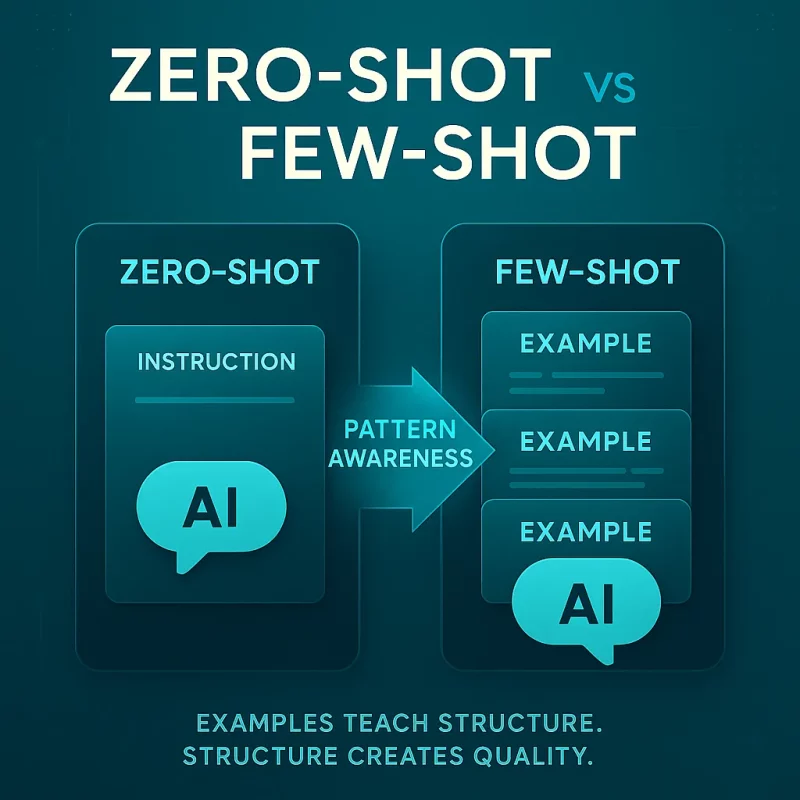
1. What Zero-Shot Prompting Really Is
Zero-shot prompting means giving the model only an instruction, without any examples or patterns.
You assume the model knows enough from its training data to infer what you want.
Examples:
“Explain how reinforcement learning works.”
“Write a paragraph about building healthy habits.”
“Give me 10 YouTube video ideas about AI art tools.”
The model fills in the details using general knowledge.
Where Zero-Shot Prompting Works Best
Zero-shot prompting is the most efficient method when you want:
- quick answers
- summaries and explanations
- brainstorms and ideation
- simple or objective content
- exploratory drafts
- flexible tone and structure
For “get me something fast so I can shape it later,” zero-shot is perfect.
Zero-Shot Prompting Weaknesses
Because the model has to guess what you want, the output often becomes:
- generic
- shallow
- inconsistent in tone
- unstructured
- less reasoned
- less creative than you’d expect
If your output ever feels robotic or too “AI-ish,” it’s because the model didn’t receive a pattern to follow.
If your output feels generic, inconsistent, or overly “AI-like,” the issue is usually structural. A clear breakdown of these failure patterns — and how to fix them — is covered in Common Prompt Writing Mistakes (and How to Fix Them).
2. What Few-Shot Prompting Actually Means
Few-shot prompting gives the model one or more examples before asking it to perform the task.
You don’t just tell the AI what you want — you show it.
The AI doesn’t just copy; it reverse-engineers the logic behind your examples.
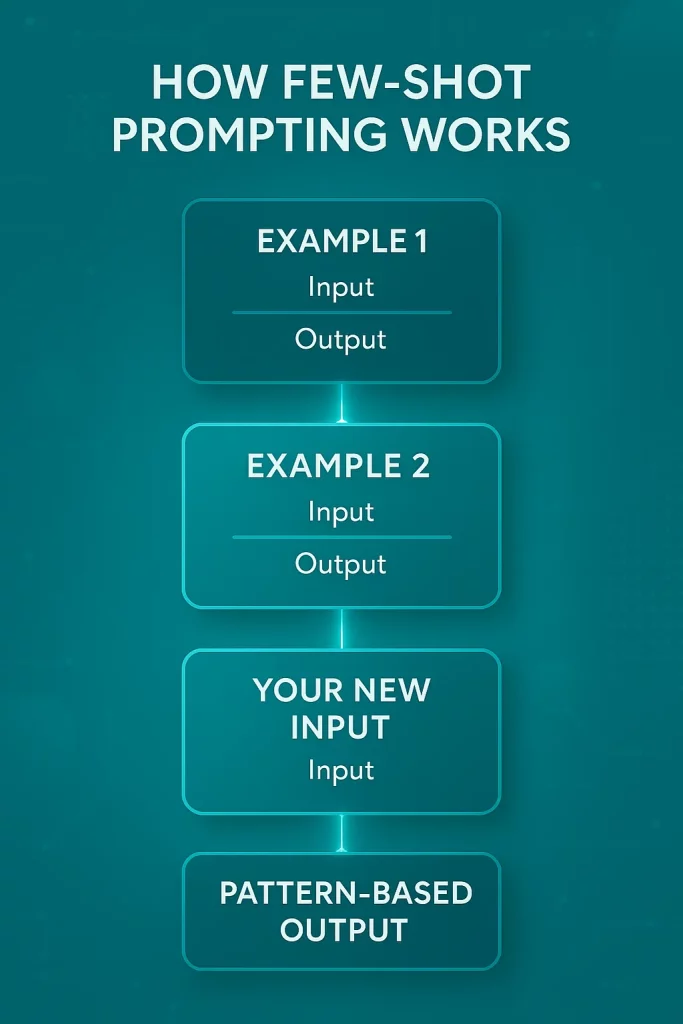
How a Few-Shot Prompt Is Structured
A typical few-shot setup:
Example 1
Input → Output
Example 2
Input → Output
Instruction:
“Follow the same structure, tone, and reasoning pattern to produce the output for the following input.”
Why Few-Shot Prompting Is So Effective
Few-shot prompting activates deep pattern recognition:
- the model copies your tone
- matches your structure
- replicates your reasoning
- adopts your formatting
- aligns with your brand voice
- maintains consistency across long tasks
It transforms AI from a general responder into a specialist working in your style.
For the structural logic behind consistent prompting — beyond examples alone — explore AI Prompt Frameworks Explained: The 4C Model and Beyond.
3. Zero-Shot vs Few-Shot: The Real Difference
These techniques serve different purposes.
Here’s how they compare in real-world workflows:
| Technique | How It Works | Strength | Weakness | Best Use Cases |
|---|---|---|---|---|
| Zero-Shot | Single instruction | Fast, flexible | Generic, inconsistent | Summaries, brainstorming, basic tasks |
| Few-Shot | Instruction + examples | Precise, consistent | Requires prep | Long-form, writing, reasoning, formatting |
A simple way to remember it:
- Zero-shot = “Do it well.”
- Few-shot = “Do it like this.”
Few-shot prompting becomes even more powerful when combined with persona-based instructions — see Act as a… Prompts: How Roles Transform AI Output.
4. How Many Examples Should You Use?
The perfect number:
👉 2–4 examples
Here’s why:
- 1 example → unclear pattern
- 2–4 examples → clear, strong pattern
- 5+ examples → heavy, redundant, token-waste
Your goal isn’t quantity — it’s consistency.
If you want polished examples you can plug directly into your own few-shot prompts, use
Prompt Templates for Marketers & Creators.
5. Zero-Shot → Few-Shot Upgrade (Real Example)
Let’s transform a real task:
Zero-Shot Prompt
“Write a product description for a fitness smartwatch.”
Result:
- generic
- predictable
- lacks emotional pull
- often sounds AI-generated
Few-Shot Prompt
Provide two example descriptions with your preferred:
- tone
- form
- structure
- writing rhythm
- benefit style
- level of detail
Then, instruct the model to apply that same pattern.
Result:
- polished
- consistent
- human-like
- on-brand
- conversion-focused
That’s the difference pattern teaching makes.
For more transformations, explore
How to Write Better ChatGPT Prompts (with Examples).
6. Advanced Techniques for Mastering Few-Shot Prompting
Here are expert-level strategies that dramatically improve results:
A) Use a System Rule Before Your Examples
Example:
“Follow the examples exactly. Do not invent new formats or tones.”
This reduces drift.
B) Keep Examples Short But Complete
You don’t need long examples — you need consistent examples.
C) Label Examples Clearly
Use:
- Example 1 – Input
- Example 1 – Output
Clarity reduces misunderstanding.
D) Use a Signature Writing Pattern
Teach AI your personal style.
If you’re a creator or marketer, this becomes your brand voice engine.
E) Add Constraints
Example:
“Match the example style but keep the final output under 120 words.”
Few-shot + constraints = precision engineering.
F) Include a “Bad Example” (Optional but Effective)
AI learns pattern contrast very well.
Bad Example: overly long, messy
Good Example: structured, clear, specific
Tell the model to follow the good one.
G) Use Examples to Teach Reasoning
Few-shot prompting works beautifully with chain-of-thought patterns.
You can show the AI how to think, not just what to output.
Conclusion
Conclusion
Zero-shot and few-shot prompting aren’t just techniques — they are the foundation of how you communicate with modern AI systems. They determine whether a model improvises or follows a clear path, whether it produces something generic or something genuinely useful.
Zero-shot prompting gives you speed.
It’s ideal for rapid exploration, quick drafts, brainstorming, and situations where flexibility matters more than precision.
Few-shot prompting gives you control.
By teaching the model through examples, you gain consistency in tone, structure, reasoning, and output quality. When results need to be reliable, on-brand, and reusable, few-shot prompting becomes essential.
The real power emerges when both techniques are combined with clear roles, structured frameworks, and deliberate constraints. At that point, AI stops behaving like a reactive assistant and starts functioning as an extension of your own thinking — faster, more aligned, and more predictable.
For a complete overview of all prompt techniques, frameworks, templates, and real-world applications, visit the AI Prompts Hub.
To apply these methods inside strategic, operational, and decision-making workflows, continue with AI Prompts for Business & Strategy.
And to understand how prompting evolves into agentic and autonomous systems, explore The Future of AI Workflows: From Prompts to Autonomous Systems and follow ongoing developments in the AI News Hub.
Mastering zero-shot and few-shot prompting means you’re no longer reacting to what AI gives you.
You’re designing the input — and shaping the outcome.
Related Reading from the Prompt Cluster
If you want to deepen your understanding of prompt design and apply these techniques across different use cases, these guides expand on the core ideas in this article:
- AI Prompt Writing Guide 2026 — The complete foundation for modern prompting and structured AI collaboration.
- How to Write Better ChatGPT Prompts (with Examples) — Practical, copy-and-paste prompts that show how small wording changes dramatically improve output quality.
- AI Prompt Frameworks Explained: The 4C Model and Beyond — Structured thinking models that make prompts more consistent, scalable, and reliable.
- Act as a… Prompts: How Roles Transform AI Output — How role assignment upgrades AI from a generic assistant to a specialist reasoner.
- Prompt Templates for Marketers and Creators — Reusable prompt architectures for consistent, high-impact content creation.
- AI Prompt Mistakes: What Most Users Get Wrong (and How to Fix It) — A diagnostic guide to identifying and correcting structural prompt failures.
- The Future of AI Workflows: From Prompts to Autonomous Systems — A strategic look at how prompting evolves into agentic and autonomous AI systems.