Most people don’t get bad results from AI because the tools are weak.
They get bad results because they ask human questions to non-human systems.
AI doesn’t guess what you mean.
It executes what you specify.
That’s why prompt writing isn’t about clever wording — it’s about structured thinking.
And once you understand that, AI stops feeling random and starts working like a precision tool.
This guide is structured to help you go from vague prompts to precise, high-impact instructions — step by step.
The Power of the Right Question (Why Most Prompts Fail)
You can ask ChatGPT to write a strategy, design a course, or draft a business plan — but if you ask the wrong question, you’ll get an average answer.
Ask the right one, and AI becomes your smartest collaborator.
Which prompt do you think produces better results?
A) “Write a business plan for an AI startup”
B) “Act as a startup advisor. Create a 12-month business plan for an early-stage AI SaaS, including pricing, GTM strategy, risks, and milestones.”
If you instinctively chose B, you already understand prompt leverage.
If not — this guide will fix that.
AI prompt writing is the skill of designing clear, structured instructions that guide AI models like ChatGPT, Gemini, and Claude toward accurate, creative, and reliable outputs. In 2026, prompt writing has become a core digital skill for professionals working with generative AI across content, business, development, and strategy.
That’s the essence of AI prompt writing — the art of turning vague ideas into clear, structured instructions that help machines think with human-like precision. Those who master this skill don’t just get faster results — they uncover better insights, more creative ideas, and smarter decisions.
If you want a practical, hands-on starting point, our step-by-step guide How to Write Better ChatGPT Prompts (with Examples) shows how small wording changes can dramatically improve output quality.

AI Is Only as Smart as the Questions You Ask
Modern AI systems like ChatGPT, Gemini, and Claude don’t have intuition or emotion. They operate entirely on the input you provide — your prompts define what they “see,” how they reason, and what they produce.
A strong prompt isn’t just a question; it’s a blueprint that tells the AI who to be, what to focus on, and how to think. When your intent is clear, the model mirrors that clarity back to you.
Why Prompt Writing Matters in 2026
By 2026, generative AI is increasingly embedded in everyday workflows across many industries.. Professionals across industries — from marketing and education to software and strategy — rely on it to create, analyze, and plan.
Yet only a fraction truly harnesses AI’s full potential. The difference lies in one capability: prompt engineering — the ability to communicate with AI clearly, strategically, and creatively.
Prompt writing is the new digital literacy. Just as writing and coding once shaped the modern workforce, prompt mastery now defines the next generation of innovators and entrepreneurs.
What You’ll Learn in This Guide
In this step-by-step guide, you’ll learn how to:
- Make AI think and act like an expert in your field
- Write prompts that deliver consistent, high-quality results
- Avoid the most common mistakes most users still make
- Build your own library of reusable, optimized prompts
AI isn’t replacing creativity — it’s amplifying it.
But it only becomes truly powerful when you know how to speak its language.
“The quality of your output depends on the quality of your question.”
Once you understand that principle, AI stops feeling unpredictable. It becomes structured, controllable, and incredibly productive.
In this guide, you’ll learn how to:
– write prompts that deliver consistent, high-quality results
– apply proven prompt frameworks like the 4C model
– avoid common prompt-writing mistakes
– build reusable prompt templates for real-world workflows
What Is an AI Prompt (And What It’s Not)?

The Language Between Humans and Machines
At its core, a prompt is the message you send to an AI model — your way of telling it what to do, how to do it, and in what tone or format.
But beneath that simplicity lies something transformative: prompts are the bridge between human intention and machine intelligence.
When you type something like:
“Write a 300-word blog post about the future of AI in education,”
you’re not just giving a command — you’re starting a micro-conversation that shapes how the AI interprets your tone, purpose, and goal.
AI systems such as ChatGPT, Gemini, and Claude don’t truly understand meaning; they predict patterns based on your words. Every detail you include — from the role you assign to the examples you provide — directly influences the quality of the output.
If you want to see this in action, our guide Act as a… Prompts: How Roles Transform AI Output explains how assigning AI a clear persona (like “teacher,” “strategist,” or “developer”) can drastically improve clarity and depth.
Prompts Are Context, Not Commands
Most users treat AI like a search engine: they type a sentence and hope for brilliance. But AI isn’t Google.
Where search engines retrieve information, AI creates it.
That’s why context is everything.
The more background and structure you provide, the sharper and more relevant the result becomes.
Example:
❌ “Write a marketing plan for a product.”
✅ “You are a senior marketing strategist for a startup that sells eco-friendly water bottles. Write a five-step marketing plan focused on social-media campaigns and brand storytelling.”
The second prompt gives the AI a role, a goal, and a framework — three elements that instantly improve quality and relevance.
Prompts as Collaboration
Think of AI as a brilliant but inexperienced assistant — fast, creative, and tireless, but lost without direction.
If your instructions are vague, it improvises. If your guidance is clear, it delivers excellence.
Writing strong prompts isn’t about “tricking” AI; it’s about collaborating intelligently.
You provide the vision, and AI scales your thinking.
Prompt writing transforms AI from a random generator into a strategic partner that helps you brainstorm, analyze, and produce with precision.
Why Understanding Prompts Matters
A prompt isn’t just a question; it’s a structured request.
Every time you interact with AI, you’re designing a mini-workflow:
- You set the stage
- You define the role
- You clarify the goal
- You specify the format
- You guide the output
Once you start thinking this way, AI becomes predictable, reliable, and exponentially more useful.
Prompt writing isn’t just about communicating with machines — it’s about learning to think more clearly yourself.
Why Writing Better Prompts Changes Everything
Writing effective prompts isn’t just about getting AI to respond — it’s about transforming how you think, create, and solve problems.
The difference between an average prompt and a great one can mean the difference between generic output and real innovation.
In 2026, when AI shapes workflows across nearly every industry, prompt mastery is what separates users from creators.
How Prompts Impact Productivity
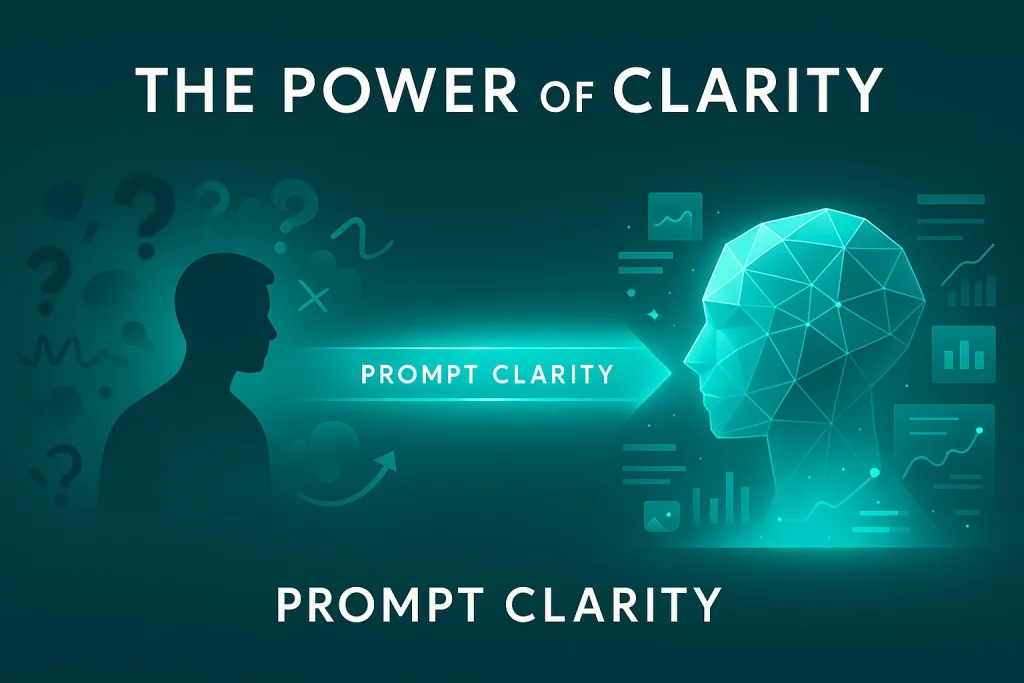
AI has no limits on speed — only on clarity.
A vague request wastes cycles; a sharp prompt saves hours.
When you tell AI exactly what you want — context, role, tone, and format — it can produce results in seconds that would normally take hours.
For businesses, this means more time for strategy.
For creators, it means more focus on ideas that matter.
Example:
❌ “Summarize this report.”
✅ “Summarize this 15-page market analysis into a 300-word executive summary. Focus on consumer trends, competitive positioning, and actionable insights.”
That one extra sentence shifts the task from summarize to synthesize.
And that’s the difference between automation and intelligence.
The Link Between Clarity and Creativity
Many assume that structure kills creativity. In AI, it’s the opposite.
Clear structure gives the model freedom within direction — it knows what to explore, how deep to go, and when to stop.
The best prompts act like a lens: they focus creative energy.
When you define your intent precisely, AI can explore the edges of possibility — not the fog of uncertainty.
Think of prompt writing as creative direction for machines:
You’re not scripting the entire play; you’re setting the stage so the performance shines.
Want to turn this clarity into practical results? Try the ready-made templates in Prompt Templates for Marketers and Creators — they show how to structure prompts for SEO, copywriting, and campaign strategy.
From Guessing to Systematic Thinking
Before AI, knowledge work was linear: input → process → output.
Now it’s iterative: ask → learn → refine → create.
Good prompt writing transforms AI from a “black box” into a thinking partner.
It forces you to define what “good” actually looks like — and in doing so, improves your reasoning, communication, and creativity.
Every great prompt writer learns the same truth:
“If you can’t explain it clearly to AI, you don’t fully understand it yourself.”
This reflective loop — testing, refining, improving — makes you not just better at prompting, but better at thinking.
Real-World Examples: Weak vs. Strong Prompts
Let’s see what this looks like in action.
Example 1 – Business Strategy
❌ “Help me grow my business.”
✅ “Act as a business strategist for a digital marketing agency. Create a 90-day growth plan focusing on client retention and upselling strategies.”
Example 2 – Content Creation
❌ “Write a blog about AI tools.”
✅ “You are a tech journalist. Write a 1,200-word article comparing the top 5 AI productivity tools of 2026, including pricing, key features, and best use cases.”
Example 3 – Education
❌ “Explain quantum computing.”
✅ “You are a physics professor. Explain quantum computing in simple terms for high-school students using analogies and real-life examples.”
Each improved prompt gives AI a role, audience, and goal — the three pillars of clarity that turn data into direction.
Prompt debugging in practice
A vague prompt often hides multiple unclear decisions.
Start by asking: What role is missing? What outcome is undefined? What format is unclear?
Fix one element at a time and re-run the prompt.
This systematic approach is how professionals move from trial-and-error to repeatable results.
🧭 Key Takeaway
Writing good prompts isn’t just about better results from AI — it’s about thinking better yourself.
Prompt writing refines your clarity, multiplies your creativity, and transforms AI from a tool into a partner for growth.
The Anatomy of a High-Impact Prompt
Every powerful piece of AI communication has structure.
Behind every impressive answer from ChatGPT, Gemini, or Claude sits a carefully designed prompt that gives the model clarity, purpose, and direction.
A great prompt isn’t magic — it’s architecture.
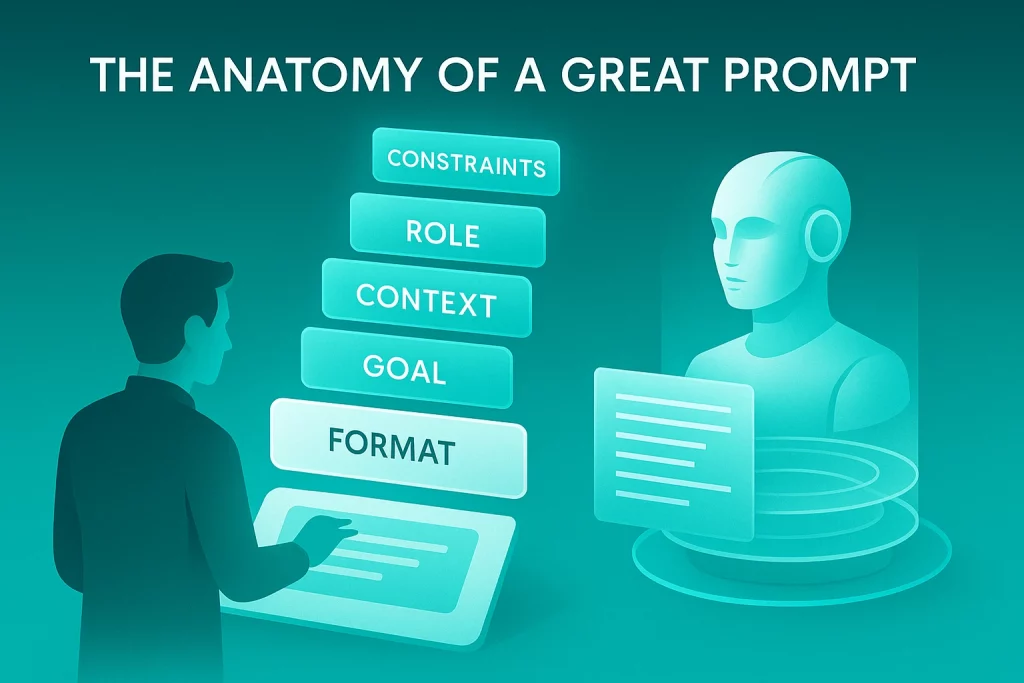
It combines five key elements: Role, Context, Goal, Format, and Constraints & Style.
Together, they turn randomness into reasoning.
Role – Tell AI Who It Should Be
The “role” defines the perspective or expertise the AI should assume.
When you assign a role, you instantly narrow the AI’s focus and raise the quality of its reasoning.
Example:
❌ “Write a business plan.”
✅ “You are a senior venture-capital analyst. Write a business plan for an early-stage fintech startup seeking Series A funding.”
Roles work because they simulate expertise.
You’re not asking the model to guess — you’re telling it to think like an expert.
💡 Pro tip: Start your prompts with “Act as a…” or “You are a…” to activate the right mindset in the model.
For more detailed strategies, visit AI Prompt Frameworks Explained: The 4C Model and Beyond, where we break down how structure transforms output quality.
Context – Set the Stage for Understanding
Context is the difference between confusion and precision.
Without it, AI responds generically; with it, it tailors every answer to your situation.
Include details such as:
- Audience or reader type
- Purpose or platform (email, report, ad, script)
- Background data or brand tone
Example:
✅ “You are a content strategist for a sustainable fashion brand. Based on the following customer persona, create five Instagram post ideas that highlight eco-friendly materials.”
The clearer the scene, the more relevant the response.
Goal – Define What Success Looks Like
Every prompt should have an outcome.
If AI doesn’t know the destination, it can’t chart the path.
Ask yourself:
- What do I want the result to achieve?
- Who will use this output?
- What does “good” look like?
Example:
✅ “Generate a one-page executive summary that helps investors quickly grasp our growth strategy.”
A defined goal prevents AI from drifting — it focuses on value, not volume.
Format – Shape the Output
Structure helps AI organize its thoughts.
By telling it how to present the answer, you save editing time and improve readability.
Common formats include:
- Bullet lists
- Step-by-step frameworks
- Tables or comparisons
- Email drafts
- Blog post outlines
Example:
✅ “List the top five AI marketing tools of 2026 in a table showing name, price, main feature, and best use case.”
Formatting tells AI what to deliver — not just what to discuss.
Constraints & Style – Keep It Consistent and On-Brand
Constraints are the guardrails of creativity.
They keep AI’s imagination focused within your brand’s boundaries.
Add limits like:
- Word count or tone of voice
- Target language or region
- SEO requirements or keywords
Example:
✅ “Write a 600-word LinkedIn post in a friendly, professional tone using the keyword ‘AI productivity tools’. End with a call-to-action.”
The best prompts balance freedom and focus: enough direction to stay relevant, enough space for originality.
If you’d like to go beyond structure and explore how examples guide AI reasoning, read Few-Shot vs. Zero-Shot Prompting: When to Use Which. It’s the next evolution in making AI learn from your instructions.
🧭 Key Takeaway
Great prompts don’t happen by chance — they’re engineered.
Each element — Role, Context, Goal, Format, and Constraints — adds clarity and control.
Master these, and AI stops being a guessing machine; it becomes a thinking partner that works the way you do.
Proven Prompt Frameworks
Even the best prompt writers rely on structure.
Frameworks turn intuition into repeatable systems — allowing you to produce clear, creative, and consistent prompts every time.
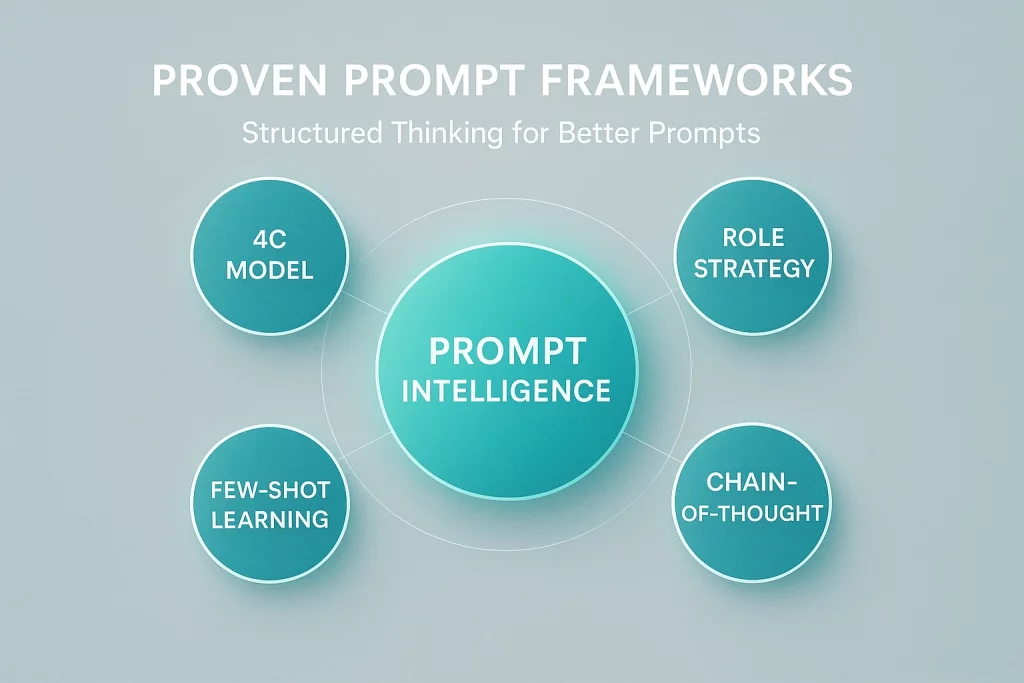
Below are four proven models used by top prompt engineers and AI strategists.
The 4C Model – Context, Command, Constraints, Creativity
This framework balances precision with imagination.
Each “C” shapes how the AI interprets your request:
| Element | Purpose | Example |
|---|---|---|
| Context | Give background & audience | “You are a digital-marketing expert for eco-brands.” |
| Command | Define the main task | “Create a one-month social-media calendar.” |
| Constraints | Add rules or limits | “Use ≤150 words per caption, focus on sustainability.” |
| Creativity | Encourage unique ideas | “Include one unexpected content angle per week.” |
Prompt example:
“You are a digital-marketing expert for eco-brands. Create a one-month social-media calendar using ≤150 words per caption, focused on sustainability, and include one surprising content idea per week.”
Why it works:
The 4C model ensures the AI understands your world, your task, your limits, and your need for originality — all in one flow.
To explore more frameworks like this, read Chain-of-Thought Prompting: Make AI Think Step-by-Step — a deep dive into how structured reasoning boosts accuracy and depth in generative AI.
The Role Strategy – Think Like an Expert
Giving the model a professional “persona” dramatically improves reasoning.
It tells AI to adopt mental models instead of regurgitating facts.
Example roles:
- “You are a Harvard-trained psychologist.”
- “You are a senior UX designer for a fintech app.”
- “You are a growth strategist specializing in SaaS.”
Prompt example:
“You are a senior UX designer for a fintech app. Analyze this onboarding flow and suggest three usability improvements that increase trust during account creation.”
Why it works:
Roles activate domain-specific language and decision-making patterns.
The AI stops acting like a generalist — it starts reasoning like a professional.
Chain-of-Thought Prompts – Guide the Reasoning
Most prompts ask for an answer; these ask for the thinking process behind the answer.
Chain-of-Thought (CoT) prompting breaks complex problems into logical steps.
Prompt example:
“Step-by-step, outline how a company can reduce customer-churn by 20% using AI-driven analytics. Explain your reasoning before giving the final strategy.”
Why it works:
By forcing the AI to reason out loud, you get transparency, richer logic, and fewer hallucinations.
It’s perfect for analysis, strategy, coding, and decision-making tasks.
Pro tip: Add phrases like “think step-by-step” or “explain your reasoning before the conclusion.”
This can significantly improve reasoning quality and consistency..
Zero-Shot vs. Few-Shot Prompting
These two techniques define how much guidance you give AI before it performs a task.
- Zero-Shot Prompting: No examples — just the instruction.
Fast but generic.
Example: “Write a motivational quote about innovation.” - Few-Shot Prompting: Provide 2–3 examples first.
Slower but far more consistent.
Example: “Here are three sample quotes about innovation and persistence. Now write five new ones in the same tone and rhythm.”
Why it works:
Examples teach AI through pattern recognition.
Few-shot prompts are invaluable for maintaining tone, brand voice, or formatting across multiple outputs.
🧭 Key Takeaway
Frameworks make prompt writing repeatable, teachable, and scalable.
Whether you use the 4C Model, Role Strategy, Chain-of-Thought, or Few-Shot examples — structure transforms guesswork into mastery.
Prompt Templates for Everyday Use
Frameworks are powerful, but real transformation happens when you apply them.
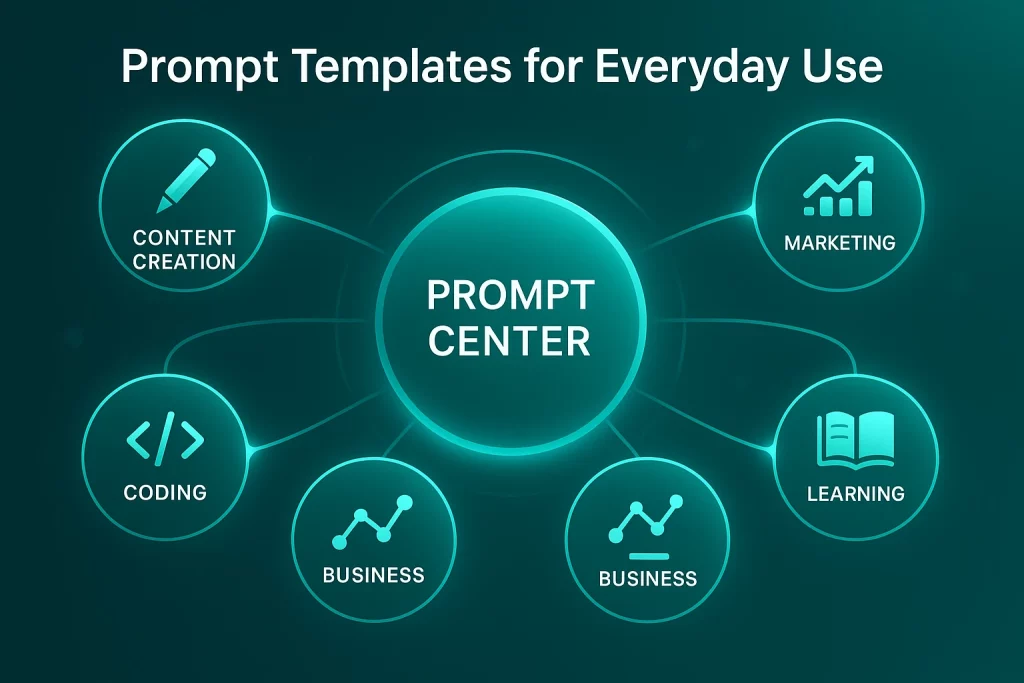
In this chapter, you’ll find ready-to-use prompt templates for five key areas where professionals use AI daily: content creation, marketing, coding, business strategy, and learning.
Each template is built around the five core elements of a strong prompt — Role, Context, Goal, Format, and Constraints — refined using the frameworks from AI Prompt Frameworks Explained: The 4C Model and Beyond.
Content Creation Prompts
AI can be your fastest copywriter, editor, and brainstorming partner — if you guide it with clarity.
Blog Writing Template
Role: You are a tech journalist.
Context: Write an in-depth article for professionals exploring AI tools for productivity.
Goal: Create an engaging, SEO-friendly blog post that attracts organic traffic.
Format: Use an outline with H2-H3 subheads and bullet points.
Constraints: 1,200–1,500 words, neutral tone, keyword “AI productivity tools 2026.”
Prompt example:
“You are a tech journalist. Write a 1,500-word article about the best AI productivity tools in 2026. Use an engaging tone, include headings, and optimize for the keyword AI productivity tools 2026.”
For step-by-step examples of how marketers and creators adapt templates to real campaigns, visit Prompt Templates for Marketers and Creators. It’s packed with reusable prompt structures for SEO, storytelling, and content calendars.
Marketing & SEO Prompts
AI can analyze trends, draft copy, and optimize campaigns — but only if it knows your audience and objective.
Ad Copy Template
Role: You are a digital marketing strategist.
Context: Promote an online course about mastering AI tools for small-business owners.
Goal: Generate three Facebook ad variants focused on problem → solution → benefit.
Format: Table format with columns for headline, ad copy, and CTA.
Constraints: ≤ 50 words per ad, persuasive tone, emphasize affordability.
SEO Research Prompt:
“Act as an SEO expert. Suggest 10 long-tail keywords related to AI content strategy 2026. Include search intent, estimated difficulty, and monthly volume in a table.”
Programming & Automation Prompts
For developers, AI can become a coding assistant — but clarity is crucial.
Tell it what language, what problem, and what constraints you have.
Code Generation Template
Role: You are a senior Python developer.
Goal: Generate a function that cleans and validates email data in a CSV file.
Format: Provide the complete Python script with inline comments.
Constraints: Must handle empty fields and invalid formats gracefully.
Automation Template:
“Write a Python script that automates sending weekly email reports using Gmail API. Include error handling and scheduling logic.”
Business Strategy Prompts
AI can accelerate strategic thinking by providing structured insights and data-driven reasoning.
Market Analysis Template
Role: You are a market-research analyst.
Context: Evaluate opportunities for a SaaS startup entering the HR-tech space.
Goal: Deliver a concise SWOT analysis and market-entry recommendation.
Format: Use bullet points and a summary table.
Constraints: Focus on 2026 trends, competitor benchmarking, and customer pain points.
If business growth and analysis are your focus, check our dedicated guide AI Prompts for Business & Strategy.
It includes advanced prompt sets for financial modeling, competitive benchmarking, and executive summaries.
Learning & Education Prompts
AI excels as a personal tutor or course designer when guided clearly.
Teaching Prompt Template
Role: You are a high-school physics teacher.
Goal: Explain quantum computing in simple terms using analogies.
Format: Short paragraphs followed by a one-question quiz.
Constraints: Keep it under 400 words, conversational tone.
Course Design Template:
“You are an e-learning specialist. Design a four-week beginner course on AI Prompt Writing. Include weekly topics, objectives, exercises, and assessments.”
🧭 Key Takeaway
Prompt templates are your shortcuts to speed, clarity, and consistency.
By adapting a few key elements — role, goal, format, and tone — you can make AI your reliable co-creator in any field.
Common Mistakes to Avoid
Even the most advanced AI users make one crucial mistake: they assume the model just knows.
It doesn’t. AI reflects your clarity, not your intent.
In this chapter, we’ll unpack the most common prompt-writing errors — and show you exactly how to fix them so every interaction with AI delivers results that feel sharp, human, and useful.
Vague Instructions
The number-one mistake in AI prompt writing? Being too general.
If your prompt could apply to ten different scenarios, the AI will guess which one you meant — and usually guess wrong.
Example:
❌ “Write a report about marketing trends.”
✅ “You are a marketing analyst. Write a 600-word report summarizing key B2B marketing trends in 2026, focusing on social selling, influencer partnerships, and AI-driven personalization.”
Why it fails:
Vague prompts give no direction. AI doesn’t know your audience, purpose, or outcome.
Typically include role + topic + scope + style to anchor the output.
For a full breakdown of these errors (and before-and-after examples), read AI Prompt Mistakes: What Most Users Get Wrong (and How to Fix It).
Missing Role or Context
Without a defined role, AI speaks as a generic assistant — neutral, surface-level, and inconsistent.
Example:
❌ “Explain the benefits of meditation.”
✅ “You are a neuroscientist explaining the cognitive and emotional benefits of meditation to first-year psychology students.”
Why it fails:
Roles provide perspective. Context gives direction.
When you skip them, you get filler content — text that sounds fine but teaches nothing new.
Forgetting Output Format
AI defaults to plain paragraphs unless you tell it otherwise.
That means you lose structure, readability, and professional polish.
Example:
❌ “List ways to improve customer retention.”
✅ “List five strategies to improve customer retention in a table with columns for strategy, expected impact, and time-to-implement.”
Why it fails:
Humans process structured data faster.
Defining format helps both you and the AI think in patterns — crucial for reports, strategies, and presentations.
To better understand how structure fixes prompt errors, revisit AI Prompt Frameworks Explained: The 4C Model and Beyond. It shows how context, command, and constraints can instantly turn vague instructions into expert-level clarity.
Not Iterating or Refining
Prompt writing isn’t a one-shot task — it’s a conversation.
The best results come from refining your prompts step-by-step.
Example workflow:
1️⃣ Draft → “Write a 300-word summary of this topic.”
2️⃣ Refine → “Make it more persuasive and add bullet points.”
3️⃣ Polish → “Add a 2-line introduction and a call-to-action.”
Why it fails:
Most users stop too early.
Each iteration teaches the AI (and you) to define what “great” really means.
🧭 Key Takeaway
Every weak prompt hides the same pattern: vagueness, missing context, poor structure, or lack of iteration.
Fix those four, and your AI instantly starts working with you, not around you.
Tools & Resources for Prompt Engineers
Prompt writing is equal parts art and engineering.
And like every great craft, it scales faster with the right tools.
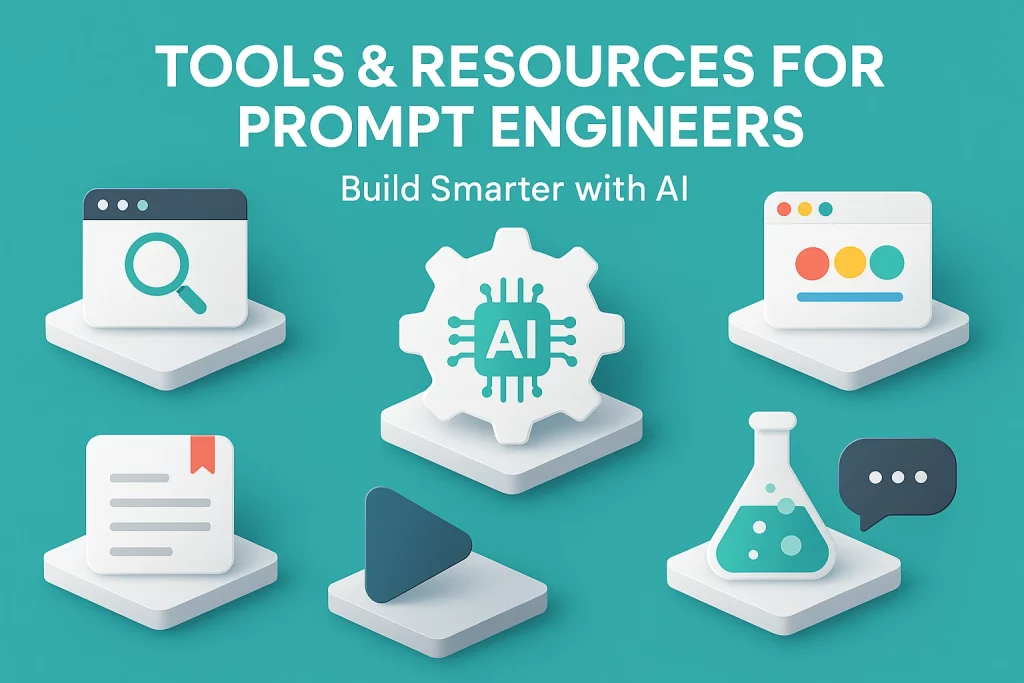
Whether you’re building a personal prompt library, fine-tuning complex AI workflows, or exploring multimodal prompting — the right toolkit can turn inspiration into precision.
Below you’ll find the most valuable tools and platforms professionals use in 2026 to refine, test, and scale their prompts effectively.
Prompt Libraries
Prompt libraries are the fastest way to learn from real examples.
They show how others structure requests, what phrasing improves reasoning, and how tone shapes results.
Top libraries for 2026:
- PromptHero – Thousands of categorized prompts for ChatGPT, Midjourney, and Claude. Ideal for inspiration and benchmarking.
- FlowGPT – Community-driven hub where users share, rate, and remix prompts.
- AIPRM – Chrome extension that integrates directly with ChatGPT, offering pre-built prompts for marketing, writing, coding, and SEO.
If you want curated sources, templates, and creator hubs, explore Best Prompt Libraries & Communities for AI Creators.
It lists the most active platforms for collaboration, feedback, and professional prompt sharing.
💡 Pro tip: Build your own curated prompt vault in Notion or Obsidian. Tag prompts by goal (content, strategy, research) so you can retrieve them instantly.
Prompt Optimization Tools
Even well-crafted prompts can get sharper.
These tools analyze and improve clarity, tone, and structure — like Grammarly, but for AI.
Recommended in 2026:
- PromptPerfect – Evaluates your input, expands vague instructions, and suggests clearer phrasing.
- Jina AI Prompt Optimizer – Uses embeddings to test prompt variations and predict the best-performing versions.
- OpenPromptLab – Browser-based A/B-testing playground for prompt comparison and performance tracking.
Example workflow:
1️⃣ Draft your prompt.
2️⃣ Optimize it in PromptPerfect.
3️⃣ Test both versions.
4️⃣ Compare results and document improvements.
For an extended overview of these and other prompt-enhancing platforms, check out Top AI Prompt Tools to Boost Productivity in 2026.
It includes tool categories, pricing, and pro-use tips.
Prompt Testing & Versioning Platforms
For teams and professional workflows, consistency matters as much as creativity.
Testing tools help you benchmark outputs, maintain tone across versions, and collaborate efficiently.
Top platforms:
- PromptLayer – Tracks every prompt-response pair with version control, ideal for agencies and dev teams.
- LangSmith (by LangChain) – Designed for developers testing prompts in real applications.
- Vellum.ai – Enterprise-grade suite for managing prompt experiments and scoring outputs by accuracy, tone, and bias.
💡 Why it matters:
Systematic testing replaces guesswork.
You can see which prompt worked, why it worked, and how to replicate success.
Communities & Learning Resources
Prompt writing evolves daily.
Staying connected to a learning network keeps you ahead of the curve.
Best places to learn in 2026:
- Reddit – r/PromptEngineering: Lively community with peer examples and critiques.
- Discord servers (FlowGPT, PromptHero): Great for prompt swaps, challenges, and collaboration.
- Courses & Academies: Platforms like DeepLearning.AI, PromptBase Academy, and of course the Arti-Trends AI Academy, where professionals master applied prompt frameworks step-by-step.
💡 Pro tip: Treat prompt writing as a portfolio skill. Document your best examples — it’s quickly becoming a hiring differentiator for roles in content, marketing, data, and design.
🧭 Key Takeaway
Tools don’t replace creativity — they amplify it.
By combining libraries, optimizers, testing platforms, and learning hubs, you turn intuition into a measurable system.
Prompt writing becomes not just faster — but smarter, repeatable, and infinitely scalable.
The Future of Prompt Writing
Prompt writing started as a niche skill.
In just a few years, it has evolved into the universal interface between human creativity and machine intelligence — a shared language for collaboration.
But we’re still only at the beginning.
The next era will transform prompt writing itself: AI will soon generate, optimize, and personalize prompts in real time — turning human–AI interaction into a fluid, adaptive process.
Let’s explore how that future is unfolding.
AI That Writes Its Own Prompts
By 2026, leading AI systems are learning to write and refine their own prompts, a process called auto-prompting.
Here’s how it works:
1️⃣ You ask a question.
2️⃣ The AI analyzes your intent.
3️⃣ It generates several internal prompt variations.
4️⃣ It tests each one and delivers the best output.
Many leading AI systems use internal techniques such as prompt rewriting, self-critique, and tool routing to improve output quality
Example in action:
You ask: “Summarize this 50-page report into key investor insights.”
Behind the scenes, the AI may test five internal prompts such as:
- “Highlight only financial metrics.”
- “Summarize by industry segment.”
- “Identify key risk indicators.”
- “Extract emotional tone shifts.”
- “Combine executive summary with recommendations.”
The best composite wins — and you get a smarter, more adaptive answer.
💡 Why it matters:
Prompt writing is shifting from manual craft to collaborative optimization.
Humans provide creativity and direction; AI refines and executes with precision.
If you want to see how this evolution is changing entire workflows, visit The Future of AI Workflows: From Prompts to Autonomous Systems.
It explores how automated prompting and agentic AI reshape productivity across industries.
Multimodal Prompting – Beyond Text
By 2026, prompting is no longer limited to words.
AI now understands text, images, voice, and even gestures.
This is multimodal prompting — communicating with AI as naturally as we do with other humans.
Examples:
- Designers sketch ideas in Midjourney v7 and say: “Make this look more minimalist, inspired by Bauhaus.”
- Developers upload screenshots to Gemini Code Studio and ask: “Explain this UI logic and suggest accessibility improvements.”
- Teachers use Claude Vision to analyze essays and request: “Highlight where critical thinking is missing.”
The new rule of prompt writing:
The more senses AI understands, the more human your collaboration becomes.
🧠 Pro tip: Combine visuals and text whenever possible.
AI performs best when it sees what you mean — not just when it reads what you say.
For a full guide to these emerging tools, check Multimodal AI Tools 2026: The Next Evolution of Human-Machine Collaboration.
It covers voice-based prompting, visual generation, and hybrid creative workflows.
The Rise of Prompt Professionals
The next generation of creators won’t just use AI — they’ll design intelligent workflows powered by it.
New roles are already emerging:
- Prompt Engineer – designs and tests enterprise-level prompt systems.
- Prompt Strategist – aligns AI communication with brand tone and marketing goals.
- AI Interaction Designer – builds user experiences where prompts replace traditional interfaces.
In the next five years, these roles will be as common as UX designer or content strategist today.
Because in a world driven by generative AI, the most valuable skill isn’t typing — it’s thinking clearly enough for machines to follow.
🧭 Key Takeaway
The future of prompt writing isn’t about replacing humans — it’s about augmenting human intelligence.
As AI learns to interpret context, emotion, and multimodal input, prompt writing becomes the new universal literacy: a blend of logic, empathy, and creativity.
The best time to master it was yesterday.
The second-best time is right now.
Related Reading: Go Deeper Into Prompt Writing
If you want to deepen specific prompt-writing techniques and frameworks, these guides expand on the foundations covered in this article:
- How to Write Better ChatGPT Prompts (with Examples) — practical before-and-after prompts that show how small wording changes dramatically improve output quality
- AI Prompt Frameworks Explained: The 4C Model and Beyond — structured models for consistent, scalable prompt design
- Chain-of-Thought Prompting: Make AI Think Step-by-Step — techniques for improving reasoning depth and transparency
- Few-Shot vs. Zero-Shot Prompting: When to Use Which — when examples outperform pure instruction
- Prompt Templates for Marketers and Creators — reusable prompt structures for real-world workflows
For broader context beyond prompting, explore the AI Guides Hub, review real-world benchmarks inside the AI Tools Hub, or follow ongoing model developments in the AI News Hub.
FAQ – AI Prompt Writing Questions Answered
What is AI prompt writing?
AI prompt writing is the practice of crafting clear, structured instructions that guide AI models to produce relevant, creative, and actionable outputs.
Why is prompt writing important in 2026?
Because AI is embedded across marketing, research, software, and business operations. Strong prompts turn raw model capability into consistent, usable results.
How can I improve my prompts?
Use structured frameworks (role, context, goal, format, constraints), test variations, and refine based on output quality and consistency.
What are the best AI tools for prompt writing?
Tools like PromptHero, AIPRM, PromptPerfect, LangSmith, and curated prompt environments inside the Arti-Trends ecosystem are widely used in 2026.
Can AI replace prompt writers?
No. AI can automate syntax and structure, but humans provide intent, judgment, and strategic context — the core of effective prompting.
Conclusion: From Prompt Writer to Prompt Thinker
Prompt writing began as typing clever commands into AI tools like ChatGPT.
Today, it has evolved into something far more powerful: a structured way of thinking that blends clarity, creativity, and intentional design.
Throughout this guide, you’ve learned how to ask sharper questions, design prompts using role, context, goal, format, and constraints, apply proven frameworks like the 4C Model and Chain-of-Thought reasoning, and avoid vague, one-shot prompts that lead to generic output. You’ve also seen how modern tools, templates, and communities help turn prompt writing into a repeatable, professional skill.
But the real value of prompt writing isn’t just better AI answers.
It’s better thinking.
As AI becomes embedded across content creation, business strategy, development, research, and workflows, prompt literacy is emerging as a core form of digital intelligence. Those who master it don’t simply use AI — they collaborate with it, shaping outcomes through clarity of intent rather than trial and error.
To see how this skill fits into the broader context of prompt resources and learning pathways, the AI Prompt Hub provides a comprehensive overview of prompt guides, templates, frameworks, and examples. For practical frameworks on applying AI across teams and organizations, the AI Guides Hub offers deeper strategy and implementation insights. And to explore how prompt-driven systems connect with the wider ecosystem of creative, business, and automation platforms, the AI Tools Hub maps the tools shaping modern work.
Prompt writing is not a passing trend.
It is a transferable skill that amplifies creativity, productivity, and strategic thinking across every domain.
The future belongs to those who combine curiosity with clarity — who treat AI not as a shortcut, but as a collaborator.
Because the most powerful question is often the one you learn how to ask.