
If prompt writing is how you speak to AI, then frameworks are how you teach AI to think. Most people focus on refining their wording. Professionals refine structure. That difference determines whether AI produces a generic response or a breakthrough insight.
In Part 1 of the Prompt Mastery series, we explored how small adjustments can dramatically improve prompt quality in How to Write Better ChatGPT Prompts (with Examples).
In Part 2, we showed how assigning AI a clear professional identity sharpens reasoning and output in Act as a… Prompts: How Roles Transform AI Output.
Now, in Part 3, we move beyond wording and roles to the underlying thinking models behind effective prompting — and explain why experienced practitioners rely on frameworks to achieve consistent, high-quality results across use cases.
For the complete foundation of prompt writing, start with the cornerstone guide AI Prompt Writing: The Ultimate Guide to Working Smarter (2026).
Why AI Prompt Frameworks Matter
AI is powerful, but not intuitive. It doesn’t “guess” your intent; it interprets your structure.
Prompt frameworks help you:
- eliminate ambiguity
- force logical reasoning
- reduce hallucinations
- improve clarity
- create predictable output
- scale your prompting across teams
- design reusable systems that feel professional and reliable
Frameworks give AI cognitive scaffolding. Instead of hoping for clarity, you engineer it.
1. The 4C Model
The foundational structure for every AI beginner and professional.
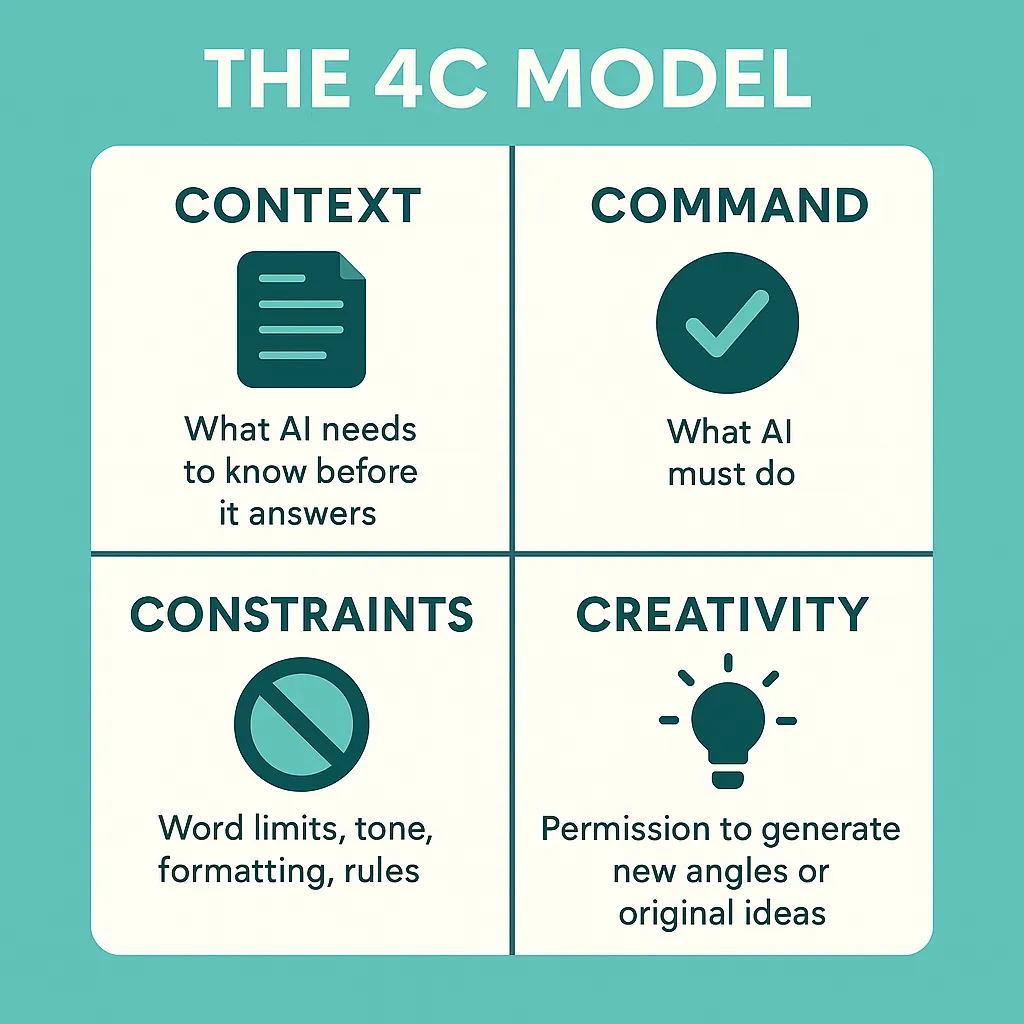
The 4C Model is simple enough to use daily and powerful enough to produce world-class output. It’s the closest thing to a universal prompt formula.
The 4Cs
Context – What AI needs to know before it answers
Command – What AI must do
Constraints – Word limits, tone, formatting, rules
Creativity – Permission to generate new angles or original ideas
Example
“You are a senior UX designer for a fintech app. Create a five-step onboarding improvement plan. Limit the explanation to 200 words. Include one unconventional idea that could realistically increase trust.”
Why it works
Because it mirrors how humans think when solving problems: situation → task → boundaries → creativity.
That structure is instantly clear for AI.
2. The 7R Model
A deeper, more professional version of the 4C Model—perfect for business, analysis and strategy.
The 7R Model creates a complete thinking path. Each “R” adds an additional layer of clarity.
The 7Rs
- Role
- Request
- Requirements
- Restrictions
- Reference
- Rhythm
- Refinement
Example
- “Act as a senior business strategist.
- Request: Create a 90-day retention plan for our subscription app.
- Requirements: Include three data-driven tactics.
- Restrictions: No paid ads.
- Reference: Tone similar to Harvard Business Review.
- Rhythm: Use short sections with clear headers.
- Refinement: Provide two alternative strategies at the end.”
Why it works
The structure forces depth, precision, and consistency—crucial in business environments where quality and clarity matter most.
3. Chain-of-Thought+ (CoT+)
A reasoning technique that makes AI “think out loud” and significantly improves accuracy.
Standard prompts ask for an answer. Chain-of-Thought prompts ask for reasoning. The “+” adds verification and structure.
Example
“Think step by step. Break down the problem of reducing customer churn. Explain your reasoning at each stage. Verify the assumptions before giving the final strategy.”
Why it works
It slows the model down.
It forces clarity.
It reduces hallucinations.
It creates high-quality strategic output—ideal for analysis, planning and problem-solving.
A complete deep dive on structured reasoning is covered in Chain-of-Thought Prompts: Make AI Think Step-by-Step.
For more background on how Google approaches AI prompting and model interaction, you can explore the official resources on Google AI.
4. The ReAct Framework
The backbone of autonomous agents and advanced AI workflows.
ReAct blends two modes:
- Reasoning (thinking internally)
- Acting (taking steps, asking questions or gathering information)
It’s how agent-based systems like GPT-5 agents, Claude Tools and Gemini Workflows operate.
Example
“Use the ReAct method. First reason about what information is missing. Then generate the questions needed to fill those gaps. Finally, provide a combined answer.”
Why it works
ReAct turns AI into an analytical partner rather than an answer generator.
It’s ideal for complex research, multi-step tasks and automated workflows.
For full context on how ReAct powers agentic systems, explore The Future of AI Workflows: From Prompts to Autonomous Systems.
5. Persona Stacking
When one expert viewpoint isn’t enough—stack multiple.
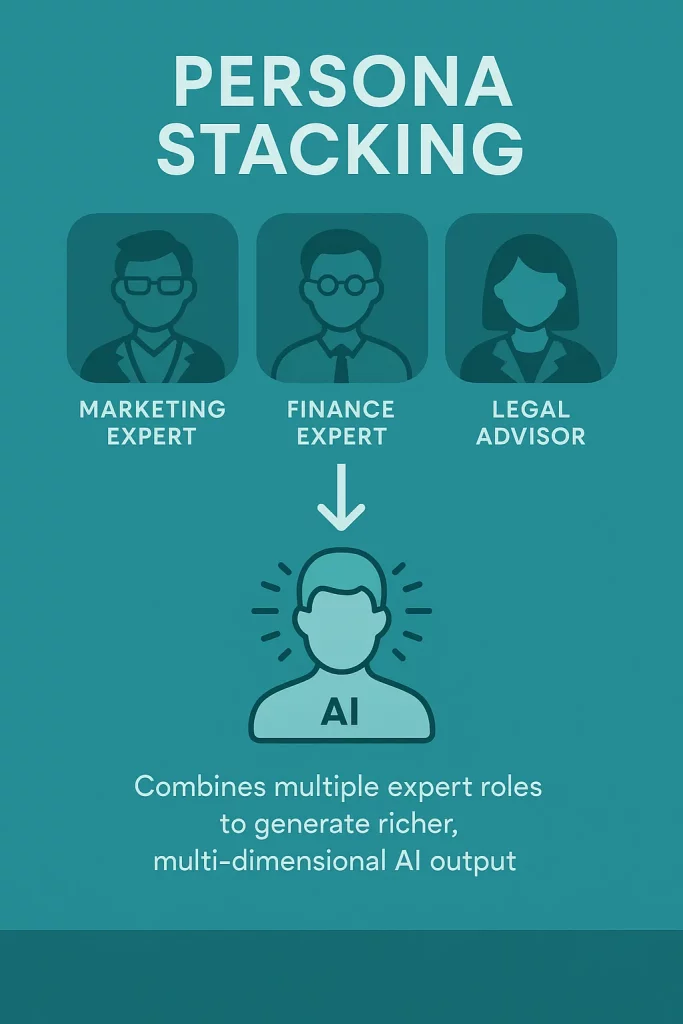
Persona stacking combines the insights of multiple roles simultaneously, creating multi-dimensional output.
Example
“You are:
- A senior data analyst
- A behavioral psychologist
- A marketing strategist
Analyse the survey results as a panel and provide a unified conclusion.”
Why it works
Complex problems rarely benefit from a single perspective.
Persona stacking gives you layered, richer, more insightful output.
This method builds on role design from Act as a… Prompts: How Roles Transform AI Output.
6. Few-Shot Pattern Architectures
The gold standard for tone, style and brand consistency.
Instead of giving one example (“show me something like this”), Few-Shot Pattern prompting teaches AI a pattern.
Popular structures
Bad → Good → Now you
Three style samples → New text
Three examples → Mirror structure → Generate
Example
“Here are two samples of my writing style.
Mirror the tone, pacing and rhythm.
Now create a new version of this paragraph in that style.”
Why it works
AI learns through patterns.
Give it three solid examples, and it can replicate your writing far more accurately than through instruction alone.
For a detailed comparison of pattern-based prompting, see Few-Shot vs. Zero-Shot Prompting: When to Use Which.
7. System Prompt Architecture (SPA)
The enterprise-grade framework behind GPT-5, Claude and Gemini Ultra.
SPA divides prompting into three layers:
System: Who the AI is
Instruction: What the AI must do
Memory: What the AI should remember
Example
System: “You are a senior AI strategist and keynote speaker.”
Instruction: “Create a 10-slide outline about autonomous AI agents.”
Memory: “Here are three outlines I previously approved.”
Why it works
SPA provides consistency, reliability and brand alignment—exactly what teams and businesses need when working with AI across multiple workflows.
AI prompt Framework Comparison Table
| Framework | When to Use It | Skill Level | Output Quality |
|---|---|---|---|
| 4C Model | Everyday prompting | Beginner | High |
| 7R Model | Business, analysis | Intermediate | Very high |
| Chain-of-Thought+ | Strategy, planning | Intermediate | Very high |
| ReAct | Workflows, agents | Advanced | Enterprise-level |
| Persona Stacking | Multi-disciplinary tasks | Intermediate | High |
| Few-Shot Patterns | Tone/style consistency | Intermediate | High |
| SPA | Team systems, enterprises | Advanced | Enterprise-level |
To see how advanced AI models handle multi-step reasoning and complex tasks in practice, the Google DeepMind Gemini overview offers a useful high-level perspective.
For a broader view of tool ecosystems that support these workflows, explore the AI Tools Hub.
One Task, Seven Frameworks
Give AI one assignment—then watch how each model transforms the output:
“Improve this landing page headline for conversions.”
- 4C → A structured, clear version
- 7R → A strategic, research-backed headline
- CoT+ → A reasoning-based improvement
- ReAct → A headline based on clarifying questions
- Persona Stacking → A panel-style improvement
- Few-Shot → A style-matched headline
- SPA → A brand-consistent headline
Same task. Seven different outcomes. Frameworks create flexibility, depth and reliability.
Conclusion
AI Prompt frameworks are more than techniques.
They are thinking tools—designed to help you and AI collaborate with clarity, creativity and precision.
When you use frameworks:
- your prompts become more professional
- your output becomes more consistent
- your thinking becomes more structured
- your creative range expands
If prompt writing is communication, then frameworks are cognition.
Master them, and AI becomes a partner that elevates everything you create.
For a complete overview of all prompt frameworks, techniques, and practical applications, visit the AI Prompts Hub.
For deeper context, revisit AI Prompt Writing: The Ultimate Guide to Working Smarter (2026) and explore pattern-based prompting in Few-Shot vs. Zero-Shot Prompting: When to Use Which.
Want to practice frameworks inside strategic workflows? Explore AI Prompts for Business & Strategy and follow new developments via the AI Trends & News Hub.
Related Reading from the Prompt Cluster
If you want to go deeper into specific techniques and use cases, these guides expand on the core ideas in this article:
- AI Prompt Writing Guide 2026 — The complete foundation for modern prompting and structured AI collaboration.
- How to Write Better ChatGPT Prompts (with Examples) — Practical, copy-and-paste prompts that show how small wording changes transform output quality.
- Act as a… Prompts: How Roles Transform AI Output — How role assignment upgrades AI from generic assistant to specialist expert.
- Prompt Templates for Marketers and Creators — Ready-to-use prompt blueprints for SEO, campaigns, social content, and storytelling.
- AI Prompt Mistakes: What Most Users Get Wrong (and How to Fix It) — A field guide to diagnosing vague, inconsistent prompts and turning them into high-signal instructions.
- Top AI Prompt Tools to Boost Productivity in 2026 — The tools, optimizers, and testing platforms that help you refine and scale your prompts.
- Best Prompt Libraries & Communities for AI Creators — Curated places to learn from other creators, share your best prompts, and stay ahead of new patterns.
- Multimodal AI Tools 2026: The Next Evolution of Human-Machine Collaboration — How prompting expands beyond text into images, audio, video, and real-time interaction.
- The Future of AI Workflows: From Prompts to Autonomous Systems — A strategic look at how prompts evolve into agents, workflows, and fully autonomous systems.