
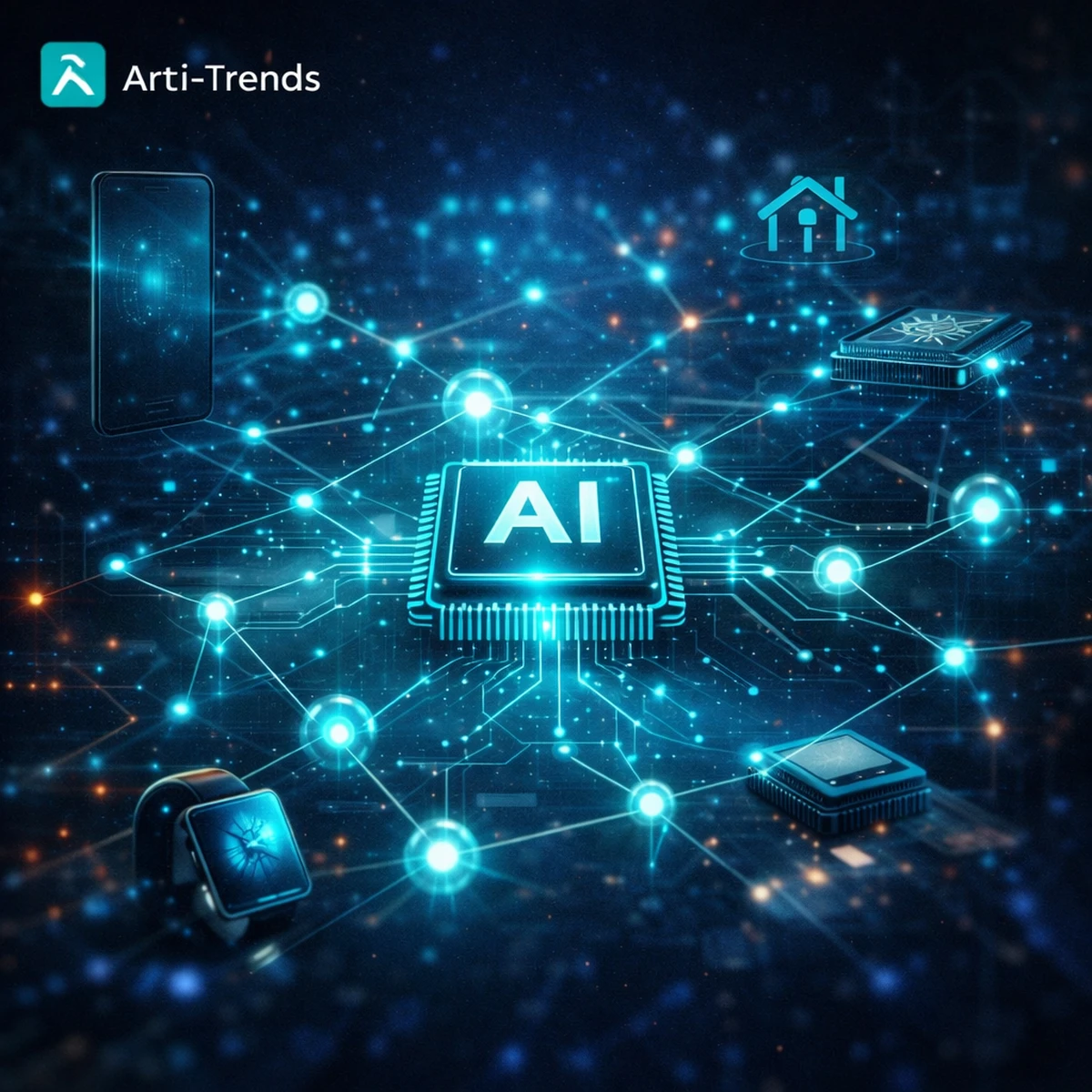
AI is no longer something users consciously open.
It is increasingly something that quietly shapes how devices behave.
At CES 2026, Samsung made that shift explicit. Rather than unveiling a single headline AI feature, the company outlined a broader strategy: deep, system-level AI integration across its entire device ecosystem — from smartphones and wearables to home appliances and semiconductors.
The signal was unmistakable.
AI is moving from a visible feature to an ambient capability embedded directly into everyday technology.
Key Takeaways
- Samsung is embedding AI across its full consumer device portfolio rather than launching isolated AI products.
- On-device AI plays a central role, reducing reliance on cloud-based inference.
- AI is positioned as a system-wide capability spanning hardware, software, and services.
- The strategy strengthens Samsung’s competitive stance against platform-centric rivals.
- Mass-scale deployment could accelerate mainstream AI adoption faster than software-first approaches.
From AI Features to AI Infrastructure
Samsung’s CES narrative emphasized continuity over novelty. Instead of asking users to consciously “use AI,” the company is designing systems where AI operates in the background — continuously, contextually, and by default.
This reflects a broader shift in how artificial intelligence works: away from explicit interaction models and toward embedded intelligence that adapts automatically.
Examples include AI-driven:
- battery optimization
- camera and image processing
- voice interaction
- predictive maintenance in home devices
AI becomes part of the system’s baseline behavior, not a feature users have to enable.
Why On-Device AI Matters Strategically
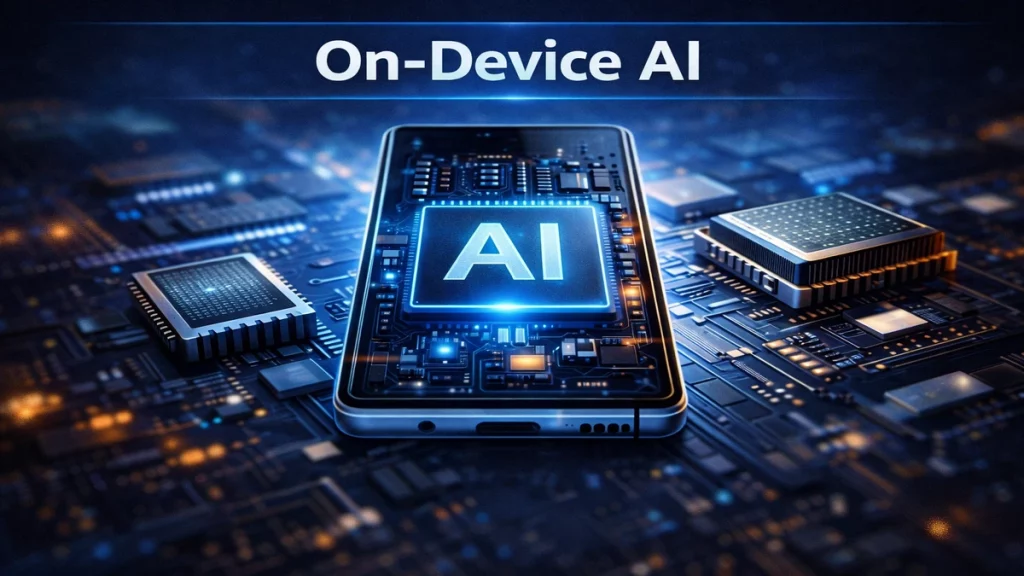
One of the most consequential aspects of Samsung’s strategy is its focus on on-device AI.
Running models locally enables:
- lower latency
- improved privacy
- reduced cloud dependency
- predictable performance
Crucially, Samsung is uniquely positioned to execute this approach. Unlike software-first competitors, it controls both the silicon layer and global device distribution. This allows Samsung to optimize AI workloads directly for its own chips — a direction that closely mirrors where the future of AI systems is heading.
According to reporting by Reuters, this strategy is already influencing demand for AI-optimized memory and processors, reinforcing Samsung’s role across the full AI hardware stack.
Competing With Ecosystems, Not Individual Products
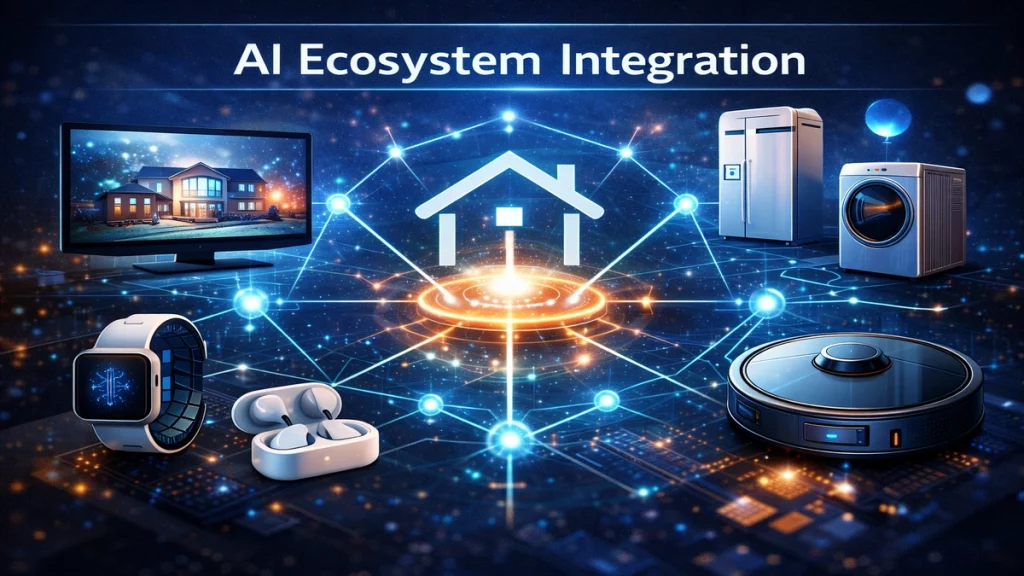
Samsung’s AI push should be understood as an ecosystem strategy, not a feature race.
Where competitors such as Apple focus on tightly controlled platform experiences, Samsung leverages scale and diversity:
- smartphones
- TVs
- wearables
- home appliances
- semiconductor components
AI functions as the connective layer across these domains. The advantage is not that any single AI feature outperforms competitors, but that intelligence is shared across contexts within one integrated environment.
What This Means in Practice (2026)
This strategy has tangible implications across different audiences.
For consumers:
AI becomes less visible but more reliable — improving device behavior through smarter defaults rather than explicit commands.
For developers and partners:
AI capabilities increasingly live at the system level, shifting innovation from standalone apps to integrations with device-native intelligence.
For businesses and platforms:
Hardware-embedded AI challenges software-only models, especially where latency, privacy, and continuous availability matter.
Implications for the Broader AI Market
Samsung’s approach highlights a growing divide in the AI industry:
- software-first AI platforms
- hardware-embedded AI ecosystems
If Samsung succeeds, it strengthens the case that mass AI adoption may happen through consumer hardware, not enterprise tools or standalone AI applications.
This has downstream effects on:
- AI chip demand
- edge computing adoption
- privacy and regulation
- long-term platform power
Why This Strategy Matters Going Into 2026
Samsung is not betting on short-term AI hype.
It is betting on distribution at scale.
By embedding AI into millions of devices already in daily use, Samsung reduces adoption friction and aligns with broader shifts shaping the State of AI going into 2026.
In the long run, infrastructure-driven AI adoption may prove more defensible than any single breakthrough model.
Sources
This article draws on reporting by Reuters, focusing on Samsung’s CES 2026 announcements and the strategic implications of large-scale AI integration across consumer devices rather than individual product launches.