


Introduction — AI regulation is no longer about models
For years, artificial intelligence regulation focused on algorithms: bias, hallucinations, safety, and training data.
New York is now pushing the debate into a different phase.
Two proposed laws — the NY FAIR News Act and a temporary halt on new data centers — treat AI not as experimental software, but as a system of power: one that shapes public information and consumes physical infrastructure at scale.
This is not about slowing AI down.
It is about re-asserting control over how AI is deployed, governed, and paid for.
Key takeaway
New York is not trying to stop artificial intelligence.
It is redefining how AI fits into society — legally, economically, and physically.
Rather than focusing solely on models or algorithms, policymakers are now addressing who controls AI-generated information, who is accountable for its impact, and who bears the cost of the infrastructure that powers it.
The era of frictionless AI expansion — driven by scale-at-all-costs and minimal oversight — is ending.
The era of governed AI ecosystems, shaped by transparency, accountability, and infrastructure limits, has begun.
Why these proposals are emerging now
The timing is not accidental.
AI has crossed three critical thresholds:
- Editorial influence — AI systems increasingly draft, summarize, and rewrite news at scale
- Public trust risk — audiences can no longer distinguish human reporting from synthetic output
- Infrastructure strain — AI workloads are stressing power grids, water systems, and regional planning
Together, these pressures force policymakers to act beyond abstract principles.
New York’s answer is structural regulation.
The NY FAIR News Act explained
What the law targets
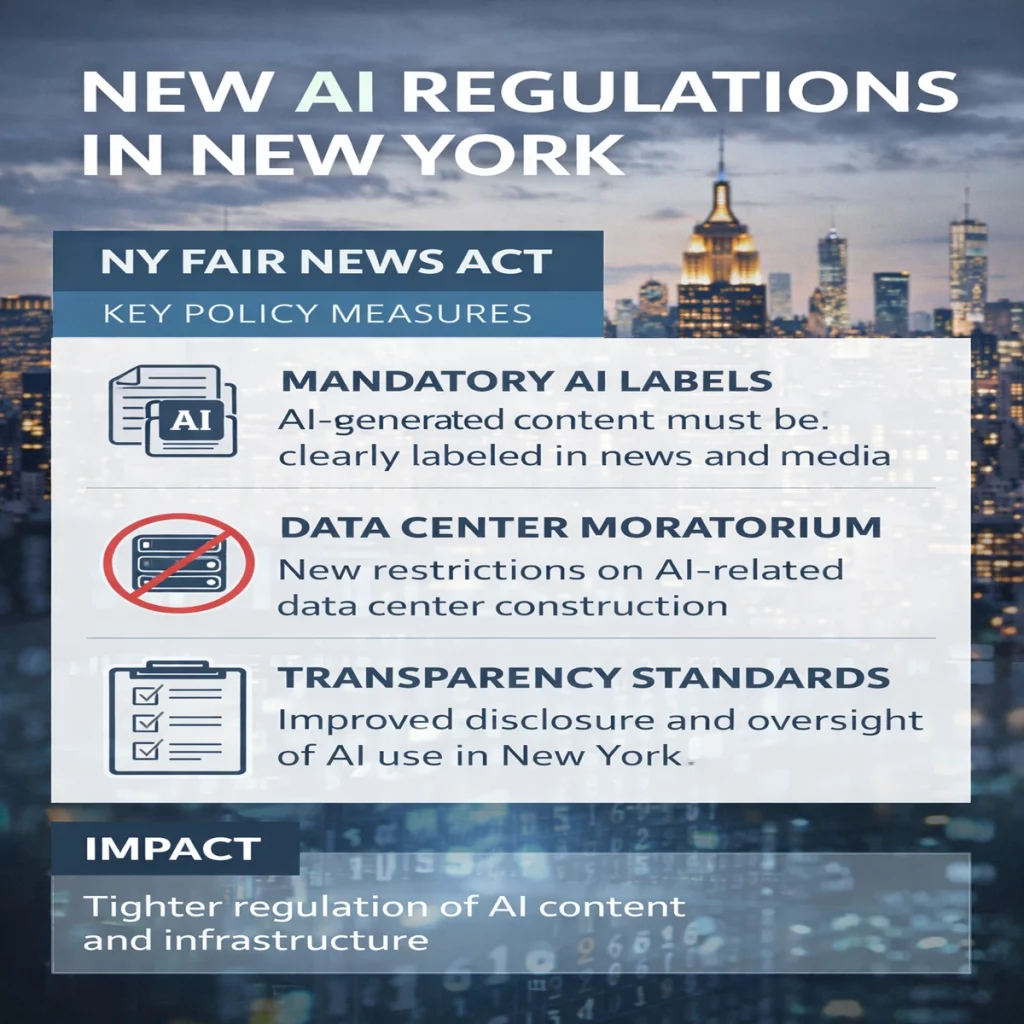
The NY FAIR News Act applies to news and journalistic content that is fully or substantially generated by AI systems, including:
- Automated article generation
- AI-written summaries or rewrites
- Synthetic reporting without direct human authorship
The law does not ban AI in newsrooms.
It regulates how AI-assisted content is disclosed and supervised.
Mandatory AI labeling in journalism
Under the proposal, publishers must clearly disclose when AI plays a material role in producing news content.
This includes:
- Explicit labeling visible to readers
- Clear distinction between human-authored and AI-generated material
- No vague disclaimers or hidden notices
The goal is simple: restore informational transparency.
Readers should know who — or what — is speaking.
Human oversight as a legal requirement
The most consequential element is not labeling.
It is responsibility.
By making human oversight a legal requirement, the NY FAIR News Act moves AI governance out of the realm of voluntary ethics and into enforceable responsibility.
Publishers are no longer shielded by the complexity or opacity of AI systems. If AI-generated content misleads, causes harm, or violates journalistic standards, accountability rests squarely with the organization that published it — not the software provider.
This shift reflects a broader regulatory movement toward AI regulation and accountability, where transparency, traceability, and human responsibility are treated as core conditions for deploying AI in high-impact domains such as media, finance, and public information.
In practice, this means AI can assist editorial work, but it cannot replace human judgment, editorial review, or legal responsibility.
The act makes publishers legally accountable for AI output by requiring:
- Human editorial review before publication
- A designated responsible editor or entity
- Full liability for errors, misinformation, or harm
AI becomes a tool, not an author.
This shifts AI journalism from an efficiency shortcut to a governance obligation.
Enforcement and oversight
Unlike voluntary industry guidelines, the NY FAIR News Act introduces:
- Formal oversight mechanisms
- Enforcement authority via state regulators
- Potential penalties for non-compliance
Self-regulation is replaced with public accountability.
What this means for the news ecosystem
For media organizations
Newsrooms face a structural change:
- Editorial workflows must document human oversight
- Compliance becomes part of publishing operations
- Smaller outlets may face higher operational burdens
AI can still accelerate reporting — but only within accountable systems.
For AI platforms serving media
Tool providers will face new demands:
- Audit logs showing AI contribution
- Traceability of generated content
- Features that support disclosure and review
AI vendors that cannot support transparency may be excluded from regulated media workflows.
The proposed data center moratorium
What the moratorium entails
In parallel, New York lawmakers are considering a three-year moratorium on new data centers, particularly those linked to large-scale AI workloads.
Key elements include:
- Temporary halt on approvals for new facilities
- Review of energy, water, and grid impact
- Potential exemptions only under strict conditions
This is not symbolic.
It directly targets the physical expansion of AI infrastructure.
Why data centers have become a political issue
AI’s environmental footprint is no longer theoretical.
Large-scale AI systems require:
- Massive electricity consumption
- Continuous cooling and water use
- Grid upgrades often funded publicly
In regions where infrastructure is already constrained, AI growth competes with:
- Residential energy needs
- Climate commitments
- Urban planning priorities
The moratorium reframes AI as an infrastructure consumer, not just a digital service.
AI as an infrastructure problem, not just software
These two laws converge on a single insight:
AI is no longer only a technological issue.
It is an information utility and an energy-intensive industry.
This places AI alongside telecom, energy, and transportation — sectors historically regulated for public interest.
Consequences for tech companies and cloud providers
For AI and cloud firms, the implications are significant:
- Slower physical scaling in regulated regions
- Higher compliance and transparency costs
- Increased importance of location strategy
Unrestricted scale is no longer guaranteed.
Infrastructure politics now shape AI economics.
Global implications — why this matters beyond New York
New York functions as a regulatory testing ground.
While these proposals originate at the state level, their impact is unlikely to remain confined to New York. Historically, regulatory frameworks developed in large, economically influential regions often serve as blueprints for broader adoption — both nationally and internationally.
What makes this moment different is that AI regulation is no longer centered on abstract risk principles, but on enforceable rules tied to information control and physical infrastructure. This places New York’s approach firmly within broader global AI regulation trends, where governments are increasingly asserting authority over how AI systems shape public discourse and scale across societies.
As a result, policymakers, technology companies, and media organizations outside the U.S. should treat these developments not as isolated legislation, but as early indicators of where AI governance is heading next.
If successful, these approaches may:
- Influence other U.S. states
- Feed into federal AI legislation
- Reinforce similar trends in Europe and beyond
The pattern is clear: AI regulation is moving downstream — from models to ecosystems.
The deeper shift: power, truth, and capacity
At its core, this is not about AI fear.
It is about:
- Who controls information flows
- Who is accountable for synthetic speech
- Who bears the cost of AI infrastructure
New York’s proposals suggest a new answer:
AI innovation must operate within public constraints.
Sources
- New York State Legislature — Proposed NY FAIR News Act (Artificial Intelligence and Media Transparency)
- New York State Energy Research and Development Authority (NYSERDA) — Data center energy demand and grid capacity assessments
- Office of the New York State Comptroller — Infrastructure and energy impact reports related to large-scale data facilities
- Columbia Journalism Review — Editorial standards and accountability in AI-assisted journalism
- Brookings Institution — AI governance, media integrity, and infrastructure policy analysis