Stretch 4 is a reality check for the robot-butler dream. Hello Robot’s new platform ditches humanoid posture for a wheeled, holonomic mobile manipulator that bundles an omnidirectional base, richer lidar and camera sensing, a mainstream compute stack, and an explicit plan for in-home pilots — all at a $29,950 list price. That combination, reported by IEEE Spectrum, pushes the conversation from speculative demos to deployability for assisted living and research use.
Key Takeaways
- Core shift: Hello Robot trades humanoid optics for a pragmatic, wheeled mobile manipulator focused on safe, repeatable home tasks.
- Why now: Advances in wheelchair wheel tech, embedded AI compute, and richer onboard perception make an affordable, holonomic home robot viable.
- Impact: Immediate pilots target people with mobility impairments, while labs and developers get a lower-cost platform for applied research.
- What to watch: In-home pilot outcomes, foundation-model partnerships, price movement toward consumer versions, and regulatory guidance for home robots.
Bottom line: Stretch 4 is not a speculative prototype; it’s a deliberately engineered step toward practical, safe in-home assistance that other robotics teams must now answer to.
Hello Robot’s Stretch 4 — What just happened
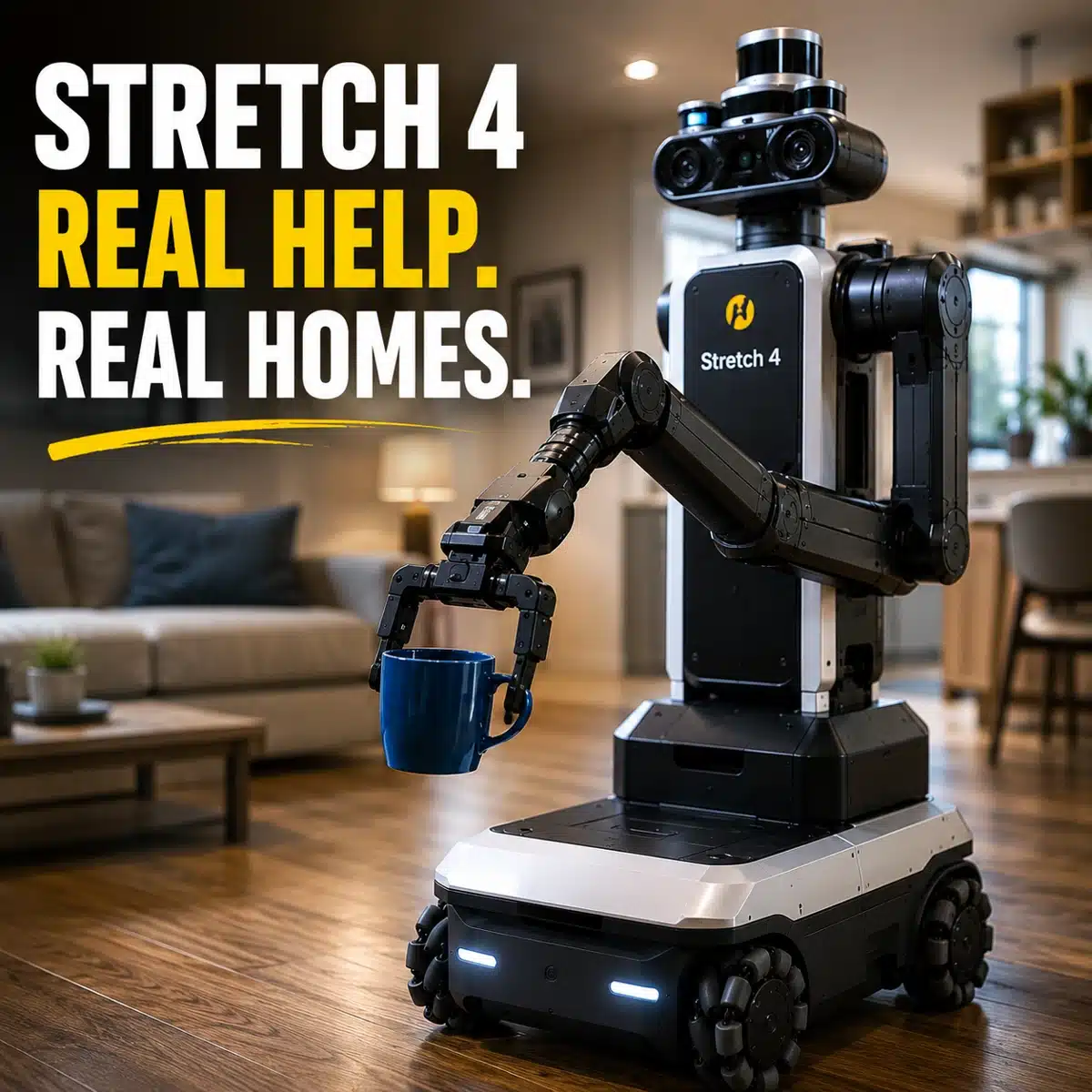
IEEE Spectrum published a detailed look at Hello Robot’s Stretch 4, the company’s newest mobile manipulator engineered specifically for real-world home deployment. Key hardware changes include an omnidirectional (holonomic) base using modern powered-wheelchair wheel technology, a denser sensor suite (pair of hemispherical lidars, Luxonis vision cameras and a wrist depth camera), and a two-part compute stack (Intel NUC 15 plus an Nvidia Jetson Orin NX). Hello Robot says the product ships with baseline autonomy for mapping, navigation, self-charging and demo-ready autonomous grasping, and the company plans explicit in-home pilot programs with people who have severe mobility impairments. IEEE Spectrum reports a US$29,950 list price.
Why this matters now
The timing matters because multiple previously separate trends are converging. Wheel designs originally developed for powered wheelchairs now enable robust holonomic bases. Meanwhile, richer embedded perception systems and affordable AI compute make local sensing and basic autonomy cheaper and more reliable. Add an emergent ecosystem of assistive-robot users and communities that can run meaningful pilots, and the result is a practical path to value that does not rely on a decades-long race to humanoid parity.
What this changes in practice
Stretch 4 shifts decisions for operators, funders, and designers from “if” to “how” when it comes to deploying home robots. Practically:
- For people with mobility impairments and caregivers: Stretch 4 is built for pilot deployments in real homes, which means earlier user feedback loops and the potential for daily, measurable assistance without waiting for humanoid breakthroughs.
- For research labs and enterprises: A sub-$30k mobile manipulator with a mainstream compute stack lowers the cost of entry for manipulation and perception experiments and enables more reproducible field trials.
- For foundation-model and LLM developers: Stretch 4 offers a well-specified, safety-minded hardware target for integrating higher-level reasoning and manipulation without requiring Hello Robot to build large foundation models themselves.
- For humanoid-first firms and investors: The market signal is clear — buyers and pilots may prioritize verified safety, cost, and utility over the allure of human-like form factors, forcing strategic reassessment.
Insight: Stretch 4 makes a simple but powerful argument—form follows function. In-home assistance demands reliability and safety; wheels plus focused manipulation currently deliver that faster than humanoid mimicry.
The bigger shift behind this
Stretch 4 illustrates a broader bifurcation in robotics: pragmatic, purpose-built systems that pair human-in-the-loop autonomy with partner ecosystems are outpacing generalist humanoids in near-term commercial viability. The shift favors open hardware targets for software partners, stronger on-device perception stacks, and business models centered on pilots and service outcomes rather than large-scale data hoarding. This is a capital-efficient route: smaller teams can combine modular, commodity compute and sensors with domain expertise to deliver measurable value sooner.
Arti-Trends perspective
Hello Robot’s approach is a corrective to spectacle-driven narratives that equate human likeness with usefulness. Stretch 4’s engineering choices — holonomic base for easier control, richer sensing to reduce brittle autonomy, and an off-the-shelf compute backbone — reflect a workflow-first philosophy. That makes Stretch 4 a credible platform for integrators and model providers who want a safe, standardized robot to build on. Smart operators should treat this moment as a re-rating of product strategies: prioritize pilots that prove safety, reliability, and caregiver workflows over flashy demonstrations.
What to watch next
Conclusion
Stretch 4 is more than an incremental robot: it is a strategic statement that practical, safe, and cost-accessible home assistance can arrive sooner via purpose-built platforms. For anyone building, funding, or buying home robotics, the immediate question is no longer whether robots will help in homes, but which platform delivers predictable, auditable value first. Hello Robot has just raised the bar for that answer.
FAQ
- Q: Is Stretch 4 available to buy now?
A: IEEE Spectrum reports a list price of US$29,950. Hello Robot is positioning the platform for research, enterprise customers, and explicit in-home pilots; availability for broader consumer sales will depend on pilot outcomes and subsequent product releases.
- Q: How does Stretch 4 handle autonomy and safety?
A: Hello Robot plans a human-in-the-loop autonomy model with baseline autonomous functions (mapping, navigation, self-charging and autonomous grasping). The company emphasizes richer onboard sensing and deliberate pilot programs to validate safety in homes rather than large-scale covert data collection.
- Q: Who should consider Stretch 4 today?
A: Early adopters include assistive-technology researchers, labs needing an affordable mobile manipulator, organizations running controlled in-home pilots with disabled users, and software teams seeking a stable hardware target for foundation-model integration.
- Q: Does Stretch 4 mean humanoid robots are irrelevant?
A: Not irrelevant, but de-risked for many home use cases. For the near term, wheeled, focused manipulators offer safer, cheaper, and more deployable solutions for assistive tasks. Humanoids may retain advantages in unstructured or specialised domains, but expectations should be recalibrated.
Source: IEEE Spectrum Robotics — Stretch 4 coverage.