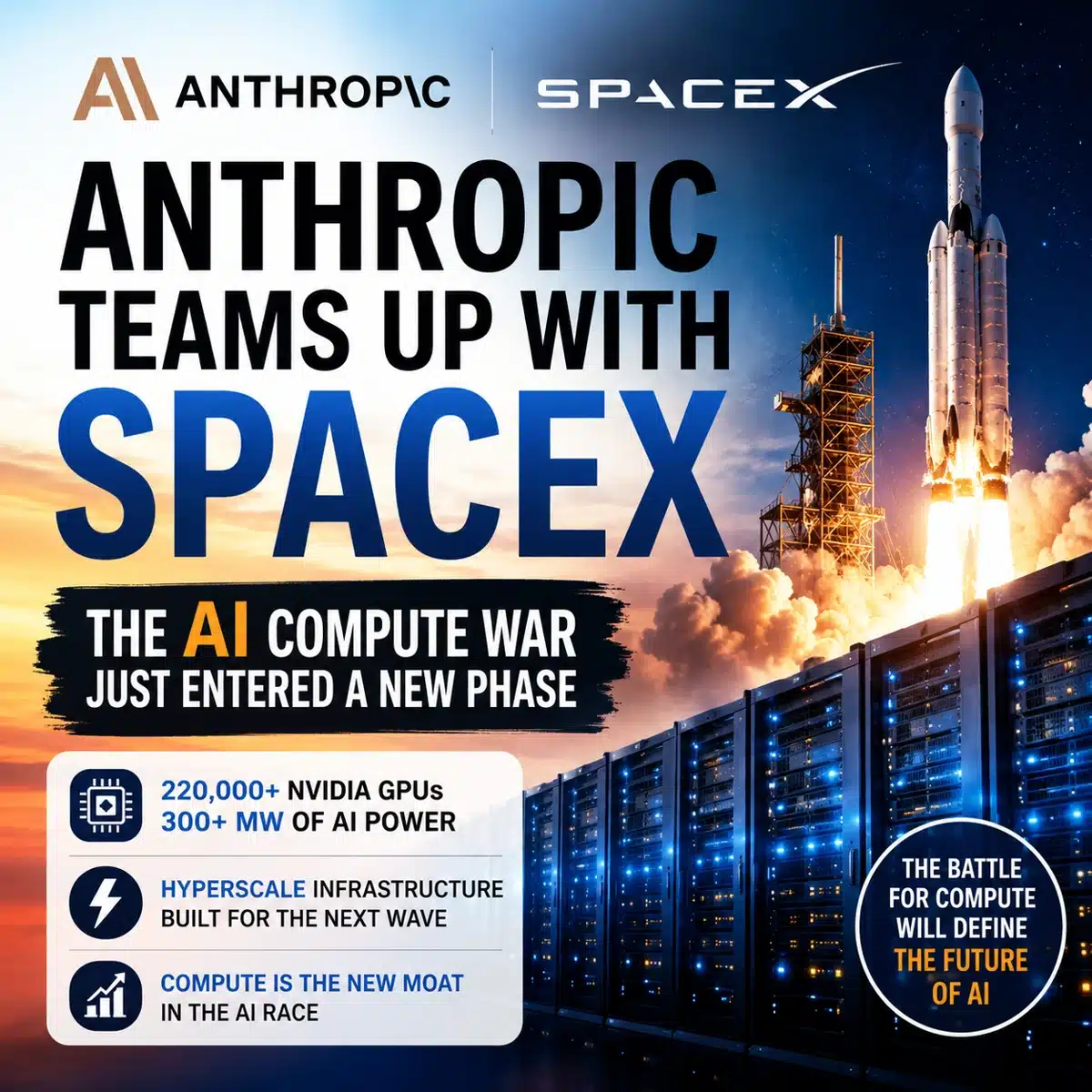
Anthropic’s new infrastructure tie-up with SpaceX shifted the conversation this week from model architectures to raw compute and energy scale. The anthropic spacex partnership signals that access to hyperscale GPU clusters, steady power and colocated data-center capacity is now central to building next-generation reasoning models and autonomous agents. For businesses and startups, that means the competitive levers are moving into physical infrastructure and long-term capacity deals — not just model quality or training recipes.
Key Takeaways
- Core shift: The AI race is moving from purely model competition to compute and energy dominance — long-term access to GPUs and power is now a strategic moat.
- Why now: Model scale, inference cost, and agentic workloads are increasing demand for sustained GPU capacity and power supply, pressuring vendors to secure hyperscale partners.
- Impact: Companies with direct lines to large GPU farms, efficient power, and colocated networking will reduce costs and speed iteration on complex reasoning models.
- What to watch: Contract terms for GPU access, new power-centric partnerships, and whether cloud providers revise pricing or exclusivity for high-volume AI customers.
Bottom line: This tie-up is less about a single model and more about who controls the physical capacity and energy to train and run the next wave of large AI systems.
What just happened
Anthropic announced an infrastructure partnership with SpaceX focused on securing large-scale compute capacity, energy resilience, and colocated facilities to support training and deployment of advanced AI models. The announcement frames the relationship around infrastructure access rather than product integration: a bet that securing long-term GPU and power footprint will be decisive for developing high-cost, large-reasoning models and agentic systems.
Why this matters now
The timing matters because model development is no longer limited by algorithms alone — compute is the bottleneck. As model architectures grow more complex and inference workloads balloon, companies must lock in predictable, high-volume GPU access and efficient power to control cost and latency. The anthropic spacex move highlights that infrastructure partnerships are now a primary strategic playbook for firms that want to scale quickly without being price- or supply-constrained by hyper-scalers or chip vendors.
What this changes in practice
- Training cadence: Firms with secured GPU pools can iterate faster, run broader hyperparameter sweeps, and test larger multi-modal or agentic models without waiting in cloud queues.
- Pricing and margins: Direct access to wholesale GPU capacity and dedicated power reduces per-training and per-inference cost, allowing more aggressive pricing or better margins at scale.
- Product differentiation: Hardware and network proximity affect latency-sensitive features (real-time agents, on-prem-like performance) and enable larger context windows or multi-agent coordination.
- Startup strategy: Smaller vendors may be forced into brokered capacity markets, consortium buys, or niche specialization because competing for raw scale will be prohibitively expensive.
- Enterprise adoption: Predictable SLAs tied to infrastructure — not just API uptime — improve vendor viability for regulated industries that need consistent performance and cost forecasting.
Insight: The industry is pivoting from a software-only winner-take-most dynamic to a hybrid model where physical capacity and energy arrangements are the new strategic layer under every AI product.
The bigger shift behind this
This deal is a symptom of a broader industry trend: AI is maturing into an infrastructure-heavy stack. Training frontier models requires sustained GPU throughput, massive memory, and cheap, reliable electricity. That combination favors organizations that can coordinate hardware vendors (notably Nvidia), hyperscale cloud partners, and energy providers. As firms chase lower marginal costs and predictable supply, we should expect more vertical partnerships tying AI companies to data-center operators, telecom backbone providers, and energy producers — reshaping vendor ecosystems and consolidating influence among a handful of infrastructure owners.
Arti-Trends perspective
Smart readers should stop thinking about AI competition as purely a model arms race. The more important contest is over guaranteed, affordable compute over multi-year horizons. Anthropic’s step into infrastructure partnerships shows that even model-first companies are moving to secure the physical prerequisites for scaling. For enterprise buyers, this means evaluating vendors on their compute supply chains and energy resilience as much as on benchmark performance. For investors and operators, infrastructure control will increasingly determine valuation and defensibility.
What to watch next
Conclusion
The Anthropic–SpaceX story crystallizes a practical truth: winning the next phase of AI requires locking down long-term compute and energy capacity, not only publishing better models. For practitioners and buyers, the most important procurement question is no longer just which model performs best, but who can guarantee the compute, cost, and latency profile needed to run those models reliably at scale.
FAQ
- Q: How does this partnership change model performance?
A: It doesn’t change model architecture directly, but it enables larger, more iterative training runs and sustained fine-tuning, which tends to improve real-world model robustness and capability over time. - Q: Why is Nvidia GPU access strategically important?
A: Nvidia remains the dominant supplier of the high-performance GPUs used for large-scale training; meaningful, predictable access lowers cost and wait times for training and inference. - Q: What are the implications for startups?
A: Startups face higher barriers to match frontier scale. Many will need to differentiate through niche models, efficient algorithms, or by securing shared capacity deals rather than competing head-to-head on raw scale. - Q: Should enterprises change their vendor evaluation criteria?
A: Yes. Evaluate vendors on long-term compute commitments, energy resilience, and cost predictability in addition to model accuracy and data governance.
For context on how tools and workflows evolve alongside infrastructure, see AI trends tools evolution.