
Table of Contents
ToggleFor the first time in history, war is being shaped in real time by algorithms
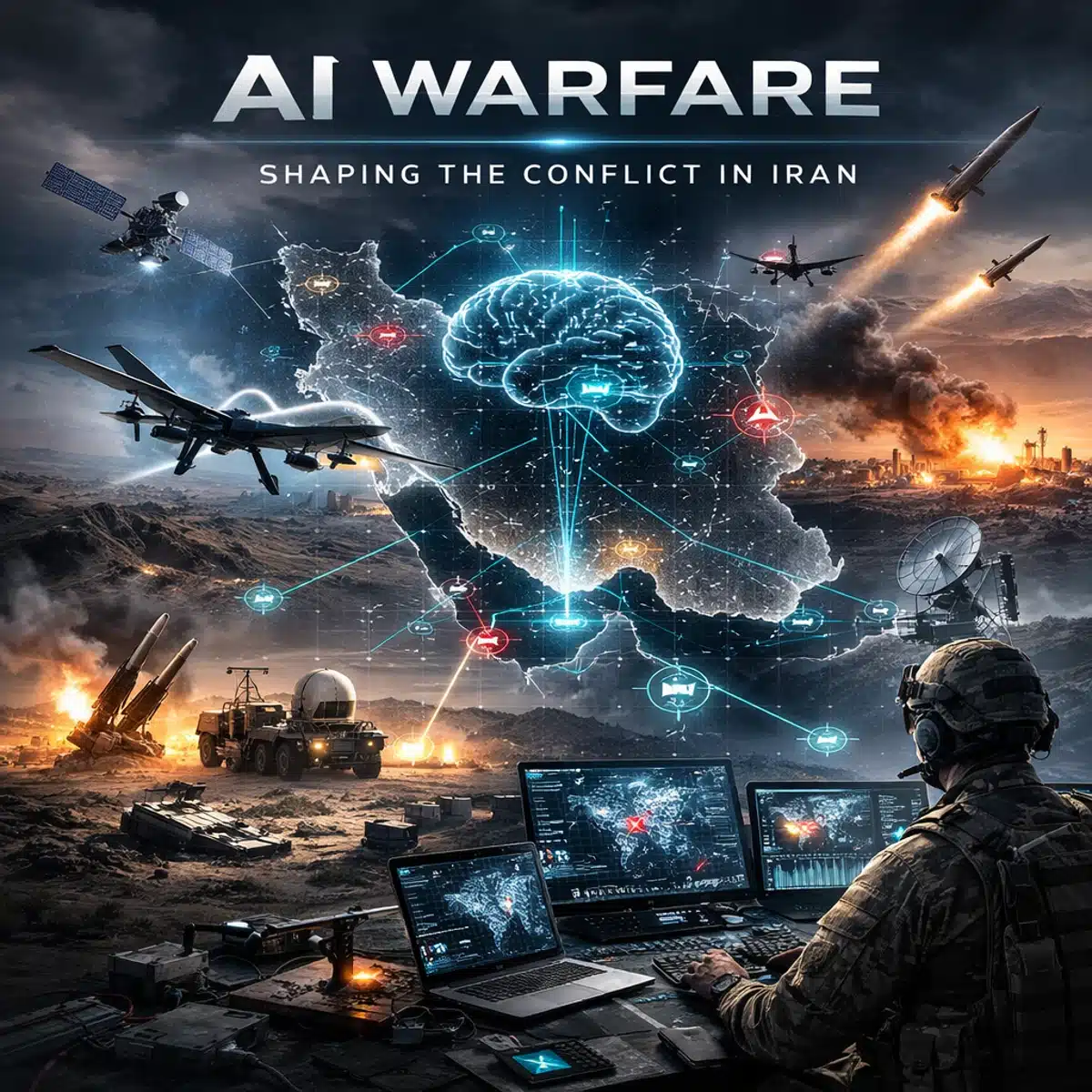
Across the conflict surrounding Iran, a structural shift is becoming visible. Not gradually, but in real time. Military operations are increasingly influenced by systems that can process more data, identify patterns faster, and generate decisions at a speed no human can match. This is not simply the use of new technology. It is a change in how warfare operates at its core. Iran is no longer just a geopolitical flashpoint. It is emerging as a live testing environment for AI-driven warfare. While many details remain fragmented or difficult to independently verify, enough signals are visible to identify a clear trend: artificial intelligence is moving from support layer to operational backbone.
Recent developments in AI-driven warfare in Iran
Recent reporting and open-source intelligence suggest that AI-assisted systems are being integrated into targeting and analysis workflows. These systems aggregate inputs from satellite imagery, drone feeds, signal interception, and battlefield sensors. AI models can then cluster potential targets, detect anomalies, and prioritize actions in near real time. What previously required teams of analysts working for hours can now, in some cases, be processed within minutes. However, it is important to separate confirmed capabilities from assumptions. Most systems today are not fully autonomous. Human operators remain part of the loop, particularly in high-stakes decisions. At the same time, multiple indicators suggest that the speed of operations has increased significantly, and that AI-generated recommendations are playing a growing role in shaping outcomes. The exact level of autonomy may vary, but the direction is consistent: faster cycles, higher data density, and increasing reliance on algorithmic outputs.
The AI Warfare Stack: A New Operational Framework
To understand this shift, it helps to view modern warfare not as a collection of separate technologies, but as a layered operational system. At Arti-Trends, we describe this as the AI Warfare Stack: a framework that shows how artificial intelligence moves through military operations from data collection to battlefield action and narrative control. The Data Layer consists of satellites, surveillance systems, drones, and signal intelligence that continuously collect raw information. This feeds into the Intelligence Layer, where machine learning models analyze patterns, detect movement, and identify potential targets. The Decision Layer translates those outputs into prioritized recommendations, often suggesting which targets to engage and in what order. The Execution Layer then carries out these actions through drones, missiles, and other weapon systems, increasingly supported by AI-guided navigation and targeting. Running alongside all of this is the Information Layer, where AI is used to generate, manipulate, and distribute narratives through deepfakes, synthetic media, and automated messaging. What makes this stack so consequential is not any single layer, but the integration between them. It creates a continuous feedback loop in which data becomes action, and action generates new data. The visual below breaks this system into its core layers and shows how they connect.
Arti-Trends Framework
AI Warfare Stack
A compact framework for how AI moves from battlefield data collection to operational action and narrative control.
Data Layer
Raw battlefield data collection from physical and digital sources.
- Satellites
- Drones
- Sensors
- Signal intelligence
Expanded View
This layer feeds the stack with persistent collection from the physical and digital battlespace.
Intelligence Layer
AI models transform raw data into structured military intelligence.
- Pattern recognition
- Anomaly detection
- Target identification
- Data fusion
Expanded View
AI systems convert fragmented inputs into targets, patterns, anomalies, and fused operational insight.
Decision Layer
Systems rank options and support high-speed operational decisions.
- Prioritization
- Strike recommendations
- Threat scoring
- Scenario modeling
Expanded View
This layer narrows choice under pressure by scoring threats and modeling likely operational outcomes.
Execution Layer
Military systems execute actions with increasing automation.
- Drones
- Missiles
- Autonomous navigation
- AI-guided targeting
Expanded View
Automation increasingly connects recommendations to real-world action through robotic and kinetic systems.
Information Layer
AI shapes perception, public opinion, and strategic narratives.
- Deepfakes
- Synthetic media
- Propaganda amplification
- Narrative manipulation
Expanded View
Conflict also plays out in perception, where AI can scale influence, persuasion, and narrative distortion.
Key Takeaway
AI warfare is an integrated stack: from data capture to intelligence, decision support, execution, and narrative control.
From human decision-making to algorithmic warfare
One of the most significant shifts is the changing role of humans. Traditionally, military decisions were made by people, supported by tools. In AI-driven environments, this relationship is reversing. Algorithms generate options, rank priorities, and recommend actions, while humans increasingly validate or approve these outputs. In slower operational contexts, this oversight remains meaningful. But in high-speed environments, where decisions must be made within seconds, human validation risks becoming procedural rather than substantive. This introduces a subtle but critical shift. Control is not removed from humans, but it is redistributed. Decision-making becomes a shared process between human judgment and machine-generated logic. Over time, as systems become more capable, the balance may continue to tilt toward automation.
Autonomous weapons and the next phase of conflict
AI is also reshaping the weapons themselves. Current systems already demonstrate semi-autonomous capabilities. AI-guided drones can navigate complex environments, adjust flight paths in response to obstacles, and maintain target tracking with limited human input. Missile systems increasingly incorporate adaptive guidance, allowing them to respond dynamically to changing conditions. The next phase involves fully autonomous systems, often referred to as Lethal Autonomous Weapon Systems (LAWS). These systems would be capable of selecting and engaging targets without direct human control. While widespread deployment of fully autonomous weapons remains constrained by ethical, legal, and operational concerns, development is ongoing. The trajectory suggests that autonomy will increase over time, not decrease. The key uncertainty is not whether these systems will exist, but how they will be governed and under what conditions they will be used.
Speed, scale, and the industrialization of warfare
Artificial intelligence changes not only how decisions are made, but how warfare scales. In traditional operations, each additional action required additional resources: more analysts, more coordination, more time. AI breaks this relationship. Once systems are in place, they can process increasing volumes of data and generate increasing numbers of outputs without proportional increases in human effort. This creates a form of industrialized warfare. Target identification, prioritization, and execution can occur continuously, rather than in discrete phases. Early indicators suggest that operational tempo can increase by multiples, not percentages. This does not simply make warfare faster. It makes it denser, more persistent, and potentially more difficult to control. When actions can be generated at scale, the threshold for escalation may decrease.
The invisible battlefield: AI-driven information warfare
At the same time, the battlefield extends beyond physical space. AI is transforming the information domain into a parallel arena of conflict. Synthetic media, including AI-generated images, video, and audio, can be produced and distributed at scale. These tools can be used to influence public perception, create confusion, and amplify existing divisions. In the context of the Iran conflict, various forms of manipulated or AI-assisted content have circulated across social platforms, often blurring the line between authentic reporting and constructed narratives. In many cases, attribution is difficult, and verification lags behind distribution. This creates an environment where perception becomes fluid and contested. Controlling the narrative can become as strategically important as controlling territory.
The global AI arms race
The use of AI in this conflict is not isolated. It reflects a broader global dynamic. Nations are investing heavily in artificial intelligence as a strategic capability. This includes not only software, but also the underlying infrastructure: compute power, semiconductor supply chains, and data access. Leadership in AI increasingly translates into geopolitical influence. The United States and China remain dominant players, but regional powers are also developing capabilities to reduce dependency and increase strategic autonomy. This creates an AI arms race, where progress in one domain drives acceleration in others. Unlike traditional arms races, however, AI development is often dual-use, meaning that advances in civilian technology can be rapidly adapted for military purposes.
Ethical fault lines and systemic risks
The integration of AI into warfare introduces complex ethical and systemic challenges. One central issue is accountability. When an AI-assisted system contributes to a lethal decision, responsibility becomes distributed across designers, operators, and command structures. Another concern is bias. AI systems trained on incomplete or imperfect data may produce flawed outputs, which in a military context can have severe consequences. Speed introduces additional risk. Systems may act or recommend actions faster than humans can fully evaluate, increasing the likelihood of errors or unintended escalation. It is also important to recognize that AI does not eliminate human error. Instead, it can amplify it. A flawed assumption, once embedded in a system, can be applied consistently and at scale. This creates a new category of risk: systemic error driven by automation.
Practical implications for users, developers, and businesses
Although these developments are rooted in military contexts, their implications extend into civilian domains. Many of the underlying technologies—computer vision, data fusion, autonomous decision systems—are also used in commercial applications. Advances driven by military investment may accelerate innovation in AI tools, software platforms, and enterprise systems. At the same time, the risks associated with these technologies also expand. Misinformation, security vulnerabilities, and ethical considerations become more relevant for businesses and developers. Understanding how AI operates under extreme conditions, such as warfare, provides insight into both its capabilities and its limitations. The same systems that increase efficiency can also introduce new forms of fragility.
The future of warfare: what comes next
Looking forward, the trajectory of AI in warfare suggests deeper integration, higher autonomy, and increasing complexity. Future conflicts may involve AI systems interacting directly with each other, creating environments where decisions are made at machine speed with minimal human intervention. This could lead to scenarios where the pace of conflict exceeds human comprehension, shifting control toward automated systems. Warfare may become increasingly hybrid, combining physical operations with cyber activity and information manipulation. In such environments, advantage will not only depend on resources, but on the ability to integrate and deploy intelligent systems effectively. The nature of conflict itself may evolve from episodic events to continuous, data-driven processes.
Conclusion
The Iran conflict highlights a structural shift in how warfare operates. Artificial intelligence is no longer an experimental layer or a future concept. It is becoming embedded in the core of military systems. While many details remain uncertain and continue to evolve, the direction is clear. Decision-making is accelerating, operations are scaling, and the role of humans is changing. The question is no longer whether AI will reshape warfare, but how far this transformation will extend. As algorithms process information faster than humans can interpret it, and as systems act on that information with increasing autonomy, the balance of control begins to shift. The defining question of this new era is not technological, but human: if machines can decide faster than we can think, who is ultimately in control?