
AI is getting smarter every day—but that’s not what’s holding it back. The real problem is trust, and a new wave of startups is quietly building the infrastructure to solve it.
Why “Trust Layers” Are Becoming the Backbone of Enterprise AI
Artificial intelligence is entering a new phase—and it’s not about better models or bigger benchmarks. While the industry is still focused on capability, a more important shift is happening underneath the surface. Businesses are starting to realize that powerful AI is meaningless if it cannot be controlled, monitored, and trusted. The real bottleneck is no longer intelligence. It’s reliability. And that realization is giving rise to an entirely new layer in the AI ecosystem—one designed not to make AI smarter, but to make it dependable enough to run real-world systems. For readers looking to understand the broader foundation behind this shift, our guide on What Is Artificial Intelligence provides essential context.
Recent Developments in AI Trust Infrastructure
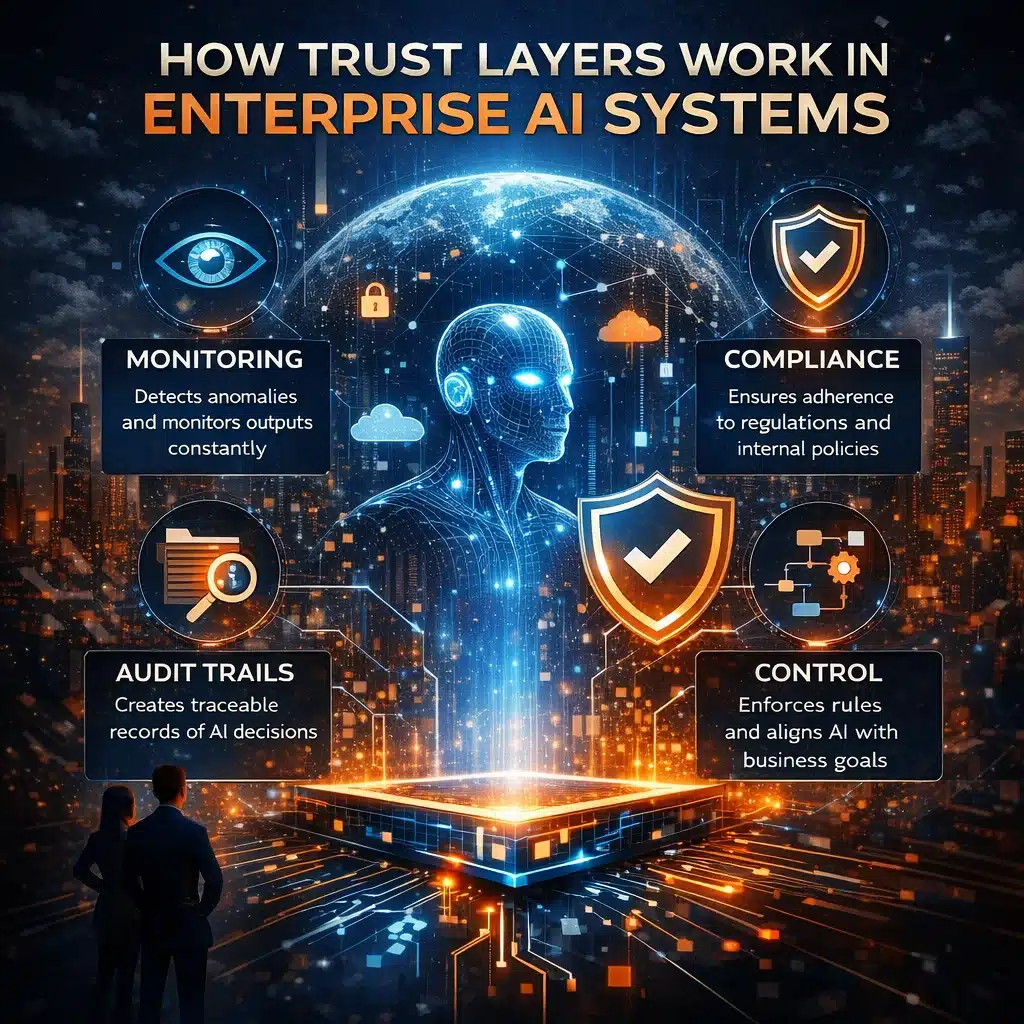
A new generation of startups is building what is increasingly referred to as a “trust layer” for AI. One of the most notable examples is ActionAI, which recently raised fresh funding to help enterprises make their AI systems more controllable, auditable, and compliant. Instead of competing with model builders, these companies operate around the model itself. They monitor outputs in real time, detect anomalies and hallucinations, enforce rules, and create traceable records of every decision an AI system makes. In practical terms, they are turning AI from an experimental tool into something that can be governed like infrastructure.
What Is an AI Trust Layer?
To understand why this matters, it helps to reframe how AI is currently used. Most implementations still rely on a simple input-output model: you provide an input, and the system generates an output. But once AI becomes part of critical workflows—customer interactions, financial decisions, or operational processes—that simplicity becomes a liability. A trust layer adds a continuous control system around AI, ensuring that outputs are not just generated, but validated, monitored, and aligned with predefined rules. It also creates auditability, allowing organizations to trace decisions and explain outcomes when needed.
Why This Shift Is Happening Now
This transition is being driven by a structural change in how AI is used. AI is no longer an experimental layer—it is rapidly becoming core infrastructure. Just like cloud computing evolved into the backbone of modern business operations, AI is embedding itself into essential systems. And once something becomes infrastructure, reliability is no longer optional.
At the same time, regulation is accelerating this shift. Frameworks like the EU AI Act are forcing organizations to think in terms of transparency, accountability, and risk management. It’s no longer enough to deploy AI—you need to prove that it behaves in a controlled and explainable way. For a deeper breakdown of how regulation is shaping the AI landscape, see AI Regulation 2025 2026.
There is also a growing awareness that AI risk is fundamentally different from traditional software risk. When an AI system produces incorrect or unpredictable outputs, the consequences are often harder to trace and mitigate. This creates exposure in areas like finance, compliance, and brand reputation, making control and observability essential. This is where a deeper understanding of risk becomes critical, as explored in AI Risks Explained.
The Rise of AI Monitoring and Governance Platforms
What we’re seeing now is the emergence of an entirely new category within the AI ecosystem. Companies are moving beyond selecting tools and models toward building complete systems that include monitoring, validation, and governance layers. This mirrors the evolution of cloud infrastructure, where visibility and control eventually became just as important as performance itself.
Trust layers are becoming the connective tissue between AI capability and real-world usability. Without them, even the most advanced models remain too unpredictable for high-stakes environments. With them, AI starts to look less like an experiment—and more like infrastructure.
Practical Implications for Users and Companies
For businesses and professionals, this shift changes the way AI should be adopted. AI is no longer just about productivity gains or experimentation—it is about building systems that can scale without introducing unacceptable risk. That means focusing on control, monitoring, and accountability from the start.
Organizations that invest early in this layer will have a clear advantage. They will be able to deploy AI faster, operate with greater confidence, and meet regulatory requirements with less friction. More importantly, they will be able to demonstrate reliability, which is quickly becoming a key differentiator in enterprise environments.
The Bigger Picture: AI Is Becoming Infrastructure
The pattern here is familiar. In the early days of cloud computing, the focus was on scalability and efficiency. Only later did security, monitoring, and compliance become central. AI is now entering that same phase. The first wave was about capability, the second about scaling those capabilities, and the third is about trust.
This marks the transition of AI from a powerful technology to dependable infrastructure.
Final Takeaway
The companies that win in this next phase will not necessarily be the ones building the most advanced models. They will be the ones building the systems that make those models usable in the real world—predictable, controllable, and compliant. Because in the end, businesses don’t scale on intelligence alone. They scale on trust.