
Key Takeaways
- The U.S. House has overwhelmingly approved the AI for Main Street Act to support AI adoption by small businesses.
- The law focuses on training, guidance, and responsible use, not on promoting specific AI vendors.
- AI policy is shifting from regulation-first toward capability building for everyday businesses.
- The initiative signals how AI adoption is likely to evolve globally — including lessons for Europe.
A Quiet but Important Shift in AI Policy
Artificial intelligence policy is often framed as a confrontation between governments and Big Tech — regulation versus innovation, safety versus speed.
The AI for Main Street Act tells a different story.
With a near-unanimous vote (395–14), the U.S. House of Representatives approved legislation aimed not at restricting AI development, but at helping small businesses understand and use AI responsibly. The bill directs the U.S. Small Business Administration (SBA) to expand AI education, training programs, and best-practice guidance for entrepreneurs.
This matters because it reveals how policymakers increasingly view AI: not as a threat to manage, but as a capability to distribute.
What the AI for Main Street Act Actually Does

At its core, the law focuses on capability building, not mandates.
Key elements include:
- AI literacy and training programs for small business owners
- Guidance on safe, ethical, and effective AI use
- Support for understanding AI risks, data protection, and automation limits
- Integration of AI education into existing SBA business development resources
Importantly, the Act does not promote specific AI platforms or tools. Instead, it treats AI as a general-purpose technology — comparable to cloud computing or digital accounting — that businesses must learn to evaluate and apply thoughtfully.
This aligns closely with the broader State of AI shift from experimentation to structured adoption.
From Abstract Policy to Practical Impact
In practice, this policy direction translates into very concrete opportunities.
A local accounting firm might use AI to categorize invoices, summarize financial reports, or flag anomalies for human review. A small retail business could apply AI to draft customer emails, forecast inventory needs, or automate basic support questions — without requiring in-house technical teams.
These are not futuristic use cases. They represent the kind of incremental, workflow-level improvements that define real AI adoption — not flashy demos.
Why This Matters More Than It Looks
Small businesses account for more than 99% of U.S. firms and employ nearly half of the private workforce. Historically, they tend to adopt new technologies later than large enterprises — not because of resistance, but because of complexity, cost, and risk.
AI introduces additional barriers:
- unclear return on investment
- concerns around data privacy and compliance
- fear of automation replacing human roles
- lack of internal expertise
By addressing these gaps through education rather than enforcement, the legislation acknowledges a key truth we consistently observe across real-world AI adoption:
AI initiatives fail more often due to misunderstanding than resistance.
This insight mirrors what we see across modern AI tools: productivity gains depend less on raw model capability and more on how well users understand workflows, limitations, and context.
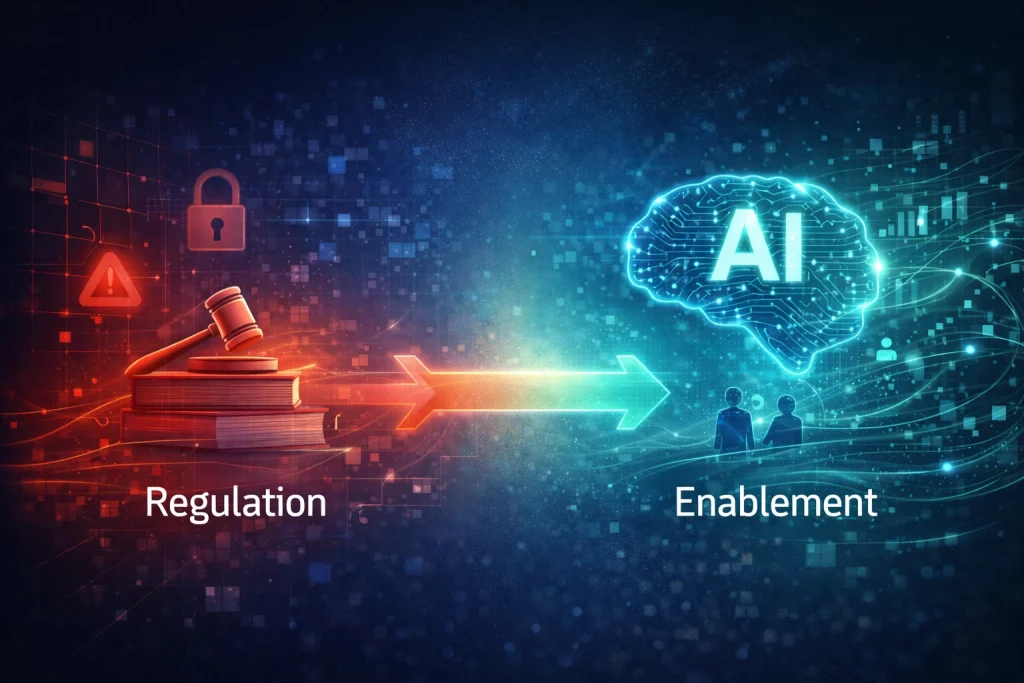
From Regulation to Enablement
Most recent AI legislation — in the U.S., Europe, and elsewhere — has focused on risk containment: bias, safety, misuse, and accountability.
The AI for Main Street Act complements that approach by addressing the other side of the equation: who actually knows how to use AI well.
Without widespread AI literacy:
- regulation becomes abstract
- adoption concentrates among large firms
- productivity gaps widen
With education and guidance, AI diffuses into sectors like retail, logistics, professional services, and local manufacturing — areas where AI tends to augment human work rather than replace it.
Lessons for European and Global Businesses
Although the Act applies only to the United States, its implications extend far beyond U.S. borders.
European small and medium-sized enterprises face similar challenges:
- fragmented AI guidance
- uncertainty around compliance
- limited internal AI expertise
As discussed in our coverage of AI regulation, rules alone do not drive adoption. Practical education does.
For entrepreneurs outside the U.S., the takeaway is not to wait for identical legislation, but to recognize that AI readiness is becoming a baseline capability, not a future advantage.
What Small Businesses Can Do Today
Even without government programs, the principles behind the Act translate directly into action:
- Start with narrow use cases
Focus on specific tasks such as drafting documents, summarizing information, or handling repetitive customer queries. - Prioritize understanding over automation
AI amplifies clarity — not strategy. Poor workflows become faster mistakes. - Treat AI as a skill, not a shortcut
Teams that invest in learning AI fundamentals consistently outperform those chasing quick wins. - Adopt responsibly
Privacy, transparency, and human oversight remain essential, especially in customer-facing applications.
These steps reflect the same logic underlying the legislation: AI delivers value when humans remain firmly in the loop.
The Bigger Signal
The AI for Main Street Act is not about headline-grabbing innovation. It is about normalization.
When policymakers focus on helping small businesses understand AI — rather than fearing it — it signals that AI has crossed an important threshold: from experimental technology to foundational business infrastructure.
That transition — from experimentation to everyday capability — may ultimately matter more than any single model release.
Sources & References
- U.S. House of Representatives voting records on the AI for Main Street Act
- Small Business Administration (SBA) policy briefings
- Public statements from bipartisan sponsors cited in congressional summaries