
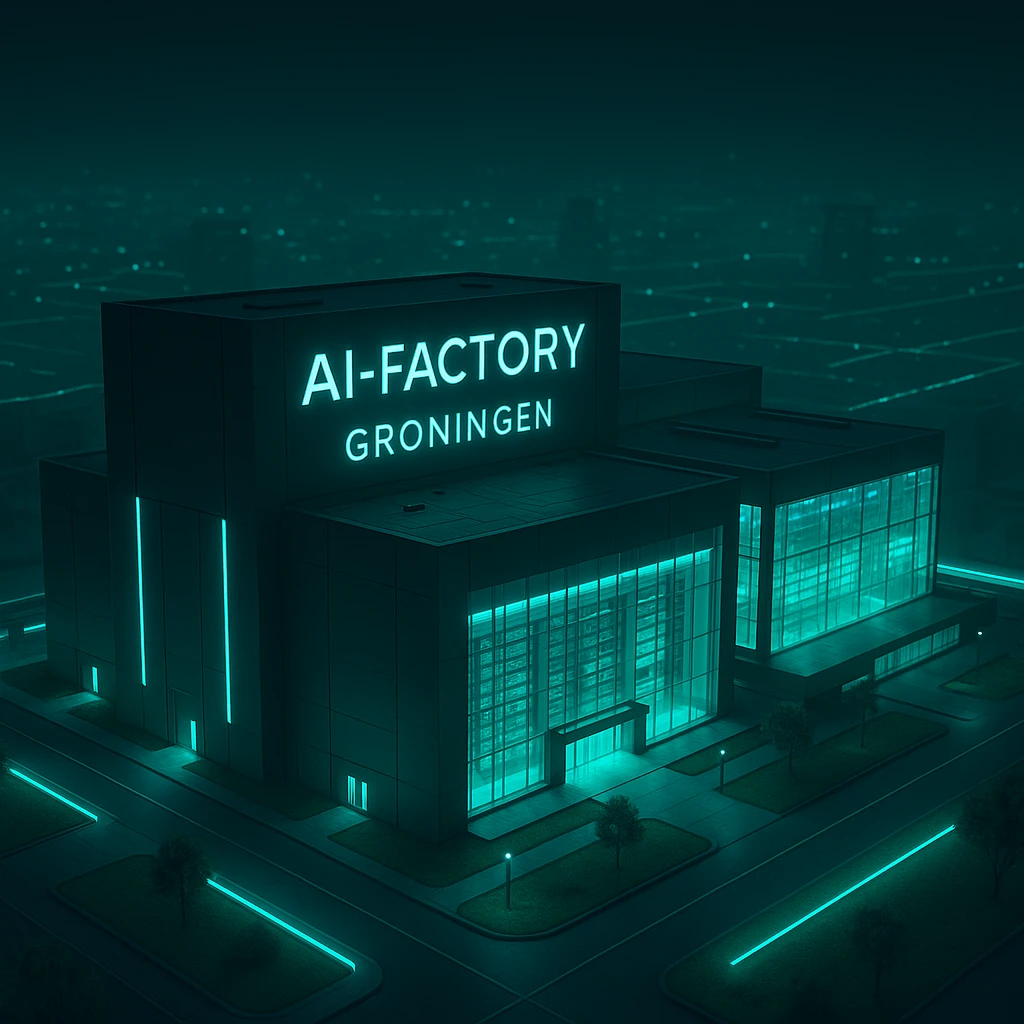
The arrival of an AI Factory in Groningen could fundamentally change how Europe develops and applies artificial intelligence. With a €200 million funding request, the Netherlands aims to build one of the most powerful AI infrastructures on the continent. This could reduce Europe’s dependence on American and Asian tech giants and accelerate innovation in healthcare, climate, and industry.
Table of Contents
ToggleRecent Developments at the AI Factory Groningen
A Dutch consortium consisting of SURF, TNO, and multiple research institutions has submitted an ambitious proposal to the European EuroHPC program: the creation of an AI supercomputing hub in Groningen. This so-called AI Factory is not meant to be just another data center, but a complete ecosystem where researchers, companies, and startups gain access to unprecedented computing power, reliable datasets, and a shared innovation platform.
The idea is simple yet powerful: today, many European organizations are forced to rely on American cloud giants to train AI models. The AI Factory would bring this work back to European soil, under European rules. That means faster access to resources, lower costs, and more control over sensitive data.
A decision on the funding will be made later this month, and expectations are high. If approved, Groningen would instantly position itself as a leading hub for European AI development. The region would benefit economically, while Europe gains a serious counterweight to Big Tech’s cloud infrastructure.
This project is about much more than hardware alone — it raises the question of whether Europe can achieve true digital sovereignty. And that’s exactly what makes the AI Factory Groningen a story worth following closely.
Practical Implications for Users and Businesses
The AI Factory Groningen marks a crucial step toward Dutch and European digital independence. For entrepreneurs, researchers, and innovators, it offers opportunities far beyond access to raw computing power. It creates an environment that enables faster, safer, and more effective AI innovation.
1. Access to powerful AI tools — without relying on American cloud providers
Until now, organizations often depended on major U.S. providers to train and run AI models. This brought risks: high costs, limited control over data, and concerns about privacy and sovereignty. With the AI Factory, a European alternative emerges — meaning you can develop your data and innovations within European frameworks and values.
2. Faster development of AI models
A major bottleneck in AI development is the long waiting time for computing resources. GPU systems are scarce and expensive. The AI Factory removes this barrier, allowing projects to start, test, and scale much faster. That means fewer delays — and more focus on creativity and innovation.
3. New opportunities for collaboration
The AI Factory will be more than a supercomputer — it’s a collaboration hub. Entrepreneurs, researchers, and developers will connect directly with European innovation programs, joint research opportunities, grants, and industry networks. For startups, this could mean the difference between staying small or breaking through internationally.
4. AI becomes more accessible
With the facility close by, both physically and digitally, the threshold for using AI decreases significantly. Ideas that previously seemed too expensive or complex can now be developed into real-world applications. Whether you work in manufacturing, healthcare, energy, or creative industries — AI becomes more accessible and practical than ever.
In short:
The AI Factory Groningen elevates AI innovation in the Netherlands and Europe. It makes AI more accessible, independent, and practical for anyone looking to innovate.
The Broader Impact of the AI Factory Groningen
The AI Factory goes far beyond technological progress. It symbolizes Europe’s ambition to develop, apply, and regulate AI on its own terms — grounded in European laws, ethics, and societal values.
1. Healthcare: safe and ethical medical AI
Healthcare systems face increasing pressure due to aging populations and shortages in staff. AI can support faster diagnoses, personalized treatments, and reduced administrative workloads. The AI Factory provides computing power and expertise to develop medical models that are safe, transparent, and ethically responsible.
2. Climate: accelerating sustainability and energy efficiency
The energy transition is one of the biggest challenges of our time. AI can optimize smart grids, predict energy consumption, or reduce CO₂ emissions. With the AI Factory, researchers and companies can analyze complex climate questions faster, making innovation more achievable.
3. Industry: digital twins, robotics, and intelligent supply chains
Industries gain access to advanced applications such as digital twins — virtual replicas of factories or processes — enabling faster testing and optimization without high costs. Robotics, automation, and supply chain optimization can reach new levels, strengthening Europe’s industrial competitiveness.
4. Regional impact: Groningen as an innovation hub
For Groningen itself, the AI Factory becomes an engine of growth. It brings high-skilled jobs, strengthens the innovation ecosystem, and positions the region as a key AI hub in Northern Europe.
In summary:
The AI Factory Groningen impacts healthcare, sustainability, industry, and regional development — and strengthens Europe’s position in the global AI landscape.
Future Outlook and Predictions
Many experts view the AI Factory as more than a local project — it could become the blueprint for a network of European AI hubs. While dependence on Silicon Valley is still high today, Groningen illustrates a future in which Europe sets its own course.
1. A European AI ecosystem by 2030
By 2030, the AI Factory may form part of a broader European ecosystem — a network of interconnected AI centers that collaborate, share knowledge, and accelerate innovation across key sectors such as energy, healthcare, education, and defense.
2. European values at the core
This network would be guided by principles such as:
- Privacy: strict European data protection standards
- Sustainability: energy-efficient AI development
- Ethics: transparent and trustworthy AI systems
3. Tangible benefits for users
For entrepreneurs, researchers, and students:
- More choice — no longer dependent on just a few U.S. giants
- Lower costs — due to European-scale infrastructure
- AI that meets European standards and future regulations
Conclusion
The AI Factory Groningen is much more than a data center full of servers — it’s a strategic investment in Europe’s technological future. It marks a turning point in which Europe no longer fully relies on foreign tech, but builds its own AI capabilities.
Whether you’re a student learning to code, an entrepreneur adopting AI, or a policymaker shaping the future — this project could influence how you work with AI in the coming decade.
The AI Factory symbolizes a new era: faster, more independent, and closer to home.
Related Articles You’ll Want to Explore Next
AI in Healthcare Investing: How Artificial Intelligence Is Transforming Medicine and Markets
How AI is reshaping medical innovation — and the investment opportunities emerging as a result.
AI United States Datacenters: Google Announces $40 Billion Investment in Texas
A deep dive into Google’s massive data center expansion and what it means for global AI infrastructure.
AI Stocks Slide as Investors Brace for a Potential Bubble Burst
A sharp look at what happens when markets question the AI narrative — and how to read the signs before they hit the headlines.
Investing in AI Startups: How to Spot the Next Big Thing in Artificial Intelligence
A practical guide to identifying high-potential AI startups before they go mainstream.
Nvidia’s Q3 Results Signal a New Phase in the Global AI
What Nvidia’s latest earnings reveal about its expanding dominance in the global AI landscape.